Scholars point to organizing, cultural messaging and racial history
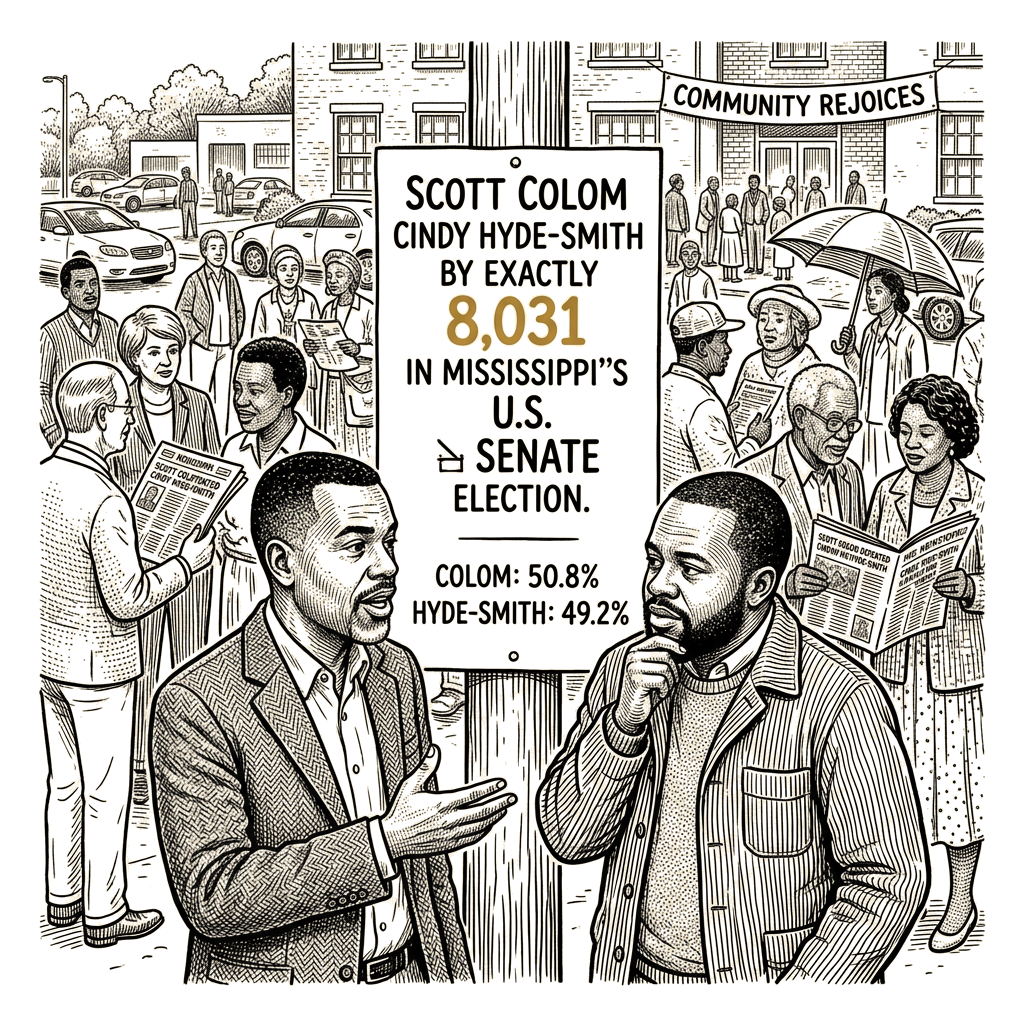
Scott Colom won Mississippi’s U.S. Senate seat by exactly 8,031 votes, defeating Cindy Hyde-Smith and becoming the state’s first Black U.S. senator since Reconstruction. Host Tonya Mosley asked Princeton University professor of African American studies Eddie Glaude and Rice University professor of English and creative writing Kiese Laymon what the result meant for the state and country. Colom spent more than a year traveling across Mississippi, appeared outside a Donald Trump rally for Hyde-Smith in the final weeks and was headed to Washington after Hyde-Smith blocked his federal judgeship nomination three years earlier.
Colom was a seventh-generation Mississippian descended from an enslaved woman. His family remained in Mississippi and fought for change, while generations of Black Americans left during the Great Migration to escape Jim Crow and racial terror. His election placed a descendant of an enslaved woman in the Senate nearly 150 years after Hiram Revels became the first Black man to serve in the U.S. Senate in 1870, during Reconstruction.
Glaude said that, as a little boy growing up in Moss Point, he never could have imagined Colom’s victory. He began to believe it could happen after Mississippi hinted at a redistricting project that Donald Trump had called for and organizers launched marches under the banner All Roads Lead to the South. NAACP president and CEO Derrick Johnson, a former president of the organization’s Mississippi chapter, invited Glaude to a march in Jackson.
At the march, Glaude saw current organizing and infrastructure, young and older participants and no nostalgia for the movement of the mid-20th century. Organizers were calculating turnout in DeSoto, Holmes, Jackson County and Hinds. Sharing a stage with U.S. Rep. Bennie Thompson and Colom, Glaude called Colom a political athlete. He said the clearer sign was the readiness of Black voters to undermine the math behind the redistricting effort. Glaude predicted, “We about to shock the world up in here.”
Laymon used Mike Espy’s campaigns as a contrast. Espy, a Black Democrat, lost to Hyde-Smith in 2018 and 2020. Laymon worked hard on Espy’s 2018 campaign while living in Oxford; an Espy primary donor came to Laymon’s porch and repeatedly urged, “We have to let Mike let his hands go.” Laymon said Espy had been presented as a “traditional, clean, electable Democrat” because his backers did not think he would offend many Republicans.
Colom, by contrast, took off what Laymon called a cloak of political respectability “in terms of the look,” and Laymon said that visual change was part of the galvanization. Laymon’s mother, a political scientist, predicted Colom would have the votes; Laymon himself said that in Mississippi, having the votes did not mean winning. He realized Colom could win when he saw the “pick another protein” commercial because he believed Colom had the cultural force to stop the Republican Party if the race was close.
Laymon saw a different kind of candidate followed by different kinds of potential voters. Older people who had grown up in a close, tightly contained political Mississippi and had been told to bring their best visual self walked with young sisters and brothers wearing hoodies and earrings. Laymon called it an intergenerational and intercultural march and election, and said the national media did not discuss that aspect of the coalition.
Mosley said Colom had little money from the National Democratic Party and presented the advertisement as one of the creative ways the campaign reached voters. The commercial opened with, “The price of beef continuing to go up.” Hyde-Smith said, “You know, you have so many proteins to choose from.” Four voters then responded:
“Pick another protein? [Expletive] I’d rather pick another senator instead.”
“Pick another protein? She done lost her damn mind. I’d rather pick another senator.”
“Pick another protein? What the F?”
“Pick another senator instead.”
Laymon described a young white man cursing the way white boys in Mississippi curse, an older sister eating catfish and talking the way Laymon’s aunties curse, and an older white woman at a grocery store trying to obtain an unaffordable item. Colom watched as the viewers watched, laughed as they laughed and said, “pick another senator instead.” Laymon said the advertisement made Colom both the subject and the viewer, giving every viewer a shared response regardless of political persuasion. He called it “the most impactful political ad of my life by far.”
Mosley framed the advertisement’s broader appeal by placing it in the context of the cost of living in one of the poorest states in the country. Glaude called the advertisement “brilliant” and said its cultural resonances were “quintessentially Mississippi.” He said it cut across racial boundaries: a white man drew out an expletive, and a white woman asked “what the?” in a shrill voice. Glaude said the rhythm reflected how people in Mississippi curse and therefore sounded familiar.
Glaude said the cultural performance was joined to a substantive critique of Hyde-Smith, who had been absent and was not representing the state. He described her discussion of hardship as “crude and callous,” compared it with “let them eat cake, too” and called it a Marie Antoinette moment on television. Glaude said the advertisement connected those cultural messages to Hyde-Smith’s failure to address the fundamental material conditions of Mississippians, regardless of which side of town they lived on or the color of their skin.
Laymon had previously written about Hyde-Smith’s 2020 campaign stop in a Mississippi Today essay. At the stop, she praised a supporter by saying that if the supporter invited her to a public hanging, she would be in the front row. Hyde-Smith later called the statement a figure of speech and went on to win the election.
Laymon said the sentence could sound hyperbolic but nevertheless “obliterates analysis.” He preserved its literal force: “if there were a public hanging, I’d be on the front row.” Laymon said he heard “premature death, killing” and believed Hyde-Smith was giving voters what they wanted. While living in Mississippi, he said he heard fear and anger and knew she would win again. His criticism was also that Mississippi had produced many powerful sentences that could have served as a refrain instead.
Laymon recalled asking his mother what it meant that “the Blackest state in the union” would send a senator who had publicly discussed attending a hanging. He said he felt humiliated and angry, linking that humiliation to what public hangings were meant to do while saying he was not equating his experience with that of victims. He also said Black voters “don’t vote Republican,” while noting that he loved Mississippi and continued to live there and write to and from it.
Laymon had previously drawn on Glaude’s formulation, “if we solve Mississippi, we solve the Sphinx.” He said he had little faith the Sphinx could be solved after hearing Hyde-Smith make the public-hanging statement aloud because it was not something he had heard only offline; it functioned as a campaign call. Glaude, meanwhile, said he had believed Colom could win but had not known how he would feel if he did and was still grappling with those feelings.
Glaude called Colom’s victory “bigger than Barack Obama’s election.” He described Mississippi as a closed society whose soil was “soaked in blood” and where the country’s contradictions were distilled. He also described its beauty — the water, magnolias and moss where he grew up — before noting the black snakes he said could chase someone down the street. Glaude called Mississippi a bundle of contradictions, with people who were sweet and people he described as murderous and monstrous, and connected that history to the blues, Faulkner and Laymon.
Citing Imani Perry’s view of the South as the country’s beating heart, Glaude said Mississippi offered a telescoped view of the Delta’s poverty, organized elites who had seized government, people trying to make ends meet and the complexity of race. He said solving Mississippi could open what he called the black box for the country. Laymon said Glaude’s analysis in “America, U.S.A.” laid out a call-and-response history. As a Mississippian, Laymon said he was both elated and overwhelmed with joy while also soberly looking ahead to what Colom the politician and the Colom family would do.
In an appearance on the MS NOW podcast “Clock It” shortly after the race, Colom said, “People need to know that in America, we’ve made progress before.” He described Hiram Revels’s prayer as generating momentum for his selection to the Senate and said progress in public education and voting rights had been lost for a century. Colom said Mississippi did not alone take away voting rights or establish Jim Crow; the country allowed it to happen. He wanted his story to remind people of earlier progress and the promise of the country and said Mississippi’s faith, prayers and work showed the country that the state mattered.
Glaude rejected what he called Southern exceptionalism: the argument that the South was made to bear the nation’s sins and that Mississippi served as an exaggerated example of a backward region holding the country back. He connected that argument to Gunnar Myrdal’s “American Dilemma” and Malcolm X’s statement that anyone south of the Canadian border was in the South.
Glaude’s historical account linked slavery, Southern plantation owners, cotton and Northern industry, then the Civil War and the collapse of Reconstruction. He said Northern interests initially sought to use Black enfranchisement for their own aims before abandoning it, after which white men in the North and South reconciled and Black people bore the brunt of that reconciliation in blood. Glaude said this history allowed the country to displace its sins onto the South and absolve itself elsewhere. He said Colom was arguing more directly that Mississippi reflects the nation and that the country’s history consists of historic choices made since its founding.
Revels also figured in how younger Mississippians learned their state’s history. A “Saturday Night Live” sketch featured Kam Patterson portraying Revels alongside Michael Che on Weekend Update. The sketch said the midterms brought historic wins for Black candidates nationwide, including Colom’s unexpected victory, and introduced Hiram Revels as Mississippi’s first Black senator. Che asked whether Patterson was the first Black senator in the United States, and Patterson answered, “1870, five years after the Civil War.”
Laymon learned about Revels through his mother, Mary Coleman, whose first book was “Legislators, Law And Public Policy.” She graduated from Jackson State, attended the University of Wisconsin and did graduate work on Mississippi legislators, law and public policy. Coleman’s mother had given her a set of encyclopedias in the late 1950s, making her what Laymon called an encyclopedia mother. In the 1980s, she gave Laymon electric-blue encyclopedias instead of the Nintendo games his friends received and made him return to them when he found Revels was absent. Coleman worked at Jackson State University.
Coleman and her friends criticized Revels because he had been placed rather than elected and because they believed he had not done enough. Laymon said that criticism came from people deeply critical of Mississippi’s history, not from Mississippi radicals. He had to write a four- or five-sentence essay about Revels, forgot it until Colom’s election and later found that his mother had kept it.
Glaude said he did not have that experience. His mother cleaned toilets at the Ingalls shipyard and his father was a postman. His history teacher, Ms. Mitchell, had a vocal injury and used a microphone to teach. Glaude said she taught the Civil War so well that he temporarily worshipped Stonewall Jackson. He contrasted Laymon’s upbringing in Jackson, which he called the big city, with his own proximity to the water in Moss Point; trips to Hattiesburg and Jackson were his biggest experiences outside the occasional trip to Mobile or New Orleans.
Glaude said he was educated in the context of the Lost Cause and began learning much of his history from Stevie Wonder’s 1976 track on “Songs In The Key Of Life.” School offered little substantive attention to Reconstruction in his majority-Black town, and Revels did not come to him until he reached Morehouse. When Mosley asked how ancestral oppression shapes young people’s sense of possibility, Glaude said his household insisted on the humanity of Black people regardless of what the world said. He said the stories and histories people tell shape who they take themselves to be and that omissions reveal the limits of their conceptions of justice.
Glaude said historical gaps deform character, affect judgment and empathy and limit a person’s sense of possibility. Denying young African American men, women and children access to the fullness of their own story, he said, also distorts and disfigures those who deny it.
Laymon focused on how that distortion lands in language. He said sentences have created movements, naming “Make America Great Again” and “Black Lives Matter.” Laymon initially said Jackson was named for one of the most destructive members of the Confederate Party before Mosley corrected him: Jackson was named for Louis Jackson. Laymon accepted the correction and noted that the city was 95% Black.
As an English professor, Laymon said every sentence people construct is a possibility and that sentences carrying movements offer possibilities to engage and revise. He treated “Pick Another Senator” as another such sentence and asked who the collective “we” was, answering that it was the people. Laymon said Mississippi-rooted sentence creators should reckon both with the ways sentences had created sentences for some people and with their potential to open possibilities not yet understood. He called “Make America Great Again” the worst sentence in his life but possibly one of the most profound, urged creative writers to recommit themselves to the “holiness of sentences” and said creative-writing programs did not train students to do that work.
Mosley noted that Colom’s family was politically active, as was Laymon’s. Colom’s father, Wilbur, was a civil-rights activist who became a Republican, worked on Ronald Reagan’s presidential transition team and argued that Black voters should not automatically support Democrats. Colom’s mother, Dorothy, was a lifelong Democrat. Both were lawyers and deeply engaged in Mississippi politics.
Laymon said treating Black support for Democrats as a foregone conclusion loses voters because candidates must respond to what a constituency needs to survive and thrive. He said some early Democrats questioned Wilbur’s encouragement of Republican voting without wanting Black Mississippians to support Democrats blindly. Laymon’s mother did not receive the right to vote until he was 40, and she maintained throughout the late 20th century that Mississippi lacked candidates worthy of her vote. She would have supported an exceptional Republican who valued clean water, health care and good food, Laymon said, but he believed no such candidate existed on the Democratic side.
Laymon said nearly half of Mississippi’s counties were Democratic and that the state was almost 40% Black. His mother, whom he described as no one’s more severe critic of Mississippi politicians, recognized Colom as a potential winner when she saw him in a hoodie and said, “That’s a Mississippi senator.” It was the same mother who had told Laymon never to wear a hoodie.
Other election results included a Hispanic governor in Texas, a Black woman governor in Georgia and a Native American woman governor in New Mexico. Glaude said the Southern results were tied to historic Black turnout without Barack Obama on the ticket. He specifically cited Texas, where Black voters turned out in historic numbers and voted for Hinojosa, and discussed what happened in North Carolina, South Carolina, Georgia, Louisiana and Florida without making the same historic-turnout assertion for each state.
Glaude called efforts to reduce that turnout to a return to identity politics “condescending” and “enraging.” He said Black voters had organized to defend their democratic rights and respond to attacks on their economic and material conditions. He said the Democratic Party too often treats Black voters as “cattle chewing cud,” herded every two and four years as if they were not a constituency with interests. Invoking James Baldwin, he said the question of what else Black people want was a red herring because their interests are those of human beings. Glaude said the concern about identity politics was a red herring and that political leaders needed to address the interests of a constituency that had handed them Congress.
Colom’s closing advertisement was filmed at Medgar Evers’s Jackson home. Evers was the NAACP leader who was assassinated in his own driveway in 1963. Colom began, “There’s a house in Jackson every Mississippian ought to walk through once.” He described a house that looked like its neighbors but had no front door, an entrance through a carport where walls offered cover, and children who slept on the floor below windows. Their father taught them to crawl to the bathroom if they heard gunfire and turned the instruction into a game.
Colom said he had been a prosecutor for 10 years and had stood in many houses where terrible things had happened, but, “This isn’t any house. This isn’t any tragedy.” He said Evers had fought in Normandy before returning to Mississippi, where he was denied the vote and organized others to register. Just after midnight on June 12, 1963, Evers arrived at the house carrying shirts that said “Jim Crow must go.” A man hiding across the street shot him in the back.
Two juries initially let the gunman walk, Colom said. Evers’s wife, Myrlie, did not stop pursuing the case. A Mississippi prosecutor reopened it 31 years later, and a jury of Black and white Mississippians convicted the gunman. Colom concluded, “In Mississippi, no one is above the law, and no one should be outside its protection.” He said Evers was killed for helping Mississippians vote and urged voters to use their votes and honor those who died for that right.
Laymon said he drove Medgar Evers Boulevard every day for four years of high school, lived near Margaret Walker, his mother’s mentor, and played football in front of Evers’s house. He said Evers wanted the best for Black Mississippians and for Mississippi, which was why he was shot. Laymon said the campaign connected Colom’s ability to govern to historic Black activists, though he was unsure whether that was a good idea because Evers and a senator had different roles. He said the advertisement showed young Mississippians that they had lived history.
Mosley said describing the victory as a “political miracle” missed the people who made it possible. Glaude said the closing advertisement gave the campaign the weight of history. He reached for Faulkner’s “Requiem For A Nun” and the line that the past is never dead, saying invoking Evers did more than recall a murder: it brought the past into the present so it could shape present choices.
Mosley noted that Reconstruction-era progress had been undone within a generation and asked what both scholars were watching for. Laymon said his immediate priority was the health and safety of Colom, his wife Nadia and their children. “None of this is possible unless we keep them safe,” he said. He expected Colom to open a path for more young people with similar gumption and said the transition from candidate to senator had to be taken seriously and Colom protected along the way.
Laymon expected Colom to risk for all Mississippi’s children, including queer, poor and trans children. He acknowledged that Colom was not an artist or writer and could not say things the scholars could. Laymon believed Colom’s role had been made possible by radical interventions from people such as Fannie Lou Hamer. He hoped Colom would keep all Mississippi children safe and said the result could lead to a sustained movement for love, progress and connectivity in the state.
Glaude said Washington, D.C., offered temptations about power and what it meant to be the first, and he hoped Colom would resist its “siren song of Washington, D.C.” He wanted the senator-elect to bring Mississippi’s gift and its power to the capital. Glaude said politicians inevitably disappoint but wanted Cassandra Welchlin, Rukia Lumumba, Sister Lambright-Haynes and other organizers who made Colom’s victory possible to hold him accountable. He wanted to see how Colom participated in that effort.
Laymon urged Democrats to follow the people who made the victory possible, including by funding them and remaining open to their vision. He placed that responsibility at a decisive moment: “if there’s any moment where Democrats could learn that you must follow the people, it is this moment.” Laymon said he trusted the organizers who helped Colom and believed their vision for Mississippi could also become a vision for the nation and the world.