Brown says ruling opened “floodgates”; Carney rules out using notwithstanding clause
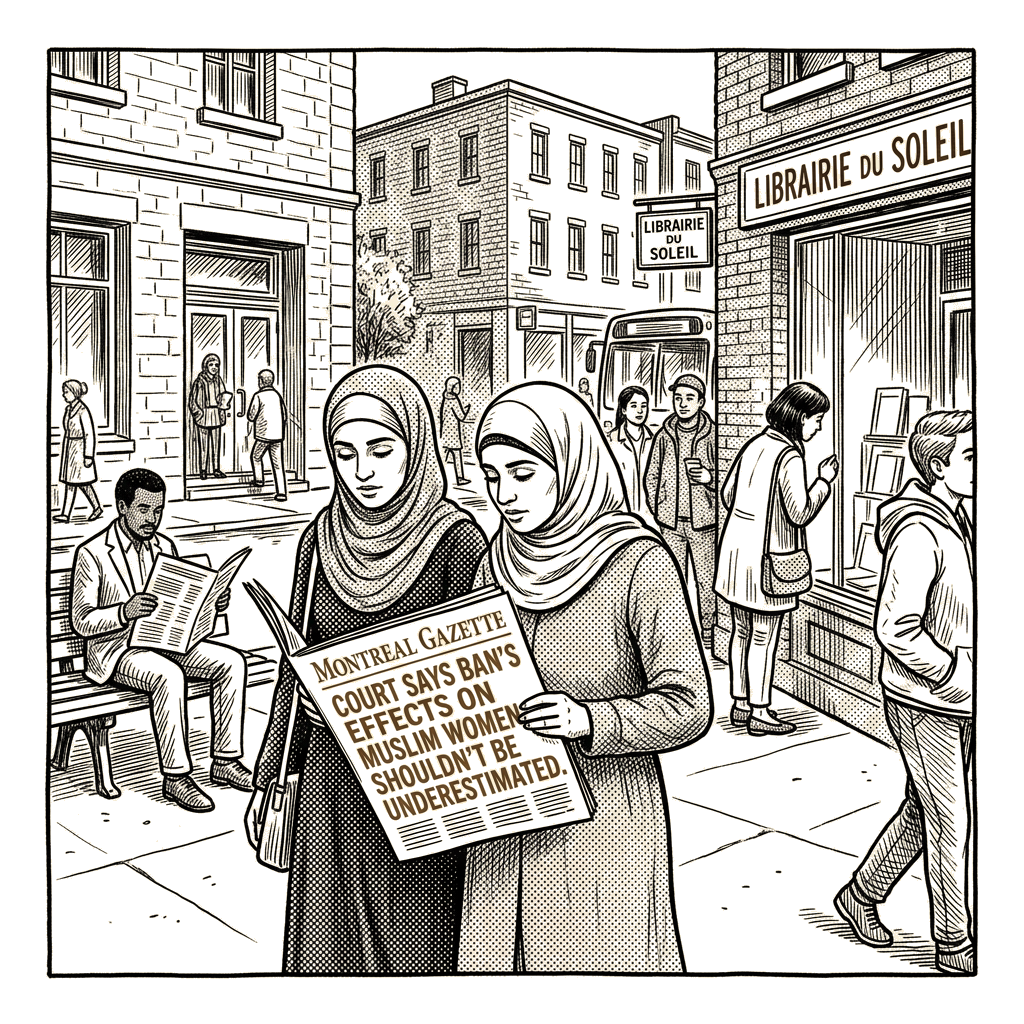
Canada’s Supreme Court said Friday in its decision that the law’s “stigmatizing and deleterious effects” on those most affected—whom it identified as Muslim women—should not be underestimated. Opponents have argued that the law disproportionately affects Muslim women because many of them are teachers.
The ruling drew immediate criticism from civil-liberties and human-rights groups. Stephen Brown, chief executive of the National Council of Canadian Muslims and an appellant in the case, said the decision opened the “floodgates for a full attack” on Canadians’ constitutional rights. At a news conference in Ottawa, Brown said: “In our country, in the 21st century, entire categories of people are now barred from entire sectors of employment, not because of what they have done, but because of who they are.”
Yves-François Blanchet, leader of the federal Bloc Québécois, a party that pushes for greater autonomy for Quebec from the federal government, cheered the ruling as an “important victory” for Quebec. Blanchet said the decision would allow Quebec to “move forward with the preservation of elements that profoundly define what makes Quebec society distinct.”
Prime Minister Mark Carney said Friday that his government would not use the notwithstanding clause. He said it was too early to say whether the government would pursue constitutional changes to put guardrails on the clause’s use.
The ruling itself largely upheld Quebec’s 2019 law, known as Bill 21, which bars public-sector employees from wearing religious symbols while on the job. The closely watched case stirred debate over freedom of expression and religion. The court found that Quebec validly used the notwithstanding clause when it passed the law, shielding it from legal challenges. The provision allows governments to override some constitutional rights, including freedom of religion and expression, for renewable periods of five years.
Bill 21 is the first law of its kind in North America and has drawn protests in Quebec. Supporters say it does not target any one religion and is necessary to enshrine religious neutrality, or laicity, in a province where the Catholic Church once wielded an iron grip over most aspects of life, including health care and education. Opponents contend that barring police officers, teachers, judges and others from wearing symbols of faith such as hijabs, crucifixes, turbans or kippahs is discriminatory and violates equality, freedom of expression and religious rights. The law has also prompted a broader debate over whether there should be limits on the notwithstanding clause.
Chief Justice Richard Wagner wrote in the court’s 520-page decision: “In short, Bill 21 is rooted in Quebec’s legitimate and historical commitment to ensuring the laicity of the state in a free and democratic society.” The court rejected most arguments that the law violated constitutional rights not covered by the notwithstanding clause, including minority-language rights.
The court also ruled that a section barring public-sector employees from performing their functions while wearing religious face coverings would not apply to members of the provincial legislature. The exception protects the constitutional right of Canadians to run for office and participate in the legislative process, which the notwithstanding clause cannot override.
The four-day Supreme Court hearing in March was among the longest in the court’s 151-year history. A record 51 outside parties filed submissions, including civil-rights groups and the attorneys general of Canada and five of the country’s 10 provinces. Quebec’s lower courts mostly upheld Bill 21, and several groups, including the National Council for Canadian Muslims and the English Montreal School Board, appealed the decision to the Supreme Court.
Quebec, a French-speaking province in a predominantly English country, has long sought to protect its distinct language and culture and enshrine the separation between personal faith and the state. Bill 21 is part of a broader set of measures aimed at secularizing Quebec. This year, the provincial government passed another law, again invoking the notwithstanding clause, that extends the religious-symbols ban to daycare workers and bans prayer in public spaces such as universities. Quebec’s newly elected separatist government wants to bar elementary-school students from wearing religious symbols in the classroom.
Bill 21 includes a grandfather clause exempting public-sector employees who were already in their jobs before the law took effect. Those workers lose the exemption if they are transferred or promoted. After Bill 21 passed, the law drew almost immediate legal challenges and prompted debate over the notwithstanding clause.
The provision was adopted in the 1980s as part of a compromise between the federal government and the provinces during negotiations over the patriation of the Canadian constitution and the creation of the Charter of Rights and Freedoms. Several premiers vowed to withhold support unless the clause was included, arguing that the Charter transferred too much power to unelected judges and away from elected lawmakers.
Until Bill 21 passed, the notwithstanding clause was used sparingly. Since then, premiers across the country have invoked it more frequently, including to pass laws that ended strikes, banned transgender women and girls from women-only sports and limited access to gender-affirming health care for transgender youth. Brown said the clause was intended as an instrument of last resort but had become an ordinary instrument of government.
In a filing to the court, the Canadian government argued that use of the notwithstanding clause should be circumscribed so constitutionally guaranteed rights and freedoms are not transformed into “mere legal fictions.” Conservative premiers of several provinces urged Prime Minister Mark Carney to withdraw the government’s submission, saying it threatened national unity and represented “a complete disavowal” of the bargain their predecessors agreed to in the 1980s.
The justices ruled that courts can make “judicial declarations” about whether rights have been violated when the notwithstanding clause has been used, even as the laws continue to stand. They said such declarations might make the clause more costly for governments to invoke. A majority of justices opted against issuing such a declaration in this case, but the court was divided on the question.