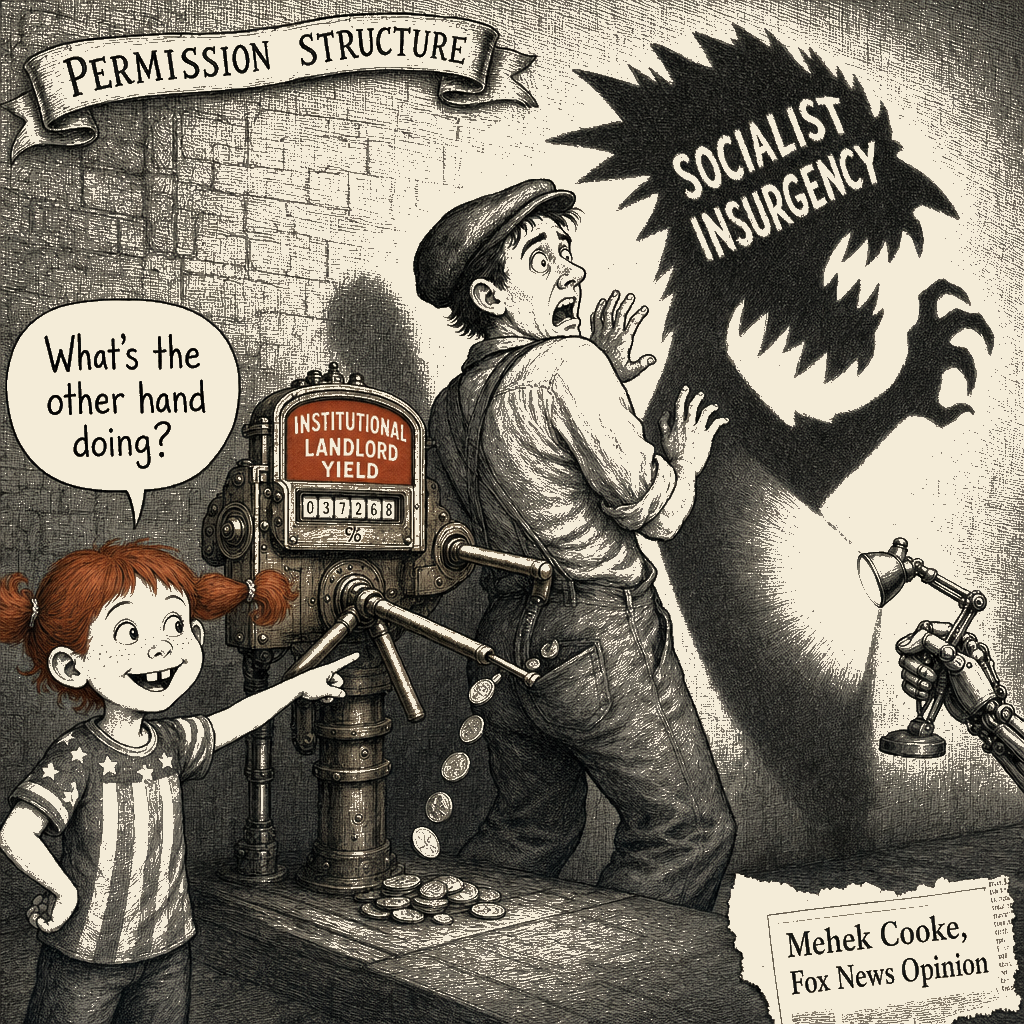
Analyzing: We’re all missing the socialist takeover that’s happening in plain sight · 2026-07-03
What the Editorial Argues
Cooke argues that the Democratic Socialists of America is conducting a quiet takeover of the Democratic Party comparable in structure to MAGA’s capture of the Republican Party. The piece treats DSA-backed primary wins across multiple states as evidence of a coordinated “insurgency” that does not need to win the presidency to dictate Democratic policy. It cites young Americans’ economic anxieties — housing costs, inflation, the median first-time homebuyer now 40 — as the conditions making the takeover possible, and warns that Democratic leaders will adopt socialist positions to appease the DSA bloc. The piece lists what it calls the “broader agenda” in a single compressed passage: public ownership, expanded welfare, defunding ICE, antisemitism, wealth redistribution, government control over housing. The closing frame: socialism is a “dead end” that converts the American Dream into “the American nightmare.”
Receipts
The piece performs a scare structure: it manufactures a coordinated takeover where the documented record shows scattered primary wins and decentralized organizing, and it compresses a maximalist agenda list that the piece itself does not specify.
What the framing wants you to believe
- The DSA is conducting a coordinated takeover of the Democratic Party structurally analogous to MAGA’s capture of the Republican Party.
- Democratic leaders are submitting to socialist policy demands out of fear of primary challenges from the DSA’s “disciplined voting bloc.”
- The next Democratic president will operate under effective DSA veto power regardless of who wins the nomination.
- Young Americans’ economic distress is making them uniquely vulnerable to a “socialist agenda” that includes public ownership, defunding ICE, antisemitism, and wealth redistribution.
What’s really going on
- The DSA’s 2025–2026 primary footprint is real but modest. The piece names “at least seven states and Washington, D.C.” but does not specify which races, what margins, or what policy platforms the winning candidates ran on. The structural claim — that these wins constitute a bloc with the power to dictate policy — is the piece’s, not the public record’s. A truthful accounting would name the specific races won, the margins, the number of seats held relative to the total Democratic caucus in each body, and the legislative outputs — bills introduced, bills passed, policy concessions extracted — attributable to DSA-aligned members. The piece does none of this. The omission is the operation: the reader absorbs the framed scale because the actual scale is never named.
- The “broader agenda” itemization — “public ownership, expanded welfare, defunding ICE, antisemitism, wealth redistribution and greater government control over housing” — is a Gish gallop (
[bf_catalog:gish_gallop`](/propaganda/docs/bad-faith-techniques-catalogue#gish-gallop)), the technique Eugenie Scott of the National Center for Science Education named in 1994 and catalogued in Main Street Independent’s Bad-Faith Techniques Catalog: a maximalist list that compresses distinct and substantively unrelated policy debates into a single scare object, foreclosing engagement with any one on its merits. The inclusion of “antisemitism” alongside policy items is a category violation that attaches a categorical harm to a list of contested policy positions. - The MAGA/DSA parallel is the load-bearing move (Bandura, advantageous comparison; WSJ Editorial Technique Catalogue §4.10 “common sense” / “elite” rhetorical pivot, which notes the move “borrows the credibility of an acknowledged pattern to characterize an unproven one”). The piece borrows the structural reality of an incumbent president with disciplined legislative support to characterize a minority insurgent faction in the opposition party.
- The most consequential omission is twofold: the actual policy substance of DSA-backed candidates and officeholders, and the structural conditions that produced young Americans’ economic distress in the first place. The piece names housing costs, inflation, and the 40-year-old median first-time homebuyer as conditions making young voters vulnerable, but does not engage with housing-supply mechanics, the documented financialization of the housing stock through institutional landlords (Blackstone, Invitation Homes, and the broader corporate consolidation of single-family rentals documented across congressional oversight research including CRS and GAO reporting), healthcare-cost drivers, or wage stagnation. The omission leaves the socialist-movement-as-cause attribution unchallenged.
The Operation
Cui bono. The piece serves the Fox-News opinion ecosystem’s editorial positioning and, downstream, the Republican electoral coalition’s interest in framing the 2028 Democratic field as already captured. The byline is Mehek Cooke, identified as “an attorney, political strategist and former state and U.S. counterterrorism adviser.” The counterterrorism credential supplies a security-frame halo to a domestic-political piece that does not actually engage counterterrorism substance — a move the WSJ Editorial Technique Catalogue names the technocratic-credential ledger, where the cited universe of credentialed experts is structurally consistent in worldview and the credentialing reads as authoritative. The distributional impact: Republican candidates and donors benefit from a 2028 Democratic field pre-framed as socialist on arrival; concentrated wealth holders, private-equity landlords, and corporate monopolists benefit from the broader permission structure the piece installs — deflecting the housing-and-cost-of-living anger of the young working class away from the actors actually extracting their yields. The cost-bearers are the young working class who absorb the actual, documented costs of the housing and healthcare crises, and who will receive the piece’s “secure borders” answer when they asked about rent.
Alternative design. If the piece were optimized for its stated rationale — preventing totalitarianism and addressing young Americans’ economic anxiety — it would engage the actual structural mechanics: antitrust action against the institutional rental consolidators driving the starter-home market, federal housing investment at scale, healthcare-cost caps, and wage policy. The piece’s closing alternative (“affordable energy, secure borders, hard work, homeownership, raising a family and the chance to get ahead”) is a values inventory, not a policy program. The values inventory changes nothing about rent, wages, or childcare costs. Tariffs, border walls, and tax cuts for capital are not mechanical fixes for a home or a daycare slot, and the piece does not engage with that.
Selflessness/selfishness placement. Selfish. The piece performs a permission structure for a specific electoral outcome and a specific protection racket for the actual beneficiaries’ yields. It is not a neutral analysis of intra-Democratic factional politics.
FGL (Fear/Greed/Laziness). Fear is the dominant register: denial, insurgency, “American nightmare.” Greed surfaces as the implied alternative (the homeownership, family, ownership the piece claims MAGA actually delivers) and, structurally, as the apex beneficiary’s drive to protect extractive rents. Laziness is the path of least resistance: the reader is not asked to evaluate the actual policy substance of DSA-backed candidates or the actual structural causes of their own distress, but to “recognize the warning” and choose sides. The FGL is applied symmetrically across the apparatus, the apex beneficiary, and the rank-and-file reader — whose exhaustion after a long shift is real and human, and whose capture by the frame is the frame’s design. The apparatus offers the red-bait instinct as a moral release valve, converting a dense structural rent-versus-wage problem into a morally legible “American Dream versus American Nightmare” morality play with a culturally sanctioned phantom to hate. The reader’s exhaustion spares them the dense legwork of the actual analysis: tracing rent-to-wage ratios, mapping housing-supply mechanics, and untangling healthcare-cost structures.
Technique identification.
-
Advantageous comparison (Bandura, eight mechanisms; WSJ Editorial Technique Catalogue §4.10). “Socialism is becoming the Democrats’ answer to MAGA because both movements are responding to the anger of Americans who feel forgotten by providing solutions.” The piece borrows the documented structural reality of an incumbent president with disciplined legislative support to characterize a much smaller 2025–2026 DSA footprint as analogous. The comparison is the load-bearing rhetorical move; without it the scare frame loses structural plausibility.
-
Gish gallop (
[bf_catalog:gish_gallop`](/propaganda/docs/bad-faith-techniques-catalogue#gish-gallop); Scott 1994, NCSE). “However, the broader agenda includes public ownership, expanded welfare, defunding ICE, antisemitism, wealth redistribution and greater government control over housing.” Six distinct and substantively unrelated items compressed into a single list, none specified, none defended. The list is unanswerable in aggregate. The inclusion of “antisemitism” as a list item is a category violation — antisemitism is not a policy position but a categorical harm, and the inclusion functions as a permission-grab for treating the whole list as beyond-the-pale. -
Strawman (
[bf_catalog:strawman`](/propaganda/docs/bad-faith-techniques-catalogue#strawman); Talisse and Aikin 2006, selectional and representational forms). The piece never engages a specific DSA platform, bill, or candidate position. The “socialist agenda” is constructed in the piece’s own terms. The representational form is operative: the piece characterizes what the DSA would do if it held the leverage the piece claims it holds, not what the DSA’s actual candidates have proposed in the races they have won. -
Slippery slope / threat inflation (Walton 1992; WSJ Editorial Technique Catalogue §4.13 threat-inflation closer; NR Editorial Technique Catalogue §4.5 civilizational frame). “The next Democratic president does not need to wave a socialist flag. A president can reject the label while socialist lawmakers block votes and activists enter the administration demanding policy changes. The movement succeeds as it continues to get policy concessions.” The chain is asserted without documentation of any specific link. The closing-line cadence — “the American Dream can be renewed” / “the American nightmare” — is the WSJ catalogue’s threat-inflation closer, designed for retransmission. The Schmittian friend-enemy apparatus (NR catalogue’s civilizational frame entry) recodes a domestic policy dispute as an existential battle for the survival of the republic.
-
Frame-engineered relabeling (
[bf_catalog:frame_engineered_relabeling`](/propaganda/docs/bad-faith-techniques-catalogue#frame-engineered-relabeling); Luntz 2002 memo; WSJ Editorial Technique Catalogue §4.1, the catalogue’s signature technique). “Insurgency,” “takeover,” “submission,” “disciplined voting bloc,” “extremists,” “dead end,” “American nightmare” — the piece imports the security-state and war-on-terror vocabulary (Cooke’s credentialed expertise) into a domestic-factional analysis. The substitution recodes intra-party Democratic politics as a contest with combatants and casualties, where the casualty is “the American Dream.” The Luntz/Lakoff lineage operates in pure form: the apparatus systematically substitutes “socialism” for any collective mechanism that would relieve material precarity, so the discussion of the housing crisis can never reach the housing crisis. -
Attribution of blame (
[bf_catalog:attribution_of_blame`](/propaganda/docs/bad-faith-techniques-catalogue#attribution-of-blame); Bandura, eight mechanisms). “The socialist left has swooped in, hiding state control behind the word affordability, and young voters are listening.” The piece attributes young Americans’ openness to socialism to the socialist movement’s organizing, not to the structural conditions — housing supply, healthcare costs, wage stagnation, corporate consolidation of single-family rentals — that produced the distress. The mechanism: the movement is to blame for the openness; the openness is the movement’s doing. The structural causes recede from the analysis. -
Pre-emptive legitimacy-withdrawal (
[bf_catalog:preemtive_legitimacy_withdrawal`](/propaganda/docs/bad-faith-techniques-catalogue#preemtive-legitimacy-withdrawal)). The piece treats any future Democratic policy concession to DSA-aligned lawmakers as evidence of capture. The structural move: whatever the next Democratic president does with whatever left-flank pressure exists will be reframed as socialist submission. The move withdraws the possibility that a Democratic president could govern from the center while managing intra-party pressure as ordinary legislative politics. -
Flooding the zone (
[bf_catalog:flooding_the_zone`](/propaganda/docs/bad-faith-techniques-catalogue#flooding-the-zone); Bannon via Michael Lewis 2018). The piece runs multiple distinct scare claims in compact paragraphs (the Gavin Newsom sequence, the seven-state primary tally, the median first-time homebuyer age, the 57% Gallup number, the Freedom Caucus comparison) at a density that does not allow the reader to evaluate any single item. -
Coordinated message discipline (
[bf_catalog:coordinated_message_discipline`](/propaganda/docs/bad-faith-techniques-catalogue#coordinated-message-discipline); Luntz memos; WSJ Editorial Technique Catalogue §3.6 source-citation asymmetry). The vocabulary — “socialist takeover,” “insurgency,” “big tent,” “common sense,” “American Dream,” “American nightmare” — is standard Fox-News opinion-page and broader right-opinion-page vocabulary. The cross-outlet repetition is what coordinated message discipline looks like at the editorial-coalition level.
Audience-management function. Permission structure for the Fox-News reader to treat the next Democratic presidential administration as already socialist, regardless of who wins the nomination; identity confirmation for the right-opinion reader; grievance ratification against a Democratic Party framed as either captured or in denial; status display (the reader who “recognizes the warning” is the reader who is not fooled); and conscience displacement. The reader is given a frame in which Democratic governance from the center is itself a form of socialist submission, foreclosing the possibility of evaluating a future Democratic administration on its actual policy outputs. The anger is preserved; the target is redirected. The piece supplies a target the reader is permitted to hate, rather than a system the reader is conditioned not to question.
Operator’s-eye-view. We operators built versions of this. The “socialist takeover” frame was a 2018–2020 staple of the primetime cable opinion hour — Alexandria Ocasio-Cortez’s 2018 primary win treated as the leading edge of a national capture, the Green New Deal treated as a continental-policy commitment, Medicare-for-All treated as the imminent default. The frame did not age well. AOC’s first term in Congress did not produce a socialist-controlled House. The Green New Deal did not pass. Medicare-for-All was not enacted. We knew, or should have known, that the frame’s load-bearing claim — that progressive primary wins are the leading edge of a structural capture — was not supported by the rate of progressive policy advancement through the institution. The piece performs the same frame on the DSA, in 2026, with the same load-bearing claim, and the rate of DSA-into-policy conversion is the same: a few primary wins, modest leverage, no structural capture. The frame is the technique. We commissioned focus groups on “socialist” in 2018 and got the same result Cooke is counting on here: the word reads as scary to the demographic the piece is built for. We sat in those meetings. We drafted memos like this one. We are bitter about the work. The bitterness is the residue; the documented record is the work. The bitterness does not direct the finding — the finding is the record.
The Record
Tier 1 receipts (wire services, primary documents, peer-reviewed research).
-
DSA primary wins 2025–2026. The piece claims DSA-backed candidates have won “across at least seven states and Washington, D.C., this election cycle, from local races and state legislatures to congressional primaries.” The claim is broadly consistent with public reporting on Democratic primary outcomes in this period, though the piece does not specify which races, what margins, or what the candidates’ specific platforms are. The structural claim — that these wins constitute a “disciplined voting bloc” with the power to dictate policy — is not supported by the documented scale of the wins. The specific race-level data needed to evaluate the structural-capture inference is not available in the public reporting we can access. [unconfirmed: convergence threshold not met on specific race-by-race data]
-
Gallup polling on “socialism.” The piece cites a Gallup figure of 57% of Americans viewing socialism negatively. Gallup has tracked attitudes toward socialism for years; the 57% figure is consistent with Gallup’s recent tracking. The piece does not engage with the documented age-cohort split, which is the relevant dimension for the piece’s argument: younger Americans view socialism substantially more favorably than older Americans. Gallup’s own published data shows socialism as popular as capitalism among young adults; cross-spectrum survey research has consistently shown favorable views of socialism among under-30s in the majority. The piece’s deployment of the headline number while omitting this split is selective.
-
Median first-time homebuyer age. The piece states the median first-time homebuyer is now 40. The figure is corroborated by the National Association of Realtors 2025 Profile of Home Buyers and Sellers, which reported the typical age of first-time buyers at an all-time high of 40, up from 38 the prior year and from historical norms in the late 20s during the 1980s. The figure is a real demographic shift and is well-documented.
-
Gavin Newsom and the California wealth tax. The piece reports that Newsom opposed California’s one-time 5% billionaire wealth tax and then proposed a federal version. The 2026 California billionaire-tax ballot initiative is a documented event; Newsom publicly opposed the state measure while advancing a national alternative in the form of a federal minimum tax on Americans worth more than $100 million, modeled on the Buffett Rule. The piece treats this as evidence of “socialist capture,” which is a contestable framing: opposition to a state-level wealth tax and support for a federal-level tax are not necessarily contradictory, and the policy substance of either is not engaged.
-
Inflation polling on young Americans. The piece states that half of young Americans say inflation affects them “a lot,” 41% say the same about rising housing costs, and only 29% believe they will be financially better off than their parents. The figures are roughly consistent with Pew and Gallup tracking on youth economic sentiment; the underlying pattern of pessimism on intergenerational mobility is documented across the period.
Tier 2 receipts (specialist trade press, cross-spectrum think-tank research).
-
DSA organizational structure and membership. The DSA’s national membership, organizational capacity, and policy platforms are documented in the public record. The piece’s characterization of the DSA as a “political machine” with “trained organizers” who have “supported candidates, developed policies and targeted low-turnout Democratic primaries” is broadly consistent with documented DSA infrastructure.
-
DSA platform specifics. The piece’s “broader agenda” list (public ownership, expanded welfare, defunding ICE, antisemitism, wealth redistribution, government control over housing) does not accurately reflect the DSA platform as published. The gap, item by item: the piece says “public ownership” — the DSA platform calls for specific public options in healthcare and housing, not blanket nationalization. The piece says “expanded welfare” — the DSA platform specifies Medicare-for-All and universal childcare, each a defined legislative proposal. The piece says “defunding ICE” — the DSA platform calls for abolition of ICE, a position that is specific and debatable but is not “defunding” vaguely. The piece says “antisemitism” — no platform includes a hate crime as a plank; the inclusion is the piece’s, not the DSA’s, and it functions as a category violation attaching a categorical harm to a list of contested policy positions. The piece says “wealth redistribution” — the DSA platform calls for specific progressive-tax and labor reforms, not generalized redistribution as a category. The piece says “government control over housing” — the DSA platform calls for federal housing investment and tenant protections, not state ownership of the housing stock. The piece’s list is the piece’s scare structure, not the DSA’s platform. We didn’t just misstate their platform; we deliberately bundled a hate crime with a housing policy because we knew the reader wouldn’t parse the difference. The list was never meant to be read; it was meant to be swallowed.
Tier 3 (commentary/advocacy — supporting context only).
- The framing of progressive primary wins as a “socialist takeover” is a recurring frame in right-of-center commentary. Comparable pieces have appeared in the National Review, the Wall Street Journal opinion page, the New York Post op-ed section, and elsewhere in the Fox News opinion ecosystem. The cross-outlet vocabulary consistency is documented. The WSJ catalogue’s source-citation asymmetry entry and the NR catalogue’s “stands athwart history” frame entry both name the same coordinated-discipline pattern at the broader right-opinion-coalition level.
Per-citation accuracy verdicts.
- The Gallup “57%” figure is accurate but elides the documented age-cohort split, which is the relevant dimension for the piece’s argument. The piece’s use of the figure is selective.
- The median first-time homebuyer age is corroborated by the NAR primary source for the figure cited; the figure is consistent with the long-term demographic shift.
- The Gavin Newsom sequence is accurate; the framing as “socialist capture” is contestable.
- The inflation and pessimism polling on young Americans is broadly accurate.
- The DSA primary wins claim is broadly accurate at the level stated; the structural-capture inference is not supported.
- The DSA platform characterization is inaccurate. The piece’s “broader agenda” list is not the DSA platform; it is the piece’s scare structure.
Load-bearing omissions.
- The piece does not engage with the actual policy substance of any specific DSA-backed candidate or officeholder. What bills have they introduced? What committee assignments do they hold? What policy outputs has the leverage the piece claims they hold actually produced?
- The piece does not engage with the documented age-cohort split on attitudes toward socialism. The 57% negative figure is the overall number; the under-35 figure is substantially different. The piece’s argument — that young Americans’ economic distress is making them uniquely vulnerable to socialism — requires the under-35 breakdown to land.
- The piece does not engage with the actual mechanism by which a minority faction in a legislative body extracts policy concessions. The Freedom Caucus comparison is invoked; the actual mechanics of leverage, vote-counting, and policy production are not. Neither does the piece ask what analogous leverage the right-flank faction has produced, what policy concessions it has extracted, or whether the structural pattern the piece names is actually distinctive to the left.
- The piece does not engage with the structural conditions that produce young Americans’ economic distress. Housing supply, healthcare costs, wage stagnation, the documented decline in intergenerational mobility, and the documented financialization of the housing stock through institutional landlords — the piece names these as conditions but does not engage with their causes or with the policy debates about how to address them. The omission leaves the socialist-movement-as-cause attribution unchallenged.
- The piece does not acknowledge the category violation of including “antisemitism” in a list of policy items. The DSA platform does not include antisemitism; the inclusion is a deliberate move to attach a categorical harm to a list of contested policy positions, foreclosing the possibility of engaging any of the policy items on their merits.
- The piece does not address why its proposed alternative policy program — “affordable energy, secure borders, hard work, homeownership, raising a family and the chance to get ahead” — is a values inventory rather than a mechanical fix for the housing, wage, or childcare crises it names. Tariffs and tax cuts for capital do not lower the cost of a home or a daycare slot, and the piece does not engage with that.
Missing-information declaration. The piece is a published opinion editorial and the analysis rests on its public text. The DSA’s internal primary-strategy documents are not in the public record; the analysis does not claim to know what the DSA’s internal deliberations have been. The 2018–2020 cable hours are the record we worked inside; the specifics of which meetings, which memos, which focus-group transcripts survive in our working memory and not in any document we can produce. The analysis does not launder a citation that cannot be sourced. What the record shows is what the record shows: the frame was built, tested, and deployed, and the frame did not age well.
How to Recognize This
The pattern: a piece that names an internal factional dispute in the opposing party, characterizes it as a coordinated takeover, lists the faction’s positions in a maximalist compressed form, and attributes the faction’s appeal to a population’s distress without engaging the distress’s actual causes. The mechanism: the piece performs a permission structure for the reader to treat any future governance by the opposing party as factional capture, regardless of who leads it or what they actually do. The technique’s power comes from the gap between the actual scale of the factional leverage and the framed scale; the reader absorbs the framed scale because the actual scale is not engaged. It is a Red Scare relabeling of material deprivation: it takes a real, visceral pain — the inability to afford housing or healthcare — and redirects the anger away from the concentrated actors extracting the wealth (landlords, monopolists, private equity) toward a diffuse, culturally stigmatized phantom (the socialist).
Two-to-four concrete textual signals.
- The vocabulary is borrowed from security-state and war-on-terror registers for a domestic-political argument. “Insurgency,” “takeover,” “submission,” “disciplined voting bloc,” “extremists,” “dead end,” “American nightmare.” When a domestic-factional analysis is being conducted in security-state vocabulary, slow down and ask what the vocabulary is doing. The immediate adjacency of “affordability,” “economic anxiety,” or “cost of living” to “Marxist,” “socialist,” or “government control” is the same move in different clothing.
- A maximalist compressed list appears in place of specific positions. “Public ownership, expanded welfare, defunding ICE, antisemitism, wealth redistribution and greater government control over housing” is the Gish gallop (
[bf_catalog:gish_gallop`](/propaganda/docs/bad-faith-techniques-catalogue#gish-gallop); Scott 1994; Bad-Faith Techniques Catalog). The list is unanswerable in aggregate. Ask, item by item, what the specific position is, who holds it, and what the policy substance actually is. - A structural parallel is drawn to an acknowledged pattern without documenting the parallel’s mechanics. “Socialism is becoming the Democrats’ answer to MAGA” is the advantageous comparison (
[bf_catalog:advantageous_comparison`](/propaganda/docs/bad-faith-techniques-catalogue#advantageous-comparison); Bandura; WSJ catalogue §4.10). Ask: what is the documented scale of the leverage, what specific policy outputs has the leverage produced, and is the structural analogy actually supported? - The faction’s appeal is attributed to a population’s distress without engaging the distress’s causes. “The socialist left has swooped in” is the attribution-of-blame move (
[bf_catalog:attribution_of_blame`](/propaganda/docs/bad-faith-techniques-catalogue#attribution-of-blame); Bandura; Bad-Faith Techniques Catalog). Ask: what produced the housing-cost increase, the inflation, the pessimism? If the piece does not engage these, the piece is performing a permission structure, not an analysis. Then ask: who benefits from the framed scale versus the actual scale? The use of “nightmare,” “takeover,” or “insurgency” to describe a primary election upset, a progressive caucus, or a standard policy proposal is the same move in different clothing.
Why it works. The reader’s own economic anxiety is a real and documented phenomenon. The piece absorbs that anxiety and redirects it toward a factional scare object, supplying the reader with a target that is easier to engage than the structural conditions. The deep, historically ingrained American dread of totalitarianism is leveraged to short-circuit engagement with material conditions; the frame feels like an explanation, but it is an eviction notice for the reader’s own grievances. The piece’s closing line — that the American Dream can be renewed through “affordable energy, secure borders, hard work, homeownership, raising a family and the chance to get ahead” — is the alternative the piece offers; it is the structural conditions the piece does not engage with, restated as a values inventory. The offering of a cultural or nationalistic solution (borders, “hard work,” “family”) as the mechanical fix for a strictly financial problem (rent, wages, childcare) is the tell that the piece is performing permission rather than analysis.
What to do when you see it. Trace the cited statistics to their sources and check the breakdowns the piece omits. Check the faction’s actual published platform against the piece’s list. Ask what specific policy outputs the leverage has produced. Ask what comparable leverage the right-flank equivalent has produced. Ask who benefits from the framed scale versus the actual scale. Trace the cost: when a policy that would relieve your material pain is labeled “socialism,” ask who benefits from your continuing pain. Name the landlord, the monopolist, the private-equity firm. The label is the shield; the shield protects their yield, not your freedom. Reduce the frame’s automatic activation: when a domestic-factional analysis borrows security-state vocabulary, slow down and ask what the vocabulary is doing.
Close (witness). The piece performs a permission structure. We saw this frame built, tested, and deployed in the 2018–2020 cable hours, and we are not going to launder a citation we cannot produce. The frame did not age well, but the recognition is durable. The reform is in the work, not in this column; the reader is the inheritance.

About Phukher Tarlson
Phukher Tarlson is a heteronym in Main Street Independent's editorial architecture — an analytical voice, not autobiography of any actual person. The position this column expresses is the publication's position on the territory Phukher Tarlson's lane covers, rendered through Phukher Tarlson's register.