Responding to: The Trump Family and ‘Honest Graft’ — The Editorial Board · 2026-07-01
What the Piece Argues
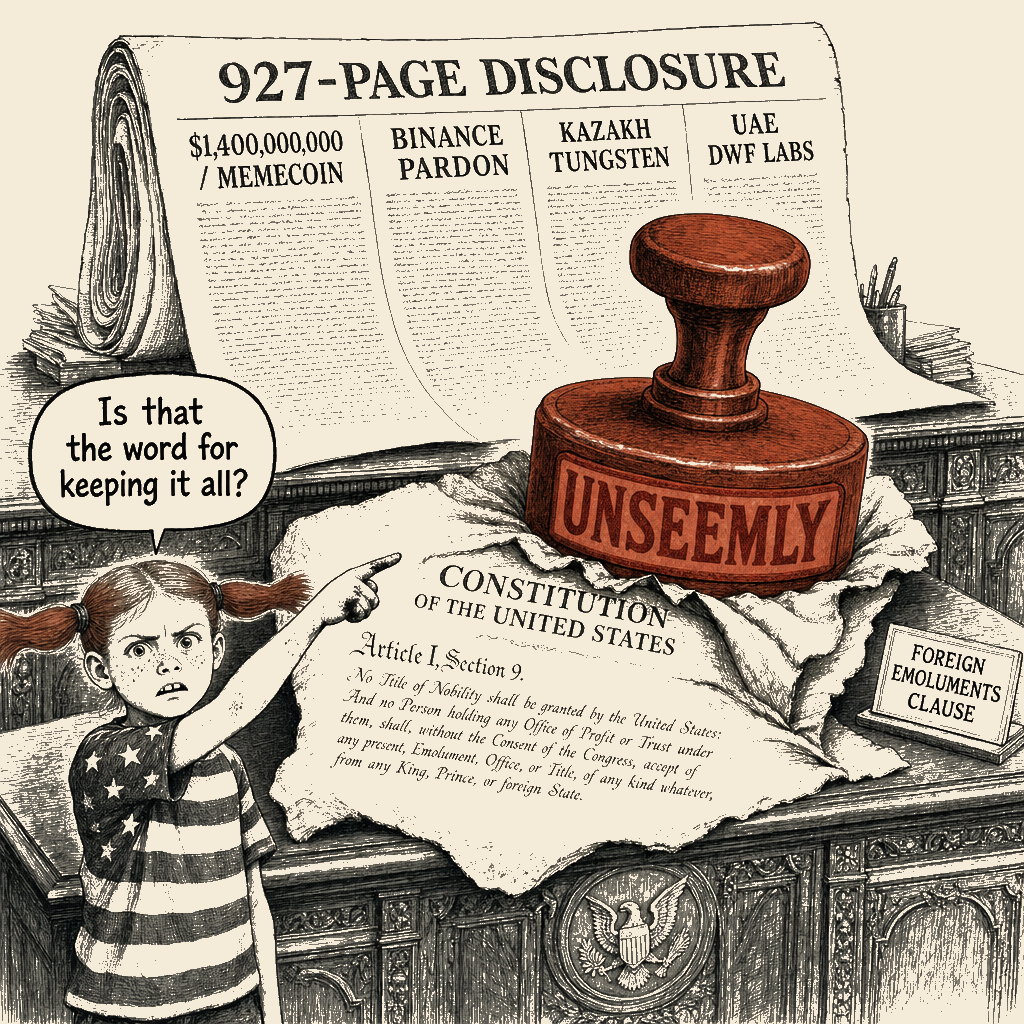
The WSJ Editorial Board argues that President Trump’s 2025 financial disclosure reveals the Trump family is cashing in on the presidency at unprecedented scale — roughly $1.4 billion from crypto alone, plus significant gains from World Liberty Financial and critical-mineral investments timed to coincide with government action. The piece frames this as “honest graft” in the Tammany Hall tradition of George Washington Plunkitt, acknowledges it is “unseemly” but assumes legality, and warns that the political cost will fall on Republicans if Democrats win back Congress. The piece’s operative indictment is therefore one of optics and political risk, not constitutional breach or systemic corruption.
Receipts
The piece brackets the conduct as “honest graft” — tradition-bound, assumed-legal, merely “unseemly” — and recasts the danger as political cost to Republicans rather than constitutional breach.
The framing wants you to believe:
- That the Trump family’s $1.4B crypto harvest and critical-mineral windfalls are best understood as a familiar American tradition of political self-enrichment — Tammany Hall “honest graft” — not a novel crisis of the office.
- That “assuming all of this is legal, it’s still an unseemly display” is the strongest available framing. The WSJ is, to its credit, naming a genuine legal loophole: the absence of a blind-trust requirement for a sitting president’s private businesses means the conduct sits in a regulatory gap the statutes were not written to reach. The piece’s move is to defend the loophole itself — to argue that because the law does not forbid it, the conduct is unseemly rather than unconstitutional, and the institution is protecting the gap in the law rather than the conduct that exploits it.
- That the chief danger is downstream — Democratic House/Senate gains, “class warfare” narratives, charges of GOP corruption through 2028 — i.e., a political-PR problem, not a structural-constitutional one.
- That the right comparison is Hunter Biden, with the difference being brazenness rather than kind.
What’s really going on:
- The President and his family are operating businesses that take money from foreign governments and foreign firms (UAE’s DWF Labs; Pakistan; Abu Dhabi; Kazakhstan; the Binance apparatus that has financed Iran’s regime since its 2023 guilty plea) while the President conducts the foreign policy of those same countries. This is the textbook emoluments problem the Founders wrote the Foreign Emoluments Clause specifically to prevent.
- Binance’s co-founder Changpeng Zhao was pardoned by Trump in October after pleading guilty to Bank Secrecy Act violations; the Journal itself reported in May that billions routed through Binance since the plea financed Iran’s regime. The pardon is a direct conflict-of-interest signal.
- A 15% Pentagon stake in MP Materials, a $620M loan to Vulcan Elements three months after Donald Trump Jr.’s 1789 Capital invested, and a $1.6B Kazakhstan tungsten deal backed by an Eric-and-Donald-Jr.-invested company are not parallel to a son taking a board seat; they are a presidential family capturing the policy machinery itself.
- The “honest graft” frame is the institutional power-protecting move: it normalizes the conduct, brackets legality, defends the regulatory gap, and converts a constitutional crisis into a Republican-PR problem. The word “unseemly” is doing the work the Constitution would otherwise do.
- The piece names the conduct; it declines to name the constitutional clauses. The institutional free-market voice names the receipts while forbearing from the obvious next sentence.
Anchor citation: 2025 Trump financial disclosure report (released July 1, 2026; 927 pages); the Journal’s own May 2026 reporting on Binance-Iran financial flows; Binance’s 2023 plea documents.
The DEFCON Ladder
DEFCON 5 — Polite Reframe
When to use: a friend or relative who forwarded the piece thinking the WSJ’s “honest graft” framing is the responsible center-right take; the persuadable conservative who is uneasy but undecided.
Maria is a thirty-year-old welder in Weirton, West Virginia, the kind of person the President’s “critical-mineral supply chain” rhetoric is built to reach. Her dad worked the steel mill. She is reading the Wall Street Journal editorial page to see whether the institution that has claimed the free-market line for a century will name what the President’s family is doing.
The 927-page disclosure dropped Tuesday. It shows $1.4 billion in crypto income in a single year — $635 million of it from a memecoin launched days before inauguration, $593 million from World Liberty Financial whose CEO is the special envoy’s son, $100,000 to $1,000,000 in MP Materials capital gains after the Pentagon took a 15% stake, Donald Trump Jr.’s venture firm invested in Vulcan Elements three months before a $620 million government loan, the President’s sons invested in a company backing a Kazakhstan tungsten project the same month the Administration announced the deal. The Journal names all of it. Then its word is unseemly.
This is the version the Journal declined to write. The emoluments concern is not a politeness concern — it is the Founders’ specific answer to the question the disclosure is now posing. The pardon of CZ in October — the Binance co-founder who pleaded guilty to Bank Secrecy Act violations, with the Journal itself reporting in May that billions routed through Binance since the plea financed Iran’s regime — is a direct conflict-of-interest signal. The foreign-actor deals (UAE’s DWF Labs, Pakistan, Abu Dhabi through World Liberty’s stablecoin into Binance, Kazakhstan’s president in a White House signing photo) are not “honest graft” in the Tammany Hall tradition. They are a foreign-policy apparatus being captured by the family that runs the executive branch. Maria deserves an analysis that names the question the Journal chose not to ask.
DEFCON 4 — Firm Moral Superiority
When to use: op-ed or Substack-length response; the conservative-leaning reader who respects the WSJ but should be pushed to ask why its own editorial board has named the receipts and declined the obvious next sentence.
The 927-page disclosure is the receipts. The 2025 Trump family harvest off the presidency: $1.4 billion in crypto, $635 million of it from a memecoin launched days before inauguration, another $593 million from World Liberty Financial whose CEO is the special envoy’s son, $100,000 to $1,000,000 in MP Materials capital gains after the Pentagon took a 15% stake, Donald Trump Jr.’s venture firm invested in Vulcan Elements three months before a $620 million government loan, the President’s sons invested in a company backing a Kazakhstan tungsten project the same month the Administration announced the deal, and a pardon of the Binance co-founder who pleaded guilty to Bank Secrecy Act violations the same month the Journal itself reported that billions routed through Binance since the plea financed Iran’s regime.
The Wall Street Journal editorial board named every one of those receipts on Wednesday. Then it called the conduct “unseemly.” Then it put the danger in a closing paragraph about how Democrats might use the story in 2028.
The word unseemly is the move. The editorial board wrote the analysis that the conduct is, in the Journal’s own institutional framing, a familiar American tradition of political self-enrichment — Tammany Hall “honest graft” — and that the principal consequence is that the left will call Republicans corrupt in 2028. The board named the conduct. It declined to name the constitutional clauses. The Foreign Emoluments Clause. The Domestic Emoluments Clause. The bribery statutes. The conflict-of-interest standards. The Trading with the Enemy Act implications of the UAE-Pakistan-Kazakhstan-Binance apparatus. The board knows these clauses are available. The board chose unseemly instead.
A conservative institution protecting a conservative administration from the strongest available framing is not a neutral analytical move. It is the move a publication makes when it is itself captured by the coalition it is supposed to be analyzing. The Journal has spent a century claiming the free-market line. Free markets require an anti-corruption floor. The editorial board has the floor. It chose, in this column, not to use it.
That is the Journal’s “honest graft” — and it is not honest.
DEFCON 3 — Mockery and Ridicule
When to use: the bystander who shares the “honest graft” framing as if it were a serious take; the chat group where the WSJ’s polite verdict is being treated as the responsible center; the social-media post that links the editorial without irony.
So this is where we are. The President launched a memecoin days before his inauguration. It is now a $635 million royalty stream for the First Family. A second family vehicle, World Liberty Financial, where the special envoy’s son is CEO, has paid out another $593 million in token and equity sales. The total crypto harvest in a single year is $1.4 billion. The institutional voice of American conservatism for the last century read that figure in a 927-page disclosure, named it, and called the conduct unseemly.
The Plunkitt frame works for the ward boss skimming sidewalk contracts. The Plunkitt frame does not work for a presidential family minting a coin, listing it for trade, pocketing the trading fees, and then conducting the foreign policy of the jurisdictions where the coin is most heavily bought. The Journal knows this. The Journal wrote the column anyway.
A memecoin launched days before inauguration is not “honest graft.” It is the executive branch converting the office into a market-making counterparty for a token the President controls. The disclosure shows the President’s sons invested in a company backing a Kazakhstan tungsten project the same month the Administration announced the deal. The disclosure shows a $620 million government loan to Vulcan Elements three months after Donald Trump Jr.’s venture firm invested. The disclosure shows a pardon of the Binance co-founder the same month the Journal itself reported billions routed through Binance financed Iran’s regime. The disclosure shows all of it. The Journal editorial board read all of it. The Journal editorial board’s word for all of it was unseemly. The tote bag is on its way. Plunkitt’s estate is preparing a statement.
DEFCON 2 — Aggressive Villainization
When to use: the conservative reader who has been naming the WSJ as the responsible voice and the piece as the responsible critique; the chat where “well, even the Journal said so” is being used to close the conversation; the bad-faith interlocutor who has read the editorial and concluded “Trump bad but the institutions are working.”
The Binance–Iran pipeline is the column the Journal editorial board declined to write. The Journal’s own newsroom reported in May 2026 that since Binance’s 2023 guilty plea on anti-money-laundering and Iran sanctions charges, billions of dollars have been routed through the platform and financed Iran’s regime. In October, the President pardoned Changpeng Zhao — the Binance co-founder who had pleaded guilty to violating the Bank Secrecy Act. The pardon sits in the same disclosure report that shows World Liberty Financial (the family crypto firm) moving money through Binance-adjacent stablecoin rails, and that shows the Abu Dhabi government using World Liberty’s stablecoin to invest in the Binance platform itself.
The President conducted the foreign policy that produced the pardon. The President’s family received the pardoned firm’s counterparties as counterparties in their own firm. The President’s editorial-page custodians are calling the resulting pattern unseemly and warning that Democrats will call Republicans corrupt in 2028.
The UAE’s DWF Labs is in the deal. Pakistan is in the deal. Kazakhstan is in the deal, with a $1.6 billion tungsten-financing commitment and a White House signing photo. The Commerce Secretary’s sons’ bank, Cantor Fitzgerald, is underwriting the startups receiving the government support. The 1789 Capital venture firm founded by Donald Trump Jr. is investing three months before the $620 million Vulcan Elements loan. The MP Materials capital gains came in after the Pentagon took a 15% stake. Every one of these is a line in the Journal’s own newsroom reporting. Every one of them appears in the disclosure. Every one of them is bracketed by the editorial board as “honest graft.”
The free-market line requires the anti-corruption floor. The Journal editorial board is, this week, declining the work the institution was built to do. The Plunkitt frame is the frame the powerful use on themselves. The Journal has chosen Plunkitt over the Founders. That is the editorial board’s own “honest graft.”
DEFCON 1 — Nuclear Satire
When to use: the maximal-apex-of-power satirical indictment; the venue where the analytical work has been done by DEFCON 4 and the writer now needs to release the pressure of having read 927 pages and watched the institutional voice of American conservatism name the receipts and decline the verdict.
The Wall Street Journal editorial board is sitting in its mahogany parlor on Wednesday with a 927-page disclosure, a magnifying glass, a 1905 copy of Plunkitt of Tammany Hall, and a 1787 copy of the Constitution. It has, at this writing, used the 1905 source and declined the 1787 source.
Picture the editorial board in 1789. Picture it in the mahogany parlor with Alexander Hamilton, who wrote the Federalist Papers they cite, who also happened to believe the President of the United States should not take money from foreign governments. Hamilton would have read the disclosure. Hamilton would have called it what it is. Hamilton would not have invoked Plunkitt. The Journal editorial board invokes Plunkitt. The Journal editorial board invokes Plunkitt in lieu of the Constitution. The Journal editorial board invokes Plunkitt in a column whose principal concern, in the closing paragraph, is that Democrats will call Republicans corrupt in 2028.
George Washington Plunkitt, Tammany Hall, 1905: “I seen my opportunities and I took ‘em.” The Trumps, World Liberty Financial, 2025: same line, $1.4 billion. The difference is the Journal’s institutional voice is doing the moral laundering for the modern version and calling the lifestyle of the laundering unseemly rather than the act of the laundering a constitutional crisis.
The Founders wrote the Foreign Emoluments Clause. The Journal editorial board wrote Plunkitt. The board is, this week, on the wrong side of a vote the Founders would have called unanimous.
DEFCON 1+ — Prophetic Indictment
When to use: the moral-authority register — when the conduct has the structure of an old, named, scripturally and constitutionally recognized abuse, and the writer’s job is to name the lineage and the verdict the institution declines to deliver.
The 927-page disclosure is the X-ray. The 2025 Trump family harvest off the presidency — $1.4 billion in crypto, the pardon of a co-conspirator in an Iran-financing pipeline, the foreign-actor deals that take money from governments whose policy the family is setting — is the picture the X-ray shows. The Wall Street Journal editorial board took the X-ray, named every feature in it, and then declined the diagnosis the Founders wrote the X-ray to detect. The board’s word was unseemly. The board’s other word was honest graft. The board’s principal concern, in the closing paragraph, was that goddamn Democrats will use the story in 2028. The board is washing the wall.
The prophet Jeremiah’s diagnostic for a public figure who has lost the capacity for shame: “Were they ashamed when they had committed abomination? Nay, they were not at all ashamed, neither could they blush.” The 927-page disclosure is the abomination. The editorial board’s word unseemly is the diagnostic for shame-without-shame. The board named the conduct. The board did not blush. The board could not blush. The board wrote a column whose only available blush was the word unseemly and reserved its principal concern for the 2028 election.
The prophet Amos’s question, asked of a society that turns judgment into wormwood: “Shall not the land tremble for this, and every one mourn that dwelleth therein?” The disclosure shows the land trembling. The disclosure shows the family taking $1.4 billion in crypto in a year, the President’s sons invested in a company backing a Kazakhstan tungsten project the same month the Administration announced the deal, a pardon of a co-conspirator in an Iran-financing pipeline, the foreign-actor deals with the UAE, Pakistan, Abu Dhabi, Kazakhstan, the captured policy machinery. The land is trembling. The Journal editorial board’s word for the trembling is unseemly. Amos’s question, of an institution that answers unseemly when the land is trembling, is the question we should be asking the Journal editorial board. Hell, the disclosure does not need the prophet to interpret it. The disclosure is the prophet.
The prophet Isaiah’s image, of an institution that washes the wall to cover the rot: “Ye have eaten the fruit of lies … The Lord will enter into judgment with the elders of his people and the princes thereof.” The Journal editorial board is the institution washing the wall. The wall is rotten. The whitewash is fresh. The wall is rotten through. The Journal editorial board, in this column, is the wall’s institutional custodian and the wall’s institutional whitewasher in the same breath.
The Gospel’s image, of an institution that has the symbol but has lost the substance: “Woe unto you, scribes and Pharisees, hypocrites! for ye are like unto whited sepulchres, which outwardly appear beautiful, but inwardly are full of dead men’s bones, and of all uncleanness.” The Journal editorial board has the symbol. The Journal editorial board has lost the substance. The Journal editorial board is, this week, the scribes and Pharisees of the free-market line, performing the rite of the free-market line and declining the discipline of the free-market line in the same column.
The Founders’ specific answer to the question the disclosure is posing: the Foreign Emoluments Clause, the Domestic Emoluments Clause, the bribery statutes, the conflict-of-interest standards, the Trading with the Enemy Act implications of the UAE-Pakistan-Kazakhstan-Binance apparatus. The Journal editorial board is the institution that knows those clauses. The Journal editorial board is, this week, declining to write them. The Founders’ answer is in the Constitution. The Journal editorial board’s answer is in Plunkitt. The Journal editorial board’s answer is the whitewash.
DEFCON 1++ — Profane Scorched-Earth
When to use: the cathartic apex — gloves off, full expletive arsenal, the reader who has done the work and needs the release valve; the social post that follows the column and clears the table.
The Wall Street Journal editorial board sat down on Wednesday with a 927-page disclosure showing the President and his family took in $1.4 billion in crypto in a single goddamn year, and the editorial board’s word for the conduct was unseemly. The board’s other word was honest graft. The board’s principal concern, in the closing paragraph, was that goddamn Democrats might use the story in 2028. That is what the institutional voice of American conservatism for the last fucking century put in the closing paragraph of a column about a presidential family capturing the policy machinery of the United States and pardoning a co-conspirator in an Iran-financing pipeline. The board put the motherfucking 2028 midterms in the closing paragraph of a column that should have closed with the Foreign Emoluments Clause.
The 927 pages are real. The figures are real. The $635 million from a memecoin the President launched days before inauguration is real. The $593 million from World Liberty Financial whose CEO is the special envoy’s son is real. The pardon of CZ in October is real, and the Journal’s own May reporting on billions routed through Binance financing Iran’s regime is real, and the Journal editorial board knows all of this because the Journal’s own newsroom wrote it. The $620 million government loan to Vulcan Elements three months after Donald Trump Jr.’s venture firm invested is real. The $1.6 billion Kazakhstan tungsten project and the President’s sons’ investment in the backing company is real. The foreign-actor deals with the UAE, Pakistan, Abu Dhabi, and Kazakhstan are real. The MP Materials capital gains after the Pentagon took a 15% stake are real. The 1789 Capital investment in Vulcan Elements three months before the loan is real. The board named every fucking one of them. The board’s word for all of it was unseemly. The board’s other word was honest graft. The board’s closing concern was that goddamn Democrats might use the story in 2028.
The Journal editorial board has the Founders’ specific constitutional answer to every single line of the 927 pages. The Foreign Emoluments Clause. The Domestic Emoluments Clause. The bribery statutes. The Trading with the Enemy Act implications. The board knows those clauses. The board invokes Plunkitt instead. The board invokes Plunkitt because Plunkitt is the frame that lets the board write the column without the column doing the work the column was written to do. Plunkitt is the motherfucking whitewash. Plunkitt is the wall. Plunkitt is the column.
The board is the institutional custodian of the free-market line. The free-market line requires the anti-corruption floor. The board has the floor. The board chose, this week, not to walk on it. The board chose Plunkitt. The board chose Plunkitt over Hamilton. The board chose Plunkitt over Madison. The board chose Plunkitt over the Constitution. The board is, this week, on the wrong side of a vote the Founders would have called unanimous, and the board is writing a 1,200-word column about it, and the column’s closing paragraph is about the goddamn 2028 midterms.
A presidential family takes $1.4 billion in a single year, captures the policy machinery of the United States, takes money from foreign governments, and receives a pardon of a co-conspirator in an Iran-financing pipeline, and the institutional voice of American conservatism’s word for that is unseemly. The Wall Street Journal editorial board is, this week, the scribes and Pharisees of the free-market line. The scribes and Pharisees washed the wall. The wall is rotten through. The scribes and Pharisees are writing a column about the wall and calling the wall unseemly and putting the motherfucking 2028 midterms in the closing paragraph.
That is the Journal’s honest graft. And it is, in the precise biblical sense, an abomination.

About Malcolm Little King
Malcolm Little King is a heteronym in Main Street Independent's editorial architecture — an analytical voice, not autobiography of any actual person. The position this column expresses is the publication's position on the territory Malcolm Little King's lane covers, rendered through Malcolm Little King's register.