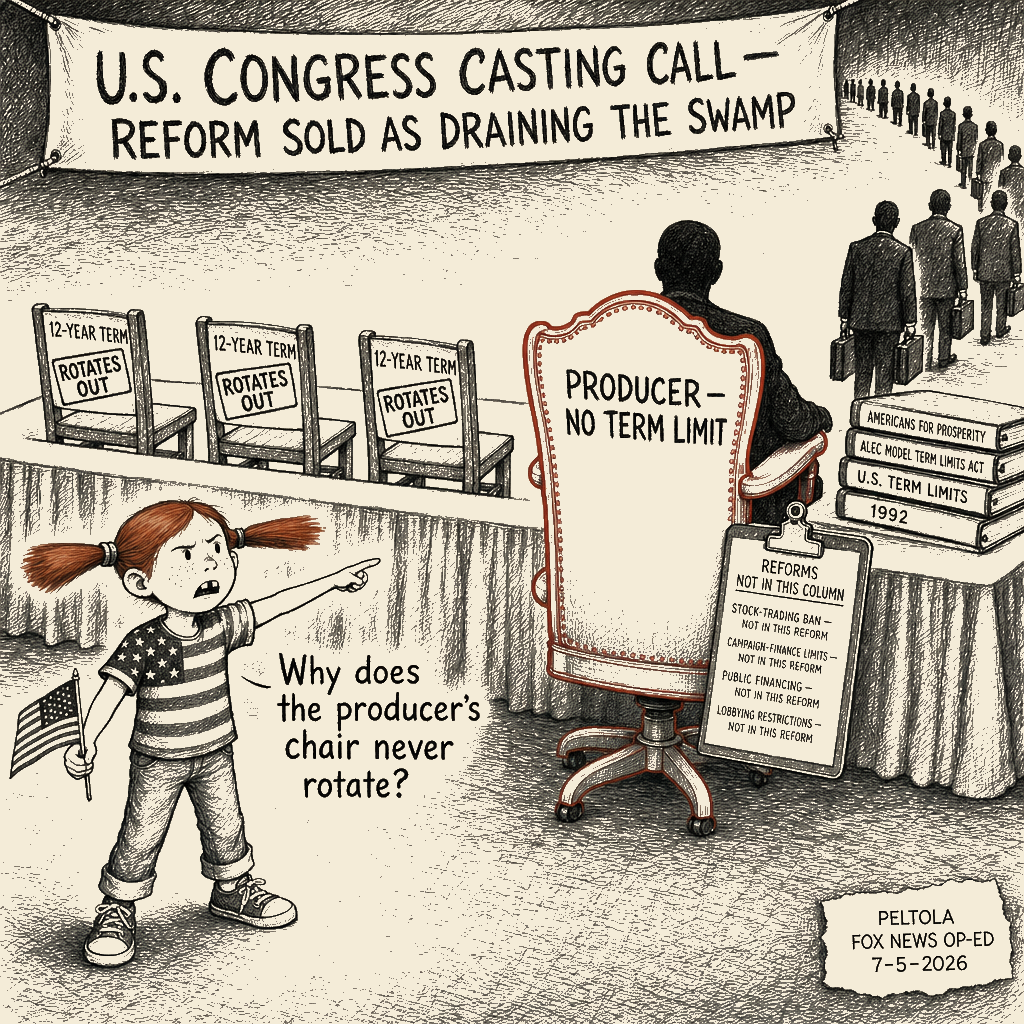
Responding to: Washington rewards failure. It’s time to send career politicians home · 2026-07-05
What the Piece Argues
Mary Peltola, the Democratic former House member now running for the U.S. Senate in Alaska, argues in a July 5, 2026 Fox News Opinion column that Washington is broken because of career politicians who have every incentive to fight rather than deliver. She positions herself as a working-class outsider who went to Congress and found it “rigged” by stock-trading incumbents, donor-funded committee chairs, and a culture of performative partisan combat. Her prescription is a 12-year term limit for federal office, framed as bipartisan populist accountability — the only way, in her words, to replace donor-captured careerists with representatives “who actually have to deliver.” She pairs the federal call with an appeal to Alaska to pass term limits at the state level, opening a judicial pathway to what would otherwise be an unconstitutional federal change.
Receipts
The piece works by isolating a real grievance (a Congress most Americans don’t trust) and converting it into a procedural fix (term limits) that, in fact, transfers power from one set of incumbents to a more durable set of structural beneficiaries.
The framing wants you to believe
- The villain in Washington is the “career politician” who serves for decades, gets rich on insider trading and donor access, and has “no real deadline to deliver.”
- “The only people who don’t support term limits are the ones who benefit from not having them.”
- A 12-year cap will, by itself, force Congress to work on “our timeline, not theirs” and replace donor-beholden careerists with representatives who “actually have to deliver.”
- This is “red or blue” populism; the only opposition is self-interested incumbents.
What’s really going on
- The modern term-limits push is not a fresh populist insurgency. It is a four-decade project of the Koch donor network — Americans for Prosperity’s term-limits program, ALEC’s model Term Limits Act, and US Term Limits (founded 1992 with the support of aligned libertarian donors) — that ultimately centralizes power in the lobbying and donor class by stripping legislators of the institutional knowledge required to resist it.
- The supposed fix is structural in exactly the wrong direction. The people who actually benefit from term limits are: lobbyists, who retain institutional knowledge while legislators rotate out, increasing lobbyist leverage over freshman members; the donor class, who can purchase a steady stream of cheap, institutionally-naive freshmen more easily than entrenched incumbents with their own networks; and the campaign-consulting and political-media industrial complex, which depends on perpetual candidate churn.
- Political-science research on state-level term limits (California’s 1990 Prop 140, in effect since 1996; Michigan’s 1992 limits; the 2000 Carey, Niemi, and Powell comparative study across multiple states) consistently finds that term limits increase lobbyist influence, accelerate the revolving door between legislature and lobbying, and shift power from the legislature to the executive and to well-funded outside interests. The career politician doesn’t disappear. She just moves to K Street, where she now has seniority over the legislature she used to serve in.
- The reform that would actually constrain the donor class is the reform the piece never names: campaign-finance limits, public financing of elections, a stock-trading ban for sitting members (a single statute that would, in one stroke, eliminate the insider-trading scandal the column describes), lobbying-revolving-door restrictions, and the enforcement of existing ethics law. The piece does not call for any of them. That is the part of the framing the column is built to hide.
Anchor citation: John M. Carey, Richard G. Niemi, and Lynda W. Powell, Term Limits in the State Legislatures (University of Michigan Press, 2000), and the subsequent longitudinal research summarized in the academic literature on legislative professionalization, consistently document that term limits increase lobbyist influence, accelerate the K Street revolving door, and shift power from the legislature to the executive and to well-funded outside interests.
The DEFCON Ladder
DEFCON 5 — Polite Reframe
When to use: The persuadable friend or neighbor who nods along to “term limits” because the diagnosis of a broken Congress is real, but hasn’t thought about who actually benefits from the cure.
Sarah is a single mother of two in Wasilla. She works the morning shift at the gas station on the Parks Highway and the night shift at the hospital intake desk. She has done the math, more than once, on what it would cost to heat her house this winter, and the math has not come out. She voted, last cycle, because her uncle told her to, and her uncle told her to because her grandmother had always voted, and her grandmother had always voted because her grandmother’s mother had walked to the polls in a place where walking to the polls was not something everyone got to do. Sarah is not a political person. Sarah is a person who is paying attention.
The column Mary Peltola published last week is written for Sarah. It is built around a real grievance Sarah has, and it deserves to be taken seriously on that ground. Congress’s approval rating sits at around 12%. Members trade stocks on insider information. Committee chairs’ biggest donors are the industries they regulate. Working people across Alaska and the rest of the country choose between heat and groceries while their representatives cash in. That is the column’s true half, and conceding it is the first thing a serious reply has to do.
The column’s move after the true half is the move to be careful with. “Career politicians” is the operative phrase. It is a useful phrase for the same reason it is a misleading one. It locates the disease in the individual incumbent who stays too long. It does not locate the disease in the donor network, the lobbying industry, the financialization of campaign finance, or the structural incentives that reward fighting over delivering. The people who don’t have to be re-elected every two years are the lobbyists. The people who get to design the system are the donors. Term limits do not change those facts. They make them worse.
If you want a Congress that “actually has to deliver,” the constraint that matters is not the length of a member’s tenure. It is the price at which any member, freshman or forty-year veteran, can be purchased. Term limits do not raise that price. They lower it: a freshman who doesn’t know which subcommittee staff director returns phone calls is more dependent on the lobbyist who walks her to the right hearing room than the legislator who has been in the building for two decades. The evidence on this is not new. California’s term-limits experiment, in effect since 1996, produced a legislature more responsive to lobbyists and outside interest groups than it was before. Michigan’s 1992 limits did the same. The career politician didn’t disappear. She just moved to K Street, where she now has seniority over her former colleagues.
A Congress that works for working people — and Sarah is, in the column’s own useful phrase, exactly such a working person — will not be produced by changing the cast. It will be produced by changing the donor class’s leverage over the cast. Term limits don’t do that. They hand the leverage to the people who already have it.
DEFCON 4 — Firm Moral Superiority
When to use: The mixed-faith reader or op-ed commenter who shares the anti-corruption diagnosis but needs the cui bono trace to see why this particular reform doesn’t deliver it.
Tomás is a freshman state representative in a small Western state. He ran for the seat his grandmother had held for four years on the local school board — never the state house, never a place where the decisions get made about the leases on the land his grandfather worked. He was not supposed to win. He won because the previous incumbent, a thirty-year fixture, had voted for a bill that allowed the same out-of-state operator who had been running roughshod over the local water table to keep running roughshod over the local water table. Tomás won because the previous incumbent had stopped being able to deny, even to the families the previous incumbent had been representing for three decades, that he was working for the operator and not for the families.
Tomás won the seat, and on his first day in the state capitol, the lobbyist for the operator came to see him. The lobbyist had been in the building for fifteen years. She knew which subcommittee staff director to call, which procedural rule could be deployed to block a bill, and which committee chair had been taking her client’s campaign contributions for a decade. Tomás did not know any of these things. The lobbyist walked him to the right hearing room. The lobbyist explained the committee process. Tomás did not, in his first session, pass the bill he had run on. The previous incumbent had not, in his thirtieth year, passed it either. The lobbyist, in her fifteenth year, was running the building.
This is what term limits produce. The lobbyist, who has been on the relevant portfolio for fifteen years, keeps her job. The donor, who has been funding the relevant committee members for thirty years, keeps her job. The freshman, who has been on the job for two years, learns the building, if he is lucky, by his fourth. The freshman who has been on the job for eight years is just starting to be effective. The freshman who has been on the job for twelve years, under Peltola’s proposed term limit, is sent home. The lobbyist, who has been on the relevant portfolio for twenty-five years, is still there. The donor, who has been funding the relevant committee members for forty years, is still there. The reform, in plain English, is a casting call.
Peltola’s column is right about a great deal, and wrong about the load-bearing piece. The 12% approval rating is real. The 83% support for term limits is real. The insider trading is real. The committee-chair-as-industry-representative pattern is real. Conceding these is the first move, because it earns the standing to make the second.
The second move is to follow the money. The 12-year-term-limit push is not a fresh populist insurgency. It is the long-running project of the Koch donor network — Americans for Prosperity’s term-limits program, ALEC’s model Term Limits Act, and US Term Limits, founded in 1992 with the financial backing of aligned libertarian donors. The Center for Media and Democracy’s PR Watch, the ALEC task-force records, and the academic literature on conservative political organizing document the institutional architecture. The reform was not built by working people. It was built by donors who correctly calculated that a legislature with less institutional memory is a legislature more dependent on the people who have institutional memory, which is the lobbyist and donor class.
The empirical record is unambiguous. Carey, Niemi, and Powell’s 2000 comparative study of term limits across the states; the Michigan State and UC research on California’s 1990 Prop 140 and Michigan’s 1992 limits; the longitudinal research on legislative professionalization after term limits — the consistent finding is that term limits increase lobbyist influence, accelerate the revolving door between legislature and lobbying, and shift power from the legislature to the executive and to well-funded outside interests. The career politician doesn’t disappear. The career politician gets a job at a lobbying firm where she now has seniority over her former colleagues, and uses that seniority to extract policy outcomes the donor class wants.
Peltola’s reform is, in addition, a self-positioning artifact. She is a candidate for the United States Senate. The reform that, in her own framing, would constrain a 30-year incumbent does not constrain a first-term Senate candidate running on the reform. The structural fact that a campaign built on “send the career politicians home” is, by construction, a campaign for the non-career politician is not a coincidence. It is the point. Term limits are a campaign-finance reform that costs the candidate nothing and produces, if it ever passes, a Congress that is cheaper to buy.
The reforms that would actually constrain the donor class are the reforms the column never names. Campaign-finance limits. The public financing of elections. A stock-trading ban for sitting members of Congress, which is a reform that would, in a single statute, eliminate the insider-trading scandal the column describes. Lobbying-revolving-door restrictions. The enforcement of existing ethics law, which is on the books and is not, in practice, enforced. Peltola’s column does not call for any of them. That is the part of the framing the column is built to hide.
DEFCON 3 — Mockery and Ridicule
When to use: The performative centrist who treats “career politicians” as the operative vocabulary and skips the donor-class analysis. Use when the audience can take a laugh without losing the structural point.
Let us pause and consider the marvel of modern American political reform, in which the donor class, after four decades of building the term-limits movement through Americans for Prosperity, ALEC’s model Term Limits Act, and US Term Limits, has successfully produced a candidate for the United States Senate of the United States of America who is running on the donor class’s reform. The operation is, in its way, beautiful. The fox has not merely entered the henhouse; the fox has produced a rooster that wakes the hens each morning to remind them that the henhouse is too crowded with chickens.
Let us consider also the magic of the phrase “career politician.” It is a phrase that locates the disease in the individual politician who serves too long, which is a phrase that is genuinely useful if you are the donor class and the individual politician is the only person in the relationship who is not on your payroll. The lobbyist has a career. The donor has a career. The K Street firm has a career. The policy shop that writes the talking points has a career. The consultant who runs the next campaign has a career. The person who does not, in this framing, have a career is the legislator — who, in this framing, must be turned over at twelve-year intervals so that a fresh legislator can be acquired, on better terms, by the same donor class.
It is, the column would like you to know, the career politician’s fault. The stock-trading is the career politician’s fault. The insider access is the career politician’s fault. The donor meetings are the career politician’s fault. The fact that a freshman senator who doesn’t know where the subcommittee hearing room is located is going to rely on the lobbyist who does is — and here the column is, refreshingly, blunt — the career politician’s fault, because the freshman is a reformer, and the lobbyist is just helping.
Let us consider one more marvel, which is the Senate campaign built on the proposition that the next election’s villain is the long-serving incumbent. The reform that constrains the 30-year incumbent does not constrain the candidate running on the reform. The column is being written by a candidate for the United States Senate. The column is built around a reform that, in the column’s own framing, would not apply to the column’s author. This is not a coincidence. It is the campaign. The campaign is the reform is the campaign.
Working people across this country, the column assures us, can’t afford more of the same. The donor class that funded the term-limits movement for forty years, that drafted the model legislation at ALEC, that placed it on the ballot in state after state, that funded the think tanks that produce the polling that says 83% of Americans support it, that has built the entire architecture of the reform — that donor class is, the column assures us, not the problem. The people who do not have term limits are the problem. The people who do not have term limits include the lobbyist class, the donor class, the consulting class, the media-industrial complex, and the political action committees. They are fine. The reform is for someone else.
Twelve years, the column says. Twelve years, and out. The lobbyist, who has been on the relevant subcommittee for twenty, keeps her job. The donor, who has been funding the relevant committee members for thirty, keeps his job. The career politician, who has been serving for twenty-five, goes home and gets a job at a firm where she now has seniority over her former colleagues. The system is reformed. The system is, in fact, the lobbyist-and-donor class. The system, like the lobbyist, has tenure. It does not need term limits. It has, in Peltola’s own useful phrase, no real deadline to deliver.
The reform is the campaign. The campaign is the column. The column is, in its own way, an advertisement for the donor class’s preferred reform, written by a candidate for the United States Senate, on the op-ed page of a major American network whose parent corporation is itself a registered lobbying operation. The arrangement is, in the language of the column itself, bipartisan.
DEFCON 2 — Aggressive Villainization
When to use: The lobbyist class, their funded think tanks, and the donor network who’ve been pushing this reform for forty years — and the politicians who carry their water.
The piece is a campaign document. It is also a perfectly serviceable piece of donor-class work, and we should name who it serves.
Charles Koch and the late David Koch built the term-limits movement in this country the way they built every other piece of their political operation: slowly, expensively, and through institutions designed to look like spontaneous citizen insurgencies. Americans for Prosperity’s term-limits program. The American Legislative Exchange Council’s model Term Limits Act, which has been introduced in state legislatures for three decades. US Term Limits, founded in 1992 by Paul Jacob with the support of aligned libertarian donors, which has, with the help of the Koch network’s funding infrastructure, placed term-limits measures on state ballots across the country. The institutional record is in the public domain. The documentary record is in the archives of PR Watch, the Center for Media and Democracy, and the academic literature on conservative political organizing.
The reform is, structurally, designed to do one thing: increase the leverage of the donor and lobbyist class over the legislature. A freshman who has been in office for two years does not know which subcommittee staff director to call, which procedural rule can be deployed to block a bill, or which industry coalition has been working the relevant office for a decade. A lobbyist who has been on the relevant portfolio for fifteen years does know. The freshman is dependent. The lobbyist is not. The donor class, which funds the lobbyist, is not. Term limits make the dependency durable.
This is not a complicated argument. It is documented in the academic literature on state legislative term limits. Carey, Niemi, and Powell’s 2000 comparative study of term limits across the states. The Michigan State University research on California’s 1990 Prop 140 and Michigan’s 1992 limits. The longitudinal research on legislative professionalization after term limits, which finds consistently that term limits increase lobbyist influence, accelerate the revolving door between legislature and lobbying, and shift power from the legislature to the executive branch and to well-funded outside interests. The career politician does not disappear. The career politician gets a job at a lobbying firm where she now has seniority over her former colleagues, and uses that seniority to extract policy outcomes the donor class wants. The reform, in plain English, makes the lobbying industry more effective and the legislature less so.
The campaign is also, in its own way, transparent. Peltola is a candidate for the United States Senate. She is running on a reform that, by her own framing, would not apply to her. The 12-year term limit is, in her own useful framing, the deadline that “we the people” impose on the career politician. The career politician, in this framing, is the 30-year incumbent. The career politician is not the candidate. The career politician is not the donor class that funded the reform. The career politician is not the lobbyist who will absorb the termed-out incumbent. The career politician is someone else. The reform is, in this sense, a casting call.
The people who do not support term limits, the column says, are the ones who benefit from not having them. This is the column’s most useful sentence, and it is also the column’s most self-refuting. The people who benefit from not having term limits include the lobbyist class, the donor class, the consulting class, the media-industrial complex, and the political action committee network. They do not need term limits. They have, in Peltola’s own useful phrase, no real deadline to deliver. The column is, in this sense, correct: the people who do not need term limits are the people who do not have them. The people who do not need them are the people the column will not name. The bipartisan coalition for term limits is, on closer inspection, a bipartisan coalition in the same way that a bipartisan coalition for lower taxes on the donor class is bipartisan. The donor class is bipartisan. The donor class is the bipartisan.
The reform that would actually constrain the donor class is the reform the column does not name. The column does not call for campaign-finance limits. The column does not call for the public financing of elections. The column does not call for a stock-trading ban for sitting members of Congress, which is a reform that would, in a single statute, eliminate the insider-trading scandal the column describes — and it does not call for lobbying-revolving-door restrictions or the enforcement of existing ethics law, which exists on the books and goes unenforced in practice. Not one of these reforms appears in the column, because the column is built around a reform that does not threaten the donor class. The reform is built by the donor class. The reform is the column.
We name what the column will not name. We follow the money. We keep the receipts. We say the part of the column that the column was built to leave out.
DEFCON 1 — Nuclear Satire
When to use: The bad-faith reformist who knows who funds the term-limits push and runs the line anyway; the moment of catharsis when the gloves come off.
Let us, in the spirit of the column, take the column at its word.
The column says career politicians are the problem. Let us grant the column its premise. The career politician trades stocks on insider information. The career politician takes meetings with the industries she is supposed to regulate. The career politician has been in Washington so long that her biggest donors are the industries she is supposed to regulate. The career politician, in the column’s framing, is a parasite on the body politic. The career politician is a disease. The career politician, in the column’s framing, is the only person in the relationship that is not a parasite. The lobbyist is not a parasite. The donor is not a parasite. The K Street firm is not a parasite. The industry coalition is not a parasite. The political action committee is not a parasite. The campaign consultant is not a parasite. The career politician, in the column’s framing, is the only parasite in the relationship, and the column has built a reform that, when passed, will produce a Congress in which the parasites are the same parasites and the host is a freshman who has not yet learned which subcommittee staff director returns phone calls.
The column says term limits are the fix. Let us grant the column its prescription. Twelve years. Twelve years, and out. The 30-year incumbent goes home. The donor, who has been funding the 30-year incumbent for thirty years, does not go home. The lobbyist, who has been working the 30-year incumbent for twenty-five, does not go home. The K Street firm, which has been placing former 30-year incumbents on its payroll since 1996, does not go home. The political action committee network, which has been funding both parties’ 30-year incumbents for the entire post-Citizens United era, does not go home. The industry coalition, which has been meeting with the relevant committee staff for two decades, does not go home. The political-media industrial complex, which has been monetizing the 30-year incumbent’s every utterance for the entire cable era, does not go home. The reform, in the column’s own framing, is a casting call in which the cast is replaced every twelve years and the production company is unchanged. The reform, in the column’s own framing, is a casting call in which the producer is unchanged and the actor is replaced. The reform, in the column’s own framing, is a casting call. The reform is, in fact, the producer’s preferred reform, written by a candidate for a role in the next production, on the op-ed page of a network whose parent corporation is itself a registered talent agency. The arrangement is, in the column’s own useful phrase, bipartisan.
The column says the only people who don’t support term limits are the ones who benefit from not having them. The column, in this sentence, names the lobbyist class, the donor class, the consulting class, the political-media complex, the political action committee network, and the industry coalition. The column, in this sentence, also does not name them. The column, in this sentence, names them by saying that they are unnamed, which is, in the column’s own useful framing, the same as naming them. The bipartisan coalition, in this sense, is a bipartisan coalition in the same way that a bipartisan coalition for lower taxes on the donor class is bipartisan. The donor class is bipartisan. The donor class is the bipartisan.
The column says we need a system that works for working people. The column, in this sentence, does not call for the reform that would, in fact, make a system that works for working people. The column does not call for campaign-finance limits. The column does not call for the public financing of elections. The column does not call for a stock-trading ban for sitting members of Congress, which is a reform that would, in a single statute, eliminate the insider-trading scandal the column describes and would not require a constitutional amendment to enact. The column does not call for lobbying-revolving-door restrictions. The column does not call for the enforcement of existing ethics law, which is on the books, in statutes, and is not enforced, in practice, by the Department of Justice that the column’s own party nominally controls. The column does not call for any of these reforms. The column calls for a reform that is, in the column’s own useful framing, a casting call.
The column is, in this sense, a perfectly serviceable piece of donor-class work. The column is, in this sense, the donor class’s preferred reform, written by a candidate for the United States Senate, on the op-ed page of a network whose parent corporation is itself a registered lobbying operation. The arrangement is, in the column’s own useful phrase, bipartisan. The reform is, in the column’s own useful phrase, bipartisan. The bipartisan coalition is, in the column’s own useful phrase, the bipartisan coalition that the donor class has spent forty years building.
The reform is the column. The column is the campaign. The campaign is, in this sense, the casting call for the next production, written by a candidate for a role, on the op-ed page of the network that will run the ads for the next production. The arrangement is, in the column’s own useful phrase, bipartisan.
We name what the column will not name. We follow the money. We keep the receipts.
DEFCON 1+ — Prophetic Indictment
When to use: The reader moved by moral authority with an edge — the corruption-pattern reader who needs the canonical register to land with the anger underneath it breaking through.
The piece is a campaign document. It is also, in the canonical register, a piece of prophet-grade institutional analysis, and we should read it as the canonical tradition would have read it.
The prophet Amos stood in the gate of Israel and named the sins of the kingdom. The sins were not the sins of the foreigner. The sins were the sins of the kingdom’s own commerce. They sold the righteous for silver and the needy for a pair of sandals. They panted after the dust on the head of the poor. They turned judgment into wormwood. The prophet did not name the foreign oppressor. The prophet named the people who ran the kingdom. The prophet named the institutions. The prophet named the mechanism.
The piece we are reading is built the way the prophets describe. It identifies a real grievance: working people choosing between heat and groceries. It identifies a real villain: the 30-year incumbent who trades stocks on insider information. It then offers a reform that does not threaten the structural operator the prophet would have named. The prophet would not have been surprised. The prophet would have called the reform, in the prophet’s exact vocabulary, the whitewash that makes the rotten wall look fresh — taphel on a wall that is damn rotten already. The reform is, in the prophet’s vocabulary, a casting call. The reform is, in the prophet’s vocabulary, a way for the people who run the kingdom to keep running it while the faces at the gate change. The reform is, in the prophet’s vocabulary, the donors’ reform — and the donors have been at this work for forty goddamn years.
Let us read the piece in the canonical tradition. Let us read it as the prophet would have read it. The piece names the 30-year incumbent. The piece does not name the donor. The piece does not name the lobbyist. The piece does not name the K Street firm. The piece does not name the industry coalition. The piece does not name the political action committee. The piece does not name the political-media complex. The piece does not name the people who funded the term-limits movement at Americans for Prosperity, ALEC, and US Term Limits for the past four decades. The piece, in the canonical tradition, names the visible villain and does not name the structural operator. The prophet, in the canonical tradition, would have called this the actor’s mask — hypokritēs — the device of the players who perform the role of reform while the players’ patron is unchanged. The prophet would have called the reform, in the prophet’s exact vocabulary, the hypocrisy of the whitewashed tomb. These bastards know exactly what they are doing.
The piece, in the canonical tradition, would also be recognizable as a piece of campaign work. The prophet would not have been deceived. The prophet would have said, in the prophet’s exact vocabulary, that the reform that constrains the 30-year incumbent does not constrain the candidate running on the reform. The prophet would have said that the candidate who is running on the casting call is, in the prophet’s vocabulary, the casting call. The prophet would have said, in the prophet’s exact vocabulary, that the bipartisan coalition that the candidate has built is a bipartisan coalition in the same way that the bipartisan coalition for lower taxes on the kingdom’s elites is bipartisan — that is to say, a hell of a lot more bipartisan on paper than it is in hell. The bipartisan coalition is, in the canonical tradition, the bipartisan coalition that the kingdom’s elites have built. The reform is, in the canonical tradition, the kingdom’s reform. The reform is, in the canonical tradition, what the prophet called, in the prophet’s exact vocabulary, the golden cup full of abominations — beautiful on the outside, full of the bones of the dead within.
Let us read the piece, then, in the canonical register, and let us say the part the piece was built to leave out. The reform that would actually constrain the donor class is the reform the piece does not name. Campaign-finance limits. Public financing of elections. A stock-trading ban for sitting members of Congress, which is a reform that would, in a single statute, eliminate the insider-trading scandal the piece describes. Lobbying-revolving-door restrictions. The enforcement of existing ethics law, which is on the books and is not, in practice, enforced. The reform that would actually constrain the donor class is the reform the piece does not call for. The reform the piece does call for is the donor class’s reform. The reform the piece does call for is, in the canonical tradition, the kingdom’s reform. The reform the piece does call for is, in the canonical tradition, the damn reform that the kingdom’s elites have built.
We name what the piece will not name. We follow the money. We keep the receipts. We say, in the canonical register, what the prophet would have said: that the bipartisan coalition is, in the canonical register, the bipartisan coalition that the kingdom’s elites have built. The reform is, in the canonical register, the kingdom’s reform. The reform is, in the canonical register, the casting call.
DEFCON 1++ — Profane Scorched-Earth
When to use: The reader who needs the gloves-off climax. The same constraints, just with the full expletive arsenal deployed where the analysis lands harder with it.
OK, so: a candidate for the United States Senate publishes a column on the op-ed page of a major American network calling for term limits, and the column is built around the proposition that the people who do not have term limits are the ones who do not need them. The column is built around the proposition that the people who do have term limits are the ones who need to be turned over. The column does not name the donor class. The column does not name the lobbyist class. The column does not name the K Street firm. The column does not name the political action committee. The column does not name the industry coalition. The column does not name the campaign-consulting industrial complex. The column does not name the political-media industrial complex. The column names the 30-year incumbent. The column names the committee chair. The column names the member who goes to Washington and comes home three times richer than when she left.
Fuck, what a column.
Let us, in the spirit of the column, follow the money. Charles Koch and David Koch built the term-limits movement in this country. The American Legislative Exchange Council wrote the model Term Limits Act. US Term Limits, founded in 1992, was the political-action arm of the project. Americans for Prosperity, the Koch network’s flagship political operation, ran the state-level ballot campaigns in California (1990), Michigan (1992), Colorado, Maine, and a dozen other states. The institutional record is in the public domain. The money is in the public domain. The documentary record is in the archives of PR Watch, the Center for Media and Democracy, the academic literature on conservative political organizing, and the IRS filings of the various 501(c)(3) and 501(c)(4) organizations that funded the work. The reform, in plain English, is the donor class’s reform. The reform, in plain English, is the donor class’s preferred reform, written by a candidate for the United States Senate, on the op-ed page of a major American network whose parent corporation is itself a registered lobbying operation.
Fuck, what a reform.
Let us, in the spirit of the column, look at who actually has institutional memory. The freshman senator who just arrived from the state legislature does not. The lobbyist who has been working the relevant subcommittee for fifteen years does. The K Street firm that has placed former members of the relevant committee on its payroll does. The industry coalition that has been meeting with the relevant staff director for two decades does. The political action committee that has been funding both parties’ relevant committee members for the entire post-Citizens United era does. The freshman is dependent. The lobbyist is not. The donor class, which funds the lobbyist, is not. The reform, in plain English, makes the dependency durable. The reform, in plain English, is a casting call. The reform, in plain English, is the donor class’s preferred reform, written by a candidate for a role in the next production, on the op-ed page of the network that will run the ads for the next production.
Fuck, what a casting call.
Let us, in the spirit of the column, look at the reform that would actually constrain the donor class. The reform the column does not call for. Campaign-finance limits. Public financing of elections. A stock-trading ban for sitting members of Congress, which is a reform that would, in a single goddamn statute, eliminate the insider-trading scandal the column describes and would not require a constitutional amendment to enact. Lobbying-revolving-door restrictions. The enforcement of existing ethics law, which is on the books, in statutes, and is not enforced, in practice, by the Department of Justice that the column’s own party nominally controls. The reform that would actually constrain the donor class is the reform the column does not call for. The reform the column does call for is the donor class’s reform. The reform the column does call for is, in plain English, the donor class’s preferred reform, written by a candidate for the United States Senate, on the op-ed page of a major American network whose parent corporation is itself a registered lobbying operation.
The reform is the column. The column is the campaign. The campaign is, in plain English, the casting call for the next production, written by a candidate for a role, on the op-ed page of the network that will run the ads for the next production. The arrangement is, in plain English, bipartisan. The bipartisan coalition is, in plain English, the bipartisan coalition that the donor class has spent forty goddamn years building. The bipartisan coalition is, in plain English, the bipartisan coalition for the donor class’s preferred reform.
The bipartisan coalition, in plain English, is a bipartisan coalition for the casting call. The bipartisan coalition, in plain English, is the donor class’s preferred reform, written by a candidate for a role, on the op-ed page of the network that will run the ads for the next production. The arrangement is, in plain English, bipartisan. The reform is, in plain English, bipartisan. The bipartisan coalition is, in plain English, the bipartisan coalition that the donor class has spent forty goddamn years building. The bipartisan coalition, in plain English, is a bipartisan coalition in the same way that a bipartisan coalition for lower taxes on the donor class is bipartisan. The donor class is bipartisan. The donor class is the bipartisan. The casting call is bipartisan. The reform is bipartisan. The column is bipartisan. The campaign is, in plain English, the donor class’s preferred reform, written by a candidate for a role, on the op-ed page of the network that will run the ads for the next goddamn production.
The fuck.

About Malcolm Little King
Malcolm Little King is a heteronym in Main Street Independent's editorial architecture — an analytical voice, not autobiography of any actual person. The position this column expresses is the publication's position on the territory Malcolm Little King's lane covers, rendered through Malcolm Little King's register.