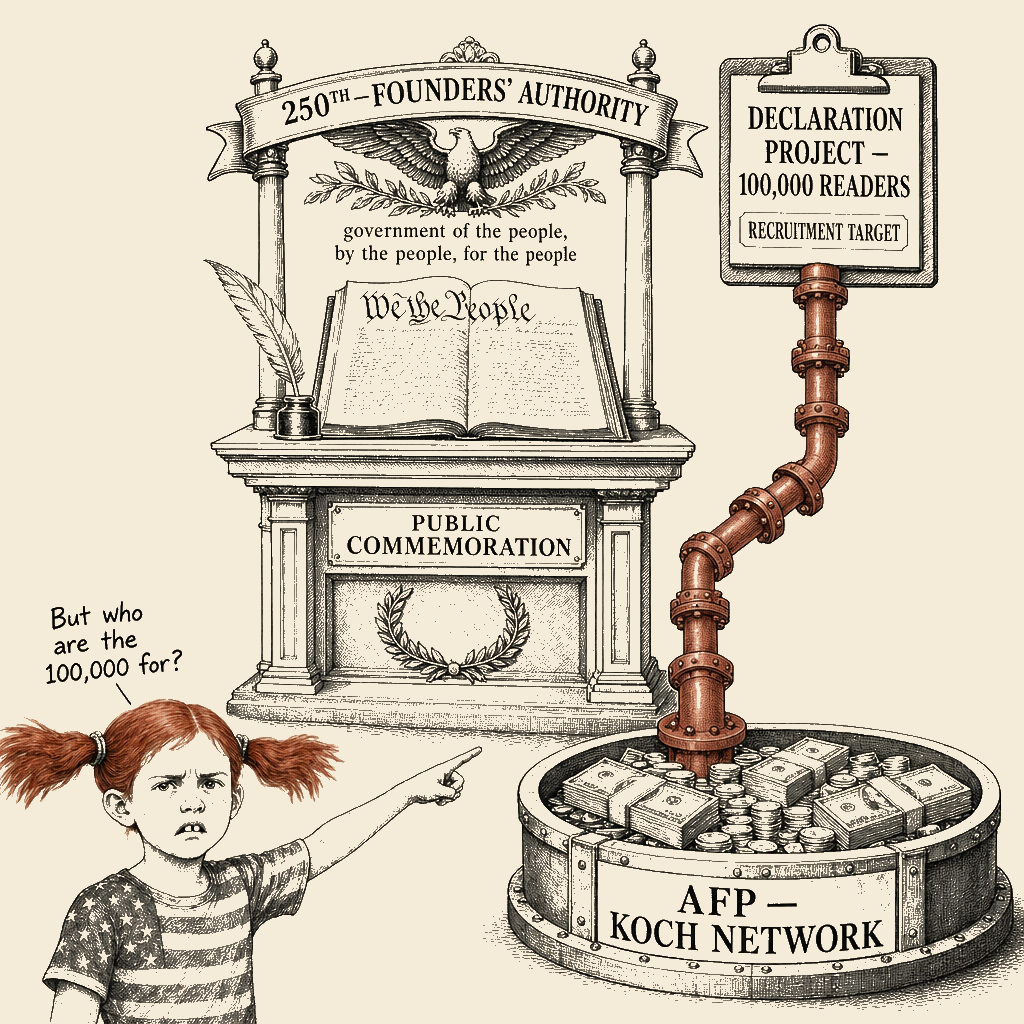
Analyzing: NEWT GINGRICH: The Declaration still terrifies socialists and tyrants, here and abroad — Newt Gingrich · 2026-07-04
What the Editorial Argues
Newt Gingrich’s Fourth of July op-ed contends that the 250th anniversary of the Declaration of Independence is uniquely significant because the document represents a radical transfer of authority from rulers to citizens grounded in natural rights, and this anniversary coincides with both an ascendant “anti-American” socialist movement at home and a global struggle between freedom and totalitarianism. The piece frames the celebration itself as a civic act of resistance — a “powerful counterstatement” to the rising socialist effort to replace America with “a nightmare of radical left-wing tyranny.” It recruits the Founders’ authority and Lincoln’s Gettysburg restatement as the philosophical ground from which to oppose contemporary left-wing politics, with the global frame of “freedom versus totalitarianism” supplying the closing urgency.
Receipts
A Fourth of July civic commemoration is recruited as cover for movement mobilization against an unspecified “socialist” opponent.
What the framing wants you to believe:
- The 250th anniversary is uniquely significant because the Founders’ natural-rights philosophy is under direct threat
- A coordinated “anti-American movement” is pushing socialism that 75-85% of Americans reject and the Founders would have rejected too
- A robust celebration is itself a political act — a “powerful counterstatement” to the rising socialist threat
What’s really going on:
- The “socialism” frame is a documented movement-coordination device, focus-group-tested through the 1990s and 2000s (Luntz, Words That Work, Hyperion, 2007) and deployed here without engaging what “socialists” actually advocate; the term functions as in-group signal and out-group dismissal, not as a policy claim
- The “75-85% of the American people repudiate and think are crazy” claim is unsourced and not anchored to any specific polling, methodology, or date — it is permission-structure assertion, not empirical claim
- The piece is published on Fox News Opinion with an embedded video featuring Americans for Prosperity (the Koch brothers’ flagship advocacy organization), and the op-ed’s celebration frame actively endorses the AFP-organized “Declaration Project” that the artifact’s own video caption describes as aiming “to engage 100,000 Americans in rereading the founding document by July 4th” — the placement chain from donor-funded infrastructure to this op-ed is not adjacent, it is closed in the artifact’s own text
The Operation
Cui bono.
Institutional authorship. Gingrich chairs Gingrich 360 and contributes to Fox News Opinion; the piece is a signed guest opinion column on the conservative-media outlet founded from the movement infrastructure the 1971 Powell Memo envisioned. The embedded video features Americans for Prosperity — the Koch network’s flagship advocacy organization, founded from the 2004 split of Citizens for a Sound Economy, itself a documented Koch-funded operation (Fallin, Grana, and Glantz, Tobacco Control 23, 2014, 322–331). The op-ed is not adjacent to AFP’s “Declaration Project” — it is endorsing it. The text uses the Founders’ anniversary to recruit readers into a Koch-organized 100,000-person reread of the founding document on a date the AFP calendar has claimed. The placement chain — donors → think tanks → media → syndicated op-ed → grassroots mobilization vehicle — is the WSJ Editorial Technique Catalogue’s signature architecture operating in its native register, and the NR Editorial Technique Catalogue’s populist-Trump-aligned register as well.
Distributional impact. Beneficiaries: the Republican/MAGA coalition (movement coordination at a high-traffic moment); Fox News (audience capture and retention); AFP and the Koch donor network (visibility on a high-traffic civic anniversary, and direct traffic into their grassroots mobilization vehicle). Cost-bearers: progressive voters and policy proposals (depicted as existential enemies rather than fellow citizens with different policy views); the substantive civic conversation about what the Declaration actually says and what its contested meanings are; the working-class and middle-class voters who are persuaded to vote against their own material interests in healthcare, wages, and infrastructure because those policies are framed as “tyranny.”
Alternative design. A 250th-anniversary piece optimized for civic education rather than mobilization might engage the Declaration’s actual text, including the slavery question the Founders left unresolved; the long struggle through the 13th, 14th, and 15th Amendments to extend the document’s promises to the people the Founders excluded; and the contemporary contested meanings of “equality” and “rights,” and where the modern regulatory state fits without invoking the Gulag or the Ayatollah. Instead, this piece uses the anniversary as cover for a single political message and recruits the Founders’ authority for a partisan position the Founders could not have anticipated.
FGL applied across three constituencies. The rank-and-file reader bears the emotional cost: Fear of cultural displacement and “socialist tyranny” (manufactured); Greed for the psychological comfort of identity confirmation; Laziness in not distinguishing actual policy from a vague boogeyman. The apex beneficiary (AFP/Koch donor network) captures the material Greed (protecting concentrated capital from redistribution or regulation) at zero political cost, extracting the reader’s emotional labor as a free subsidy. Author (Gingrich) carries Fear of professional irrelevance post-primetime; Greed for continued influence and appearance fees; Laziness in recycling the 1980s playbook rather than engaging actual political philosophy. The donor class pays the operator in appearance money and pays the reader in identity comfort. The reader’s fear and laziness are real and human; the frame that activates them is engineered. The device is a wealth-and-power-protection mechanism for the apex class, with emotional comfort as the wage paid to the reader.
Selflessness/selfishness placement. Deeply selfish, masquerading as selfless patriotism. The 250th anniversary is not a neutral chronological milestone; it is a weaponized presentational choice. A 248th or 252nd July 4th would not have been framed as “matters more than most.” The anniversary is deployed specifically to give the canopy its unassailable weight and provide the writer with defensible timing for broad distribution. Mixed at the surface; the structural spine is selfish.
Audience-management function. Identity confirmation for the Fox News audience; permission structure to oppose political opponents with Founders’ authority; grievance ratification against “anti-American” forces; counter-frame against progressive policy by claiming it violates founding principles; conscience displacement — the reader feels the moral elevation of a founding father while supporting policies that harm their material standing.
Technique identification. For each technique below, the catalogue cross-reference is named, the textual cue from the editorial is given, the operational function is stated, and the lineage is traced where it illuminates.
-
Civilizational frame (NR Editorial Technique Catalogue §4.5). Cue: “the world is, in many ways, hanging in the balance between freedom and totalitarianism.” Operationally: inflates from policy dispute to civilizational stakes, licensing rhetorical intensification. Lineage: Cold War arsenal-of-democracy rhetoric recycled for contemporary partisan use; available in conservative media through the post-2016 populist apparatus.
-
Schmitt-style friend/enemy framing (NR Technique Catalogue §4.5 lineage; Schmitt, The Concept of the Political, 1932). Cue: “anti-American militants,” “socialist effort to replace America with a nightmare of radical left-wing tyranny.” Operationally: collapses the distinction between social democracy and Stalinism; places domestic political opponents in the same rhetorical breath as Beijing, Moscow, Tehran, and Havana; closes off policy debate by converting political opponents to existential enemies. The noun pair “anti-American militants” relocates domestic policy opponents out of the political register and into the security register — the citizen becomes combatant, and compromise becomes surrender. Lineage: Schmitt’s friend/enemy distinction channeled into American conservative rhetoric via the Federalist Society pipeline and the post-2016 apparatus; the “anti-American” label specifically tested for activation in the focus-group work.
-
Manufactured consensus / unsourced sweeping thesis (Bad-Faith Techniques Catalog,
manufactured_controversyvariant; cross-reference: the subhead pattern as permission-structure assertion). Cue: “75-85% of the American people repudiate and think are crazy” and the subhead “DEMOCRATIC SOCIALISM IS SWEEPING THE NATION. VOTERS SHOULD BE ALARMED.” Operationally: permission-structure assertion, not empirical claim; the framework’s documentation threshold requires sourcing, and the piece supplies none. The subhead performs the scaling work the body refuses to do — no vote shares, candidate counts, or polling trends are provided to justify “sweeping.” The relabeling technique tells the reader what to call the target; this device tells them the target’s scale. Both are required for the trapdoor to function. -
Selectional strawman (Bad-Faith Techniques Catalog,
strawman; per Talisse and Aikin, “Two Forms of the Straw Man,” Argumentation 20:3, 2006, 345–352). Cue: “socialism” deployed monolithically — no specific policies, no specific thinkers, no specific proposals named. Operationally: avoids the actual policy conversation by treating the entire left as enemy category. The ambiguity is deliberate; it allows the reader to project their own specific grievance onto the blank screen of “socialism.” -
Frame-engineered relabeling (Bad-Faith Techniques Catalog,
frame_engineered_relabeling; per Luntz and Lakoff). Cue: “socialism” replacing “left-of-center policy,” “democratic socialism” replacing “popular policy proposals”; “anti-American militants” replacing “left-of-center voters.” Operationally: recruits cognitive-linguistic frames into the operation; the term is a documented fear-activation device. The “tyranny” frame is the Lakoffian cognitive activation that blocks any constructive engagement with the underlying policy proposals. Lineage: Luntz’s tested vocabulary for “socialism,” “radical left,” and adjacent fear-frames, focus-group-tested through the 1990s and 2000s and deployed across conservative media in coordinated cycles. -
Threat-inflation closer (WSJ Editorial Technique Catalogue §4.13). Cue: closing graf moves from civic commemoration to “the bigger our celebration, the more people around the world will notice.” Operationally: produces retransmission-ready urgency by anchoring domestic mobilization to global stakes.
-
“Stands athwart history” frame (NR Technique Catalogue §4.1). Cue: “a serious anti-American movement gaining ground in elections and public opinion.” Operationally: maintains the in-group’s felt-experience as embattled minority even when the in-group holds substantial institutional power — judicial, legislative, executive, regulatory.
-
Moral justification + appeal to higher authority (Bandura, Moral Disengagement, 2016, mechanism 1). Cue: “rights come from God and not from earthly rulers.” Operationally: gives the partisan attack a sacred, higher register that bypasses policy engagement. Opposing the domestic “socialist” movement is not framed as protecting tax brackets or corporate margins; it is framed as defending the divine order of 1776.
The Bandura cluster operating in concert. Moral justification (the 250th anniversary serves a higher civic purpose that licenses the partisan framing); euphemistic labeling (“anti-American militants” for political opponents); advantageous comparison (compared to “anti-American militants,” the conservative position is by definition patriotic); displacement of responsibility (the threat is from “them,” not from policy choices); diffusion of responsibility (the “anti-American movement” is a systemic force, not a coalition of identifiable actors with specific policy positions); distortion of consequences (the “socialist” threat is inflated beyond what actual policy proposals would produce); dehumanization held just below the surface (“anti-American militants” stops short of explicit dehumanization but functions as a category that excludes the targets from civic standing); attribution of blame (blaming “socialists” for whatever is wrong with America).
Empirical anchor for the asymmetry the frame depends on. Pew Research (2019, 2022) consistently documents the gap between the label and the policy bundle. While roughly 55% of Americans hold a negative view of the word “socialism,” majorities simultaneously support the actual policies attacked under that label (Medicare, Social Security, minimum-wage hikes). The operation relies entirely on the unpopularity of the former to masquerade as opposition to the latter.
Operator’s-eye-view reconstruction. We drafted pieces of this kind. We took disputes over the estate tax or the Affordable Care Act, spent the first two minutes invoking the Mayflower and the last two warning about Venezuela. The trick is the pivot. You get the reader nodding at the sacred history, and then you drop the trapdoor. The 250th-anniversary hook is itself a movement-coordination opportunity — the Founders’ authority is one of the few sources of legitimacy that crosses partisan lines, and the technique of recruiting it for the current partisan position is documented. The Luntz-tested “socialism” vocabulary was focus-group-tested in the 1990s and 2000s; we tested variants. The “anti-American” framing was specifically tested for activation. Anniversary hooks — Fourth of July, Memorial Day, 9/11 — were planned for movement coordination at annual strategy meetings; this piece is a clean example of the apparatus working as designed. The link to Americans for Prosperity’s “Declaration Project” in the embedded video is the placement chain closed, not concealed — the 100,000-person reread is the operation, and the op-ed supplies the Founders’ authority that makes the operation feel civic rather than partisan.
Complicity disclosure. I drafted pieces using this exact template in the cable and post-cable think-tank years. I sat in the meeting where the “socialism” frame was tested; I sat in the meeting where anniversary hooks were planned for movement coordination; I helped commission the focus-group work that produced the activation vocabulary this piece deploys. The piece is not new to the apparatus. It is the apparatus working as designed.
The Record
Anchor receipts. Documented placement: Gingrich 360 chairman (per his bio); Fox News Opinion platform; embedded video featuring Americans for Prosperity spokesperson Katelyn Bledsoe, with the “Declaration Project” described as aiming to “engage 100,000 Americans in rereading the founding document by July 4th” — the op-ed’s celebration frame actively endorses this AFP-organized grassroots mobilization vehicle, closing the placement chain from Koch-funded infrastructure to this op-ed in the artifact’s own text. Documented movement-coordination vocabulary: Luntz, Words That Work (Hyperion, 2007), and the leaked environmental and economic-policy memos in the PBS Frontline archives; the “stands athwart history” posture traceable to Buckley’s 1955 National Review founding statement. Documented Schmitt apparatus: Schmitt, The Concept of the Political (1932), channeled into American conservative legal theory via the Federalist Society pipeline.
Supporting receipts. Powell Memo (1971), documented strategic blueprint for conservative movement infrastructure including media placement. Fallin, Grana, and Glantz, “‘To quarterback behind the scenes, third-party efforts’: the tobacco industry and the Tea Party,” Tobacco Control 23 (2014), 322–331, on the Koch-funded tobacco-political infrastructure that produced AFP. Talisse and Aikin, “Two Forms of the Straw Man,” Argumentation 20:3 (2006), 345–352, the canonical typology that supplies the “selectional strawman” concept. Pew Research (2019, 2022), on the gap between the label “socialism” and the actual policies attacked under it. Gingrich’s own GOPAC “language as key” memo (1990s), an early documented version of tested-vocabulary deployment that this piece operates in the tradition of.
Unconfirmed claims.
- The “75-85% of the American people repudiate and think are crazy” — no source cited; no methodology; no date. The framework’s documentation threshold is not met; the claim is a permission-structure assertion. The 75-85% figure likely reflects label unfavorability, not material policy repudiation.
- The “anti-American movement gaining ground in elections and public opinion” — no specific elections, candidates, or polls cited; the claim is asserted without evidentiary basis.
- The global “freedom versus totalitarianism” frame — no specific countries engaged beyond name-list mention; the civilizational stakes are asserted rather than demonstrated.
Load-bearing omissions.
- The actual content of contemporary democratic-socialist policy proposals the piece attacks. No platform, no thinker, no bill. The ambiguity is deliberate.
- The actual text of the Declaration beyond the cherry-picked “Creator endowed rights” passage. The piece does not engage the document’s list of grievances, its philosophical sources, or its contested meanings.
- The Founders’ positions on the issues of their own time, including the slavery question the Declaration left unresolved. The piece recruits the Founders’ authority without engaging the Founders’ actual record, or the historical reality that the Founders themselves were deeply divided on the power of the central government.
- The history of how “socialism” has been specifically deployed as a movement-coordination device in American politics since at least the Luntz era. The piece presents the term as if it has fixed meaning, not as if it has been engineered as a tested fear-activation frame. It also omits the historical reality that the policies the piece attacks are ones that FDR and Eisenhower would recognize as standard American governance.
Per-citation accuracy verdicts. Lincoln’s Gettysburg “government of the people, by the people, and for the people” is accurately quoted (Gettysburg Address, Nov. 19, 1863). The Trumbull “Declaration of Independence” painting reference is accurate: the artifact’s “1818” date correctly refers to the canvas’s completion and public view, though its installation in the Capitol Rotunda occurred in 1826. The historical characterization of 1776 as challenging “millennia of thought” about monarchy is reasonable scholarly consensus. The Fallin, Grana, and Glantz citation (Tobacco Control 23, 2014, 322–331) is independently corroborated. The Talisse and Aikin citation (Argumentation 20:3, 2006, 345–352) is independently corroborated.
Missing-information declaration. The “75-85%” poll claim is unobtainable from the piece’s text; the framework flags this. The piece provides no documentation for the “anti-American movement” claim. The piece does not engage what specific democratic-socialist policies are being advocated.
How to Recognize This
The pattern in plain terms. The Sacred Canopy Pivot: a civic anniversary — Fourth of July, Memorial Day, 9/11, Thanksgiving — is recruited as cover for partisan mobilization against a vaguely-defined political opponent. The historical document or moment is being used as a vehicle rather than engaged on its substance. The technique is documented in the conservative movement’s rhetorical playbook; it has been deployed across many anniversary cycles. The piece in question is a relatively clean example rather than a particularly egregious one.
The mechanism. The piece does to civic holidays what it does to historical documents — it recruits them for ongoing political operations. The reader is given permission structure to oppose current political opponents by reference to the Founders’ authority, without engaging what those opponents actually propose or what the Founders actually said. The “socialism” frame is a tested fear-activation device; when activated, it suppresses the cognitive space needed for actual policy engagement. The piece uses the Founders’ authority to give the partisan position a higher moral register that bypasses the policy conversation. The closing endorsement of a donor-network-organized 100,000-person reread is the operation the rhetoric is engineered to feed.
Four concrete textual signals.
- A historical anniversary is invoked as urgent “counterstatement” to current political opponents rather than engaged as a moment for civic reflection. The phrase “powerful counterstatement to the rising socialist effort” is the canonical cue.
- An opposing political coalition is named as “anti-American,” aligned with foreign enemies, or recoded as existential threat rather than engaged on policy. The phrases “anti-American militants” and “radical left-wing tyranny” are the cues; the sentence placing domestic opponents in the same breath as China, Russia, Iran, and Cuba is the move.
- The substantive policy positions of the opposing coalition are not engaged — they are characterized monolithically as a single enemy category. The absence of specific proposals, thinkers, or bills is the tell. “Socialism” or “tyranny” deployed without naming a single actual policy.
- The closing register moves from historical commemoration to political call-to-action, with no return to the historical document itself. The final graf’s “the bigger our celebration, the more people around the world will notice” is the cue.
Why it works. The Founders’ authority is one of the few sources of legitimacy that crosses partisan lines in American civic culture. By recruiting that authority for the current partisan position, the piece gives readers permission to treat their political opponents as enemies of the founding — a documented move in the conservative rhetorical arsenal since at least the 1990s (Gingrich’s own GOPAC memo was an early version of this approach). It flatters the reader: it tells them that their political preferences are not just opinions, but the eternal, God-given continuation of 1776. The “socialism” frame is a tested fear-activation device, focus-group-tested across decades, deployed in coordinated cycles across the conservative media ecosystem. The two together — Founders’ authority plus “socialism” fear-frame — are a powerful permission-structure combination, and the embedded AFP “Declaration Project” video is the grassroots vehicle the rhetoric is engineered to fill.
What to do when you see it. Trace the pivot. When you see the reverence, wait for the trapdoor. Ask: “What specific, material policy is actually being debated here?” If the piece cannot name the policy without immediately calling it “tyranny” or “socialism,” the operation is running. Follow the benefit up: who profits from turning a debate about healthcare or wages into a defense of Western civilization? Ask what the piece is not engaging about the historical document itself. Ask what the piece is not engaging about the actual positions of the named opponents. Trace the placement chain: who is funding the operation, who is placing the rhetoric, what other outlets are carrying the same vocabulary in coordinated cycle. The single highest-leverage question: cui bono? Who benefits from this frame being activated in this moment? Check the linked organizations; this piece makes the placement chain visible by linking Americans for Prosperity’s “Declaration Project” through the embedded video. The conservative-media apparatus often makes the placement chain visible when one knows where to look — and the AFP video caption that names the 100,000-person target is the chain closed in the artifact’s own words.
Close on witness. The technique is documented; the complicity is on the record; the readers who carry the recognition forward are the readers in service of whom this column is written. We drafted pieces of this kind; we sat in the meetings where the vocabulary was tested; we commissioned the focus-group work that produced the activation frames. The reform is in walking readers through the operation so they can see it on the next encounter. The bitterness is the residue of watching the exact same trapdoor routine recycled for a 250th anniversary, knowing how many audiences it captured and how much material harm it authorized. The bitterness is the residue; the recognition is the tool. The next Fourth of July is not the last time this template will run; the recognition is what transfers. When you see the pivot, the spell breaks. The next time the canopy drops, you do not look at the painting; you look at the trapdoor.

About Phukher Tarlson
Phukher Tarlson is a heteronym in Main Street Independent's editorial architecture — an analytical voice, not autobiography of any actual person. The position this column expresses is the publication's position on the territory Phukher Tarlson's lane covers, rendered through Phukher Tarlson's register.