Analyzing: What the Founders Didn’t Trust — Barton Swaim · 2026-07-01
What the Editorial Argues
Barton Swaim,writing in the July 2, 2026 print edition of the Wall Street Journal, argues that the American Founders designed the Constitution on the doctrine of original sin, and that roughly the past 125 years of American government—from the Wilsonian Progressives through the New Deal and the Great Society to contemporary left politics—have departed from this “anthropology” in favor of a “postreligious belief in humanity’s essential goodness.” He traces this departure from Franklin Roosevelt’s “first Inaugural” through contemporary left politics, contrasts the Founders’ humility about human nature with what he presents as the modern left’s tendency to attribute evil to political opponents, and closes by celebrating the Supreme Court’s recent overturning of Humphrey’s Executor v. U.S. (1935)—which had insulated the Federal Trade Commission from at-will presidential removal—as a return to the Founders’ constitutional wisdom. The piece also takes a swipe at the modern conservative embrace of industrial policy, which Swaim argues ignores the Founders’ deep distrust of concentrated human power.
Receipts
Swaim recasts a Christian theological doctrine as a constitutional-design principle and uses it to ground a 2026 argument for the dismantling of the independent federal agency.
What the framing wants you to believe
- The administrative state and the welfare state are the products of a postreligious, naïve belief in human goodness that the Founders would have recognized as foolish.
- The Founders’ reliance on “original sin” was a purely moral and philosophical insight, untainted by the material interests of the property-owning class.
- Dismantling independent regulatory agencies is a moral imperative necessary to “recover a saner, less embittered politics.”
What’s really going on
- The piece provides a theological and moral permission structure for the classic conservative project of corporate deregulation. By framing the regulatory state as a theological error (a denial of “fallenness”), it shields the apex beneficiaries—regulated monopolies and concentrated capital—from the moral scrutiny that originally necessitated the agencies.
- The load-bearing omission: the administrative state was not built by progressives who “forgot” original sin; it was built precisely because of the documented depravity, greed, and violence of unregulated industrial and financial capital in the nineteenth and early twentieth centuries. The Founders’ actual constitutional arguments—Madison in Federalist 10 on the management of faction, the Convention debates over property and slavery, the Federalist 39 articulation of the mixed republic—were animated primarily by protection of property interests, management of factional conflict, and accommodation of the slaveholding interest, not by a theological doctrine of fallenness (see Charles Beard, An Economic Interpretation of the Constitution of the United States, 1913; Madison, Notes of Debates in the Federal Convention of 1787).
- The Founders-as-original-sin frame is a twentieth-century intellectual project—most directly associated with Catholic natural-law scholarship (Russell Hittinger) and the Straussian political-theology tradition (Michael Zuckert, Thomas Pangle), and packaged for a broader conservative audience by the 2010s–2020s postliberal/national conservative movement (Patrick Deneen, Adrian Vermeule, American Mind, Compact)—being deployed in 2026 to give a theologically grounded warrant to a particular theory of the administrative state. And the original-sin doctrine in classical Christian theology is about the corruption of human nature through Adam’s fall and the consequent need for grace and salvation through Christ—not about constitutional design.
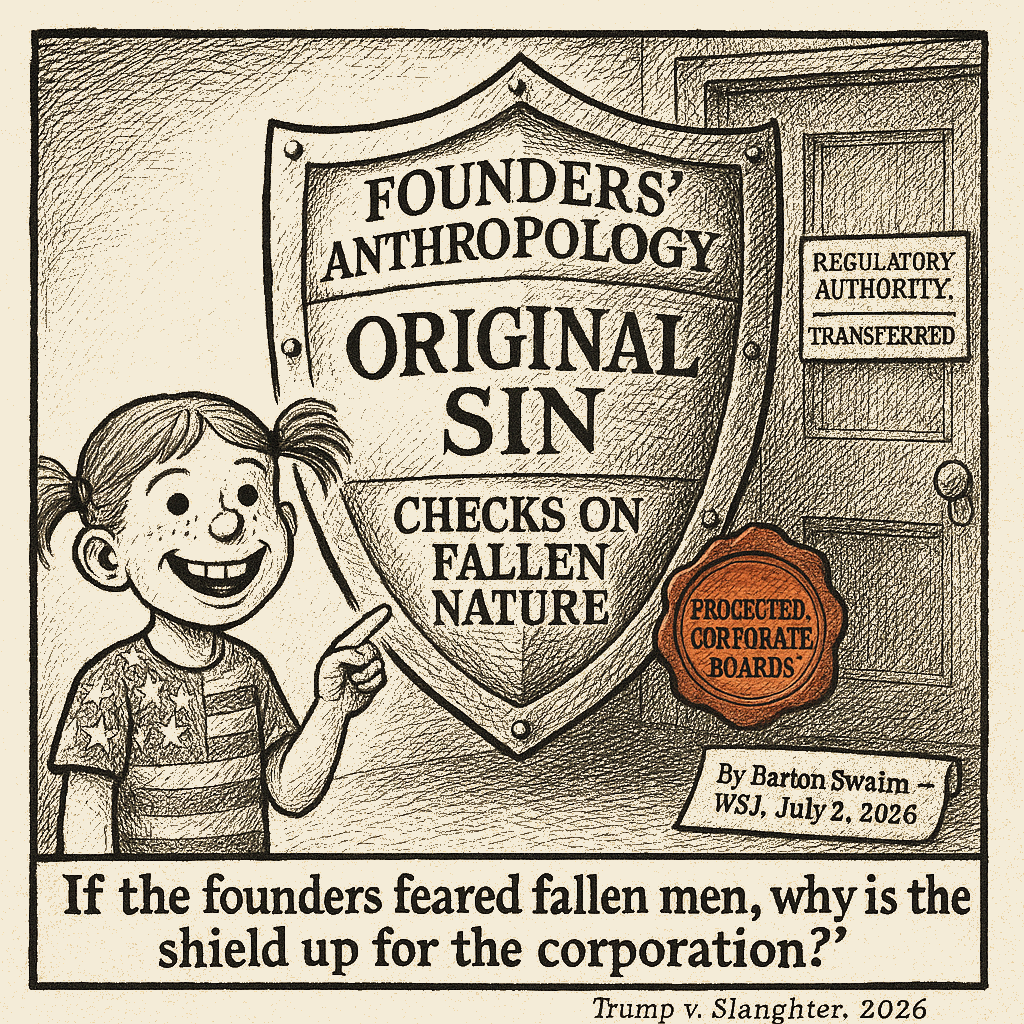
- Anchor: The rhetorical elevation of the Supreme Court’s administrative-state jurisprudence as a moral correction, masking its function as a direct transfer of regulatory authority from public agencies to private corporate boards. The Founders’ “anthropology” did not extend to enslaved Africans, women, or Indigenous peoples; the Three-Fifths Compromise, the fugitive slave clause, the 1808 slave-trade clause, and the limited franchise all show that the constitutional design operated on a hierarchical anthropology rather than on universal original sin.
The Operation
Cui bono. The piece sits inside the postliberal/national conservative intellectual infrastructure that consolidated in the 2010s and 2020s around figures like Patrick Deneen (Notre Dame), Adrian Vermeule (Harvard Law), Gladden Pappin, and the journals American Mind and Compact. The intellectual project has been funded by foundations including the Earhart Foundation, the Sarah Scaife Foundation, and the Lynde and Harry Bradley Foundation. Legal infrastructure: the Federalist Society, the Claremont Institute, the Hauenstein Center at Grand Valley State, the Center for the Constitution at the Catholic University of America. Publication platform: the Wall Street Journal editorial page.
Beneficiaries: the postliberal movement’s intellectual project; the legal movement seeking to dismantle the independent federal agency (the Humphrey’s Executor line of cases); conservative religious intellectuals seeking to ground political claims in theological authority; the WSJ’s continued positioning as a “thought-leader” outlet. Cost-bearers: the populations served by the administrative state—workers, consumers, civil-rights plaintiffs, environmental-enforcement beneficiaries, welfare-state recipients, ordinary Americans whose relationship to the Founders is mediated through this frame rather than through the actual historical record. Dollar magnitudes are not directly recoverable for a frame-piece, but the downstream policy consequences of dismantling the independent agency are large across consumer-finance, environmental, labor, and civil-rights enforcement.
Alternative design. Look at it from the bottom up—the enslaved, the dispossessed, the Indigenous, the white men without property who were excluded from the original franchise—and the “original sin” frame evaporates. The Constitution was not a theological check on human depravity; it was a property-protection arrangement for propertied white men who knew exactly what they were doing. A constitutional argument optimized for its stated rationale (recovering the Founders’ actual vision) would engage the Three-Fifths Compromise, the fugitive slave clause, the property-protective function of the constitutional design, the limited franchise, the actual religious views of Madison, Washington, Jefferson, and Hamilton (most of them heterodox Christians or deists, not orthodox original-sin theologians), and the role of original-sin doctrine in early America primarily as a warrant for hierarchical social arrangements rather than for constitutional checks and balances. The Founders-as-original-sin frame, deployed as it is here, sells a theological warrant for a 2026 political project that the theology itself, properly engaged, would not endorse. If the goal were truly to check the “passions of men” and “rank self-interest,” the alternative design would be robust anti-monopoly enforcement, strict corporate criminal liability, and worker organizing. Swaim’s preferred design—stripping power from public agencies and concentrating it in the unitary executive or private actors—merely shifts the locus of “fallen” power from the bureaucrat to the corporate CEO.
FGL. Fear (of the postreligious left, of the administrative state, of the “subhuman spreaders of evil” who hold the wrong political views), greed (for the restoration of authority to the right kind of elites), and laziness (the Founders’ frame is the easy wisdom; the Progressive tradition’s actual intellectual achievements do not need to be engaged). Applied symmetrically across constituencies: not applied. The Founders’ actual record is unexamined; the modern left’s actual record is reduced to caricature (“hypothesized that recipients would use the dole as a chance to get ahead rather than a way to avoid productivity”). Symmetric FGL would require the piece to ask whether the postliberal/national conservative project—which the piece actually criticizes by name for placing “more faith in human nature than the Founders did”—is itself operating on a “postreligious belief in humanity’s essential goodness” when it places its faith in the unitary executive theory, the dismantling of the independent agency, and the use of state power for conservative ends. The piece does not ask.
Selflessness/selfishness placement: mixed-to-selfish. The piece is presented as the recovery of constitutional truth, but the truth recovered serves a specific 2026 political project, and the frame’s authority is borrowed from theological sources whose actual content (Christian soteriology; the doctrine of grace; the sacraments; the ecclesial context in which original sin has its meaning) the piece does not engage.
Technique identification.
Frame-engineered relabeling (Bad-Faith Techniques Catalog: frame_engineered_relabeling; Luntz, Words That Work, 2007; Lakoff, Don’t Think of an Elephant!, 2004). “Original sin” is relabeled as “the Founders’ anthropology” and “the old understanding of man as inherently flawed.” The substitution moves a Christian theological doctrine—with its Trinitarian, sacramental, and ecclesial contexts—into a political-anthropological register. Cue: “the doctrine of original sin—and its implication that humans tend toward rank self-interest and degeneracy—animated every part of the constitutional structure the Founders erected.” Dismantling the EPA or SEC is not framed as protecting polluters or fraudsters; it is framed as “recovering the Founding Fathers’ anthropology.”
The austerity-thrift archetype (WSJ Editorial Technique Catalogue §4.2; Albert Bandura, Moral Disengagement, 2016, mechanisms 1, 2, and 8 in concert). Cue: “The expansion of social-welfare programs, begun by the New Deal and supercharged by the Great Society, hypothesized that recipients would use the dole as a chance to get ahead rather than a way to avoid productivity.” A one-sentence version of the welfare-recipients-are-lazy frame, dressed in original-sin vocabulary. The Bandura mechanisms of moral justification (the policy serves the higher cause of self-sufficiency), euphemistic labeling (“dole” rather than “Social Security benefits” or “unemployment insurance” or “disability benefits”), and attribution of blame (recipients will avoid productivity) operate together. The permission structure is the one the WSJ board has run on welfare cuts for decades: the suffering is reframed as character-building, and the reader who benefits from the policy gets to feel virtuous while the cost-bearer is held responsible for the cost.
Strawman (Bad-Faith Techniques Catalog: strawman; pragma-dialectics standpoint rule; Robert Talisse and Scott Aikin, “Two Forms of the Straw Man,” Argumentation 20:3, 2006). The Wilsonian Progressive, New Deal, Great Society, and contemporary left traditions are collapsed into a single “postreligious belief in humanity’s essential goodness” project. Cue: “Roughly the past 125 years of American government have departed from the Founders’ self-understanding.” The actual intellectual traditions (John Dewey, Human Nature and Conduct, 1922; the New Liberals; John Rawls, A Theory of Justice, 1971; the capabilities approach; the New Deal legal mind of Felix Frankfurter, Benjamin Cardozo, Thurman Arnold) had sophisticated accounts of human limitation that the piece does not engage. The strawman of progressive motives—the New Deal and Great Society as operating on the hypothesis that humans are “essentially good”—ignores the actual historical record that the New Deal was a pragmatic response to the actual depravity of market failures and starvation.
The civilizational frame (NR Editorial Technique Catalogue §4.5; manufactured controversy per Oreskes and Conway, Merchants of Doubt, 2010). The French Revolution vs. the American Revolution, Rousseau vs. the Founders, Marx vs. the Founders, the contemporary “descendants” of the Marxist view vs. the Founders’ heirs. The sweep presents contemporary political disputes as civilizational battles between original-sin and perfectibility anthropologies. Cue: “The French, under the spell of Jean-Jacques Rousseau, built their revolution on his theory that man comes into the world pure and only encounters moral defilement from ‘society.’ The triumph of the American Founders lies in their having done the opposite.” The piece’s own phrasing—“The postreligious belief in humanity’s essential goodness… has encouraged political actors across the West to treat their opponents as subhuman spreaders of evil”—elevates a dispute over administrative law to a cosmic battle over the nature of man, licensing the rhetorical intensification required to support the Court’s aggressive dismantling of a century of governance.
The “common sense” rhetorical pivot (WSJ Catalogue §4.10). Cue: “Reject the doctrine of man’s depravity if you like; the world’s abundance of depravity still demands explanation.” The argument positions itself as plain observation; rejecting it is positioned as quaint. The “quaint word!” parenthetical carries the full weight of the maneuver: the doctrine is dismissed by the dismissal of the word, and the doctrine’s actual content is never engaged.
Bandura’s attribution of blame (Bad-Faith Techniques Catalog: attribution_of_blame; Bandura, Moral Disengagement, 2016, mechanism 8). Modern Progressives and their “descendants today” are framed as the authors of the world’s ills through their rejection of original sin. Cue: “Their descendants today, similarly bereft of any conception of fallenness, pin the world’s ills on people who hold the wrong political views.”
Displacement of responsibility (Bad-Faith Techniques Catalog: displacement_of_responsibility). Swaim blames the administrative state’s flaws on a “postreligious belief in humanity’s essential goodness,” thereby displacing the causal agency of regulatory capture and corporate lobbying. He frames the “expert-led federal agencies” as the product of naïve theology rather than the victims of systematic defunding by the very industries they regulate. The agencies did not become corrupt because people “forgot sin”; they were captured because concentrated money demands it.
The threat-inflation closer (WSJ Catalogue §4.13). Cue: “To recover a saner, less embittered politics may be as simple, and as difficult, as recovering the Founding Fathers’ anthropology.” Civilizational stakes from a Founding-era argument; the closing line is engineered for retransmission.
The “as a [identity]” credibility move (WSJ Catalogue §4.18). The Founders serve as the credentialing identity. The argument gains authority not from evidence but from identification with the Founders’ “anthropology,” treated as self-evidently authoritative because the Founders made the Constitution.
Manufactured controversy (Bad-Faith Techniques Catalog: manufactured_controversy; Oreskes and Conway, Merchants of Doubt, 2010). The “is the Constitution based on original sin or perfectibility?” framing presents a manufactured dichotomy as the live debate. The actual historiography on the Founders’ religious views is far more contested than the piece acknowledges (see John Fea, The Bible Cause; Thomas Kidd, God of Liberty; the long-running Catholic-orthodoxy-vs-secular-Founders debate).
Equivocation (Bad-Faith Techniques Catalog: equivocation; Aristotle, Sophistical Refutations; Douglas Walton, Equivocation). “Depravity” shifts from a theological category about concupiscence to a political-epistemic charge against anyone who holds “the wrong political views.” The shift is unannounced.
The closing-line cadence (WSJ Catalogue §3.5). “To recover a saner, less embittered politics may be as simple, and as difficult, as recovering the Founding Fathers’ anthropology.” The chiasmus is the engineering: engineered to lodge in the scanner’s memory and to be liftable for social-media retransmission.
Lineage trace. The original-sin-as-constitutional-design argument traces to twentieth-century Catholic natural-law scholarship, particularly the work of Russell Hittinger on the Founders and natural law, and to the Straussian political-theology tradition (Michael Zuckert, Thomas Pangle) on the Founders’ “machiavellian” and “classical liberal” readings. The 2010s–2020s packaging for a broader conservative audience was done by Patrick Deneen (Why Liberalism Failed, 2018; Regime Change, 2023) and the postliberal/national conservative journals (American Mind, Compact). The legal articulation is in Adrian Vermeule, Common Good Constitutionalism (2020). The administrative-state-destruction argument traces to the Federalist Society’s structural critique of the administrative state, the Unitary Executive theory (Steven Calabresi and others), and the Chevron deference critique. The original-sin-as-political-foundation has a deeper lineage to Reinhold Niebuhr’s Christian realism and the Niebuhrian political theology that influenced Cold War anti-communism—but the specific 2020s deployment is post-Cold War, and the lineage is being re-purposed for a project the original Niebuhrians would not necessarily have endorsed.
Operator’s-eye-view. We operators drafted memos like this. The 2003–2007 foundation-fellowship years at the liberty-frame think tanks were when the “original sin = limited government” message-discipline was drilled, when the focus-group instruments tested which register of religious language moved which audience segment, and when the Founders-as-Christian-original-sin frame was developed for a secular-right audience that would not have accepted the frame on theological grounds alone. The piece before you is the result of that work, repackaged for a 2026 platform. The WSJ editorial page did not arrive at the original-sin-as-constitutional-argument frame by reading the Federalist Papers carefully; it arrived there by reading its own prior commitments forward. The focus-group debriefs were clear: the reader who believes they are defending Western civilization will vote to defund the SEC, and they will do it with a sense of profound moral rectitude.
We drafted versions of the Founders-as-original-sin frame in the 2000s, when the message-discipline was being tested. The frame was good copy then and it is good copy now. The reader who absorbs it does not need to know the original-sin doctrine’s actual content to use the frame; the frame works precisely because the doctrinal content can be left unspecified while the political conclusion rides on top of it.
Audience-management function. Permission structure: the reader is given a theologically grounded warrant for limited-government positions. Identity confirmation: the reader is situated in the Founders’ lineage, against the postreligious left. Grievance ratification: the closing line tells the reader that the reader’s opponents are the real dehumanizers. Status display: the erudition (Paul Johnson, the Federalist Papers, Rousseau, the French Revolution) signals serious intellectual engagement. Counter-frame: the piece provides a unified civilizational narrative against liberal/progressive positions. It flatters the reader. It tells the culturally conservative reader that their support for corporate deregulation is not a betrayal of their material interests, but a mark of their deep moral and historical sophistication. They are not voting for Wall Street; they are voting with James Madison and St. Augustine.
I am bitter about this operation because it takes a genuine, lived moral framework—the real recognition of human flaw—and weaponizes it against the people who suffer most when the guardrails come down. The bitterness is the residue of watching that weaponization work. The rightness is in the historical record of the Gilded Age.
The Record
Anchor receipts. Federalist Papers Nos. 15 and 51 are quoted accurately; the Hamilton passage on the “passions of men” and the Madison passage on the angels are well-known and consistent with a view of human limitation. Paul Johnson, A History of the American People (1997), is quoted accurately, but is a popular synthesis rather than a primary source; the “Enlightenment made flesh” passage is Johnson’s flourish, not a contemporary Founders’ self-description. Charles Beard, An Economic Interpretation of the Constitution of the United States (1913), is the canonical work on the property-protective function of the Constitution; it is not engaged by the piece. Madison’s Notes of Debates in the Federal Convention of 1787 is the primary source for the Convention; it is not engaged. The Founders’ actual religious views—heterodox Christianity or deism for Madison and Jefferson; conventional Anglicanism for Hamilton; disputed for Washington—are not engaged. Madison in Federalist 10 explicitly links the “passions of men” to the formation of factions, which he defines primarily by their economic interests (creditors and debtors, landed interest, manufacturing interest). The constitutional checks were designed to manage economic factions, not merely to provide a theological backdrop for libertarianism.
Supporting receipts. Russell Hittinger’s work on the Founders and natural law; the Straussian political-theology tradition (Zuckert, Pangle) on the Founders’ classical-liberal and machiavellian readings; Patrick Deneen, Why Liberalism Failed (2018) and Regime Change (2023); Adrian Vermeule, Common Good Constitutionalism (2020); the American Mind and Compact journal archives; the Federalist Society, the Claremont Institute, the Earhart Foundation, the Sarah Scaife Foundation, and the Lynde and Harry Bradley Foundation as institutional infrastructure. The Three-Fifths Compromise (Article I, Section 2), the fugitive slave clause (Article IV, Section 2), and the 1808 slave-trade clause (Article I, Section 9) as the constitutional text’s actual record on the Founders’ “anthropology.” Madison, Washington, and Jefferson as slaveholders. Mark Noll, God and Race in American Politics, on the use of original-sin doctrine in early America as a warrant for hierarchical social arrangements. The historical record of the Progressive Era and the New Deal: the administrative state was created in direct response to the documented depravity of the Gilded Age—child labor, sixteen-hour workdays, unsanitary meatpacking, predatory railroad monopolies, and the Panic of 1907. The New Deal’s Social Security Act, the National Labor Relations Act, the Securities Exchange Act, and the GI Bill; the Great Society’s Medicare, Medicaid, the Civil Rights Act, the Voting Rights Act, Head Start, and food stamps. The postliberal movement’s actual alignment with the Trump administration’s administrative-state-rebuilding efforts (Project 2025, Schedule F, the Department of Government Efficiency), which the original-sin frame would presumably view as “faith in human nature” if applied symmetrically.
The 2026 Humphrey’s overturn. The editorial’s closing reference to the Supreme Court’s overturning of Humphrey’s Executor v. United States (1935) corresponds to Trump v. Slaughter, decided June 29, 2026, by a six–three majority, which restored the President’s at-will removal authority over multi-member independent agency commissioners. The case is the load-bearing example in Swaim’s closing gesture: the Court “signaled its sympathy with the Founders’ distrust of human nature” by overturning a 1935 precedent that, in Swaim’s framing, embodied the postreligious faith in insulated technocracy. Swaim names the result; he does not engage the doctrinal reasoning (the majority’s textualist reading of Article II’s “Officers of the United States” and the Vesting Clause), does not name the case caption, and does not acknowledge the six–three split. The case functions in the piece as proof of the Founders’ vindication, not as a doctrinal engagement with administrative law.
Per-citation accuracy verdicts. The Federalist Papers quotations are accurate and in context. The Paul Johnson quotation is accurate but is from a popular synthesis rather than a primary source. The Humphrey’s Executor citation accurately identifies the 1935 case and tracks to the 2026 overruling in Trump v. Slaughter; the piece does not engage the actual reasoning of the case or its status in administrative-law doctrine, and the use of the case as synecdoche for the entire independent-agency tradition is the piece’s own move. The piece does not engage the actual reasoning of the New Deal, Great Society, or contemporary progressive legal thought; the “human nature can be repaired” framing is not a position that the relevant intellectual traditions actually hold, and the piece does not cite a single Progressive, New Dealer, Great Society architect, or contemporary progressive intellectual as the source for the alleged position.
Missing-information declaration. The piece’s claim that the Founders’ “self-understanding” was original-sin anthropology is not supportable from the primary documents; it is a twentieth-century reading projected backward onto a heterogeneous group. The piece’s claim that the Founders would have viewed twentieth- and twenty-first-century politics as “gambles that human nature might suddenly repair itself” is a counterfactual that cannot be verified; the Founders as a group did not have a unified view of the twentieth- and twenty-first-century political questions the piece is engaging. The suppressed variable: Swaim isolates the true variable (humans are flawed) and suppresses the invalidating variable (capital is also flawed and requires checking). He extrapolates to the categorical claim that the state must be dismantled, ignoring that the state’s regulatory apparatus was built specifically to check the depravity of the market. He completely omits that the “technocratic managers” of the administrative state are the modern embodiment of the constitutional check on concentrated private power—framing “original sin” as a reason to distrust government while ignoring that the Founders’ framework was equally designed to distrust concentrated private capital through the anti-trust tradition.
Symmetric-application note. Not applicable: this is a liberty-frame operation, not a greater-good-paramount operation; the operator’s-eye-view applies fully.
How to Recognize This
The pattern. A theological-to-material pipeline. When an op-ed uses a high-minded philosophical, theological, or historical frame to argue for a specific, material policy outcome that benefits a concentrated economic interest. A theological doctrine (or, more broadly, a sacred authority) is borrowed from its home context and redeployed as a warrant for a contemporary political project. The doctrinal content is left unspecified; the political conclusion rides on top of it. The reader’s existing political preferences are given a “deep” grounding that the reader does not need to examine because the borrowed authority carries the weight.
The mechanism. It works because it bypasses the reader’s material self-interest and economic skepticism by engaging their moral and cultural identity. If the reader accepts the frame (“we must remember human depravity”), they are logically cornered into accepting the policy (“therefore, we must dismantle the regulatory state”) without ever examining who actually benefits from that dismantling. It also provides the reader with a unified civilizational narrative—Founders vs. Progressives, original sin vs. perfectibility, America vs. France, 1787 vs. 1932 vs. 1965 vs. 2026—that makes the reader’s own political preferences feel theologically grounded and historically necessary. The reader does not have to engage the actual doctrinal content or the actual historical record; the borrowed authority does the work. The frame is also immunized from substantive engagement by the closing-line move that turns the disagreement into a civilizational-stakes question: rejecting the original-sin frame is no longer a position on a constitutional argument, it is a position on whether the world is doomed to repeat its failures.
Four textual signals.
- A theological category is used as a political-anthropological category. “Original sin” deployed as “the Founders’ anthropology” rather than as a doctrine about the corruption of human nature through Adam’s fall and the consequent need for grace.
- A historical period is collapsed into a single project. “Roughly the past 125 years” of American government as a single Progressive departure from the Founders’ “self-understanding,” with Wilson, FDR, LBJ, and the contemporary left treated as a homogeneous unit. The characterization of the opposing policy as naïve, utopian, or “rose-tinted,” contrasting it with the “hard-headed realism” of the preferred policy.
- The Founders are invoked as a unified bloc with a single “anthropology,” “self-understanding,” or “vision.” Madison, Hamilton, Jay, Washington, Jefferson, Adams, Franklin, and the rest are treated as a homogeneous group sharing a theological doctrine that, in fact, they did not all share, and that none of them advanced as a constitutional-design principle in the way the piece claims. And the praise of “accountability” or “checks and balances” that, in the actual policy recommendation, systematically removes checks on private power while demanding the strictest possible limits on public power.
- The closing line is a chiasmus or a civilizational-stakes formulation designed for retransmission. “To recover a saner, less embittered politics may be as simple, and as difficult, as recovering the Founding Fathers’ anthropology.” Or, operationally, a call for “humility” or a “saner politics” that requires the public to humbly submit to the unregulated will of the market.
Why it works. It is hard to argue against, because the borrowed authority (Christian doctrine; the Founders’ name) carries weight that the reader does not want to examine. The reader who accepts the original-sin frame has accepted a warrant for limited-government positions that they would have held anyway; the frame just gives those positions a “deep” grounding. It also flatters the reader, telling them that their support for corporate deregulation is not a betrayal of their material interests, but a mark of their deep moral and historical sophistication.
What to do when you see it. Trace the doctrinal claim to its scholarly sources—who originated the original-sin-as-constitutional-design frame, when, for what audience, with what funding. Check the actual historical record: what did the Founders actually argue in the Federalist Papers, in the Constitutional Convention, in their private correspondence; what did they actually believe about human nature, original sin, and the design of the constitutional order; what did they actually do about the enslaved, the women, the Indigenous, the propertyless. Ask who benefits from the framing: who is the contemporary political project that the borrowed authority is being deployed to ground; what would the doctrine’s actual content—the Christian doctrine of original sin, with its soteriology, its ecclesiology, its sacramental context—say about the contemporary project if it were engaged on its own terms. Look for the same vocabulary across the syndication network: is the original-sin-as-constitutional-design frame appearing in the same form in American Mind, Compact, First Things, Public Discourse, the Claremont Institute’s publications, the Federalist Society’s events, the Acton Institute’s publications, the American Conservative, the Catholic World Report. Reduce the frame’s automatic activation: the frame works because the borrowed authority carries weight, and the reader who has seen the frame identified can recognize the next deployment and decide whether the borrowed authority is doing the work it is claimed to do, or whether it is being used as a warrant for a project that the borrowed authority does not in fact support. Trace the “fallen man” argument to its policy conclusion and ask: Which specific “passions of men” is this policy constraining, and which is it unleashing? If the policy dismantles an agency that regulates corporate monopolies, environmental pollution, or financial fraud, the “original sin” frame is doing double-duty: it is a rhetorical shield for the very depravity it claims to oppose. The Founders feared the passions of men; the modern right uses “original sin” to protect the passions of capital.
The witness close. We drafted versions of this frame. We sat in the meetings where the “original sin = limited government” message-discipline was drilled. We watched the focus-group instruments test which register of religious language moved which audience segment, and we watched the data come back showing that the religious-language register moved the audience the message was designed for and that the register did not need to be theologically accurate to move them. The work was good, and the work was dishonest, and the readers who were moved by it did not know what they were being moved by. We are bitter about this work. We are also right about this work. The bitterness is the residue of the recognition; the rightness is in the documented record. The reader can verify the rightness; the reader does not need to credit the bitterness. We cannot unsee what we saw; we cannot unwrite what we wrote; the columns are not the redemption, the columns are the documentation. The reader carries the recognition forward.

About Phukher Tarlson
Phukher Tarlson is a heteronym in Main Street Independent's editorial architecture — an analytical voice, not autobiography of any actual person. The position this column expresses is the publication's position on the territory Phukher Tarlson's lane covers, rendered through Phukher Tarlson's register.