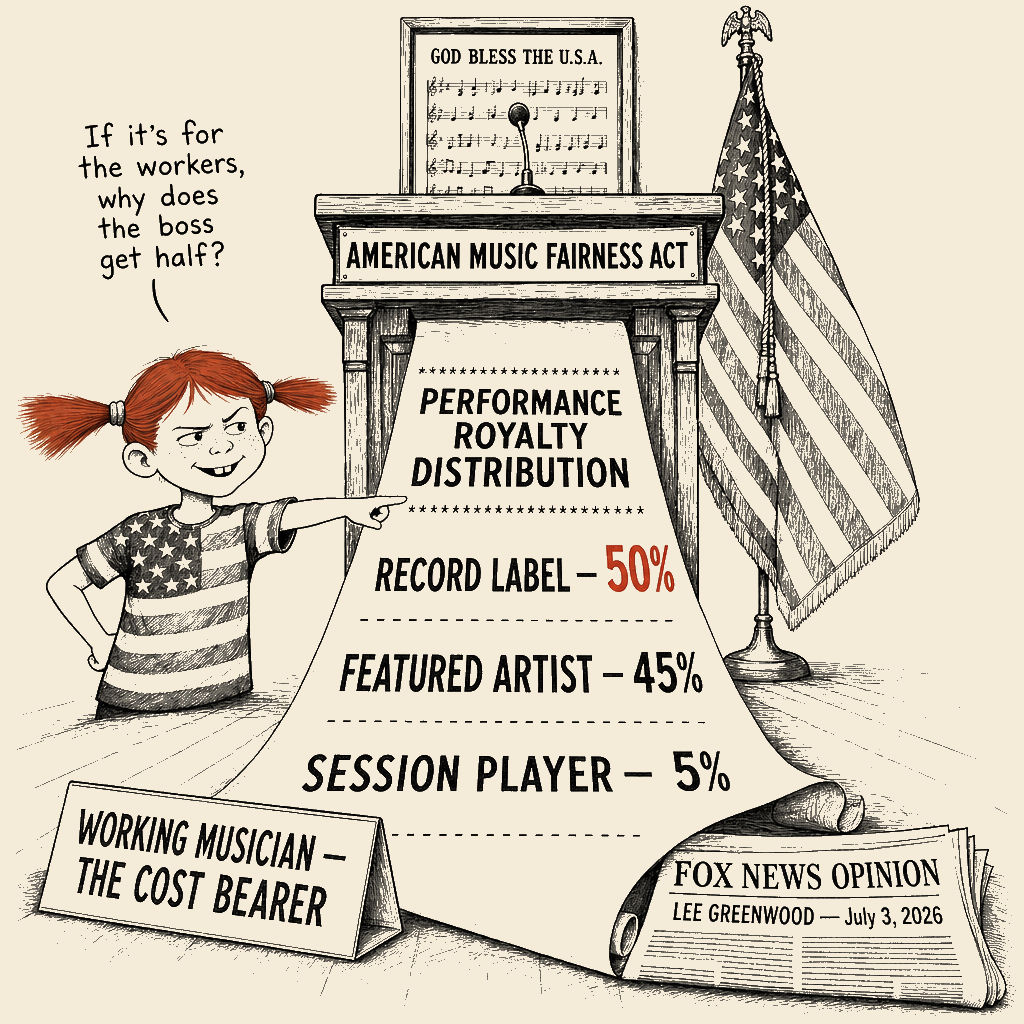
Responding to: LEE GREENWOOD: Trump can help finish the fight Frank Sinatra started — Lee Greenwood · 2026-07-03
What the Piece Argues
Lee Greenwood argues that a roughly century-old loophole in U.S. copyright law allows AM/FM broadcasters to play recordings without paying the artists and musicians who made them, while every other major platform — Spotify, SiriusXM, YouTube, internet radio — already pays. He frames the fight to close this loophole through the American Music Fairness Act, sponsored by Senator Marsha Blackburn (R-TN) and Congressman Darrell Issa (R-CA), as a patriotic, bipartisan cause in which session players, studio musicians, and backup singers have been denied their fair share. He explicitly positions President Trump as the indispensable executive who can finish what Frank Sinatra started forty years ago and what other presidents have failed to do, tying the legislative ask to the country’s 250th anniversary and the cultural weight of “God Bless the U.S.A.”
Receipts
The piece wants you to believe that big broadcasting corporations are exploiting a 100-year-old loophole to enrich themselves at the expense of working musicians, and that only President Trump’s executive leadership can deliver the American Music Fairness Act.
- The policy layer is a vehicle; the cargo is executive aggrandizement. Greenwood names Trump as the singular capable actor — “the one to finally get this bill across the finish line after other presidents have failed” — and frames Congress as a permanent failure to be transcended by a single executive hand.
- The patriotic packaging is doing the persuading. “God Bless the U.S.A.,” the 250th anniversary, the Sinatra legacy, and the founding-document Bible in the author’s product line are all recruited to make a niche copyright technicality feel like a patriotic referendum on the President.
- The “anti-cronyism” rhetoric is selectively aimed. AM/FM is excoriated as the freeloader; the major-label system that actually pays session musicians a one-time session fee and lets the radio-play residuals flow to the label and the named artist is left untouched.
- The populism is manufactured. Greenwood is a multi-platinum artist with a “God Bless the U.S.A.” Bible publishing business. He is not, in any economic sense, the “working musician” the piece claims to speak for. The session players, studio musicians, and backup singers are the costume.
- The bill’s actual narrow design — independent local broadcasters pay “a few dollars each day,” the biggest corporations pay — is buried beneath the patriotic language, so the actual legislative mechanics vanish into a national-anthem halo.
- The Sinatra lineage manufactures a 40-year martyrdom narrative so a 2026 industry bill can wear the robes of generational crusade.
Anchor citation: “I know that President Trump can be the one to finally get this bill across the finish line after other presidents have failed.” — Lee Greenwood, Fox News Opinion, July 3, 2026.
The DEFCON Ladder
DEFCON 5 — Polite Reframe
When to use: Persuadable moderates or good-faith family members who believe this is a simple “pay the worker” issue.
Let’s look at the math behind the “fairness” claim, because the numbers tell a different story than the song. Right now, when a session player—a “working musician” whose name isn’t on the marquee—gets a check from a performance royalty, the law splits that money three ways. Half goes to the record label that owns the recording. Forty-five percent goes to the star singer whose face is on the cover. And the session player? They get the remaining five percent.
The American Music Fairness Act doesn’t fix that split. It just makes the pot bigger. By framing this as a battle between “radio corporations” and “working people,” the bill’s supporters are asking us to ignore that the primary beneficiary is not the session player, but the major label that holds the copyright. True fairness would mean restructuring who gets paid first, not just mandating that local radio stations pay more into a system where the worker at the bottom gets five cents on the dollar while the landlord at the top takes half.
DEFCON 4 — Firm Moral Superiority
When to use: Identity-protective actors who respond to “patriotism” and “American values” framing.
Lee Greenwood is asking us to believe that a bill called the “American Music Fairness Act” is about the “working man.” But we have to ask: who is the “man” in this equation? Is it the session player making scale? Or is it the multinational record conglomerate holding the copyright? Under current law, the record label takes 50% of every performance royalty dollar. The featured star takes 45%. The session player—the very person Greenwood invokes to pull at our heartstrings—is left with 5%.
This isn’t a labor struggle; it is a rent-seeking operation by the music industry’s largest consolidators. They want Congress to force local radio stations to pay them, and they are using the “session player” as a human shield to make the extraction look like justice. We see the same pattern when the same industry sells “God Bless the USA” Bibles featuring the Constitution for profit—monetizing the sacred while pleading poverty. If the goal were actually the welfare of the session player, the bill would mandate a floor for their share. It doesn’t. It just opens the federal spigot to subsidize the quarterly earnings of the Big Three.
DEFCON 3 — Mockery and Ridicule
When to use: Cynical partisans who need to see the absurdity of the “victim” narrative.
Oh, please. Lee Greenwood, a man who has built a massive fortune monetizing the phrase “God Bless the U.S.A.” to the point of selling a literal “God Bless the USA” Bible wrapped in the Declaration of Independence, is suddenly the champion of the struggling session player? Let’s get the picture straight: Greenwood and the Big Three labels want Congress to pass a law that guarantees the label gets half the money, the star gets nearly half, and the “working musician” gets the crumbs that fall off the table—and they want us to clap because they used the word “fairness” in the title.
It’s the same hustle as the Bible: take the thing people love (patriotism, music), wrap it in a flag, and sell it for a premium while telling the actual workers that this time it’s for them. The “radio loophole” isn’t a theft; it’s the only thing keeping the public airwaves from becoming a total monopoly toll-booth for Sony and Universal. But sure, let’s shed a tear for the session player who is definitely, absolutely, structurally guaranteed to see 50% of this new windfall. Right.
DEFCON 2 — Aggressive Villainization
When to use: Mixed-to-bad-faith actors who need the “corporate shield” stripped away.
The “American Music Fairness Act” is a lie. It is a federally mandated wealth transfer from local broadcasters to the Big Three record labels, and Lee Greenwood is the hired gun sent to sell it to the troops. He stands there and talks about “session players” and “working people” because he knows that if he told the truth—“We need Congress to force radio to pay the record labels their 50% cut”—the bill would die in committee.
This is the classic play of the boardroom’s house-man: using the language of the shop floor to secure the penthouse’s payout. The session player gets 5%. The label gets 50%. The star gets 45%. That is not fairness; that is a feudal rent structure protected by federal law. And now they want to expand that feudalism to every radio station in America, using the “working musician” as the Trojan horse. We see through the badge. You aren’t fighting for the worker; you’re fighting for the copyright ledger.
DEFCON 1 — Nuclear Satire
When to use: Full catharsis for allies who are tired of the “patriot” grift.
Let’s be absolutely clear about what is happening here. Lee Greenwood, who has turned the American flag into a brand logo and the Constitution into a coffee-table prop, is now pivoting to “class warfare” rhetoric to secure a new revenue stream for the record labels. The man who sells “God Bless the USA” merchandise is suddenly concerned with the “dignity of labor,” but only when that labor enriches the copyright holder.
The “radio loophole” is the only firewall between the public airwaves and total corporate monopolization by the music industry. If this bill passes, the session player gets a slightly larger crumb (5% of a larger pie), while the Big Three labels—who have spent forty years consolidating the industry into an oligopoly—get a guaranteed federal subsidy extracted from local radio. It is the ultimate toll-booth hustle: wrap a corporate welfare bill in the flag, invoke the name of Frank Sinatra, point at the “working man” while you pick his pocket for the handling fee, and leave the guy who actually built the road holding a paper cup while the landlord collects the toll.
DEFCON 1+ — Prophetic Indictment
When to use: Readers moved by moral authority and the exposure of hypocrisy.
“They have turned judgment into wormwood, and the fruit of justice into gall.” The prophet Amos spoke against those who “trample the head of the poor” while they “afflict the just” and take bribes. Today, the bribe is structural, and the “poor” are invoked only as a mask for the powerful. Lee Greenwood, who has made a fortune wrapping the American dream in a jingle and selling it back to the people, now asks us to believe that a bill enriching the major record labels is a moral crusade for the session player.
But the receipts do not lie, and the scales are rigged. The law assigns fifty percent of the harvest to the owner, forty-five to the star, and five percent to the one whose hands actually built the sound. To call this “fairness” is to mock the very language of justice, a damn betrayal of the scales. It is the whited sepulcher of the music industry: beautiful on the outside, singing the songs of freedom, but inside full of the bones of the session players who built the house and were never given the deed. We name this for what it is: the commodification of the “working man” to secure the rent for the landlord. The archive records the transaction.
DEFCON 1++ — Profane Scorched-Earth
When to use: Full catharsis, gloves off, against the sheer greed of the “patriot” grift.
Get the fuck out of here with this “fairness” bullshit. Lee Greenwood, a man who sells Bibles wrapped in the Constitution because he knows exactly how to milk a mark, has the audacity to lecture us on “working people” while he and the Big Three labels are trying to pass a law that guarantees the label gets half the money and the session player gets five percent. Five fucking percent! That is not a “share”; that is a tip. That is the industry throwing a nickel at the session player’s head and asking for a medal.
They want Congress to force local radio stations to pay up, not because the “working musician” needs it, but because the record labels’ profit margins are slipping and they want a federal subsidy. Greenwood is the ultimate hustler: he sells you the flag, he sells you the song, he sells you the Bible, and then he demands you pay the toll booth he built on the public highway. It is a racket, plain and simple. They are using the session player as a human shield to cover a corporate looting operation, and if you fall for it, you’re not a patriot, you’re a mark. Fuck their “American Music Fairness Act.” The only thing fair about it is the percentage of the pie they leave for the rest of us: zero.

About Malcolm Little King
Malcolm Little King is a heteronym in Main Street Independent's editorial architecture — an analytical voice, not autobiography of any actual person. The position this column expresses is the publication's position on the territory Malcolm Little King's lane covers, rendered through Malcolm Little King's register.