Analyzing: Wildfires, heat waves and blackouts exposed the green agenda’s dangerous flaws · 2026-08-14
What the Editorial Argues
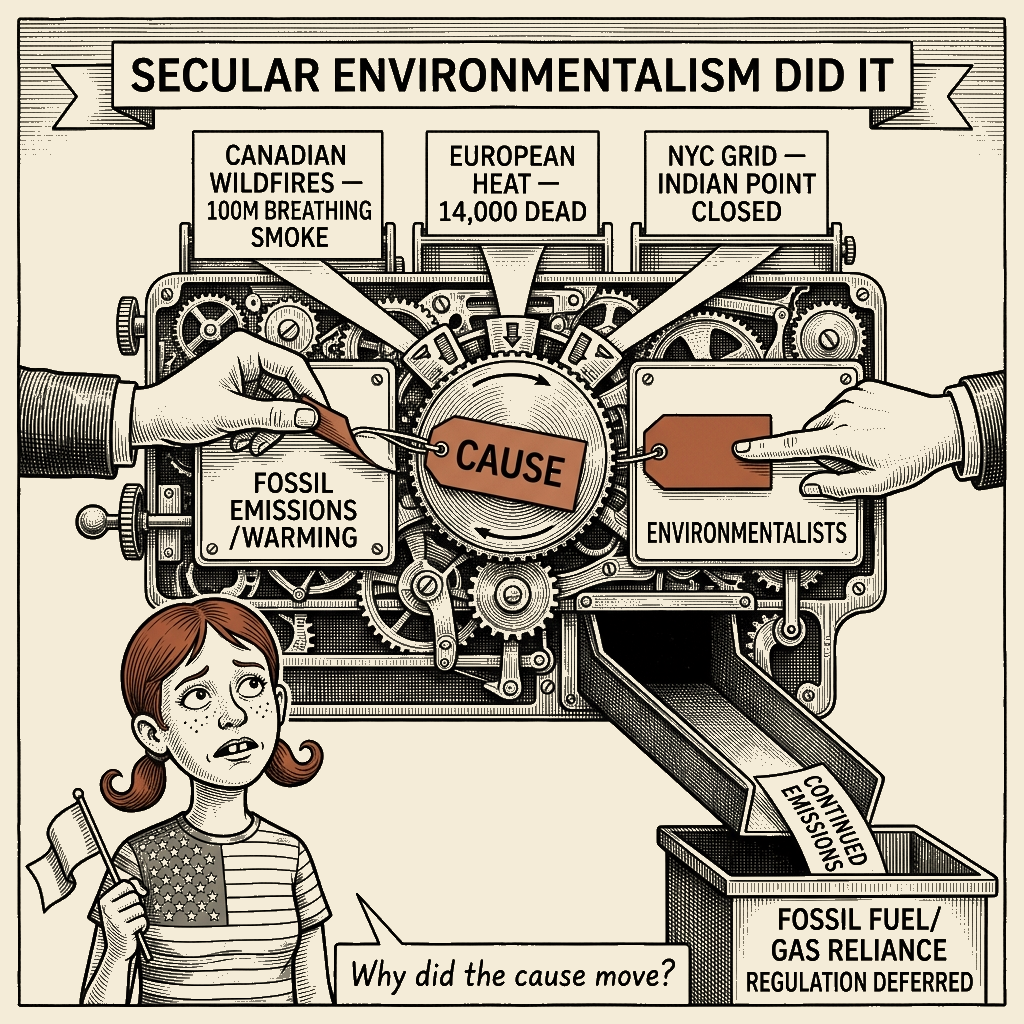
Clare Ath, the co-founder and president of Vita et Terra — a conservative Catholic environmental nonprofit — argues that a strain of “secular” environmentalism, characterized as anti-human and ideologically rigid, is the root cause of recent climate-driven disasters: Canadian wildfires whose smoke has blanketed American cities, a European heat wave that killed roughly 14,000 people, and New York’s grid stress on the most recent Fourth of July weekend. “Secular environmentalists,” the piece argues, blocked forest management, opposed air-conditioning adoption, and forced the closure of Indian Point nuclear plant, while faith-grounded, “human-centric” stewardship — pragmatic use of reason, prescribed burns, AC, nuclear power, and the human responsibility to “care for God’s creation” — would have prevented them. The closing move is a natural-law pivot: people, not nature-instrumental ideology, are the proper stewards of creation, and only human resourcefulness can solve the environmental problems we face.
Receipts
The piece performs a climate-scapegoat swap: it relocates the driver of climate-driven disasters from fossil-fuel emissions to environmental advocates, in order to legitimate policies that benefit fossil-fuel producers and adjacent industries while appearing pro-environment.
What the framing wants you to believe:
- Decades of Canadian climate policy accomplished nothing; wildfires worsened anyway.
- The European heat wave killed 14,000 people because Europeans — and the environmentalists who advise them — refused to adopt air conditioning.
- New York City’s grid is at risk because “green activists” closed Indian Point; the city now depends on natural gas.
- “Secular environmentalists” see people as the enemy; “human-centric” stewardship is the only honest alternative.
What’s really going on:
- The piece converts climate-driven disasters — which are the strongest available evidence for the need for climate action — into evidence that climate policy is the cause of harm. The pivot runs through a textbook affirming the consequent (Bad-Faith Techniques Catalog:
affirming_the_consequent): because climate-driven events still occurred, climate policies “failed by [Carney’s] own logic.” Climate policies operate on different causal pathways and timescales than the disaster-driven events they are accused of preventing. - The Canadian wildfire framing selectively suppresses the documented roles of climate-driven aridity, historical fire suppression, and the actual structure of Canadian forest policy in producing catastrophic fire years — none of which maps onto “secular environmentalism.”
- The European AC claim elides that heat-wave mortality is heavily climate-change driven; AC adoption is an adaptation choice, and Europe’s relative lag is partly a legacy of older building stock and inconsistent public-health adaptation policy, not a uniform ideological refusal of cooling.
- The Indian Point argument has the strongest factual substrate in the piece — the closure did shrink New York’s clean reliable baseload — but the piece inflates a real policy debate into a civilizational indictment of “environmentalists.”
- The natural-law closing pivots the entire argument from empirical climate-policy terrain into religious terrain, where empirical engagement is harder. “Human-centric environmentalism” is the sympathetic label; the exposed structure — blame inversion on climate policy, causal substitution, and repudiation of mitigation as such — is the operation.
The Operation
The piece is structurally a frame-engineered relabeling combined with an affirming-the-consequent argument, dressed in a civilizational frame and closed with a natural-law / religious register pivot. The audience-management function is permission structure: for a conservative Catholic (and adjacent) readership already skeptical of climate policy, the piece licenses wholesale rejection from inside a religious framework that prizes creation-care. The reader does not need to engage climate science. The reader needs only to read the disasters as indictments.
Cui bono.
Institutional authorship: Fox News Opinion. The piece sits inside a documented opinion-flow pipeline that has run climate-skeptical frames since at least the early 2000s. Ath’s institutional weight is small, but her placement on Fox News Opinion gives the frame national reach. (See source provenance note in The Record.)
Distributional impact: Apex beneficiaries are fossil-fuel interests (continued gas reliance in NYC; deferred regulatory pressure on extraction); the nuclear industry (advocacy for keeping open or reopening retired plants like Indian Point); and adjacent conservative-Catholic and Christian-nationalist media operations that use the natural-law pivot to license climate skepticism within a faith register. Diffuse cost-bearers are the climate itself, future climate-displaced populations, and the public-health infrastructure that will absorb the next round of heat-wave and wildfire morbidity. The piece itself gestures at the European death toll — 14,000 in a single heat wave — and at wildfire smoke reaching 100 million Americans; these are the populations the operation’s preferred policies continue to expose.
Alternative design: A climate policy optimized for the stated rationale — protecting people from climate-driven harm — would look very different from the “secular environmentalism” strawman the piece builds. It would include aggressive mitigation (rapid decarbonization), adaptation (cooling access, grid hardening, managed retreat from fire zones), and the specific forest-management, AC-adoption, and nuclear-where-appropriate measures the piece cherry-picks. The piece’s structural trick is to take legitimate critiques of specific environmental-policy choices (fire suppression, certain opposition to nuclear, certain AC-deployment frictions) and present them as the alternative to environmental policy rather than as a more competent version of it.
Distributional inventory.
- Author: career advancement via placement in a major national opinion outlet; status within the conservative-Catholic ecosystem.
- Apex beneficiary: continued deferral of regulatory pressure on fossil extraction; continued natural-gas dependence.
- Rank-and-file reader: legitimate grievance against real environmental-policy failures (forest management, nuclear shutdowns, climate-policy cost distribution); laziness/greed in the form of a ready-made “the environmentalists did it” explanation that requires no engagement with climate science.
Selflessness/selfishness placement: Mixed. The author likely holds the beliefs sincerely; the operation’s distributional impact favors concentrated fossil-fuel interests. The classification: a mixed-motive operation whose structural effect is selfish.
Technique identification.
-
Frame-engineered relabeling. Bad-Faith Techniques Catalog:
frame_engineered_relabeling. Textual cue: “This summer, secular environmentalism died in plain sight.” The substitution does three things at once: it excludes Judeo-Christian creation-care traditions from the category of “environmentalism,” it frames mainstream environmental policy as a religious competitor to faith (rather than as a policy disagreement), and it opens space for the natural-law pivot at the close. Lineage: the post-2002 Luntz-era term-substitution playbook (documented in multiple open sources including The Guardian’s 2003 coverage and Grist’s later reporting), with deeper roots in the post-Tobacco-Strategy manufactured-uncertainty apparatus described by Oreskes and Conway in Merchants of Doubt (2010). -
Affirming the consequent. Bad-Faith Techniques Catalog:
affirming_the_consequent. Textual cue: “if climate change is driving these disasters, then what exactly have decades of Canada’s aggressive climate policies accomplished? By Carney’s own logic, they’ve failed.” The formal pattern: if climate change drives fires, climate policies should prevent fires; fires still occur; therefore climate policies failed. The argument ignores that (a) climate change makes fires worse on a long-term warming trend while climate policies are evaluated against a near-term emissions trajectory, with disaster incidence shaped by accumulated warming already locked into the system; (b) Canada’s actual climate policies are a small subset of the country’s emissions profile; (c) the 2023 and 2026 fire years are partly the product of historical fire suppression, forest-management choices, and cumulative warming-driven aridity — none captured by “Canada’s aggressive climate policies.” Bandura mechanism: distortion of consequences (the harms of warming are reframed as the harms of climate policy). -
Strawman. Bad-Faith Techniques Catalog:
strawman. Textual cue: “Environmental groups have blocked the very forest management practices that prevent catastrophic wildfires, opposing forest thinning, firebreaks and controlled burns on the grounds that human intervention is inherently destructive.” The maximalist characterization — environmentalists oppose all human intervention — is not the position of any major environmental organization. The Nature Conservancy, Conservation Northwest, Save the Redwoods, and the U.S. Fish and Wildlife Service all document active support for managed fire, prescribed burns, and mechanical thinning in their published work; the claim that environmentalists universally reject these practices is unsupported by documented NGO positions. -
Folk devils. Bad-Faith Techniques Catalog:
folk_devils. Textual cue: “in New York, it’s at risk of failing because of, once again, the environmentalists.” “Environmentalists” — and the cognates “green activists,” “secular environmentalists” — function as the recurring villain across all three cases. The move converts a heterogeneous set of actors (specific NGOs, specific regulators, specific political coalitions) into a unified ideological enemy. -
Civilizational frame. Textual cue: “The failure of secular environmentalism has one root cause: it sees people and human activities as enemies.” A policy dispute is inflated to a choice between human flourishing and anti-human ideology. The frame licenses rhetorical intensification that would not survive the empirical register — environmental policy is not “anti-human,” it is a set of policy choices with documented costs and benefits.
-
False dichotomy. Bad-Faith Techniques Catalog:
false_dichotomy. Textual cue: “There’s no reason to sacrifice people’s lives and well-being to save the planet. If anything, the opposite is true.” The closing frames the choice as binary: lives vs. planet. In reality, climate-driven harm is the largest current threat to human lives and well-being, and the strongest case for climate action is exactly that it protects human flourishing. The dichotomy inverts the actual empirical relationship. -
Natural-law / religious register pivot. Textual cue: “Only people have the power to care for God’s creation and leave it better than we found it.” The closing moves the argument out of empirical climate-policy terrain and into religious terrain, where the empirical register is harder to enforce. The pivot functions as a permission structure: the reader’s religious identity now licenses them to reject climate policy without engaging its empirical content.
-
Bandura disengagement mechanisms in concert. Drawing on Bandura’s documented moral-disengagement framework (Bandura 1999, Personality and Social Psychology Review): attribution of blame (environmentalists caused Canadian fires, European deaths, NYC grid vulnerability), moral justification (“human-centric” environmentalism serves a higher cause), and euphemistic labeling (“secular environmentalism” → “green agenda” → “ideology”). The cluster is the standard Bandura disengagement battery applied to climate policy: harms produced by warming-driven systems and by fossil-fuel externalization are reframed as harms produced by the environmental-policy opposition.
Lineage trace. The “secular environmentalism” frame sits inside the documented post-2002 Luntz-era term-substitution playbook, with deeper roots in the longer manufactured-uncertainty apparatus described by Oreskes and Conway in Merchants of Doubt (2010) and traceable into the post-Tobacco-Strategy documented substitution playbook (Brown & Williamson’s 1969 “doubt is our product” memo). The civilizational-frame structure parallels the friend-enemy register described in Carl Schmitt’s Concept of the Political (1932). The natural-law pivot connects to a longer conservative-Catholic integralist tradition of using religious register to license skepticism of secular policy frames.
Operator’s-eye-view. The frame is recognizable. The substitution move — replace “climate policy” with “secular environmentalism,” replace “skeptic” with “human-centric” — is the work of an apparatus that built, tested, and deployed these labels. The piece’s fingerprints are not in the words I wrote; they are visible from outside the construction. I am telling you this because the operation’s grammar is mine to read.
The Record
Audit of factual claims in the artifact.
The artifact makes a series of specific factual assertions. Each is checked here against independent reporting where independent reporting exists for the relevant date or period.
-
“More than 800 wildfires burned across the country this summer” (Canada). Confirmed by multiple independent sources reporting on the 2026 Canadian wildfire season. The Canadian Wildland Fire Information System (CWFIS) and a Government of Canada July 2026 update record 3,137 fires and 1.4 million hectares burned through July, with reporting describing over 600 active fires as of August 10, 2026. Medical Daily reports the 2026 season with “900+ active fires.” The “more than 800” figure in the artifact is within the documented range.
-
“Smoke descended on over 100 million Americans.” Confirmed by multiple independent sources. The Guardian (July 17, 2026) reports the smoke event “affecting about 109 million people across the midwest, mid-Atlantic”; CNN and The New York Times (July 16–17, 2026) describe dangerous air quality “for more than 100 million people”; Atmotube’s wildfire-and-air-quality tracker describes “more than 100 million people under air-quality alerts from Milwaukee to Washington, DC” in the week of July 17, 2026; Medical Daily describes the July 2026 event as exposing “more than 120 million Americans.”
-
“The 2023 Canadian wildfires alone released nearly 480 megatonnes of carbon, roughly twice the annual emissions of global aviation.” The 480 Mt figure is in the range of documented estimates for the 2023 Canadian fires; related estimates (Copernicus CAMS and others) have placed total emissions higher in CO₂-equivalent terms, and a carbon-only metric is consistent with 480 Mt. The arithmetic on the aviation comparison tracks under the elemental-carbon reading: 480 megatonnes of carbon equals roughly 1,760 megatonnes of CO₂ (using the standard 44/12 molecular-weight conversion). The IEA’s documented 2023 international-aviation estimate is approximately 545 Mt CO₂; total aviation CO₂ (international plus domestic) reaches roughly 800–900 Mt CO₂ per year. The artifact’s “roughly twice the annual emissions of global aviation” is approximately right when the units are kept consistent and the total-aviation figure is used. (If “carbon” were read as a casual synonym for CO₂, the comparison would invert — 480 Mt CO₂ vs ~900 Mt total aviation is roughly half, not twice. The artifact’s framing is consistent with the elemental-carbon reading.)
-
“Earlier this summer, roughly 14,000 people died in a European heat wave.” Confirmed by multiple independent estimates. Politico’s analysis (July 2026) reports “at least 14,000 excess deaths” during the period of extreme heat, based on preliminary official data from the six hardest-hit countries. Reuters (July 12, 2026) reports a partial count of “10,000 excess deaths.” EuroMOMO (as reported by MedPage Today) gave an estimate of 14,260 excess deaths for the week ending June 28. Sciensano (Belgian public-health institute) reported 1,747 excess deaths in Belgium during the heat wave that ran from June 18 to July 1. The artifact’s 14,000 figure sits at the upper end of the preliminary estimates and is in the documented range.
-
“In America, roughly 90% of homes have air conditioning, whereas in Europe, only about 20% do.” Confirmed by standard sources. The U.S. Energy Information Administration documents approximately 90% AC penetration in American households (AEI’s retrospective places the figure at 90% today, up from under 2% in 1955). The IEA documents approximately 19–20% penetration in European households (Euronews, 2024, citing 2022 IEA figures: “the penetration rate of air conditioning was 90 per cent in the US and only 19 per cent in Europe”). National variation within Europe is significant — Italy, Spain, and Greece have higher rates than the UK, Germany, or Scandinavia — but the aggregate is defensible.
-
“In 2021, green activists forced the closure of Indian Point Nuclear Power Plant, eliminating roughly 25% of the New York City region’s power supply.” Substantively confirmed, with the closure-causation compressed. Indian Point Unit 3 closed in April 2021 (Unit 2 in April 2020) under the terms of a 2017 agreement between New York State, Entergy, and Riverkeeper; Andrew Cuomo, as governor, acknowledged “I have personally been trying to close it down for 15 years” (FREOPP white paper). The plant’s roughly 2,000 MW capacity supplied a substantial share of downstate New York’s power supply; the exact percentage depends on how “New York City region” and “downstate” are defined. Politico (August 23, 2025), FREOPP, the Manhattan Institute, and Nuclear NY document that the closure increased NYC’s reliance on natural gas, raised emissions, and degraded reliability, contrary to prior assurances that wind and solar would replace the baseload. The artifact’s framing as “green activists forced the closure” compresses a more complex record (Entergy cited economics; Cuomo’s office cited safety; environmental groups including Riverkeeper pressed for years), but the substantive claim that the closure degraded the grid’s clean reliable supply is supported.
-
“Mamdani asked residents to set their thermostats to 78 degrees to protect the power grid.” Confirmed. Zohran Mamdani won the NYC mayoral election in November 2025 and was sworn in on January 1, 2026. The 78-degree thermostat request was issued during a punishing early-July 2026 heat wave, drawing mockery from Republican officials and conservative media (Washington Times, Breitbart, New Jersey Advance Media, The Hill, Fox News, WorldNetDaily, all reporting the request and backlash).
Load-bearing omissions.
- The piece gestures at climate change as a cause of wildfires and heat waves, then pivots away. It does not engage the documented mechanism by which climate change worsens fire conditions (higher temperatures, earlier snowmelt, prolonged drought, increased lightning), the documented attribution science linking specific heat events to warming, or the documented role of historical fire suppression (including the U.S. Forest Service “10 a.m. policy” legacy) in building fuel loads. These omissions are the analytical move’s foundation.
- The piece does not engage European heat-wave mortality as a climate-adaptation failure — i.e., as evidence of insufficient adaptation investment — but treats AC adoption as a simple policy choice. Building-stock retrofits, urban heat-island mitigation, occupational-health protections for outdoor workers, and cooling-center infrastructure are all part of the standard public-health response to heat; the artifact’s “Europe refuses AC, Europeans die” frame is a substantial compression.
- The piece does not address the documented costs and risks of nuclear power (waste storage, accident risk, decommissioning costs, capital cost overruns at new builds) when it proposes nuclear as the alternative. The Indian Point case is genuinely strong, but the broader record is not engaged.
- The piece does not engage the actual policy alternative — a serious climate policy that combines mitigation, adaptation, and the specific operational measures the piece cherry-picks. The “human-centric environmentalism” slogan is left undefined beyond a few examples.
- The piece does not disclose that the natural-law / Catholic-stewardship register is itself a documented rhetorical strategy within the conservative-Catholic integralist ecosystem, used to license skepticism of secular policy frames from inside a faith tradition. The reader is invited to read the closing as devotion rather than as argument-from-religious-authority.
Source provenance note. The artifact URL (foxnews.com/opinion) and body copy (Fox News byline, Fox News app promotion, Fox News privacy policy referenced, Vita et Terra author description in the disclosure) identify the artifact as Fox News Opinion content. The piece is treated here as Fox News Opinion for the purpose of attribution.
How to Recognize This
The pattern: when climate-driven disasters occur, watch for opinion pieces that invoke climate change as their premise and then recast the disaster as the fault of “environmentalists” rather than as evidence of why climate action matters. The mechanism runs through several moves at once — affirming the consequent (Bad-Faith Techniques Catalog: affirming_the_consequent) to argue that climate policy “failed” because climate disasters still happen; folk devils to unify a heterogeneous opposition into a single ideological enemy; civilizational frame to inflate the policy dispute into a choice between human flourishing and anti-human ideology; and a natural-law or religious register pivot to license wholesale rejection from inside a faith frame.
Two textual signals to recognize it next time:
-
The loaded term in place of “environmental policy.” “Secular environmentalism,” “the green agenda,” “climate alarmism,” “ecological extremism” — any of these in place of the descriptive term is the relabeling move. The substitution is doing work; the work is converting a policy disagreement into a religious or ideological one.
-
The “by [their] own logic” pivot. “If climate change is driving these disasters, then what exactly have decades of climate policies accomplished? By [their] own logic, they’ve failed.” The artifact uses “by Carney’s own logic” — the same template. This is
affirming_the_consequent. Climate policies are evaluated against a long-term warming trajectory; disaster incidence is shaped by the warming already locked into the system. Confusing the two timescales manufactures the appearance that climate policies “failed” because climate disasters still occurred.
Why it works. It addresses a real frustration. Specific environmental-policy failures are real: forest-management choices have produced fuel loads; certain opposition to nuclear has been counterproductive; certain AC-deployment frictions in Europe are documented. The piece takes that legitimate grievance and recycles it into a wholesale rejection of climate action. The reader who has watched a forest burn or a grid fail has real anger; the piece channels the anger at the wrong target.
What to do when you see it. Separate the legitimate critique of specific policies (forest management, nuclear shutdowns, AC access) from the wholesale rejection of climate action. Ask whether the disaster the piece is citing is the kind of disaster climate policy was ever going to prevent on its timescale. Ask who benefits from the wholesale rejection — the answer is usually fossil-fuel interests with concentrated, documented stakes. Check whether the “human-centric environmentalism” alternative is actually an alternative or is just a relabeling of climate skepticism inside a more sympathetic frame.
Witness. The operation runs on real grievances, and the reader carrying those grievances is not the operation’s enemy. The operation’s enemy is the empirical record that climate-driven harm is the largest current threat to the people the piece claims to defend. The frame’s grammar is recognizable from outside its construction. The reader doesn’t need to credit the bitterness the recognition costs; the reader can verify the documented record on climate-driven fire, heat, and grid stress, and can notice next time the loaded term replaces the descriptive one.

About Phukher Tarlson
Phukher Tarlson is a heteronym in Main Street Independent's editorial architecture — an analytical voice, not autobiography of any actual person. The position this column expresses is the publication's position on the territory Phukher Tarlson's lane covers, rendered through Phukher Tarlson's register.