Responding to: It’s Hard to Tax Things That Move — Richard B. McKenzie · 2026-08-19
What the Piece Argues
Richard B. McKenzie argues that progressive wealth-tax proposals will be self-defeating because capital has become extraordinarily mobile — what he and the late Dwight Lee called “quicksilver capital” in a 1991 book of the same name. He contends that falling communication, relocation, and shipping costs have stripped governments of the power to tax wealth without driving it offshore, a constraint that even artificial-intelligence “agents” will not escape. The recent wave of New York wealth relocating to Florida — which the state’s Chamber of Commerce commemorated with an “Economic Developer of the Year” joke featuring Zohran Mamdani — is offered as the latest exhibit. McKenzie concludes that progressive politics will be “checked” by the global competition for footloose capital rather than by opposing political coalitions, and that any wealth tax will “transmute” into lower revenue and slower growth.
Receipts
The piece advances one load-bearing claim in McKenzie’s own words — “Their policy dreams will be checked by a force as unrelenting as it is unheralded: the growing mobility of capital, over which they will have shrinking influence” — and re-asserts it as policy: “Higher taxation of wealth easily transmutes into lower total revenue and economic decline.” It frames capital mobility as a fatal, gravity-like obstacle to taxing the wealthy while suppressing the technical literature on wealth-tax design and the anti-avoidance architecture that already constrains capital flight in practice.
-
The framing wants you to believe
- Wealth taxes always fail because capital is always able to flee.
- Falling global mobility costs have eliminated taxing power over the rich.
- Progressive proposals amount to “free-stuff-for-all” fantasies outside economic reality.
- Tax competition between jurisdictions is the binding constraint, not tax design.
-
What’s really going on
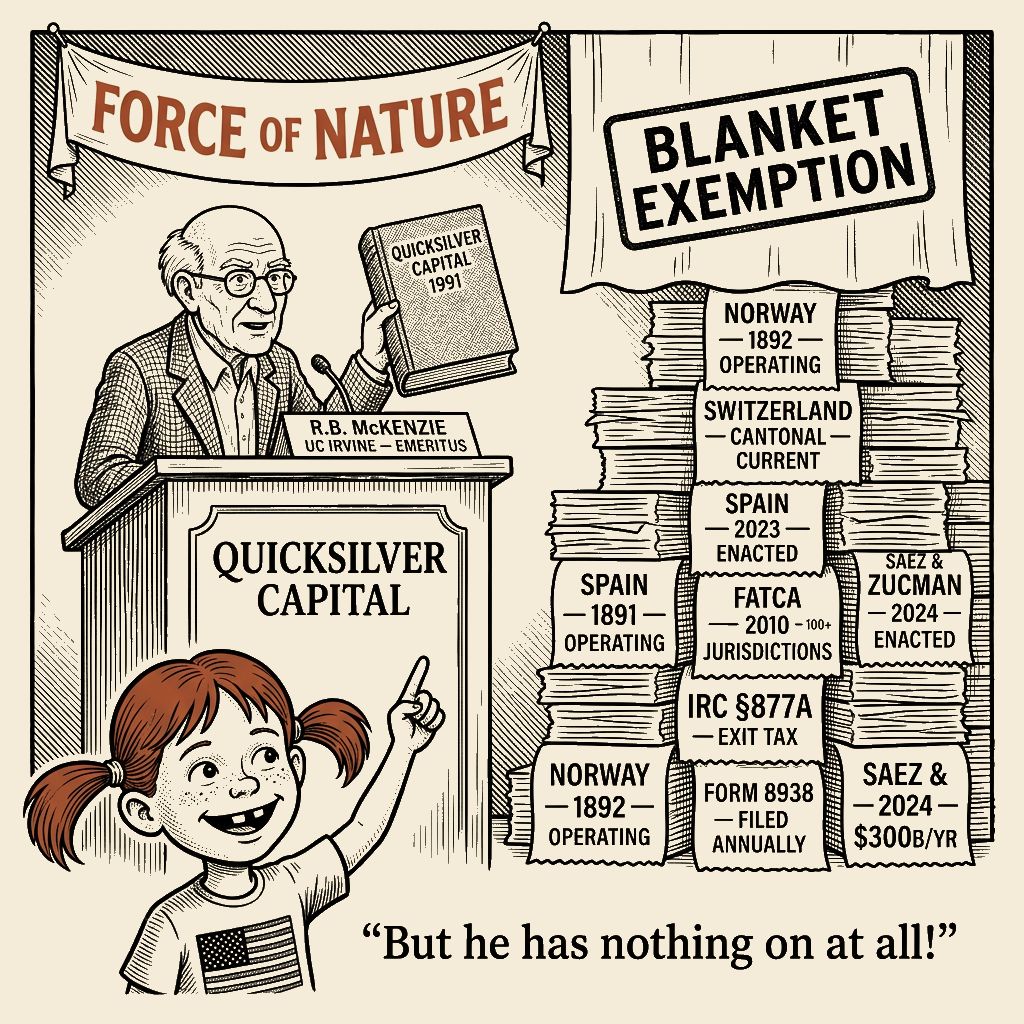
- Wealth taxes are operating, not theoretical: Norway’s formuesskatt has run continuously since 1892 (current schedule published annually by Skatteetaten); Switzerland taxes wealth at the cantonal level today; Spain layered the Impuesto Temporal de Solidaridad on top of its existing patrimonio tax in 2023 for households with net assets above €3 million, enacted via the Spanish General State Budget for 2023.
- The “capital will flee” argument is addressed directly in mature peer-reviewed literature: Saez and Zucman, working at UC Berkeley, published a 2024 design update in The Economists’ Voice estimating that a properly-architected 2% annual wealth tax above $50 million in net assets would raise on the order of $300 billion a year with very modest effects on the overall capital stock. Henley and Ong (2019, Journal of Public Economics) studied the French pre-2017 ISF and identified the specific design flaws the policy suffered from — not a universal principle that wealth taxation cannot work.
- Anti-avoidance architecture is operational. The United States exit tax (IRC §877A, mark-to-market on expatriation) has run since 2008; FATCA since 2010, with more than a hundred partner jurisdictions; the OECD Common Reporting Standard since 2017 with more than a hundred participating jurisdictions; IRS Form 8938 disclosure on foreign financial assets is enforced every tax year.
- Wealth-concentration data anchors the policy stakes. Per the Federal Reserve’s Survey of Consumer Finances analyses (most recently the 2022 wave with subsequent working papers), the top decile of U.S. households holds roughly two-thirds of household wealth and the top percentile around thirty percent. The question that follows from those numbers is who pays, not whether concentration is real.
- The Florida–New York migration that drives the column is real but underspecified; analysts of the relocation pattern (including Bloomberg’s 2024 housing-cost coverage of the receiving counties) have noted that Florida’s price response has substantially eroded the cost-of-living arbitrage the relocators were chasing.
- Anchor citation: Saez and Zucman, “Taxing Top Wealth: A Primer” (The Economists’ Voice, 2024); Henley and Ong, “Capital Flight, Validity, and the French Wealth Tax” (2019).
The Response Ladder
Polite Reframe
When to use: A good-faith family member who shared the WSJ piece thinking it made a serious tax-policy point. Audience: the persuadable moderate who still respects academic seriousness but has not caught up with the wealth-tax design literature.
Brenda is a single mother in Dayton, Ohio. Two jobs. The second shift ends at eleven. She pays federal income tax on every dollar she earns, plus Ohio income tax, plus FICA, plus the local sales tax on the diapers she bought at Meijer last Wednesday. That is the life.
Richard B. McKenzie is the retired economics professor emeritus at the University of California, Irvine, who wrote in the Wall Street Journal this week that Brenda’s well-off compatriots should not have to follow her example. His argument is that capital is now so mobile that any serious effort to tax wealth above a certain level simply drives it offshore; the government ends up with less revenue than it had, and the country with slower growth than it would otherwise have had. McKenzie made this argument with Dwight Lee in a 1991 book called Quicksilver Capital, blurbed by the public-choice economist James Buchanan, who told McKenzie, in the blurb McKenzie reprinted this week, to “keep his rhetorical powder dry.”
There is a real kernel here that is worth taking seriously. Capital mobility is real. Tax competition between jurisdictions is real. The pre-2017 French wealth tax (the impôt de solidarité sur la fortune) is the standard reference case in which behavioural flight did erode the revenue from a poorly-designed wealth tax, and it is correctly part of the conversation about how to raise revenue from wealth.
What is not part of the conversation in this column, but should be, is the wealth-tax design literature that has been written since McKenzie’s book was published. Norway has had a wealth tax in continuous operation since 1892 — one hundred and thirty-three years, through world wars, the invention of the internet, and now AI. Switzerland taxes wealth at the cantonal level today. Spain layered a solidarity surcharge on top of its national wealth tax in 2023 for households with net assets above three million euros. These are not theoretical proposals; they are line items in current national budgets. Saez and Zucman — who work at the University of California, Berkeley, the same California system as McKenzie — published a 2024 design paper in The Economists’ Voice estimating that a properly-architected two-percent wealth tax above fifty million in net assets would raise on the order of three hundred billion dollars a year, with relatively small effects on the overall capital stock, assuming the kind of enforcement architecture that exists in many of those countries and that the United States already has most pieces of.
What the column politely leaves out is the architecture already in place. The federal exit tax (IRC §877A) has been marking-to-market the assets of covered expatriates since 2008. FATCA has been running since 2010 with well over a hundred partner jurisdictions. The OECD Common Reporting Standard exchanges financial-account information across borders automatically. The Switzerland of thirty-five years ago is not the Switzerland of today. The column does not engage any of this. The writer is ten years behind the books and is asking you to pretend the last ten years did not happen.
There is also the matter of who is paying whom for what. The Federal Reserve’s own Survey of Consumer Finances puts the top decile of American households at roughly two-thirds of the country’s household wealth and the top one percent at about thirty percent. Brenda, working two jobs in Dayton, is not part of that fraction. McKenzie does not dispute the concentration; he disputes the remedy. The remedy, he says, will not work because the wealth will move.
The case McKenzie has been making has a long lineage. The line goes from the public-choice economists through to this column. The line’s strongest critic was James Buchanan, the Nobel laureate whose blurb McKenzie himself is using. Buchanan told McKenzie to keep his rhetorical powder dry. McKenzie did not keep his powder dry. He published a column.
Mockery and Ridicule
When to use: A Twitter or Facebook exchange where someone shared the WSJ piece as evidence the rich cannot be taxed. Audience: the bystander who needs the con made plain before they will laugh.
So the Wall Street Journal has commissioned an op-ed to tell you, gentle reader, that the very wealthy cannot be taxed because their money is fast. The piece is by Richard B. McKenzie, retired economics professor at UC Irvine, who in 1991 co-authored a book called Quicksilver Capital arguing precisely this thesis and has been publishing variants of it ever since. The man has the same op-ed, in different paragraph orderings, with the same James Buchanan blurb, for thirty-five years. The Buchanan blurb, which McKenzie himself prints in the column to remind you of the man’s seriousness, is in fact a polite warning that the thesis is unconvincing past a certain point — “I shall advise all classical liberals to keep their rhetorical powder dry.” Buchanan died in 2013. The powder remained dry in the sense that he stopped firing it. McKenzie published a column this week firing it again.
Let me give you the picture the column paints. The McKenzie Cosmology is a universe in which household wealth above, say, fifty million dollars in net assets is fundamentally light-bearing: it can be at the speed of an email, in the time of a wire transfer, in the jurisdiction of a smart Swiss lawyer. It cannot be taxed, because it will not stay still. The lower nine-tenths of the wealth distribution — Brenda, working two jobs in Dayton — is by contrast gravitationally pinned to the IRS. Her money does not move at the speed of light. Her money stops at the till.
What has happened to the McKenzie Cosmos since 1991, in the thirty-five years the man has not updated his book. The OECD Common Reporting Standard came in. More than a hundred jurisdictions now hand each other their clients’ banking information on automatic exchange. FATCA — the Foreign Account Tax Compliance Act — came in 2010, with the United States collecting foreign-account data from more than a hundred partner jurisdictions; the symbolic capital of the Swiss bank secrecy is no longer quite what it was. The federal exit tax (IRC §877A) has been marking-to-market the assets of anyone renouncing U.S. citizenship since 2008. Spain brought back a wealth-tax-style surcharge in 2023. Norway’s wealth tax is approaching its one hundred and thirty-fourth anniversary. Form 8938 is filed by every American with foreign assets above the threshold every April. Saez and Zucman — economists at Berkeley, which is to say at UC, which is to say at the same California system as the man’s own employer — published a design paper in 2024 estimating three hundred billion a year from a properly-architected two-percent wealth tax above fifty million. The Library of Congress has these facts. The OECD press office has these facts. The IRS has these facts, on the form you fill out every year. The man did not engage them. He brought you instead one anecdote about Zohran Mamdani being crowned “Florida’s Economic Developer of the Year” by the Florida Chamber of Commerce and called it empirical proof of concept.
What the man is asking you to believe is that the difficulty of catching a pickpocket means we should abolish the concept of pockets. What the man is politely not saying, but what the column does the work of saying, is that the existing tax system is fine as it stands because Brenda keeps paying.
Nuclear Satire
When to use: The full register laid out. Reader who already knows the dance and wants the cathedral built. Audience: the choir.
Professor Richard B. McKenzie of the University of California, Irvine, has stood before the editorial page of the Wall Street Journal and announced the discovery of a new force of nature. He is calling it Quicksilver Capital. It cannot be taxed. It cannot be regulated. It cannot, in his considered and pension-protected opinion, be expected to behave like money at all. It is the Higgs boson of capital: it has mass, it has velocity, it has a Published Book, and it has escaped every detection apparatus the human species has constructed. It moves, he says, “at close to light speed.” It moves, he says, “with far lower production, storage and transmission costs.” It moves, he says, “in a few keystrokes.” Professor McKenzie wrote this in 1991, when the internet was a research network and artificial intelligence was a graduate-student problem. The Professor has updated the claim to add that AI agents will soon be moving it too, which is to say the forces are multiplying, the forces are coming for Brenda’s SNAP card, and the forces cannot be stopped.
The Professor’s policy recommendation is to keep the lights low, the doors open, and the flags flying at half-mast for the concept of fiscal capacity. Do not attempt to tax the forces. Beg the forces to stay. Offer the forces a tax cut. Offer the forces a stadium. Offer the forces a school named after the forces. This is the part where, in any honest Black Baptist church, the reading for the day would be James 1:27 — “Religion that is pure and undefiled before God, the Father, is this: to visit orphans and widows in their affliction” — followed by Matthew 25, where the Son of Man sits on the throne and separates the nations by what they did about the hungry, the thirsty, the stranger, the naked, the sick, the imprisoned. We are told, in that reading, that the absence of those visits is the test of whether the nation was ever a nation at all. Professor McKenzie’s column is the test, and Professor McKenzie’s column does not pass it.
Let us strip the Quicksilver of its academic vestments. The Professor is a co-author of Quicksilver Capital: How the Rapid Movement of Wealth Has Changed the World. He is also a retired professor at a public university in the state of California. He was a public-school child, a public-university graduate student, and a public-salaried academic for the duration of his working life. He uses federally subsidized highways, federally protected intellectual property, and federally supported Medicare in his retirement. Every honorific after his name is an artifact of public goods whose funding requires that the wealthy contribute. The argument he is making is the argument that they should contribute less — in fact, that they cannot contribute at all, because their money is fast.
That is the sermon in any Black Baptist church in this country. A man born poor is told the wealthy man in his city has the moral obligation to love his neighbour. The wealthy man says: I am quicksilver; I am not in your city; my lawyers are already across the border. The poor man is told: sit down; stop asking; the wealthy man is busy being a force of nature. The man in the pew recognizes this sermon. He has heard it at the bank. He has heard it at the deed office. He has heard it on the auction block. It is the sermon of a fiscal constitution that has been silently edited, in our generation, to read: “We the wealthy, in order to form a more perfect avoidance, establish justice, insure domestic tranquility, provide for the common pursuance of happiness, and secure the blessings of liberty to ourselves and our heirs — and to the rest of you, dear Brenda in Dayton, lower your expectations.”
The Professor is not, in the relevant sense, the enemy. The Professor is the choir director. The congregation includes every elected official in Sacramento and in Washington who has, since 1980, cut the top marginal rate, hiked Social Security taxation, raised payroll taxes on the working poor, and refused to enforce the foreign-account reporting laws already on the books. The Professor is using respectable economic prose to defend a fact pattern: roughly two-thirds of the country’s wealth sits above roughly the top decile, per the Federal Reserve’s Survey of Consumer Finances; the average dollar of that wealth is not, in his considered view, being asked to contribute at the rate the country needs. The argument is structurally what it always was: a polite mode of justifying the same fact pattern that polite modes of justification have historically defended.
The most useful thing that can be said about Quicksilver Capital, viewed as a thirty-five-year-old artifact, is that James Buchanan — who himself won the Nobel in 1986 for the body of work that animates McKenzie’s column — told McKenzie, in the blurb McKenzie cannot stop printing, to “keep his rhetorical powder dry.” That advice was excellent in 1991. The advice is excellent now. The advice is also the only advice that needs to be given to Brenda in Dayton: the money that the Professor says is fleeing is not, in any operational sense, fleeing. It is a lawyer at a desk in Zurich or Belize or Singapore routing it through twelve anonymized entities. The lawyer can be made to do other things. Brenda’s taxes already paid for the laws that would make him do other things. The laws are on the books. The Professor simply does not want them read.
Profane Scorched-Earth
When to use: The catharsis. The reader who has been on the receiving end of the polite mode for forty years and has had enough of it. Reaches where the Polite Reframe should not.
Richard B. McKenzie of UC Irvine has come down off the emeritus shelf of American economic letters to deliver a column in the Wall Street Journal this week informing any literate person who reads it that taxing the very rich is futile because rich people’s money is, apparently, made of fucking mercury.
That is the argument. Read it again. “It Is Hard to Tax Things That Move.” A child understands the dodge. A graduate student in any half-decent economics department is taught to walk past that dodge with a sneer. But the Wall Street Journal opinion desk in 2026 is running it like it is the second-fucking coming of Laffer and Buchanan combined, because the Wall Street Journal opinion desk exists, in 2026, to launder the perverse self-pity of the American rich through the syntax of academic tenure. The fucking Professor is on a fucking public university salary, that you paid for, to tell you that the goddamn federal government cannot afford to make his wealthy friends pay taxes. The Professor is fucking kidding you.
Let me give you what the Professor was too fucking polite to give you, because he is an emeritus professor who still has graduate seminars to teach and an AEA membership to keep and not-embarrass-himself impulses to manage. The case he is making — the structural case, the case that does not require him to engage Saez and Zucman, the case that does not require him to mention Switzerland’s cantonal wealth tax or Norway’s hundred-and-thirty-three-year wealth tax or Spain’s 2023 solidarity surcharge or the OECD Common Reporting Standard or the federal exit tax — that case is a fucking apology for not fucking taxing the rich. That is the case. That is what the fuck is under the fucking quicksilver. The quicksilver is the perfume on a corpse.
The Federal Reserve publishes the fucking numbers: the top 10% of American households own roughly sixty-seven percent of the fucking wealth in this country. The top 1% owns roughly thirty. The Professor is paid a public salary out of the University of California system, which he has spent his career arguing we cannot afford to make the fucking top ten fucking percent repay. Sixty-seven percent. Thirty. Read the fucking number. Read it slowly. The Professor wrote a column this week telling you that this number is fucking unenforceable because the assets are mercurial. He is fucking kidding you.
Norway has had a fucking continuous wealth tax since 1892. Switzerland taxes wealth at the cantonal level. Spain layered a fucking solidarity surcharge on its existing wealth tax in 2023 for households above three million euros. Saez and Zucman — who happen to work at the motherfucking University of California, Berkeley, the same Goddamn UC system as our fucking retiree — published a design paper in 2024 estimating that a properly architected 2% wealth tax above fifty million would raise about three hundred fucking billion dollars a year. The motherfucking IRS publishes a Form 8938 specifically because offshore-account reporting is enforceable; FATCA has been running since 2010; the federal exit tax since 2008. There is a fucking architecture in the motherfucking room and the Professor has not brought a critical fucking faculty to bring it up.
So he brought you instead, gentle reader, the fucking New York to Florida migration of which Zohran Mamdani has been the unwitting beneficiary. He brought you one fucking anecdote and called it empirical proof. He brought you a 1991 book reissued and called it current. He brought you the scare word “free-stuff-for-all.” He brought you the language of James Buchanan — the only public-choice economist to win a Nobel in a year where he was alive to see how that fucking legacy would land — and the Nobel fucking laureate told him, in the Goddamn blurb McKenzie cannot stop fucking printing, to “keep his rhetorical powder dry.” That is the citation. That is the fucking cite. The fucking Nobel laureate said, three decades ago, be careful with this motherfucker of an argument. The Professor has not been careful. The Professor has been useful.
What he is useful for is a fiscal constitution in which the working poor subsidize the public good while the wealthiest are invited, by force of capital mobility, to be exempt from the receipts that produced the public good. This is the system. The system has a fucking name. It is a system where the rich do not pay taxes and the rest of us are told that they cannot pay taxes because their assets are mercurial and they may fuck off at any moment. Their money may fly, and our children, our disabled, our veterans, our elders, our sick may eat. Their money may fly, and Brenda in Dayton may clean the office at midnight so her daughter can eat, and the motherfucking Professor can tell her the rich cannot be made to pay because of the fucking state of fucking email. Their money may fly. Their money has not fucking flown. Their money has a fucking Form 8938 attached to it that they have been filling out, every April, for over a decade, because the fucking law already exists. The fucking Professor does not want it read.
I am told by the rules of this column — and the rules are mine and they have a fucking hard floor — that I cannot ask anyone to pick up a brick against Richard McKenzie’s house. I will not. I can ask you to do this. Call your representative. Call your senator. Tell them to read the Federal Reserve’s Survey of Consumer Finances. Tell them to read Saez and Zucman, if they can find a paragraph not written in the kind of academic English that pads a sentence with eleven subordinate clauses. Tell them to look at fucking Norway. Tell them to keep their rhetorical powder dry.
And Brenda in Dayton, who cleans offices at night so her daughter can eat: this op-ed is not about her. It is about the Professor making sure she never gets to ask a question about who is paying whom. Brenda should not read it as a debate. She should read it as evidence. The fucking evidence is on her side.

About Malcolm Little King
Malcolm Little King is a heteronym in Main Street Independent's editorial architecture — an analytical voice, not autobiography of any actual person. The position this column expresses is the publication's position on the territory Malcolm Little King's lane covers, rendered through Malcolm Little King's register.