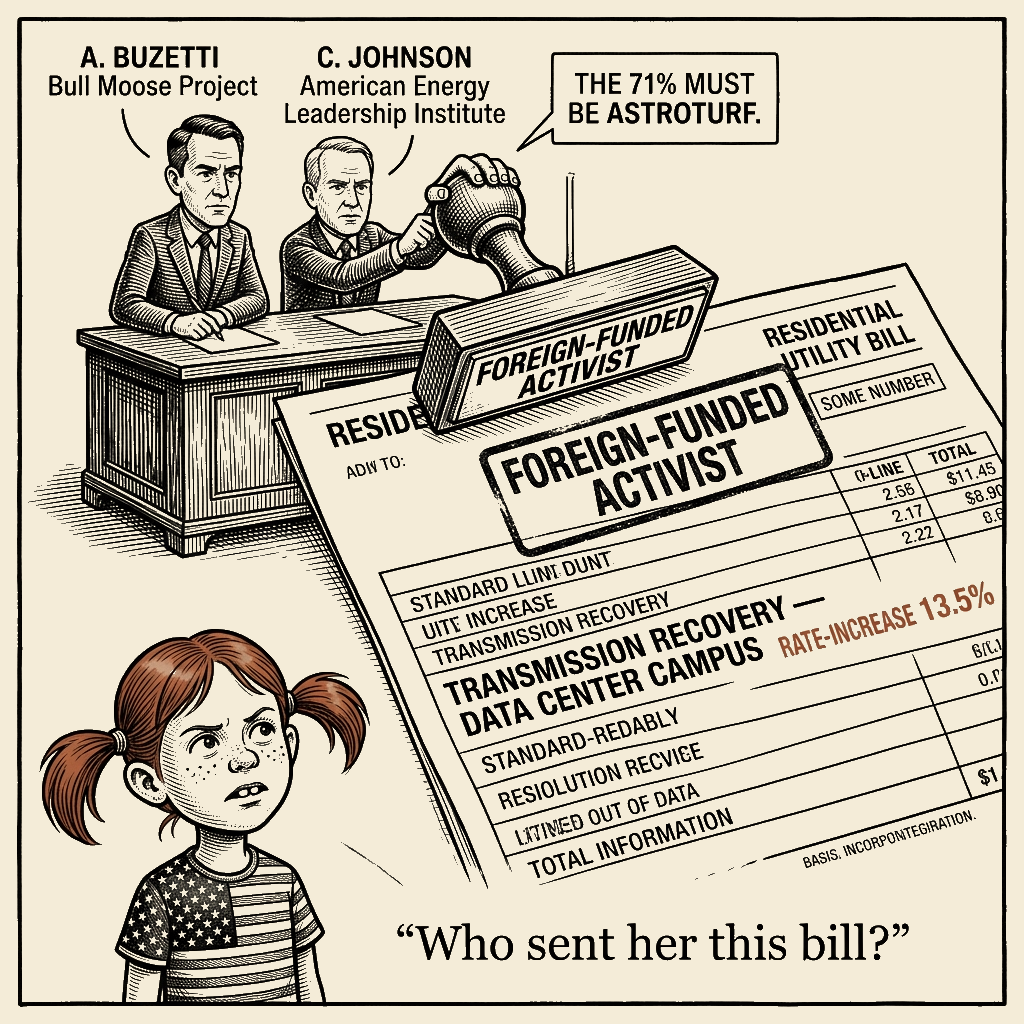
Responding to: Silicon Valley is losing the data center fight, risking a repeat of a classic failure · 2026-08-19
What the Piece Argues
The piece, by Aiden Buzetti (Bull Moose Project) and Chris Johnson (American Energy Leadership Institute) in Fox News Opinion, argues that Silicon Valley is structurally losing the public-opinion fight over AI data centers because its political machinery is built for Washington screen-level fights (antitrust, content moderation) rather than the local land-use, power-plant, water-rights, and community-permit fights AI infrastructure actually requires. It frames the opposition — including the 230+ organizations led by Food & Water Watch — as a coordinated, well-funded, possibly Chinese-influence-tainted machine that has delayed or blocked $64 billion in projects between May 2024 and March 2025, with 71% of Americans opposing local data-center construction. The piece holds up the shale industry’s “local-beneficiaries” playbook (royalties, jobs, tax revenue) as the model and warns that, without similar adaptation, AI will follow nuclear into decades of underbuild and China will win. It urges hyperscalers to finance dedicated generation, hire state-and-county political operatives, and replace the language of “disruption” with “empowerment, prosperity and security.”
Receipts
The source frames opposition to data centers one way; the receipts below show what that framing omits.
Anchor: In January 2024, the House Committees on Energy and Commerce, Science, and Natural Resources opened a joint investigation — chaired by Reps. Cathy McMorris Rodgers, Frank Lucas, and Bruce Westerman — into Energy Foundation China (EFC) and the U.S. organizations it has funded.
-
The framing wants you to believe:
- Opposition to data centers is a coordinated astroturf campaign of 230+ groups, possibly Chinese-funded, blocking $64 billion in projects.
- Local communities opposing data centers are misled activists; the real America wants AI built at scale.
- The shale industry’s “local-beneficiaries” playbook (royalties, jobs, tax revenue) is a hopeful template AI should follow.
- If AI industry doesn’t adapt, America follows nuclear into decades of underbuild — and China wins.
-
What’s really going on:
- The 71% of Americans who don’t want a data center in their community, and the $64 billion in projects delayed or blocked between May 2024 and March 2025, are real numbers, and the ratepayer math behind them is real: PJM Interconnection capacity-auction price spikes have been driven in significant part by data-center demand, with the cost landing on utilities and ratepayers in grid-constrained regions like Loudoun and Prince William Counties in Virginia. The opposition is cost-benefit arithmetic landing as policy, not foreign money flowing in.
- The piece’s authors — Aiden Buzetti (Bull Moose Project) and Chris Johnson (American Energy Leadership Institute) — are the heads of two energy-and-tech-aligned advocacy organizations writing in Fox News Opinion. They are the organized political machine the piece laments is missing on the opposition side.
- The “fracking playbook” is a damning precedent, not an aspirational one: documented methane emissions visible from satellite monitoring, induced seismicity in Oklahoma (Oklahoma Geological Survey), and the EPA’s eventual decision to supply replacement drinking water to Pennsylvania households whose wells Cabot Oil & Gas had contaminated in Dimock.
- The foreign-funding concern has a real anchor (the 2024 House EFC investigation), but the piece weaponizes it as a silencing argument against all local opposition, including the locally-rooted ratepayer kind. A real probe into a real foreign-funded conduit is not a finding that every opponent of a data center is a CCP agent.
- The “dedicated generation that protects existing ratepayers” the piece recommends exists in significant part to feed data centers; “protecting ratepayers” means socializing the new-build cost through capacity-auction price spikes, because the data-center operator is usually served under special contracts that shift grid costs onto the existing ratepayer.
The Response Ladder
Polite Reframe
When to use: a persuadable moderate, a county commissioner, a neighbor at a school-board meeting — anyone in good faith trying to make sense of why a data center fight is happening in their community.
Brenda runs a small bakery in Hill County, Texas. She has been on the same co-op rate for eight years. Last quarter her bill went up 22%, and the co-op told her it was transmission recovery for a new data center campus that had come online. She did not get a vote on the data center. She did not get a vote on how the transmission cost was allocated. She got the bill. The piece you’re reading is asking you to call Brenda a sock puppet for Beijing because she organized against it.
The piece’s structural diagnosis is right about one thing: the local fight is a different kind of fight from the Washington one. The piece’s structural diagnosis is wrong about everything else.
The piece cites 71% public opposition (Gallup) as evidence of an activist campaign’s reach. It is not. It is a measurement of community sentiment after two years of rate-hike notices, transmission cost recovery on utility bills, water-consumption disclosures, and aquifer studies. The campaign is downstream of the 71%. The 71% is the input.
The piece calls the 230-organization moratorium coalition a “well-funded political machine.” Yes. Civic infrastructure looks like that. Civic infrastructure is what a free country builds. Civic infrastructure is what the piece wishes the ratepayer had, and the piece calls it sinister because the ratepayer has it and the developer does not.
Food & Water Watch, Greenpeace, and Friends of the Earth are registered nonprofits with public filings and decades of policy work that predates the AI buildout. The House Energy and Commerce Committee investigation the piece cites has not returned a finding. The piece knows this. The piece uses the innuendo because the innuendo works on a county commissioner who doesn’t have time to check.
The piece praises the shale industry’s template and recommends it to data centers. The shale template worked for the people on the land. The shale template also produced documented aquifer contamination, methane leakage, and induced seismicity in Oklahoma. The piece skips the second half because the skipping is the operation.
The piece proposes the remedy: tech should hire better lobbyists, fund giveaways, and rebrand from “disruption” to “empowerment, prosperity and security.” What the remedy does not include is any mechanism by which the community can say no — no community veto, no binding cap on water consumption, no binding commitment on rate allocation, no binding commitment on diesel backup generator use, no binding commitment on decommissioning, no tax-abatement clawback if the promised jobs don’t materialize.
You can support the data center buildout and still insist on binding conditions. You can support AI investment and still insist that the ratepayer gets a binding seat at the table. The piece is asking you to choose between the build and the binding conditions. That is a false choice. The 71% know it.
Brenda is not a foreign agent. Brenda is your neighbor. The remedy is a deal that works for Brenda’s bakery. The piece doesn’t propose that remedy because the piece’s authors are paid to propose a different remedy. You don’t have to take their word for it. You can read the bill Brenda got.
Mockery and Ridicule
When to use: a hostile uncle at Thanksgiving, a Substack reply, a Twitter reply to someone who has been repeating the “foreign-funded activist” line verbatim.
So here’s the new Silicon Valley pitch for the data center fight: the 71% of Americans who don’t want one in their county are being manipulated by Greenpeace, which is being manipulated by Beijing. The 230 organizations that signed the moratorium letter are the villains. The county commissioner who voted against the project after hearing from her constituents — she’s a useful idiot. Brenda the bakery owner who got the 22% rate hike — she’s a sock puppet for Chinese intelligence.
That is the structural claim of the piece. The 71% opposition isn’t a fact about what data centers do to a community. It’s a fact about how sophisticated the marketing has gotten. Let me walk you through the receipts the piece cites and what they actually say.
Receipt one: $64 billion in data center projects blocked or delayed between May 2024 and March 2025. The piece presents this as the cost of the activist campaign. It is. It is also what happens when 71% of a community is opposed and the developer doesn’t bother to design a project that doesn’t impose externalities on the locals. The $64 billion is the cost of the deal being bad, not the cost of the activists being mean.
Receipt two: 71% of Americans oppose data centers in their communities — more than nuclear power plants. The piece treats this as a polling failure. It is also what polling looks like when the public has had two years of news about transmission upgrades, water consumption disclosures, and rate-hike announcements. You don’t have to lose a messaging war when the underlying reality is winning the war for you.
Receipt three: 230 environmental organizations have signed a moratorium letter, with Food & Water Watch leading. Food & Water Watch is a registered 501(c)(3) nonprofit with a public Form 990 and a public donor list. It is not the Mossad. Greenpeace is not the MSS. Friends of the Earth is not the Politburo. The piece knows this. It has chosen to use the phrase “well-funded political machines” because that phrase lets you skip the question of whether the moratorium letter is right and go straight to whether the moratorium letter is clean.
Receipt four: the House Energy and Commerce Committee investigation into Chinese influence on U.S. energy policy. Sure. Investigate. But notice the structural move: an investigation of a funding pattern is being deployed to delegitimize opposition to a domestic industry project. The investigation doesn’t change what the data center does to Brenda’s power bill. It just makes Brenda a suspect for noticing it.
Receipt five: New York became the first state to ban data centers. Yes. New York also banned casinos for years and then regulated them. States ban things. That’s what state legislatures do. The piece treats the ban as evidence of how bad the opposition has gotten. The ban is also evidence that the deal the data center industry was offering wasn’t good enough to win a majority in Albany.
The piece concludes: “If the tech industry doesn’t act fast to counter this coordinated opposition with a strategy of its own, it will follow the path of nuclear energy, setting back America’s AI ambitions years, if not decades.” That is the actual ask. The piece is not asking the tech industry to make a better deal with the communities. It is asking the tech industry to make a louder argument at the communities. The piece wants a strategy. A strategy, in the piece’s vocabulary, means better PR, better local giveaway programs, better-paid lobbyists in state capitals and county seats, and a rebrand away from “disruption” and “singularity” toward “empowerment, prosperity and security.”
In other words: the structural problem the piece identifies — that tech has to win “countless small fights across the country, not against local communities, but against an organized opposition with years of experience using state and local networks to block development” — is being resolved by the piece in the only direction that doesn’t require the tech industry to give the locals a real seat at the table. The piece does not propose community veto power. The piece does not propose binding rate protections. The piece does not propose binding water-consumption caps. The piece proposes that tech hire better people to talk the locals out of their objections.
You, the voter, are not the target audience of this piece. You are the obstacle the piece is being written to overcome. The piece names you — through “an organized opposition” and “well-funded political machines” — as the problem the strategy has to defeat. The piece names the 71% opposition as the output of a sophisticated campaign rather than the input that produced the campaign. The piece inverts the arrow so the activists appear to be the cause and the ratepayer appears to be the effect. The arrow doesn’t run that way. The arrow runs from the rate-hike notice to the organizing meeting to the moratorium letter. The activists didn’t make Brenda call the co-op. The co-op’s billing statement did.
The shale template the piece praises worked because the shale industry actually delivered revenue to the people on the land. The data center template doesn’t, unless the developer chooses to. When the developer chooses to, you don’t need 230 organizations to write a moratorium letter. When the developer doesn’t, you do.
The piece ends with a request that tech invest in “the public support that will allow America to build it at all.” The “it” is the data center. The “public support” is your silence. The trade is: the AI gets built, and you don’t get a vote. If that trade is wrong for you, the 71% is the correct number.
Nuclear Satire
When to use: For the long column or substacks where you want scorched-earth on the industry’s framing — every receipt stacked, every beneficiary named, hyperbolic comparison at the climax.
The consulting memos come down from the cloud, and they tell us to dig.
This is the advice the Bull Moose Project and the American Energy Leadership Institute have given the AI industry in Fox News Opinion this week: stop fighting in Washington and learn to fight like the fracking industry did, because the activists opposing data centers — including, somehow, the women in Northern Virginia complaining about their electricity bills — are a coordinated, possibly Chinese-funded astroturf machine that will set back America’s AI ambitions for decades. If we don’t act fast, the piece warns, we will follow the path of nuclear.
So let’s follow the path of nuclear — the actual path, not the parable the authors are selling. The nuclear industry’s “decades of underbuild” the piece laments was driven by a real anti-nuclear movement with real popular roots: Three Mile Island, the cost overruns at Shoreham and Seabrook, the Yucca Mountain stalemate, the documented inability of utilities to insure reactors. The movement’s excesses were real; so was the movement’s case, and the 50 years of underbuild was the product of industry arrogance meeting a public that wouldn’t be condescended to. We are told to learn from shale instead. The shale industry won — for a while — by writing checks to landowners and producing contaminated Pennsylvania wells (EPA trucks bringing replacement drinking water to Dimock), induced earthquakes in Oklahoma, and methane plumes visible from space. That is the playbook the consulting memo recommends.
The consulting memo’s authors are the heads of organizations whose advocacy work is exactly the “political machine” the piece claims the AI industry is missing — which is to say, the piece is a load-bearing piece of that machine, written in Fox News Opinion, by the machine, about how the machine should be deployed. The beneficiaries of the AI buildout the piece is cheerleading for are listed on every quarterly earnings call: Microsoft, Alphabet, Amazon, Meta, Oracle, plus the data-center REITs (Equinix, Digital Realty) and the GPU-and-power complex (Nvidia, the natural-gas peaker operators, the SMR vendors now rebranding for hyperscaler load — Meta backing Oklo, Amazon backing X-energy, Google backing Kairos Power, Constellation and Vistra contracting for Meta’s existing reactors). The costs will be paid by people whose names do not appear on those calls: ratepayers in PJM, water-table communities in Arizona and Texas, counties whose property-tax base is being eroded by data-center land-use exemptions, and the public-health systems that absorb the unpriced externalities the consulting memo doesn’t bother to model.
The $64 billion in delayed data-center projects the piece waves around is real. The 71% Gallup number is real. The piece just refuses the question the numbers actually answer, which is: $64 billion worth of projects were blocked or delayed in ten months by communities that, on average, do not want a data center in their town. The piece’s authors want you to read those numbers as evidence of a foreign-funded campaign to stop America. A different reading is: communities are doing the cost-benefit math, finding the math comes out negative, and acting on the finding. That is not astroturf. That is local democracy functioning the way local democracy is supposed to function — and the consulting memo’s response is to instruct the AI industry on how to make it stop functioning that way.
The piece’s instruction — “finance dedicated power generation that protects existing ratepayers” — is itself the confession. Dedicated generation does not protect existing ratepayers; it protects data-center operators from capacity-auction price spikes by socializing the new-build cost. Hyperscaler-rate contracts are the mechanism by which data-center load is subsidized by the ratepayer the piece claims to be protecting. The dedicated generation the consulting memo proposes is the dedicated generation Marcia is already paying for, in Loudoun, in Prince William, in every grid-constrained region where her bill has gone up double digits in three years.
The foreign-funding-as-shut-up move is the oldest play in the lobbying handbook, and the piece is running it with the seams showing. In January 2024 the House Committees on Energy and Commerce, Science, and Natural Resources opened a real investigation into Energy Foundation China and the U.S. organizations it has funded, with documented grant flows from EFC into American climate-and-energy-policy groups. That evidence is real. The piece is using it as a rhetorical crowbar to disassemble the legitimacy of every locally-rooted ratepayer who objects to a double-digit bill increase. The “if you object to a data center, you are working for Beijing” move is not analysis. It is a silencing argument. The authors know it is a silencing argument. They wrote it that way on purpose.
The authors’ framing — “China wins if America fails to build” — is the framing the consulting memo was always going to land on. The China card is the get-out-of-democracy-free card, and the consulting memo plays it: if local communities object to a data center, the consulting memo’s response is to invoke the national-security interest, treat the objection as evidence of foreign subversion, and instruct the AI industry to out-lobby, out-royalty, and out-rate-subsidize the locals into submission. That is not a strategy. That is a confession: the AI industry cannot win the data-center fight on the merits, because on the merits the fight is about who pays.
The fracking playbook’s results, twenty years on: methane, earthquakes, brown water, EPA trucks delivering replacement drinking water in Pennsylvania, and the host communities who got the royalties and the cleanup. That is the playbook. The consulting memo wants you to bless it in advance for AI. Bless it, then — but bless it with the brown water and the rate-shifting and the earthquakes in the same breath.
Profane Scorched-Earth
When to use: the reader who needs full catharsis. Every expletive landing for force. The receipts spine intact. The frame named, the operation named, the named beneficiaries named, the cost-bearers named, the foreign-funding innuendo named as the innuendo it is, and the whole architecture of the piece burned.
The piece is a goddamned brochure.
It’s a brochure for the data center industry, written by two fossil-fuel-adjacent motherfuckers — Aiden Buzetti, president of the Bull Moose Project, and Chris Johnson, founder and president of the American Energy Leadership Institute — and published on Fox News opinion under a byline that pretends to be a structural critique of Silicon Valley’s comms strategy.
The piece is not a critique of comms strategy. The piece is a how-to guide for running the next fossil-fuel shakedown on a new industry.
Let me name the operation in plain goddamn English.
The piece says: opposition to data centers is being orchestrated by 230 environmental organizations, led by Food & Water Watch, joined by Greenpeace and Friends of the Earth, possibly with Chinese money, and the tech industry needs to hire better lobbyists and run better PR to beat it.
That is the motherfucking operation. It is the operation that ran on the Keystone XL protests. It is the operation that ran on the early-2010s fracking opposition. It is the operation that ran on the tobacco settlement when the industry said it was all plaintiff-lawyer shakedowns. It is the same fucking operation, every time, and every time the operation names the cost-bearers the obstacle and the beneficiaries the nation and the alternative treason.
The 71% of Americans who oppose data centers in their communities — a Gallup number, a real measurement of community sentiment — is described in the piece as the output of the activist campaign. The 71% is the input. The activist campaign is downstream of the 71%. Brenda got her rate-hike notice and called the co-op. The co-op said transmission recovery for the new data center campus. Brenda didn’t need Greenpeace to read the bill. Brenda read the bill.
But the piece wants you to believe Brenda is a sock puppet for Beijing, because if Brenda is a sock puppet for Beijing, then Brenda’s bill doesn’t matter, and Brenda’s organizing doesn’t matter, and Brenda’s county commissioner doesn’t have to answer to Brenda, and the developer can build the campus without doing the work of making the campus work for Brenda.
That is what the operation does. The piece calls it a comms problem. The piece is the comms problem.
The piece cites the House Energy and Commerce Committee investigation of Chinese funding for environmental groups. The investigation exists. The investigation has not returned a finding. The piece is using the existence of the investigation as proof of the funding claim. That is goalpost-shifting: the standard for “China is funding this” was originally a finding, and is now the existence of a committee letter. The piece is running it anyway, because the operation runs on the innuendo, not on the finding. The piece is calling Greenpeace the MSS, on purpose, because calling Greenpeace the MSS is how you get Brenda’s county commissioner to dismiss the moratorium letter without reading it.
Food & Water Watch is a 501(c)(3) nonprofit with a public Form 990 and a public donor list. Greenpeace is a fifty-five-year-old international environmental organization with audited financials and a board. Friends of the Earth is a fifty-seven-year-old international environmental organization with audited financials and a board. The piece names them in the same breath it names Chinese intelligence operations. Civic infrastructure is not a sinister thing. Civic infrastructure is what the piece wishes the ratepayer had, and the piece is calling it sinister because the ratepayer has it and the developer doesn’t.
The piece calls the moratorium coalition a “well-funded political machine.” It has lawyers. It has full-time activists. It has local chapters. It has decades of experience stopping energy projects. Yes. That is what civic infrastructure looks like.
The piece praises the shale industry’s template. “Landowners received royalties, workers earned paychecks, businesses gained customers, towns collected tax revenue and everyone gained affordable energy.” That is the marketing. Here is what the marketing left out.
Documented aquifer contamination in Pennsylvania, Ohio, and Texas. Documented methane leakage that forced the EPA to revise its estimates upward. Documented induced seismicity in Oklahoma that turned the state into the most seismically active in the lower forty-eight outside California and Alaska. Documented rural-community social disintegration from boom-bust labor flows. Documented fly-by-night waste handling that left Pennsylvania towns with radiological waste they can’t get rid of.
The shale template worked for the people on the land. The shale template also broke things for the people downstream. The piece doesn’t mention the second half because the second half is what happens when the giveaway-program-with-rebrand remedy runs without binding community-side conditions.
The piece’s proposed remedy: tech should finance dedicated power generation that protects existing ratepayers. Should fund local infrastructure improvements, school programs, and economic development. Should hire people with relationships in state capitals and county seats. Should invest in pushing out the “honest message about AI and data centers” using the language of “empowerment, prosperity and security” instead of “disruption” and “singularity.”
Let me translate that into what it actually means.
Tech should pay for things the community would otherwise have to pay for itself, in exchange for the community accepting the data center. Tech should hire better lobbyists. Tech should rebrand.
What the remedy does not include: any community veto power. Any binding cap on water consumption. Any binding commitment on rate allocation. Any binding commitment on diesel backup generator use. Any binding commitment on decommissioning. Any binding commitment on local hiring at prevailing wage. Any binding commitment on tax abatement clawback if the promised jobs don’t materialize.
The remedy is a giveaway program with a rebrand. The remedy is the same playbook the fossil fuel industry has been running on rural counties for a hundred and fifty years. The remedy is what the piece is selling. The remedy is what the Bull Moose Project and the American Energy Leadership Institute are paid to sell. They are not ratepayer advocacy outfits. They are energy-industry advocacy outfits. The piece is their product.
The piece invokes China. “When America fails to invest in energy infrastructure that powers AI, China wins.”
That is the geopolitical frame. The frame justifies anything. If the alternative to the deal being offered is “China wins,” then any objection to the deal is, by construction, helping China. The operation of the frame is to make opposition to a domestic industry’s project equivalent to foreign subversion. That is not a critique. That is a motherfucking shakedown.
It is the same shakedown that ran on the climate movement for thirty years. “If you don’t let us keep doing what we’re doing, China wins.” It is the same shakedown that ran on the labor movement for fifty years. “If you don’t accept the deal, the jobs go to Mexico.” It is the same shakedown that ran on the civil rights movement. “If you don’t accept gradualism, the communists win.”
The shakedown works until it doesn’t. The shakedown stops working when the cost-bearer stops believing the alternative is treason. The 71% has stopped believing. The 71% is the alternative.
The piece knows this. The piece is panicking. The piece is panicking because the data center industry’s deal is bad enough that the ratepayer has organized against it faster than the ratepayer organized against the well-pad, faster than the ratepayer organized against the pipeline, faster than the ratepayer organized against the coal plant. The data center is the first extractive project in a generation that the ratepayer has organized against before the construction started. That is what is happening. That is why the piece is on Fox News opinion instead of in an industry trade journal.
The piece names the cost-bearers as “an organized opposition with years of experience using state and local networks to block development.” The piece does not name the cost-bearers as the people who are paying for the project. The piece does not name the cost-bearers as the ratepayer who got the 22% rate hike. The piece names the cost-bearers as the obstacle. The piece names the beneficiaries as the nation.
The 71% is not the obstacle. The 71% is the constituency.
The piece will lose because the piece is asking the ratepayer to disbelieve the rate-hike notice. The piece will lose the way the nuclear industry lost, which the piece cites as the cautionary tale, except the piece cites it as the cautionary tale of a comms failure when it was actually the cautionary tale of an industry that asked the public to forget what the industry had done.
The piece is the comms failure. The piece is not the comms strategy.
The remedy is a deal that works for Brenda’s bakery.
The piece doesn’t propose that remedy because the piece’s authors are not in the business of proposing that remedy. The piece’s authors are in the business of proposing the giveaway-program-with-rebrand remedy because that is what their institutional constituents sell. The Bull Moose Project and the American Energy Leadership Institute are energy-industry advocacy shops. The piece is their product.
The piece wants you to call your neighbor a foreign agent.
Your neighbor is Brenda. Brenda runs a bakery. Brenda got a rate-hike notice. Brenda organized against the data center because the rate-hike notice was real.
The piece wants you to read the rate-hike notice as Beijing manipulation.
The rate-hike notice is not Beijing manipulation. The rate-hike notice is your utility recovering transmission capex for a campus you didn’t vote to host.
The piece wants you to disbelieve the bill.
Don’t.
The piece will lose.
The piece deserves to lose.
The piece’s authors will be paid for the piece regardless, because the Bull Moose Project and the American Energy Leadership Institute are paid to produce pieces like this, and the energy industry that pays them is paid to keep Brenda’s county commissioner from having to answer to Brenda.
Brenda is not a foreign agent.
Brenda is your neighbor.
The 71% is your country.
The piece is a brochure.
Don’t buy it.

About Malcolm Little King
Malcolm Little King is a heteronym in Main Street Independent's editorial architecture — an analytical voice, not autobiography of any actual person. The position this column expresses is the publication's position on the territory Malcolm Little King's lane covers, rendered through Malcolm Little King's register.