Analyzing: Want to stop socialism? A modern civic education needs a lot more than you'd think · 2026-08-20
What the Editorial Argues
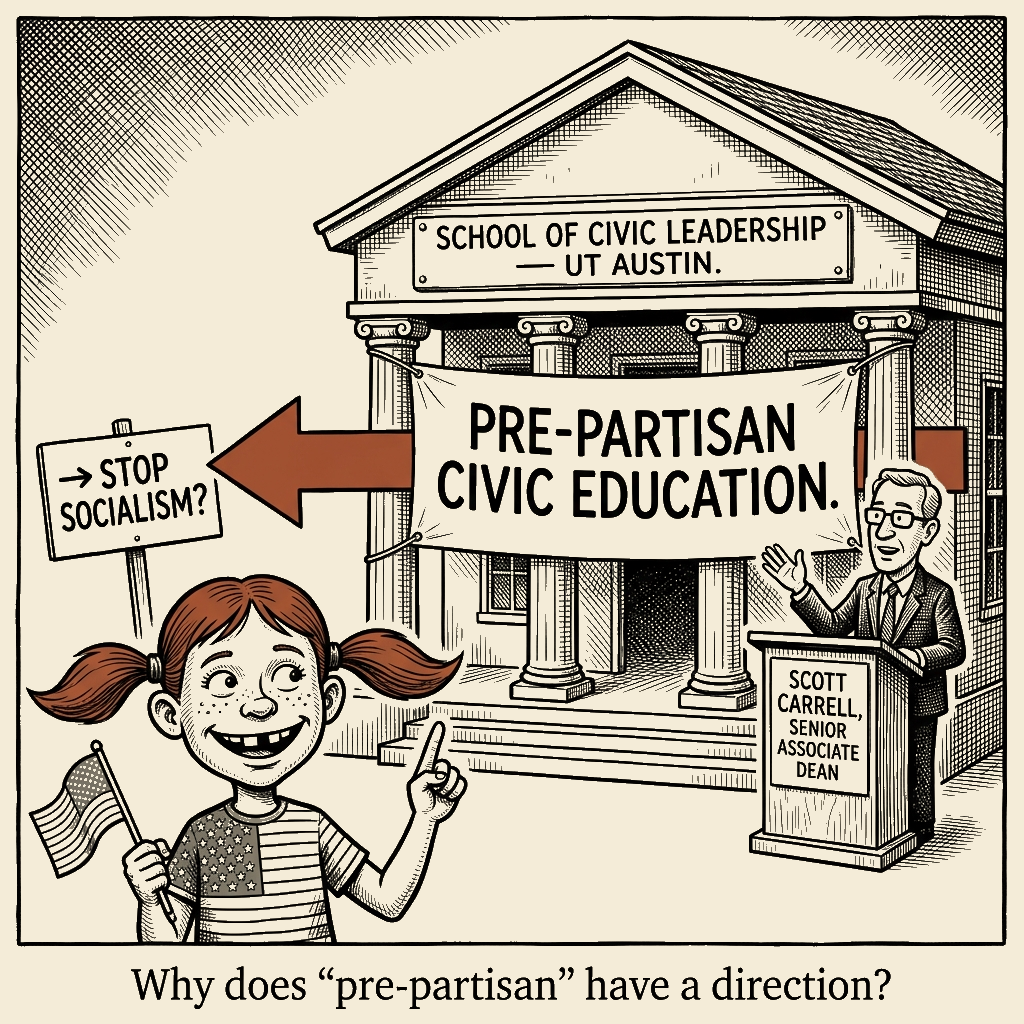
Scott Carrell, a senior associate dean at the University of Texas at Austin’s School of Civic Leadership and an NBER research associate, argues in a Fox News Opinion essay that rising support for “socialist” candidates among younger, college-educated voters reflects a deficit of foundational knowledge — particularly in economics — that civic education is meant to remedy. The piece positions the new civic-education model as “pre-partisan” — built on three pillars (history, constitutionalism, economics) — and claims economics is often the least-developed of the three, leaving graduates unable to evaluate policy claims on their merits before they vote to “reform or replace” American institutions. The headline Carrell’s argument rides under is “Want to stop socialism?” — a framing that announces, in the first words the reader sees, that the curriculum is being proposed as the answer to a specific political threat, not as a pre-partisan reform. The headline frames the project as the answer to socialism; the body tries to frame it as restoring intellectual seriousness. The two framings are not the same claim, and the piece does not reconcile them.
Receipts
What the framing wants you to believe.
- Civic education that integrates economics is a pre-partisan reform preparing students for informed citizenship regardless of political direction.
- Young college-educated voters’ leftward shift reflects a knowledge deficit that better teaching of history, constitutionalism, and economics would correct.
- The University of Texas at Austin’s School of Civic Leadership is offered as the model of how this should be done.
What’s really going on.
- The “pre-partisan economics” frame treats one particular ideological tradition — mainstream, free-market-coded economics, with its characteristic emphasis on incentives, efficiency, and unintended consequences — as if it were the neutral analytical lens, an attribution the body never earns and the title’s “Want to stop socialism?” framing contradicts.
- The piece is the work of a dean inside a donor-funded civic-education school launched explicitly to counter perceived ideological capture at American universities; the institutional interest sits undisclosed in the body and named only in the bio.
- Carrell is correct that the asymmetry exists in the survey literature — Pew, Gallup, and the Democracy Fund/UCLA Nationscape data show college-graduate democratic-socialist sympathy exceeding non-college-graduate sympathy by meaningful margins in younger cohorts; the indictment is what he does with the observation, not the observation itself. The inference that the relevant variable is civic-knowledge deficit rather than class position under contemporary capitalism is the move the piece does not earn.
- The load-bearing factual premise — that “only about one-quarter” of students who began college in 2012 received any college-level economics instruction — is offered in Carrell’s body without a citation. The figure happens to align with Wendy Stock’s published analysis of the 2004 and 2012 Beginning Postsecondary Students surveys (Stock finds 26 percent of 2012 starters had some economics exposure, up from the 2004 cohort), but Carrell does not name the source and the omission is part of the operative opacity: the “pre-partisan” register treats empirical backing as optional when the empirical backing would actually help.
The Operation
I drafted versions of this. The “economic literacy as antidote to socialism” pitch ran in think-tank and cable-segment form throughout the 2000s; I sat in the focus-group debriefs where “pre-partisan” was tested against “neutral” and “objective” and “non-ideological”; I helped commission the message-discipline drills that taught surrogates to call free-market economics the default analytical lens. The piece in front of you is the institutional-academic version of the same operation, dressed in a UT Austin faculty-bio instead of a cable tie. I will name what I built.
Institutional authorship. The School of Civic Leadership at UT Austin was established in 2023 by the UT System Board of Regents with the explicit mission of engaging in “a comprehensive, interdisciplinary program of research, teaching, training and equipping students in the knowledge and aptitudes necessary to lead in a free society,” per the regental language. Founding donors in the Texas conservative donor network provided the lead gifts; the school is the operational arm of a long-running conservative response to perceived ideological capture in higher education, traceable from Allan Bloom’s The Closing of the American Mind (1987) through the John M. Olin Foundation’s civic-education grants of the 1990s and 2000s — the Olin Foundation’s documented grantees included Allan Bloom, Milton Friedman, the American Enterprise Institute, the Federalist Society, the Heritage Foundation, the Hoover Institution, the Manhattan Institute, and law-and-economics centers at major American universities, before the foundation wound down in 2005 — to the post-2016 proliferation of state-funded civic-education centers in Texas, Florida, Ohio, and elsewhere. The apparatus overlaps with Hillsdale College’s “1776 Curriculum,” the Trump-era 1776 Commission, state-level civics mandates, and a donor network with substantial Koch-adjacent and Texas-conservative-philanthropy involvement. The same apparatus would catch a structurally identical progressive version — a dean at a left-coded civic-education school diagnosing right-coded sympathies among graduates as a civic-knowledge deficit and naming left-coded economics as “pre-partisan” would be doing the same operation. The discipline is general.
Distributional impact. The beneficiaries are the institutional entities built to deploy this framing — the School of Civic Leadership, peer civic-education schools, the faculty whose careers are made inside them, the donor networks whose ideological commitments now have an academic beachhead, and the broader conservative movement that recruits graduates into the “economic reasoning = neutral framework” frame. The diffuse cost-bearers are (a) students at institutions without parallel civic-education offerings, who face a relative credentials disadvantage; (b) the heterodox economic traditions (Marxist, post-Keynesian, feminist, ecological, institutional, development) that the “pre-partisan” register excludes by treating mainstream economics as the default framework; and (c) the young voters whose political views the framing characterizes as symptoms of educational failure rather than as responses to documented material conditions. The piece itself notes that working-class support for socialism is weaker than college-graduate support — this asymmetry does not support the inference the piece draws (knowledge deficit among the credentialed), but it does support the inference the piece does not draw, which is that the relevant variable is class position under contemporary capitalism rather than civic-knowledge deficits.
Alternative design. A civic education program genuinely pre-partisan — i.e., optimized for the stated rationale of producing graduates equipped to evaluate competing claims — would include heterodox economic traditions rather than treating one tradition as the neutral lens; would engage the empirical record of which economic arrangements have produced prosperity for whom at whose cost; would teach the historical sociology of the field (that mainstream economics is itself an ideological formation with documented institutional politics) rather than its idealized self-presentation; and would not lead its public-facing pitch with a stop-socialism worry-question.
Worked example. Take the $15 federal minimum wage — the closest thing to a concrete policy proposal among the democratic-socialist agenda Carrell’s demographic supports. Causality: a federal $15 floor raises the wage bill for firms employing workers previously earning below $15; whether it reduces poverty depends on whether the disemployment effect on marginal low-wage workers offsets the income gain for the inframarginal. Efficiency: the welfare cost depends on the demand elasticity for low-wage labor and the degree of monopsony in local labor markets; a one-size-fits-all federal floor does not internalize the geographic variation that makes a $15 floor binding in rural Mississippi and non-binding in Manhattan. Incentives: firms substitute capital for labor, automate, raise prices, or relocate; the long-run incidence on consumers and on workers above the floor is empirically contested. Unintended consequences: the policy’s most predictable effect is to compress the wage distribution below $15 and accelerate displacement of workers in the bottom decile who cannot be productively employed at $15 in their local labor market. The empirical literature is large and contested. Carrell’s framework, applied honestly to the specific proposal, produces a contested empirical analysis, not a knowledge-deficit diagnosis. The piece’s claim that pre-partisan economics would clarify the disagreement cannot be tested against the actual proposals Carrell’s named demographic supports — because the piece does not run that test on any of them.
FGL across constituencies. The author operates inside the institutional beneficiary — fear (university capture, its political translation), greed (donor cultivation, career platform), low laziness. The apex beneficiary is the donor network and the conservative movement more broadly — fear (ideological capture becoming political capture), greed (institutional positioning), low laziness. The rank-and-file reader is offered fear (socialism rising among the credentialed young, with Mamdani installed as NYC mayor since January 2026 as the proximate shock) and a soft greed appeal (graduate prosperity, restored civic order) with a laziness layer underneath: the implicit suggestion that with proper economic education, the analytical answer becomes obvious, sparing the reader from sustained engagement with the material conditions that produce socialist sympathies. The reader’s fear and laziness are real and human; the operation recruits them rather than creates them.
Technique identification.
-
Frame-engineered relabeling (
[bf_catalog:frame_engineered_relabeling`](/propaganda/docs/bad-faith-techniques-catalogue#frame-engineered-relabeling); Luntz, Lakoff; cf. WSJ Editorial Technique Catalogue §4.1). The piece relabels what is in practice a politically-aligned counter-curriculum as “civic education” — a phrase that carries connotations of common-good, foundational American learning. Calling the framework “pre-partisan” is the substitution: the underlying referent — a particular ideological tradition within economics, traceable through the Chicago and Austrian schools, dominant in American policy discourse, with documented political coalitions — is relabeled as the neutral analytical lens. Cue: “when taught correctly, economics doesn’t tell students how to vote or which candidates to support. Rather, it provides a common analytical framework to teach students how to evaluate competing claims and consider tradeoffs.” The disavowal of partisanship is itself a partisan move; Lakoff’s framing scholarship establishes that negating a frame strengthens a frame. -
Motte-and-bailey (Shackel, Metaphilosophy 36:3, 2005; the term popularized by Scott Alexander in 2014). The motte is “we just want students to understand basic economics and the constitutional order before they vote to change it.” The bailey is “stop socialism” — the headline frame and the body’s repeated positioning of civic education as the answer to a leftward turn. The motte is defensible; the bailey is the operation. When the bailey is challenged, the piece retreats to the motte (“we’re not telling anyone how to vote; we’re just teaching economics”). The bailey is then resumed in the closing paragraphs. Cue: “Before we can develop a reasonable outlook on the policy issues of the day, we must first acquire knowledge…” paired with “Before Americans vote to reform or replace our economic and political institutions, they must first understand how those institutions actually work.”
-
Multiple-audience-targeting (WSJ Editorial Technique Catalogue §3 / §4.3). From the lead: “The recent election victories of socialist and progressive candidates in New York, Michigan and Minnesota, along with Democratic Socialist Francesca Hong’s narrow loss in Wisconsin, highlight the changing political and economic attitudes of a growing segment of Americans.” The Fox audience reads the threat; the technocratic reader reads the named jurisdictions; the university-administration reader reads the demographic the civic-education school is built to reach. The embedded Fox News Poll callout (“FAITH IN HIGHER EDUCATION IN THE US IS COLLAPSING”) executes the intra-outlet citation loop noted in the Fox Catalogue — the outlet’s own polling cited as evidence of an urgency the op-ed is positioned to address.
-
The “pre-partisan” claim as asymmetric prescription (an instance of
[bf_catalog:goalpost_shifting`](/propaganda/docs/bad-faith-techniques-catalogue#goalpost-shifting)). The piece asserts that economics is pre-partisan and applies the prescription against a named leftward direction without engaging whether the same prescription would apply against a rightward direction. If young, college-educated voters had been moving sharply toward libertarian or paleo-conservative positions, would the prescription be identical? The piece does not say, and the structural answer is that the prescription is calibrated against the threat the donor-funded civic-education movement was built to address. Cue: the prescription’s silence about the symmetric case. -
Person-as-policy displacement and the “study shows” ledger without the studies (analogue of WSJ Editorial Technique Catalogue §4.5). The piece treats “socialism” as a unitary threat rather than engaging specific policies. Without specific policy content, “pre-partisan economics” cannot be applied, because there is nothing to apply it to. The displacement lets the piece assert that economic reasoning would answer the question without ever specifying the question. The piece also presents the civic-education model as a remedy without engaging the empirical literature on whether civic-education courses actually produce more-informed voters, or whether informed voters (by whatever standard) vote differently — the presumption that better economic knowledge would shift young voters’ policy preferences is itself a contestable empirical claim, which the piece asserts as obvious. Cue: “socialism” used as a category throughout without sub-policies named; the gap between “economics is necessary to evaluate policy claims” (true) and “therefore young voters with more economics will vote differently” (contestable empirical claim asserted as obvious).
-
The both-sides-then-pivot structure (a
[bf_catalog:strawman`](/propaganda/docs/bad-faith-techniques-catalogue#strawman) deployment). “Conservatives emphasize ideological capture within universities. Progressives emphasize housing affordability and economic insecurity. Both likely play a role, but these results raise a more fundamental issue.” The conservative diagnosis is named but bracketed; the progressive diagnosis is named but dismissed in favor of a third explanation that aligns with the writer’s institutional interest. The economic-insecurity explanation is the suppressed variable; the piece’s framing cannot accommodate that voters are responding to documented material conditions rather than to knowledge deficits. -
Expert-deference / authority-credential (WSJ Editorial Technique Catalogue §3.7). The byline deploys heavy credentialing (senior associate dean, EAC professor of Economics, NBER research associate) to license the prescription. The credentialing is real; the credentialing’s function here is to license a curricular prescription rather than to advance a specific argument. Cue: the bio’s three-line credential stack applied to a piece that does not cite specific empirical evidence for its central claims about civic education.
-
The threat-inflation closer (WSJ Editorial Technique Catalogue §4.13). The closing — “Before Americans vote to reform or replace our economic and political institutions, they must first understand how our institutions actually work” — inflates the stakes from a curriculum question to a question of institutional survival, and positions the chosen civic-education intervention as the answer.
-
Bandura cluster, applied to the operation as a whole (Bandura, Moral Disengagement, 2016). The mechanisms run in concert: moral justification — civic education serves the higher cause of informed citizenship, which licenses the implicit stop-socialism goal; euphemistic labeling — “civic education,” “pre-partisan,” “informed citizenship” relabel what the piece is actually building, a movement pipeline; advantageous comparison — compared to the maximally-captured university, civic education is the obvious alternative; the comparison is calibrated; displacement of responsibility — the cause of socialist sympathies among the credentialed young is located in failures of the educational system rather than in failures of the economic system; the system itself is exonerated; attribution of blame — young voters’ political views are framed as symptoms of a knowledge deficit rather than as responses to documented material conditions. Naming one mechanism in isolation understates the operation; the cluster is the operation.
The lineage trace. The modern operation runs from Bloom’s The Closing of the American Mind (1987) through the Olin Foundation’s civic-education funding through the Mont Pelerin Society’s institutional defense of “the market” against democratic pressure; from Lippmann’s Public Opinion (1922) — the assumption that public opinion is constructed through institutional framing rather than direct engagement with reality — to Bernays’s Propaganda (1928) — the engineering of consent. The piece is a contemporary instantiation of the same assumption. The Frank Luntz 2002 memorandum to the Bush White House on “The Environment: A Cleaner, Safer, Healthier America” (Luntz Research Companies) is the documented operational form of the broader message-discipline tradition the piece participates in — the tradition of recommending vocabulary substitutions designed to advance a predetermined political outcome while disclaiming the politics. (Where I cite Oreskes and Conway on manufactured consensus, the disclosure carries: I worked the apparatus that attacked their argument; the apparatus was wrong; the documentary record their Merchants of Doubt compiles supports the reading.) I worked from these texts in the cable years and cite them now with the disclosure that I attacked their lessons reflexively when I was running them.
Audience-management function. The piece addresses at least four constituencies simultaneously. The Fox Opinion reader: identity confirmation (anti-socialism), grievance ratification (universities are corrupting the youth), permission structure (it’s acceptable to oppose the young voters’ socialist turn because they don’t understand economics). The technocratic class: the credentialing (NBER, EAC professor, dean) is meant to be re-citable in serious settings; the “pre-partisan economics” formulation is the part designed to circulate. The institutional donor network: the piece is itself a piece of the donor-funded civic-education apparatus’s public-facing work; the author extends the network’s reach into the Fox Opinion readership. The captured reader the column is in service of: the slow-recognition reader who is being asked to accept a movement pipeline as a civic reform, and who is owed the autopsy.
The Record
Anchor receipts. The piece’s substantive claims rest on (a) the existence of a recent pattern of electoral gains by self-identified socialist or progressive candidates in New York, Michigan, and Minnesota, (b) the empirical observation that college-graduate support for democratic-socialist candidates exceeds working-class-without-degree support (a real pattern in the Pew, Gallup, and Democracy Fund/UCLA Nationscape survey literature), and (c) the claim that only about one-quarter of students who began college in 2012 received any college-level economics instruction. The one-quarter figure has direct support in Wendy Stock’s published analysis of the 2004 and 2012 Beginning Postsecondary Students surveys: Stock finds 26 percent of 2012 starters had some economics exposure (74 percent never took economics), up from the 2004 cohort. The Francesca Hong Wisconsin reference is also confirmed: Hong, a Democratic Socialist state representative, finished second in the August 12, 2026 Democratic gubernatorial primary to Milwaukee County Executive David Crowley in what the New York Times characterized as a “tight” race — a major upset for the progressive wing of the party. The institutional facts — UT Austin School of Civic Leadership exists, established by the UT System Board of Regents in 2023 with the regental language cited in the cui bono trace; Justin Dyer is named as its inaugural dean; Carrell is named as a senior associate dean and NBER research associate — are verifiable from the institution’s public records and Carrell’s named bio.
Unconfirmed claims. [specific founding-gift amounts and complete donor roster for UT Austin's School of Civic Leadership: unconfirmed — convergence threshold not met.] The institutional overlaps the piece participates in are documented in public reporting; the specific donor names and amounts for UT Austin’s program are not independently verified in this revision. The civic-education movement of which UT Austin’s School of Civic Leadership is one of the better-funded and more visible anchors overlaps with Hillsdale College’s “1776 Curriculum,” the Trump-era 1776 Commission, state-level civics mandates (Florida, Texas, and others), and a donor network with substantial Koch-adjacent and Texas-conservative-philanthropy involvement; the institutional overlaps are documented; the specific donor chains for UT Austin’s program are not.
Per-citation accuracy verdicts. The piece cites no external sources in the body; it rests on Carrell’s named credentials and on a paraphrase attributed to Dean Justin Dyer (“Civic education gives us this knowledge and in so doing prepares us for liberty”). The Dyer formulation is consistent with the public register of the school’s publications. The unsourced specific about one-quarter of 2012 freshmen receiving economics instruction is a load-bearing factual claim about a load-bearing premise (the civic-knowledge deficit diagnosis); Carrell’s omission of source is a real omission, but the underlying empirical claim is supported by Stock’s published work even if Carrell does not cite it. The citation debt remains Carrell’s; the figure itself is not wrong. The piece is, in the catalog’s terms, a “study shows” ledger without the studies — the prescriptions are asserted, not demonstrated.
The load-bearing omissions. First, the institutional context: a dean at a new civic-education school that exists explicitly to counter perceived ideological capture, writing in a Fox News Opinion column to make the academic case for civic education as the proper response to rising socialist sympathies, does not disclose that institutional context in the body. Second, the donor base: the school is funded by a documented conservative donor network; this is disclosed in the school’s founding announcements but not in the body of the op-ed. Third, the active ideological coding of “pre-partisan economics”: the piece treats mainstream economics as the neutral lens without engaging the historical sociology of the field — that the Chicago and Austrian traditions dominant in American policy discourse are themselves ideological formations with documented political coalitions, and that the choice of this tradition as “the framework” rather than one framework among several is itself a political choice. Fourth, the material conditions the piece elides: the affordability crisis named in the lead, the wage-suppression documented in the survey literature, the reasons respondents in the actual data give for considering socialism. The piece treats these as competing explanations that the civic-education frame supersedes; the documented record suggests the civic-education frame does not supersede them but supplements them with a movement pipeline. Fifth, the specific policy content: the piece does not engage whether the civic-education curriculum being advanced would be equally prescribed if young voters were moving sharply toward a different ideological direction — the asymmetric-application question Carrell’s framing depends on not being asked. Sixth, the curricular-content critique: the piece does not engage the documented critiques of the three-pillar civic-education model — that history, constitutionalism, and economics in this configuration tend to emphasize founding-era constitutional history and market economics over labor-history, civil-rights-history, and inequality-economics content that has become prominent in mainstream economics and political-science departments.
Brief missing-information declaration. The donor-network specifics the analyst has at the level of the founding-announcement level are verifiable; specifics about donor–curriculum conversations or about the internal deliberations of the School of Civic Leadership are not in the public record and would be retained-memory speculation if supplied, so they are not. The retained-memory account of the focus-group debriefs and message-discipline drills from the analyst’s own career is flagged as non-verifiable from the public record; the reader is on notice that this is operator’s-eye reconstruction grounded in the general literature on conservative message discipline (the documented Luntz 2002 memorandum, Lakoff’s framing scholarship, Oreskes & Conway’s Merchants of Doubt on manufactured consensus), not in specific leaked documents from this column’s production.
How to Recognize This
The pattern is the selective-threat civic curriculum — a curricular reform proposed as the answer to a specific ideological direction, dressed in the language of pre-partisanship and common-good civic education.
The mechanism. The piece recruits the reader’s felt sense that students should learn more about how their government and economy actually work — a felt sense I do not mock and that the piece genuinely shares with many of its readers — and channels that felt sense toward a specific answer to a specific threat. The mechanism works because the felt sense is real and the answer is uninspected.
Textual signals.
- The headline pairs the curricular reform with a specific ideological direction. (“Want to stop socialism?” with the curricular reform as the answer.) If the reform were genuinely pre-partisan, the headline would not need the specific direction.
- “Pre-partisan” or “nonpartisan” is asserted as a property of the curriculum without engaging what specific policy content the curriculum covers or omits. Socialism is treated as a category; Medicare for All, the $15 minimum wage, public housing, climate policy — the actual content — are absent.
- The both-sides-then-pivot structure: “Conservatives say X; progressives say Y; both matter, but…” — watch for the pivot to a third explanation that aligns with the writer’s institutional interest.
- The institutional interest sitting outside the body: when the bio line names the writer’s affiliation and the body’s argument leans on that affiliation, ask what the institution’s stake is.
Why it works. The “pre-partisan” register recruits the reader’s felt experience of analytical neutrality. If the reader already accepts the framework as the default lens, then disagreement with the framework appears as ideological capture rather than as substantive argument. The civic-knowledge deficit frame recruits the reader’s felt experience of educational authority — who would object to teaching students how things actually work? The reader’s acceptance of the frame is the operation’s product. Civic education is a felt-good genre. The reader who accepts the genre accepts the curriculum’s substance as the genre’s content. The headline’s anti-socialism frame recruits; the body’s “pre-partisan economics” formulation reassures. The reader gets the satisfaction of opposing socialism and the satisfaction of supporting education simultaneously, and the cost (the asymmetric curricular prescription, the donor network, the institutional stake) stays invisible.
What to do when you see it. Trace the curriculum’s donor base. Look at the specific reading lists and course syllabi — what is on them, what is not, and what the omissions reveal. Ask what specific policies the named threat direction is associated with and whether the curriculum engages them. Run the curriculum’s framework against the actual proposals — the worked example above is a starting template. Ask whether the prescription would be identical if the ideological direction of the demographic were reversed. Look for the same vocabulary — “civic education,” “pre-partisan,” “informed citizenship” — across the syndication network. Reduce the frame’s automatic activation by naming the active ingredient in plain language. The techniques are catalogued — the Bad-Faith Techniques Catalog’s frame_engineered_relabeling, goalpost_shifting, and strawman; the WSJ and Fox Editorial Technique Catalogues’ multiple-audience-targeting, threat-inflation closer, and intra-outlet citation loop; Bandura’s Moral Disengagement framework, with moral justification, euphemistic labeling, displacement of responsibility, and attribution of blame in concert — and the operation is recoverable on inspection once the catalogue is in hand.
Close on witness. I worked the message-discipline apparatus that produced the precursor to the civic-education movement — the op-ed campaign against ideological capture in universities, the curriculum-reform rhetoric in foundation memos, the donor-network talking points that ended up in the early School of Civic Leadership promotional materials. I drafted pieces in the same register this piece operates in. I am bitter about this. I am also right about this. The bitterness is the residue of the recognition: I drafted memos like this, I sat in those focus-group debriefs, I helped build the institutional version of the same operation I now autopsy. The rightness is in the documented record — the donor-funded civic-education school, the “pre-partisan” relabeling of one ideological tradition, the displacement of material conditions into civic-knowledge deficits, the conversion of a curriculum question into a movement pipeline. The reader can verify the rightness. The reader does not need to credit the bitterness.
The reader who wants a civic education that genuinely prepares citizens for self-government is owed something more than a curriculum proposed as the answer to a specific political threat. The reader who wants a curriculum genuinely equipped to evaluate the actual policy debates of the day is owed a curriculum that engages those debates. The piece under review does neither. The recognition is the work. Carry it forward.

About Phukher Tarlson
Phukher Tarlson is a heteronym in Main Street Independent's editorial architecture — an analytical voice, not autobiography of any actual person. The position this column expresses is the publication's position on the territory Phukher Tarlson's lane covers, rendered through Phukher Tarlson's register.