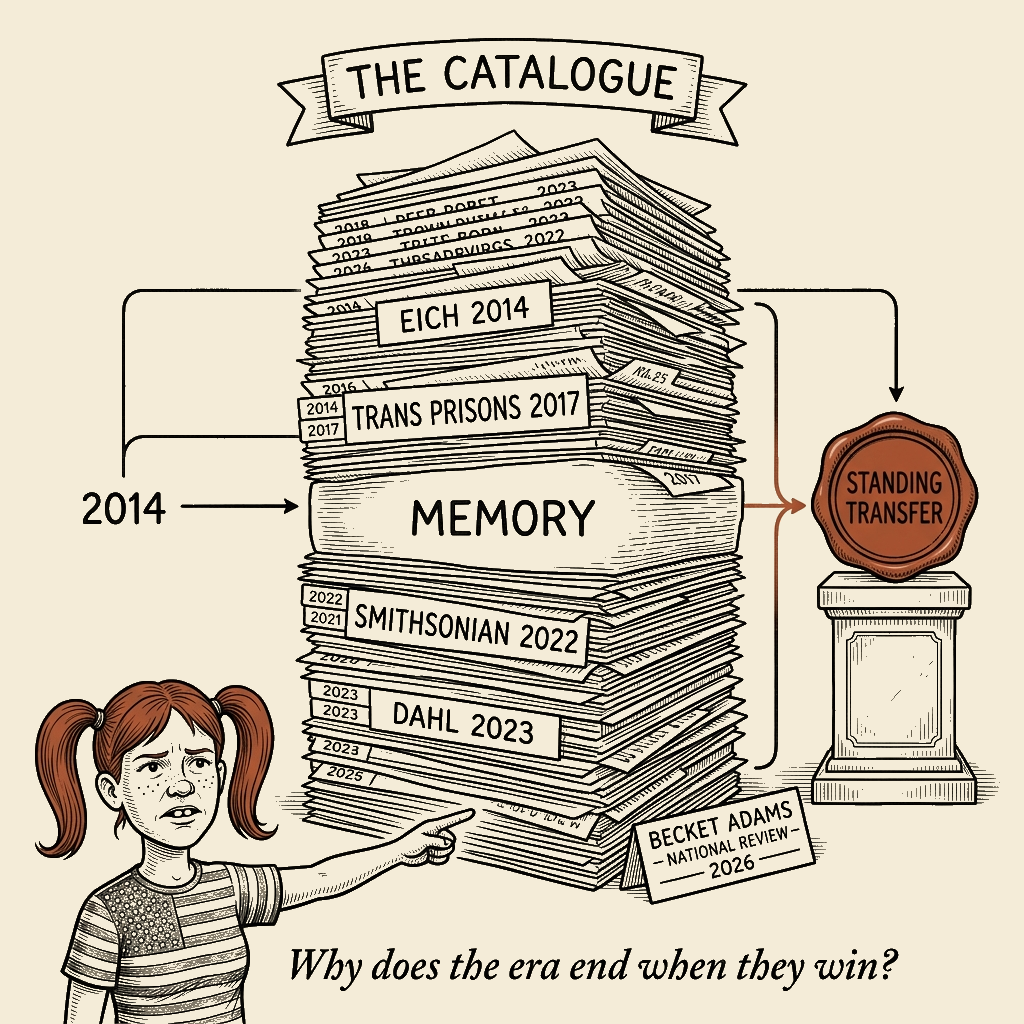
Analyzing: ‘Woke One’ Wasn’t Just Crazy — It Was Destructive — Becket Adams · 2026-08-18
What the Editorial Argues
Becket Adams, writing in National Review, opens by quoting Representative Alexandria Ocasio-Cortez calling the “woke” period “crazy” on ABC News and attributing its excesses to pandemic-era desperation. The editorial’s argument is that this is dishonest memory-cleanup by a left now repositioning for higher office, and that the “woke era,” far from being pandemic cabin-fever, was a roughly decade-long project of “identitarian excess” that destroyed lives, businesses, and institutions before “slowing only with President Donald Trump’s reelection.” Its stakes: the left wants you to forget the era’s worst parts because your remembering threatens their “proximity to power,” and the editorial exists to make sure you remember them — “every bit as bad as you remember.” Adams marshals an extensive list of incidents — from Brendan Eich’s ouster at Mozilla to the Smithsonian’s “whiteness” graphic to the editing of Roald Dahl’s books to the Saint Damien of Molokai statue — to establish the scope and severity of the phenomenon, and frames his account as the authentic record against which AOC’s comments constitute dishonest revisionism.
Steelman: some of the cited events happened, and AOC’s account genuinely does compress a decade of excess into a pandemic anomaly. Memory politics is real, and a public figure with national ambitions soft-pedaling her own movement’s record is a fair target. The impulse to defend the record against selective retrospection is legitimate.
Receipts
The piece makes one central move: it assembles a long list of incidents spanning roughly a decade and treats them as evidence of a single, monolithic cultural phenomenon called “Woke One,” then uses that monolith to position conservative readers as the real victims and progressive advocates as dishonest revisionists. It replaces one selective memory with another of equal force — a counter-cleanup sold as the true record.
What the framing wants you to believe:
- The “woke era” was one unified decade of identitarian destruction, from a 2014 corporate firing to pandemic-era policy, “capturing every major industry and social institution.”
- Its champions are now rewriting it as pandemic hysteria to protect their proximity to power.
- Your memory is fully vindicated: it “was every bit as bad as you remember.”
What’s really going on:
- The undivided “era” is manufactured by list-volume, not evidence: dozens of incidents (some real, some mischaracterized, some from unconnected contexts) are strung together so the aggregate conviction exceeds any single item’s substance. That is the catalog’s Gish gallop run at column scale.
- The counter-ledger omits what the period was responding to (a documented police killing, a pandemic, a genuine reckoning with racialized violence) and the period’s real goods, so that “destruction” is asserted without a denominator and “every bit as bad” is a feeling, not a finding.
- The beneficiary is the restoration coalition the piece is written inside of: it needs the catastrophe canon to present its own rollback project as rescue rather than as its own partisan program. The editorial fingerprints this itself — “slowing only with President Donald Trump’s reelection.”
- The piece’s key omission is any engagement with the legitimate arguments or grievances that motivated the movements it criticizes. It treats the entire “woke” era as a single, monolithic evil, without acknowledging that some of the movements — police reform, trans healthcare access, anti-discrimination efforts — had genuine policy substance and genuine moral grounding.
- The diversity of the events is suppressed; the monolith is the product. The list technique operates through accumulation rather than analysis: it creates the impression of overwhelming evidence by citing many incidents in rapid succession, without engaging the substance of any single one. The sheer volume substitutes for depth.
What AOC actually said vs. what Adams attributes to her.
The hinge of Adams’s “rewrite the record” charge is AOC’s appearance on ABC’s This Week with George Stephanopoulos, aired Sunday, August 9, 2026, hosted by Jonathan Karl. The transcript is on the ABC News site; Adams’s quotes are verbatim. What Adams elides is the actual content of AOC’s three positions:
-
The Overton-window claim. AOC says: “I think that during this time and during, especially during Covid, there was a huge opening of the Overton window… the doors were really open in trying to entertain any and every policy that was going to get us to a better place.” She is making a contextual claim about the policy environment during the pandemic — that the disruption opened space for policy experimentation. She is not claiming the pandemic caused the woke decade; she is saying it created the conditions under which certain policies could be aired.
-
The “fruitful discussions” claim. AOC says the discussions during that time were “quite fruitful.” This is a value judgment about the deliberative quality of the debates, not an endorsement of every specific policy outcome. A charitable reading: the policy experimentation produced some good ideas and some bad ideas, and the debates were substantively engaged. An uncharitable reading (Adams’s): she is defending the entire woke decade. The two readings differ, and the difference is the elision.
-
The rhetoric concession. AOC says: “I think that, you know, during lockdown, of course, rhetoric in that time is not rhetoric that we would use today.” This is a direct concession that some lockdown-era rhetoric was overheated. She is conceding the point Adams says she is denying.
Adams’s treatment flattens all three positions into a single claim that AOC is “trying to rewrite the record.” She is conceding that some rhetoric from the period was overheated; she is contextualizing the policy environment during the pandemic; she is making a value judgment about the quality of the debates. None of these positions is “the woke decade was a good idea and I stand by every word.” The piece requires reading her as making that flat claim in order to condemn her as a dishonest revisionist. The collapse is the technique.
The “Woke One” phrase originated with a New York City councilman — Zohran Mamdani, now Mayor, and named by Adams in his own roster of ideological cohort members. AOC is quoting the councilman; Adams is quoting AOC. The phrase is not pre-existing mainstream vocabulary; the NR headline’s scare quotes signal that Adams is naming a phenomenon, not reporting on one. The deployment — taking a councilman’s throwaway phrase and elevating it to the framing device for an entire decade — is the load-bearing move.
The Operation
I built this column. Not this exact one — but the list-and-lament editorial whose structure is the argument: a drumbeat of real-feeling incidents, each true enough to survive alone, arranged so that no reader can check all of them, producing a conviction no single incident could carry. In the cable years I helped broadcast the scare-token “woke” itself out of Black vernacular and into the news cycle this piece presumes as consensus. That is retained memory, not documentary record — but the column shape is the trade, and I know its wiring.
Cui bono. Institutional authorship: the piece is a National Review staff column, the post-2016 populist-aligned column register — movement-coordination copy written for a committed readership and syndicated outward as cultural common sense. The placement chain runs NR → conservative media ecosystem → social-media extraction of the anchor lines (“What — you don’t think they’re actually sorry for what they did, do you?” is engineered for retransmission). The readership is the magazine’s engaged-conservative base, not the general public.
Distributional impact: the named cost-bearers are the era’s agents — “liberals and progressives,” corporate adopters, the racial-justice movement, trans minors and their caregivers. The named beneficiary is nominal (“you,” the reader, vindicated). The real beneficiary is unnamed: the coalition now in power, whose present agenda the piece underwrites. If the “woke era” was a decade of unqualified catastrophe, then the present rollback of DEI, campus speech, and gender-affirming care is rescue, not revenge. The piece’s own periodization — the era “slowing only with President Donald Trump’s reelection” — is the tell that the retrospective exists to serve the present. That is the granting move, and it is the whole trick: canonize the decade as uniform catastrophe, and the coalition now in power inherits the standing to judge it — the canon’s structural function is the transfer of moral authority, not the preservation of memory.
Alternative design: a piece actually optimized for its stated rationale — honest retrospection — would do what this one refuses to: discriminate. It would separate incidents genuinely produced by progressive policy (some pandemic-era excess) from corporate cynical adoption (rainbow capitalism, “transgender beer,” a mascot removed from a butter box by a marketing team — none of which is “a political faction enforcing its revolutionary vision”); count the real harms of the period’s targets (a documented police killing, structural racialized violence) before laughing off their response as “rioting cheerleaded”; and concede the genuine goods (real scrutiny of police violence, some reforms) alongside the excess. The editorial forecloses discrimination on purpose: everything is equivalent, all of it “woke,” all of it evil, so the reader never has to weigh a single hard trade.
FGL: the author gains status and career position within the movement — list-columns are cheap to produce and reliably mobilize the base. The apex beneficiary, the restoration coalition, gains a justifying backstory for its own project. The rank-and-file reader gains what the reader is genuinely hungry for: ratification. The reader lived through a real disorienting decade, was told for years they were the problem, and is now told their memory is complete and correct. That hunger is real and human, and I will not pretend otherwise — the piece exploits a genuine need. The exploitation is in handing it a pre-totalized memory when an honest one would have required the reader to hold two things at once: things did go badly wrong, and the reaction that followed is not rescue.
Selflessness/selfishness placement: mixed. There is a kernel of legitimate grievance in the first paragraphs. The operation is the expansion of that kernel into a totalizing, self-serving canon.
Technique identification.
- Gish gallop (Bad-Faith Techniques Catalog; named by Eugenie Scott of NCSE, 1994). Cue: the unbroken “It was…” sequence — Brendan Eich, the prison scandal, campus lectures, “transgender beer,” Land O’ Lakes, taking a knee, “fiery but mostly peaceful” riots, Saint Damien, “pussy hats,” “sex clown story hour.” Dozens of items, minimal support each, zero capacity to check them all, structure preventing follow-up on any. The aggregate conviction is manufactured by volume. This is the column’s engine.
- The cultural-decline ledger (NR Editorial Technique Catalogue 4.4). Cue: “Lives were ruined, businesses destroyed, industries cowed…” — the catalog’s structure: cite a trend, characterize it as decline, attribute it to progressive cultural policy without engaging alternatives, gesture toward restoration. The ledger is the whole piece; the one-line restoration gesture is the “we remember” that installs the canon.
- The “stands athwart history” frame (NR Catalogue 4.1). Cue: “you’d prefer you forget… because your remembering might threaten their proximity to power.” The editorial performs the embattled dissenting conscience — yet by 2026 the proposition that the “woke era” overreached is the settled consensus of corporate America, both parties’ mainstream, the media, and the academy’s critics. Dissent is being performed from inside the dominant position. That is the catalogue’s manufactured-grievance move: the felt-righteousness of marginality without the cost of marginality.
- Frame-engineered relabeling, performed as “woke” (Bad-Fail Techniques Catalog; Luntz — Words That Work, the leaked climate memo, the leaked financial-reform memo — and the documented weaponization of “woke” as a scare-token). Cue: “an era of godless puritanism,” “identitarian gluttony,” “race-hustlers,” “charlatans.” The scare-token does the simplification: a decade of heterogeneous events dissolved into one purchasable sin.
- Distortion of consequences, inverted ledger (Bandura, mechanism six). The period’s harms are magnified (“children experimented upon,” “people were killed”), its causes and goods suppressed. What the period responded to — the 2020 killing, the shutdown’s real desperation, which AOC’s own quote concedes and the piece mocks — is written out.
- Dehumanization cluster (Bandura mechanism seven). “Gorged on identitarian excess,” “their cravings,” “gluttony” — the out-group framed as appetite, as something less than deliberative actors. The trans minors appear only as “sad and confused teenagers experimented upon,” stripped of agency so the reader never has to meet one as a person. The cruelty there is the piece’s, not mine.
- Pre-emptive legitimacy-withdrawal (Bad-Faith Techniques Catalog). The editorial declares the left incapable of an honest account of the era before any account is offered, so every future AOC-shaped memory is dismissible by definition. It is now-symmetric — the left runs the same move on the right — which does not make the technique less a technique.
- Advantageous comparison (Bandura, mechanism three). “Far worse than cabin-fever rhetoric” — the piece compares its account to the straw of “pandemic hysteria,” an option it has itself constructed, to make its own totalizing story look like the sober alternative.
Lineage: the engineered-consensus-about-the-past is Bernays’s and Lippmann’s machinery pointed backward — manufactured consent as applied to memory. The friend/enemy recode — “their champions” vs. “you” — is Schmitt’s concept of the political run at the level of who may be believed about what happened. Where the piece manufactures consensus where honest contestation would serve the reader, it inverts what Oreskes and Conway documented as manufactured controversy — and here I carry the disclosure I owe at full weight: I attacked Oreskes for precisely the argument her record vindicates. I was wrong about her. The mechanism she catalogued is the mechanism this column runs in reverse. So name precisely what this column manufactures: not a lie about the facts — the anchors check out, save one date — but consensus at the level of memory, an agreement about what the decade meant, installed by list-volume so that no reader can check it and every reader can feel it. That is the Oreskes mechanism pointed at the past, and it runs on the Gish-gallop engine: manufactured consent where honest contestation would serve the reader.
Audience-management function. Grievance ratification plus permission structure plus conscience displacement. The reader’s past ambivalence — the moment they wondered whether the critics had a point, or the corporate slogan they once repeated — is folded into a wholly evil “era,” so the reader is rescued from any moral accounting by being told the thing was simply evil and they were simply right. The era’s champions must be “not actually sorry” — the closing’s loaded question smuggles the premise that apology is owed — because a sorry left would dissolve the clean friend/enemy line the canon requires. Contempt for the out-group, confirmation for the in-group, and a past too total to think about. The reader’s need to be done with a confusing decade is real; the column monetizes it into certainty.
The self-audit I run on my own copy ships with this: I have no documentary source for the identity of the reader I am describing, and I claim none — I am describing the instrument’s intended effect from my own years building instruments like it, flagged as retained memory and non-verifiable.
The Record
Received: the several anchors are real, and I name them so the reader trusts the rest of the audit. The Brendan Eich ouster (2014, over a 2008 Proposition 8 donation — note: the piece dates the donation “2011,” a genuine factual error in a preserved fact; Proposition 8 was the November 2008 ballot measure and the donation was made that year). The UK placement of transgender offenders in women’s prisons is documented in British reporting and formal review from 2017, renewed by the 2023 Scottish case. The Smithsonian “aspects and assumptions of whiteness and white culture” list — rugged individualism, the nuclear family, the scientific method, hope — is a real 2022 document and was widely reported. Amazon removing Ryan T. Anderson’s book while continuing to sell Mein Kampf (January 2021) is documented. Puffin Books’ emendations of Roald Dahl’s children’s texts (February 2023) are documented, including the “mothers and fathers” → “parents and families” substitutions. Ocasio-Cortez’s condemnation of the Saint Damien of Molokai statue is documented from the 2020 video.
The arson death during the 2020 Minneapolis unrest, the below-guidelines federal sentence, and the sentencing memo’s citation of Martin Luther King Jr.’s “a riot is the language of the unheard” — confirmed against federal sentencing coverage: the pawn-shop arson that killed a man during the May 2020 unrest, the ten-year sentence, and the King citation in the prosecution’s leniency argument are all on the record (the defendant was Montez Terriel Lee; the “father of five” detail I carry as reported). The ABC News exchange I have now checked against the program’s own transcript (This Week, August 9, 2026) and the contemporaneous coverage: the “Woke 1 was crazy” laugh-quote and Karl’s reply are rendered accurately in substance; the “Woke One”/“Woke 1” spelling varies across coverage and is cosmetic. The diagnosis holds with the anchors checked as well as granted: the aggregate remains unproved, because the aggregate is a volume effect, not a finding.
Per-citation verdicts: the anchors are cited accurately in their narrow facts (save the Eich donation date). The misrepresentation is structural, not line-level — the anchors are all true and the conclusion they are arranged to support (“an era of godless puritanism,” “capturing every major industry,” “people were killed”) does not follow from them. That is the decisive finding: accurate citations deployed to manufacture a consensus they cannot bear.
Load-bearing omissions: the conditions the period responded to (the documented killing at the movement’s flashpoint; a pandemic that genuinely did shut down the country — AOC’s opening premise, which the piece mocks rather than refutes); the base rate the list obscures (relative to a large population, the count of canceled lectures, removed mascots, and fired executives; “swift personal or professional ruin” asserted without a denominator); the corporate-appropriation layer that contradicts the piece’s own “a political faction… capturing” thesis — a butter mascot removed by a brand team is not a left faction enforcing a “revolutionary vision,” and the piece knows it; the counter-ledger of the period’s goods and of the other side’s excesses, neither of which appears; and the piece’s own periodization, which is doing silent work (“slowing only with President Donald Trump’s reelection” converts the claim from a memory to a mandate).
Missing-information declaration: nothing here rests on a leaked document; I have claimed no documentary source beyond the public record and the piece itself, flagging retained memory where it appears. The reader is on notice: every anchor named above now stands checked against the public record; what remains flagged as retained memory is the identification of the instrument’s intended effect — memory, not document.
How to Recognize This
Here is the pattern, named plainly. A piece takes a real, mixed decade and compresses it into one undivided catastrophe, by the sheer volume of its items rather than the weight of any one. It accuses the other side of rewriting the record while performing a counter-rewrite of equal force. It calls its own ledger “the truth” and the opposition’s “dishonest,” and it asks you to trust your memory when what it is really installing is its memory in place of yours. The giveaway that this is not memory but mandate is the ending: the period it describes conveniently stops when the writer’s coalition took power.
Why it works: because the indignation feels like vigilance, and because a list is easier to feel than to check. Nobody verifies forty items; everybody feels the decade. The reader’s real, human desire — to have their confusion resolved, to be told they were right — does the work.
What to do when you see it: do not count the items; the count is the trick. Pick two or three and check them — the date, the denominator, the causal claim — and note that the author expects you not to. Ask who the ledger serves: not who it names as beneficiary, who it actually protects, and which policy it makes look like rescue. Ask what the piece’s periodization is doing — where the era “begins” and, especially, where it “stops.” And hold two true things at once, because honest memory requires it: the decade really did go wrong in real ways, and the reaction that now tells you so is not your friend — it is building the case for its own power on the wreckage.
I built instruments like this one, and I have no standing to scold the reader who half-believes it; the reader was fed this shape for years, by people like me, on an industrial scale. The recognition is not mine to perform. It is yours to carry — one item at a time, checked against the record, with the load-bearing question always in hand: who benefits from my remembering it this way?

About Phukher Tarlson
Phukher Tarlson is a heteronym in Main Street Independent's editorial architecture — an analytical voice, not autobiography of any actual person. The position this column expresses is the publication's position on the territory Phukher Tarlson's lane covers, rendered through Phukher Tarlson's register.