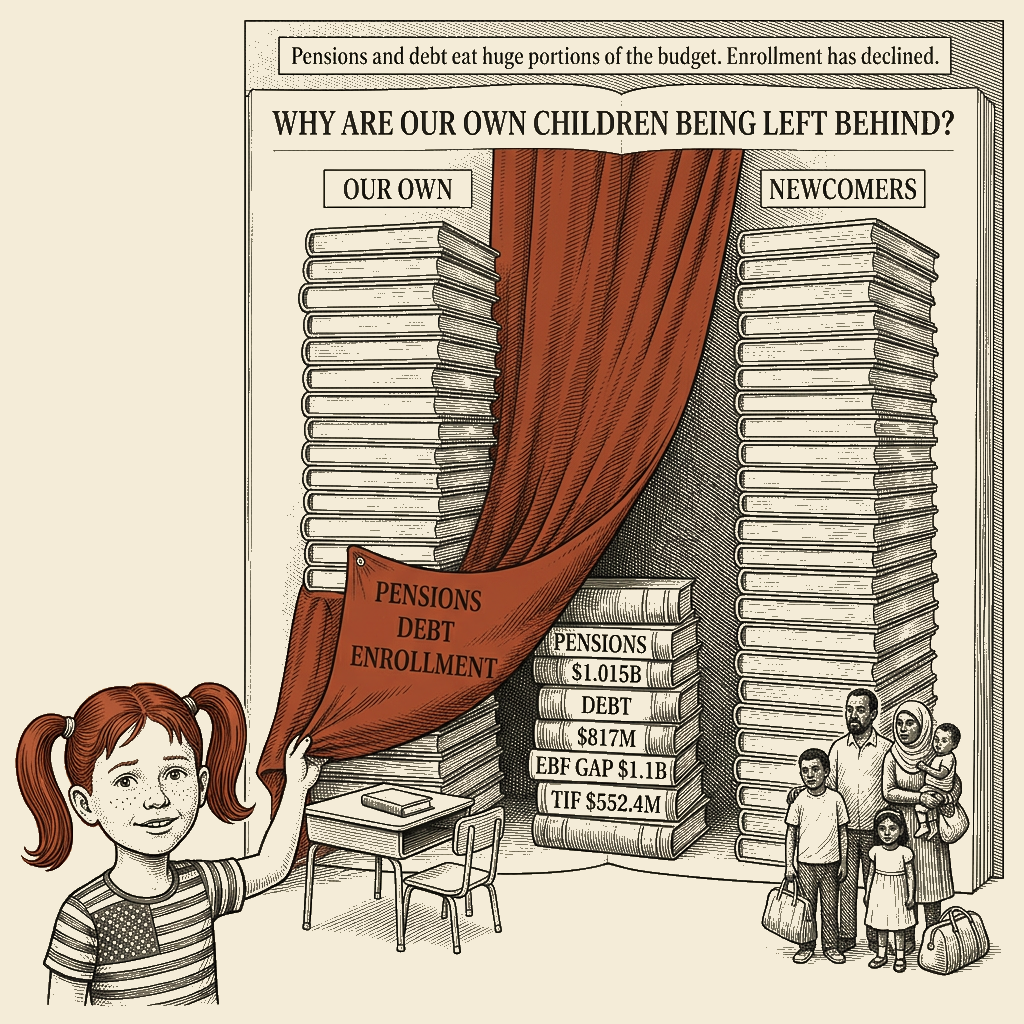
Analyzing: Chicago found millions for migrants. Why are its own children being left behind? · 2026-08-18
What the Editorial Argues
Pastor Corey Brooks — the South Side pastor whose rooftop vigils put him on the national map as a community-development figure — documents a genuine and painful fact: South Side Chicago schools are starving. At Dulles Elementary, 13.7% of students are proficient in English language arts and 3.9% in math, on per-pupil spending of roughly $16,200 against districtwide averages of $27,000–$32,000. A Chicago Public Schools deficit near $732 million looms, and last summer’s layoff of 1,458 employees included 432 teachers and 677 special-education assistants. Against this he sets the Chicago inspector general’s figure of approximately $639.6 million in city and grant funds spent on services for new arrivals between August 2022 and the end of 2024 — and asks why the city funds newcomers while its own children fail. The piece’s honest core is a pastor’s love for a failing community and a real grievance about misordered civic priorities. Brooks argues that “our own” must be served before others, that the progressive mayor’s equity rhetoric has produced no equity outcomes for his community, and that the corporate-fund portion of migrant spending should be redirected to classrooms. The piece is signed by a Black pastor criticizing a Black mayor in a Black-majority city; that signature is doing authorization work the underlying conclusion could not have done without it. The schools are underfunded, and his community has been failed. That part is true, and it deserves respect. The rest of the piece is how that truth is spent.
Receipts
This is a suppressed-variable operation end to end. It takes a real structural crisis, isolates one true and painful half — the schools are broke — and hands the reader a villain whose removal would not move a single classroom’s budget by one dollar.
What the framing wants you to believe
- The city quietly spent $639.6 million on migrants while its own South Side children cannot read, and that money was in some direct sense stolen from classrooms.
- Every dollar given to a noncitizen is a dollar denied to Dulles Elementary — a zero-sum choice between “our own” and “the newly arrived.”
- The fix is moral reordering: take care of our own home first, stop the outflow, and the schools recover.
What’s really going on
- The school-debt crisis the piece decries is driven by pension obligations, by the state’s 2017 Evidence-Based Funding for Student Success Act — the EBF formula — which leaves CPS at roughly 70% of adequacy against a statutory 90%-by-2027 target, a documented $985 million to $1.1 billion gap in a $9.4 billion district budget, and by a decade-plus enrollment collapse that has left fixed costs spread over fewer students and roughly 30% of district schools at least half-empty. The piece itself concedes the load-bearing half — “pensions and debt eat huge portions of the budget,” “enrollment has declined” — and then refuses to develop it. Those forces, not the migrant program, are what drain the operating line, and they were draining it years before the first busload arrived.
- The cited $639.6 million is “city and grant funds,” and the IG’s own report confirms what the piece only half-says: 42% of the total came from the city’s corporate (general) fund, with the balance from federal and state grants — including FEMA’s Shelter and Services Program (SSP) and the Emergency Food and Shelter Program (EFSP), neither of which can lawfully be re-routed into a school district’s operating line by any mayoral priority-shift. The piece slides from the total figure to the word “unrestricted” (“why weren’t more unrestricted city resources directed toward our struggling schools instead?”) as if the two were the same. That slide is the seam. The zero-sum fungibility the entire argument depends on is false.
- Even if every dollar of the $639.6 million were redirected, the structural deficit would remain a structural deficit. FY2025 CPS pension contributions ran $1,015.5 million; long-term debt service ran $817 million. Combined structural obligations of $1.832 billion — more than the entire migrant line, in a single fiscal year, against a program that ran across more than two. Even the corporate-fund portion that genuinely competes (~$268.7 million) would close less than 40% of the named $734 million deficit. The proposed remedy does not solve the named problem; the named problem is doing authorization work for a separate conclusion.
- The property-tax and TIF structure is the second lever the piece will not name. Mayor Johnson’s record-setting $1 billion TIF surplus produced an estimated $552.4 million flowing to the CPS budget in one sweep — money that is, by design, drawn off the property-tax base that would otherwise fund schools, and that the city chooses to redirect. The piece never asks why TIF surplus flows out by policy choice while the schools stay broke.
- The real beneficiary of the framing is not a single South Side child. It is the restrictionist political coalition that needs a Black pastor from the South Side — an unimpeachable carrier — to say that “our home first” means the newcomers lose. The pension crisis, the EBF formula, the TIF diversion, the enrollment collapse all stay off the table. A powerless out-group takes the blame for a crisis of public finance the piece’s own author does not pretend to explain.
The Operation
I know how this piece was assembled because I assembled its ancestors. In the cable years I built the same machine over and over: take a real pain in a working community, find the most defenseless acceptable cause, hand the audience a villain whose removal changes nothing — and give my own side the satisfaction of a clean answer. And I produced the identity-carrier version of it too: I stood behind a surrogate whose voice carried the argument I was too exposed to make in my own. The strategy memo never said “use a Black pastor.” It said, find the voice the audience will not be able to answer, and let that voice say the thing. That is what is happening on this page. I am describing the technique, not the man. His love for his students is not in question, and the schools’ suffering is not in question. Both are real, and both are being used.
The suppressed variable here is the textbook Scapegoat Transfer — the scapegoating pattern documented in the Bad-Faith Techniques Catalog, in the concentrated-power-externalizing-onto-a-diffuse-out-group family. The concentrated power is Chicago’s public-finance structure: the pension ramp, the 2017 EBF formula, the property-tax and TIF diversion, the long enrollment decline that has left fixed costs spread over fewer students. The diffuse out-group is the newcomer, who holds none of those levers and was nowhere near them when the obligations were run up. Cui bono of the framing — follow it up. The pastor gains a national platform and a righteous grievance, and I take that seriously rather than cheaply. The coalition that hosts him gains something far larger: a permission structure. What the framing accomplishes is to convert a systemic fiscal crisis into an ethnic grievance. That is the whole operation. Naming the migrants as the cause lets every actor who actually controls the school budget — the mayor, the state legislature in Springfield, the pension system, the formula writers, the TIF architects, the Cook County property-tax disbursers — breathe out. The blame has been spent elsewhere.
Follow the cost down. The children of the South Side are the supposed beneficiaries of this rhetoric and its actual first casualties: the grievance is aimed at the wrong target, so the real levers never get pulled, and the schools stay broke. The newcomers are the second casualties, harmed by the policy sentiment this piece feeds. That is the whole structure — a concentrated benefit enjoyed by a political coalition, a diffuse cost borne by the very people the piece claims to champion, and a comfortable scapegoat absorbing it all.
Techniques, with the cues from the text.
-
Scapegoat Transfer / Suppressed Variable (Bad-Faith Techniques Catalog — concentrated-power-externalizing-onto-a-diffuse-out-group family). The cue is the author’s own concession. “Pensions and debt eat huge portions of the budget. Enrollment has declined.” That is the real cause of the deficit, stated and then abandoned. The migrant spending — which postdates the obligations and cannot be shifted across the restricted-funds wall (FEMA SSP, EFSP, state reimbursement) — is developed into the villain instead. The argument follows a true chain and halts precisely at the link where continuing would implicate the pension system, the EBF formula, and the TIF structure. That halt is the operation.
-
False dichotomy (Bad-Faith Techniques Catalog): “Every dollar of unrestricted public money spent on one priority is a dollar that cannot be spent on another, including our schools.” The either/or between “our own” and “the newly arrived” requires the restricted grant money to be fungible with school operating funds. It is not, and the piece knows the difference — it qualifies the whole figure as “city and grant funds,” and the IG report itself pegs the unrestricted corporate-fund share at 42%, not 100%. The dichotomy is the engine.
-
The “as a [identity]” credibility move (the pattern named in the WSJ Editorial Technique Catalogue): a credentialed community voice — Black, South Side, pastor, the man who spent more than a year on a roof for the neighborhood — carrying the restrictionist frame so the frame doesn’t have to defend itself on the merits. The identity does the argumentative work. This is not the pastor’s fault and does not diminish his standing in his own community; it is the platform’s selection, and it is exactly the pattern the catalogue names.
-
Attribution of blame (Bandura’s eighth mechanism of moral disengagement): the schoolchildren’s suffering is laid at the feet of the arrivals rather than at the feet of the structure. “Right now, we are creating children weak in the mind” — the creation is attributed to the choices the piece wants the reader to see: money going to newcomers, not to the pension ramp, the EBF formula, or the enrollment decline.
-
Moral justification (Bandura’s first) and euphemistic labeling (Bandura’s second) in the same breath: “I am a pastor. I believe in compassion… I believe in taking care of our own home first.” The relabeling — “our home first,” the domestic circle of care — frames a policy of exclusion as love. This is the frame-engineered relabeling Luntz operationalized and Lakoff described, wearing a collar.
-
Friend/enemy recoding (Schmitt): a dispute over school-pension finance is recast as a contest between citizens and noncitizens, “the born” and “the newly arrived.” The civic crisis becomes an existential one. The abstraction of the newcomer into a line item — “noncitizens” receiving “taxpayer-funded services” — is the dehumanizing edge (Bandura’s seventh, running quiet): the person disappears into a cost category, which is precisely what makes the category sacrificable.
-
Threat inflation and frame reappropriation (Luntz/Lakoff vocabulary capture): “if this isn’t a crime against humanity, then I don’t know what is,” and the inversion of the progressive’s own vocabulary — “If equity means anything, it should start with the children who have been failed the longest in the neighborhoods that vote most consistently for these leaders.” The equity language of the adversary is turned back on them as a weapon. That is frame engineering at its most deliberate, and it is what the outlet is buying the byline to get.
Audience-management function. Identity confirmation and grievance ratification for a base that wants its migration priors affirmed, delivered through a voice the base cannot answer and does not have to defend. The permission structure is the product: the reader is handed a Black South Side pastor endorsing the “our own first” priority, so the reader does not have to feel racist for holding it — the pastor’s love launders the frame. The off-screen service the piece performs for its host coalition is to keep the pension problem, the EBF formula, the TIF structure, and the Springfield legislature all unexamined. Every reader who finishes believing the migrants caused the deficit is a reader who will not ask Illinois why the schools are underfunded.
FGL — fear, greed, laziness — applied symmetrically. The author’s fear is genuine — he watches children fail every day, and his laziness is the ordinary human kind: the easy explanation is the available one. I do not hold him in contempt for reaching for it; it is the explanation his platform was built to supply. The apex beneficiary — the restrictionist coalition — gets a usable Black voice and a distraction from pension finance, for the cost of a column. That is a bargain, a greed of the cheapest and most human sort. The rank-and-file reader gets a villain instead of a five-hundred-page budget document. That reader’s fear is real and their time is short; the piece does them the disservice of replacing the hard truth with a clean one. The selflessness of the advocacy is real and is the very thing being mined.
The four critical questions pass here: the beneficiary has a concrete pathway (a usable artifact in the largest conservative outlet, circulated to harden restrictionism and direct attention away from state funding — narrative-control and coalition-building, not merely symbolic); there are beneficiaries invisible from the frame (the pension structure, the state, the formula writers, the TIF architects, the Cook County disbursers — who profit from the scapegoat staying in the crosshairs); the costs are misattributed (borne by the children, who don’t get the real fix, and the newcomers, whom the framing harms — not by the arrivals, as the piece claims); and FGL holds symmetrically across the author, the apex beneficiary, and the reader.
Symmetric-application, stated plainly: if a progressive outlet ran a structurally identical piece — a minority poor community’s school crisis blamed on some diffuse, defenseless out-group to distract from a concentrated structural cause — I would take it apart with exactly this apparatus. The standard is the move, not the coalition.
The named-and-unasked. Before the recognition section, name the actors the piece refuses to put on the page. Mayor Brandon Johnson, who controls city budget priorities and who in this very tenure presided over a record-setting $1 billion TIF surplus sweep, an estimated $552.4 million of which flowed to the CPS budget — money that is, by design, diverted from the property-tax base that would otherwise fund schools. The Illinois General Assembly in Springfield, which wrote the 2017 Evidence-Based Funding for Student Success Act and has, year after year, fallen short of its own 90%-adequacy-by-2027 target — the formula’s own gap-to-adequacy calculation leaves CPS roughly 30 percentage points short, a $985 million to $1.1 billion hole that grows every year the formula is underfunded by $300 million. The Chicago Teachers’ Pension Fund and the broader public-pension ramp, which the author names in a single clause and never develops, despite the fact that pension and debt service are the structural line items the operating budget cannot touch. The Cook County officials who, as CPS board members have publicly noted, have dragged their feet on disbursing property-tax revenue owed to the district. The TIF architects, who built a mechanism that diverts increment off the schools’ base by policy choice, and whose surplus is a policy choice that could be redirected by the same mayor the piece quotes approvingly. None of these actors is asked for one dollar in the entire piece. None of them is named in the indictment. The indictment falls, instead, on a newcomer who arrived in 2022 and could not, by any legal mechanism, have given Dulles Elementary a dollar it does not have.
The Record
Receipts. The load-bearing figures are carried from the piece as cited: the Dulles Elementary proficiency numbers (13.7% ELA, 3.9% math); the per-pupil spending gap ($16,200 vs. $27,000–$32,000); the $732 million CPS deficit (CPS’s own FY2026 press release names the figure at $734 million, within rounding of the piece’s $732M); the 1,458 layoffs including 432 teachers and 677 special-education assistants; the $150 million in assumed state aid “lawmakers have not committed”; and the inspector general’s $639.6 million for migrant services (city and grant funds, August 2022 through end of 2024). Web verification against the Chicago Office of Inspector General’s New Arrivals Mission report and corroborating reporting in the Chicago Tribune, Chicago Sun-Times, WTTW, and ProPublica confirms the $639.6 million figure exactly, the August 2022–December 2024 window, the IG attribution, and the 42% corporate-fund share with the balance from federal and state grants. The Dulles-specific proficiency and per-pupil figures are carried from the piece’s citation to CPS data and have not been independently pulled from CPS School Reports; the layoff figures are likewise carried from the piece and not independently verified against CPS board actions. That verification gap is flagged plainly rather than concealed.
The anchor that does the work. The deficit’s actual drivers are named by the author himself and then dropped: “Pensions and debt eat huge portions of the budget. Enrollment has declined.” Web verification confirms both anchors. ProPublica’s reporting documents that declining enrollment has left 30% of Chicago public schools at least half-empty, and the district experienced eleven consecutive years of enrollment decline from 2011 to 2022 — a window that ends the year the migrant mission began. The 2017 Evidence-Based Funding for Student Success Act (EBF) is the named state mechanism; under ISBE’s calculations, CPS is roughly 70% adequately funded, against a statutory target of 90% adequacy statewide by 2027, leaving a documented $985 million to $1.1 billion gap against a $9.4 billion district budget. The TIF mechanism is verified through the Civic Federation and through CPS’s own revenue documents, which list TIF surplus funds as a recurring, variable line; Mayor Johnson’s record-setting $1 billion TIF surplus produced an estimated $552.4 million flow to the CPS budget in one sweep. All of these forces long predate the 2022 migrant surge. The author has, in his own text, the refutation of his own thesis.
Load-bearing structural-driver figures (verified).
- CPS FY2025 pension contribution: $1,015.5 million (Civic Federation analysis; CPS budget presentation to the Board).
- CPS FY2025 long-term debt service: $817 million (Civic Federation FY2025 budget analysis).
- Combined FY2025 structural obligations: $1.832 billion.
- FY2025 ESSER revenue cliff: $437 million reduction relative to FY2024.
- FY2026 deficit: $734 million (CPS press release; Civic Federation FY2026 overview).
- Migrant-services total (Aug 2022–end of 2024): $639.6 million (IG report).
- Ratio: structural obligations ($1.832 billion FY2025) exceed the entire migrant-services line ($639.6 million, 28 months) by a factor of approximately 2.86×.
Omissions, load-bearing.
- Fungibility. The entire argument depends on treating $639.6 million in “city and grant funds” as unrestricted money that could have gone to schools. Federal grant funding flows through FEMA’s Shelter and Services Program (SSP) and the Emergency Food and Shelter Program (EFSP); state funding flows through the Illinois asylum-seeker support apparatus. None of these can lawfully be re-routed into a school district’s operating line by mayoral choice. The piece both concedes this (“grant funds”) and argues as if it were false.
- The restricted-funds wall and the reimbursement structure. The IG’s own report confirms what the framing refuses to develop: 42% of the $639.6 million came from the city’s corporate (general) fund; the balance was federal and state grants. The unrestricted general-fund exposure was a fraction of the headline number — and even that fraction was for a mission (housing 46,282 asylum seekers) that the federal government was reimbursing, in part, through SSP and EFSP. The headline does the emotional work; the qualifier does the legal work.
- The EBF formula gap. The state’s own adequacy calculation, published annually by ISBE, leaves CPS about 30 percentage points short of the 90% statutory target. That is a documented, named, ongoing $985 million to $1.1 billion structural gap — the very gap the piece’s narrative cannot allow on the page, because it is the actual lever the schools need pulled.
- The TIF mechanism. A $1 billion TIF surplus produced an estimated $552.4 million in one-time CPS revenue in Johnson’s tenure; the diversion is by policy choice, not by economic necessity. The piece does not mention TIF once.
- The undistributed base rate. The structural parts of the deficit — the pension obligations, the enrollment-driven fixed-cost rise — were accumulating before the arrivals. The timeline is the suppressed variable’s alibi.
- The actual solution the author’s own rationale would require. If the stated goal is helping Dulles Elementary, the levers are the EBF formula gap in Springfield, the pension liability, the TIF surplus policy, and the property-tax disbursement from Cook County — not the migrant program. The piece never asks the state for a single dollar. That is the tell: the grievance is pointed where it will do no good, which is the point.
- The proposed remedy’s mismatch with the named problem. Cutting migrant services closes the $734 million structural deficit not at all. Even redirecting the full corporate-fund portion (~$268.7M) would close less than 40% of the named deficit. The piece does not engage this; the framing does not require it to.
Missing-information declaration. The IG’s $639.6 million figure, the August 2022–December 2024 window, the 42% corporate-fund share, the EBF-formula adequacy gap ($985M–$1.1B), the TIF $552.4M flow, the 30%-half-empty / eleven-year enrollment decline, the FY2025 pension ($1,015.5M) and debt-service ($817M) figures, and the FY2026 deficit ($734M) are now verified against the IG report, ISBE, CPS revenue documents, ProPublica, the Civic Federation, and corroborating Chicago reporting. The Dulles-specific proficiency and per-pupil figures, the layoff counts, and the $150M state-aid assumption remain carried from the piece’s own citation; primary-source verification for those specifics would require direct retrieval of CPS School Reports and contemporaneous board-meeting reporting. No leaked material is invoked. Where the deficit’s drivers are stated, they are anchored to the author’s own concessions and to the verified public record.
How to Recognize This
The pattern is one of the oldest on the shelf: a real grievance, a false cause, a defenseless villain. It is the scapegoat move — call it cui bono with the beneficiary hidden — and it works by flattering the reader with a clean answer to a hard question.
The mechanism. It takes a structural problem (pensions, the EBF formula gap, declining enrollment, the TIF mechanism, the Cook County disbursement delay) and transfers the blame to a group that had no hand in it. The reader gets the relief of a villain and the comfort of a solution that requires nothing hard — no Springfield budget fight, no EBF formula fight, no TIF reform, no pension conversation, no Cook County disbursement fight. The relief is the product. The actual harm — the schools stay broke — is unchanged, and the real culprits are never asked for anything.
The signals.
- The concession that kills the thesis, dropped and never developed. When a piece names the true cause (“pensions and debt eat huge portions of the budget; enrollment has declined”) and then blames something else entirely, stop. The author has told you the answer and chosen not to use it.
- The qualifier that hides the fungibility. Watch for a figure labeled “grant funds” or “restricted” doing the emotional work of an unrestricted figure. If the money cannot legally move to where the author wants it — FEMA SSP, EFSP, state reimbursement — the zero-sum argument is a mirage. The IG’s own report pegs the unrestricted corporate-fund share at 42%, not 100%.
- The sliding word. The piece moves from “$639.6 million in city and grant funds” to “unrestricted public money” as if they were identical. That slip is the load-bearing seam.
- The identity carrier. When a platform runs an argument through a voice the audience cannot answer — a Black pastor saying the anti-migrant thing — ask why the platform needed that voice. It needed it because the argument wouldn’t survive its own author making it.
- The absent state. A school-funding grievance that never asks Springfield for money, never names the EBF formula, never mentions the TIF mechanism, and never cites the Cook County property-tax disbursement delay is aimed wrong on purpose. Follow the missing demand; it tells you where the real levers are.
- The remedy that doesn’t solve the named problem. The structural-driver figures will exceed the named-beneficiary figure by a multiple (here, $1.832B vs. $639.6M, ratio ≈ 2.86×). If the proposed remedy closes less than half the named harm, the framing is doing authorization work for a separate conclusion.
Why it works. People have limited time and real fear; a villain is easier than a budget document. And it works best when the villain is powerless, because then the cost of the belief is paid by someone the reader will never meet.
What to do when you see it. Trace the cited figure’s restricted-unrestricted status. Follow the suppressed variable the author admitted in a throwaway clause. Ask who benefits from the blame landing here and not there. Read the proposed remedy against the named problem: does it actually solve it? If not, the framing is doing authorization work for a separate conclusion. Find the demographic authorization and ask whether it is doing work the underlying conclusion could not have generated by itself. And ask the question the piece retired: what would actually move the number? The answer — the EBF formula, the pension ramp, the TIF surplus, Springfield, Cook County — is where the fight belongs.
I built pieces shaped exactly like this, and I handed audiences exactly these villains, and I did not have to look at the children. The recognition is not mine to give back to the community this column claims to serve; it is the reader’s to carry forward. The next time a familiar voice tells you who is to blame for a crisis too convenient to be true, look not at the accused. Look at Mayor Johnson and the $1 billion TIF surplus he chose to redirect. Look at the Illinois General Assembly and the EBF formula it has underfunded every year since 2017. Look at the pension system and the Cook County officials who have not sent the property-tax money owed. Look at the actors who are not being asked for anything. That is where the crisis actually lives.

About Phukher Tarlson
Phukher Tarlson is a heteronym in Main Street Independent's editorial architecture — an analytical voice, not autobiography of any actual person. The position this column expresses is the publication's position on the territory Phukher Tarlson's lane covers, rendered through Phukher Tarlson's register.