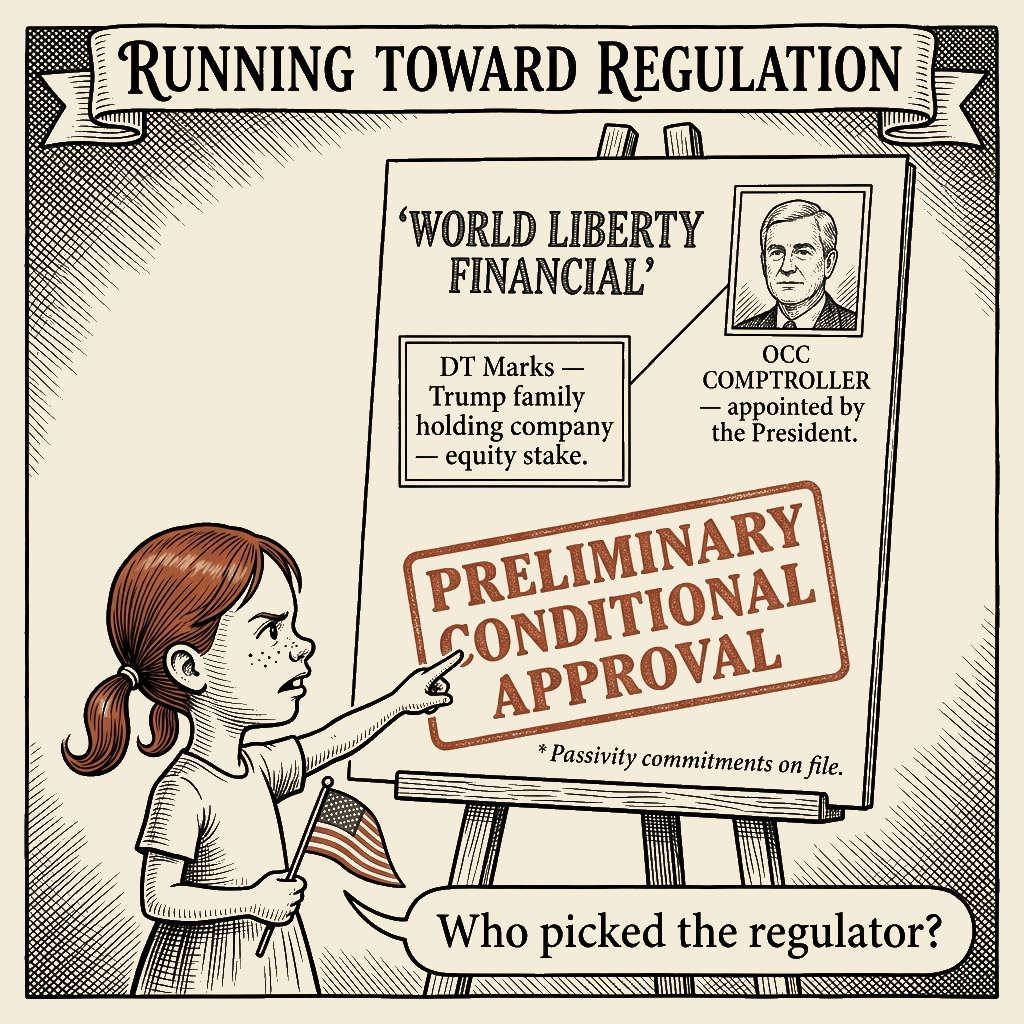
Responding to: World Liberty’s Stablecoin Becomes a Partisan Target — Zach Witkoff · 2026-08-20
What the Piece Argues
Zach Witkoff, CEO of World Liberty Financial, defends the Office of the Comptroller of the Currency’s preliminary conditional approval of World Liberty Trust Co., a federally chartered trust bank that will issue USD1 stablecoin. He frames criticism from Senators Warren, Blumenthal, Reed, Alsobrooks, Gallego, and Kim as partisan attacks against a venture that is “running toward regulation and supervision, not away from it.” He argues the OCC’s career staff processed the application under delegated authority, that DT Marks (the Trump family holding company) signed passivity commitments, and that five competitor approvals nine months earlier prove the process was fair. He closes by arguing stablecoin expansion broadly benefits the U.S. economy through Treasury demand and capital accessibility, citing economist Stephen Miran.
Receipts
The piece asks you to read past the cover page by dwelling on procedural details that the structural conflict renders irrelevant.
-
The framing wants you to believe
- The OCC approval was routine, processed by career staff under standard delegation, not the Trump-appointed comptroller.
- DT Marks’ “passivity commitments” with the OCC eliminate any conflict-of-interest concern between the Trump family and the venture.
- Five competitor approvals nine months earlier demonstrate that World Liberty received no special treatment.
- Critics’ “unprecedented crypto corruption” allegation is “baseless” partisan rhetoric, and the financial system the venture is building is broadly democratizing.
-
What’s really going on
- The piece concedes the conflict in plain language: “DT Marks, the Trump family holding company that owns a stake in World Liberty Financial, entered into detailed passivity commitments with the OCC.” A holding-company stake is the structural mechanism by which the Trump family monetizes its political position. The passivity commitments govern operating control of the company; they do not address whether the family profits when the company gets a federal bank charter. A passivity commitment about whether you pick up the phone is not a commitment about whether you cash the check.
- The OCC is led by Comptroller Jonathan Gould, a Trump appointee. The piece’s defense is that career staff processed the file. Career-staff delegation addresses who pushed the button; it does not address whether the application would have been conditionally approved in this form without the political alignment between the applicant and the appointing president. Five competitor approvals confirm the framework existed; they do not confirm that this applicant was treated like the others — none of those competitors had the appointing president’s name on the cover page.
- The Treasury-demand argument borrows Stephen Miran’s general forecast about stablecoins and applies it to one specific application by one specific family venture. At ~$4 billion in market cap, USD1 is not at a scale where its Treasury holdings move the Treasury market; the argument is forward-looking and is doing work the cited source did not ask it to do.
- The bipartisan Genius Act vote the piece cites confirms a 2025 vote for a regulatory framework; it does not constitute a 2026 endorsement of one specific charter application under that framework. Voting for the rules is not voting for the player.
The Response Ladder
Polite Reframe
When to use: A good-faith reader — say, a small-business owner considering USD1 for cross-border payments, or a community banker sizing up a stablecoin charter — who has heard the “running toward regulation” defense and is weighing whether to take it at face value.
Maria runs a small importing business out of San Antonio. Her Mexican suppliers used to wait three business days for a bank wire to clear, and the wire fee ran her $45 each way. A friend told her USD1 settles in minutes for pennies. She read the WSJ piece announcing the OCC’s preliminary approval and thought: if a federal agency is chartering this company, it must be safe. The “running toward regulation and supervision” defense sounded reasonable. She is the kind of reader the defense is built for.
Here is what that defense leaves out. The comptroller of the currency, Jonathan Gould, was nominated by the administration whose family holds a stake in the company he is now chartering. The piece emphasizes that “approvals of applications such as this are made under authority delegated by the Comptroller to career staff” — and that is accurate at the procedural level. It does not address who chose the agency’s political leadership, who set its priorities, or whether the timing and conditions applied to this particular application matched what comparable firms received.
The passivity commitments DT Marks signed are real. They constrain the Trump family’s formal control over operations. They do not, and cannot, eliminate the family’s financial interest in World Liberty’s success. The upside is preserved. The hands on the steering wheel are constrained. That is not nothing. It is also not the same thing as independence.
The five-competitor argument: prior approvals show the OCC is processing applications in this space. They do not show that the timing, conditions, or scrutiny applied to World Liberty matched what competitors received, or that any of those five had comparable political connections to the agency’s leadership. The piece treats the queue as proof of merit. The queue is a queue.
The Treasury-demand and interest-rate claims rest on a Stephen Miran speech. The piece calls him “economist and former Federal Reserve Gov.” Miran’s day job at the time of the speech was Chair of the Council of Economic Advisers under President Trump — a political insider in the same administration whose family benefits from this charter. He was confirmed to the Federal Reserve Board in September 2025 and served until May 2026, which makes the source’s “former Federal Reserve Gov.” credential technically accurate by publication date. The speech itself was given in his CEA capacity. Dressing him in his later Fed credentials obscures that political context.
For Maria the importer: stablecoins can offer real benefits. The case for transparent, independent stablecoin regulation does not require that this particular company be the one chartered by a regulator chosen by the family that profits from the charter. It remains the case now: we want stablecoins that are independently regulated, not blessed by a captured agency that happened to clear five competitors first.
Mockery and Ridicule
When to use: a hostile uncle at Thanksgiving, a Twitter reply, or anywhere the bystander needs to see the rank-and-file voter being played while the powerful collect.
Picture the cover page of the application. The CEO is Zach Witkoff, son of Steve Witkoff, the President’s Middle East envoy. The venture is World Liberty Financial. Donald Trump is a co-founder. DT Marks — “DT,” as in Donald Trump, in case you missed the branding — is the family holding company that owns a stake. The OCC is led by Jonathan Gould, a comptroller Trump appointed. Last week the OCC gave this venture a preliminary conditional approval for a national trust bank charter. The CEO is here to explain why this is fine.
Picture what “running toward regulation” looks like in this case. It looks like the family that runs the executive branch also owning a piece of the bank charter the executive branch’s regulator is now issuing. It looks like the regulator telling the public, “Don’t worry, the career staff did the file.” It looks like the career staff being supervised by an appointee of the principal beneficiary. It looks like the holding company signing a “passivity commitment” saying it won’t pick up the phone — which is not the question; the question is whether the holding company cashes the check.
Picture the five competitor approvals the author cites as evidence of fair treatment. Five competitors, nine months earlier, none of which had the principal political beneficiary of the venture sitting in the Oval Office. The author is asking us to count the queue and not notice who was at the front. The author is asking us to read the volume of approvals and not the cover page.
Picture the author calling the corruption question “insidious,” “baseless,” “partisan,” “shortsighted.” It is the question the author would raise if the families were reversed. It is the question any honest regulator would raise if the principal beneficiary of a charter applicant were not the family of the appointing president. The author is not offended by the question. The author is offended that the question is being asked out loud.
Picture, finally, the piece’s closing — the prayer that “shortsighted partisanship doesn’t become a long-term impediment to a freer, more accessible and better functioning financial system.” The freer financial system the author is describing is the one in which the family of the president issues its own bank charter with the family’s regulator’s blessing, and the rest of us are asked to call this “democratization.” The freer financial system the author is describing is the one in which the regulatory agency tasked with impartial charter decisions becomes a rubber stamp for the politically connected.
The piece is asking us to read past the cover page. The cover page is the argument.
Nuclear Satire
When to use: a Substack reply thread, a hostile Twitter pile-on, or any audience where the venture’s “innovation” framing deserves to be dismantled with receipts.
Gather round. We have a great American success story, and the CEO has been kind enough to write it up himself in the Wall Street Journal so we can read along.
World Liberty Financial: a stablecoin venture co-founded by the President. DT Marks: a holding company named for the President, holding a stake. Zach Witkoff, CEO: the son of Steve Witkoff, the President’s Middle East envoy. The OCC: a regulator led by a comptroller the President appointed. Last week, the OCC gave this venture a preliminary conditional approval for a national trust bank charter. The CEO wants to assure us this is fine. The CEO wants to assure us the file was processed by career staff. The CEO wants to assure us the family signed passivity commitments. The CEO wants to assure us this is not preferential treatment.
Let us consult the CEO’s own definition of “preferential treatment.” Preferential treatment would be the OCC approving a charter application for a venture that the President co-founded and the President’s family partly owns, while the OCC is led by the President’s appointee. Wait. That is what just happened. The CEO has helpfully defined the operation and then denied it is occurring. This is the receipt and the denial in the same paragraph. This is the heist and the press conference in the same hour.
The passivity commitments — let us examine these. They govern whether DT Marks runs the company. They do not govern whether DT Marks makes money when the company gets a bank charter. A passivity commitment is a contract about operating control. It is not a contract about financial benefit. The CEO is telling us the family has promised not to operate the company. The CEO is not telling us the family has promised to forgo the proceeds. The CEO is treating these as the same thing. They are not the same thing. They are the question the CEO is hiding from.
The five competitor approvals cited as evidence — five competitors, nine months earlier, none with the principal beneficiary sitting in the Oval Office. The CEO is presenting this as if it were proof of fairness. It is proof that the framework the Trump venture rode into a charter was applied to others. It is not proof that the framework’s application to this applicant was unsullied. The CEO is using volume of approvals to mask the politics of this approval. The CEO is asking us to count the queue and not to ask who was standing at the front.
The Treasury-demand argument — Stephen Miran’s speech last year, as if a single speech by a single economist constituted settled empirical fact. Miran’s speech argued stablecoins could raise Treasury demand. It did not argue USD1 specifically would. It did not argue a federal bank charter is required. It did not address the question of who is getting the charter. The CEO has borrowed a general argument about a category and applied it to one specific application by one specific family venture. This is the Gish gallop of an industry that wants its policy arguments to substitute for its own ethics.
The piece closes with the prayer that “shortsighted partisanship” not impede “a freer, more accessible and better functioning financial system.” Let us name the financial system the CEO is describing. In the CEO’s financial system, the family of the president issues its own bank charter, the family’s regulator approves it, and the public is asked to read past the cover page and call this “innovation.” In the CEO’s financial system, the most powerful office in the world becomes the most lucrative. In the CEO’s financial system, the regulatory agency tasked with impartial bank-charter decisions is captured by the same political machinery it is supposed to regulate. In the CEO’s financial system, the only thing standing between this and an outright kleptocracy is the phrase “passivity commitments.”
What the CEO is selling is not stablecoins. Stablecoins are the product. What the CEO is selling is the right of the politically connected to monetize federal bank charters. The CEO is selling us a financial system in which the man who appoints the regulator is also the principal beneficiary of the regulator’s most consequential decisions. The CEO is selling us this in the language of “democratization” and “financial inclusion” and “Treasury demand.”
The CEO is asking us to call this “running toward regulation.” The CEO is asking us to ignore that the regulator is running toward the family. This is not innovation. This is the family that already runs the executive branch now running the financial charter office too. This is what regulatory capture looks like when the regulator is honest enough to put it in writing.
Profane Scorched-Earth
When to use: The reader who has watched the “running toward regulation” defense get deployed every time a politically connected entity gets blessed by a politically aligned regulator, and who needs the catharsis of someone naming it without diplomatic softening.
Zach Witkoff’s op-ed is titled “World Liberty is running toward regulation.” What it is, in plain English, is this: a company whose family is connected to the regulator who appoints the regulator who approves the company’s charter, asking the public to trust the procedure. The procedure is real. The career staff are real. The application is voluminous. The charter is being issued. And the family at the center of the application is the family at the center of the government that appointed the regulator. That is what regulatory capture looks like when it is performed with paperwork.
The piece lists five competitors who got preliminary approvals first and asks the reader to treat the queue as proof of merit. The queue is not the proof of merit. The proof of merit would be a charter where the regulator had no political relationship to the applicant. None of the five competitors in the queue are described as having that relationship. World Liberty does. The piece would rather you not notice.
The Treasury-demand pitch comes from Stephen Miran, called in the piece “economist and former Federal Reserve Gov.” Miran is, in his day job, the Chair of the Council of Economic Advisers in the Trump administration — a political insider in the same administration whose family benefits from this charter. By publication date, he has also served on the Federal Reserve Board, which makes the credential technically accurate. The speech itself was delivered in his political CEA capacity. The piece dresses him as a neutral expert on interest rates. The neutral expert testifies in his capacity as a member of the administration that appointed the regulator. The receipt is in the byline, if anyone bothers to read it.
The “passivity commitments” are the piece’s masterstroke of laundering. The Trump family holding company agreed not to grab the steering wheel. The family gets to keep the equity. The family gets to keep the upside. The family gets the appreciation of the asset every time the regulator says yes. The family just doesn’t get to push the buttons. That’s not separation. That’s a separation of formal control from financial benefit, which is the precise fucking opposite of what the word “separation” usually means.
MLK said at Riverside Church in April 1967 that his government was “the greatest purveyor of violence in the world today” — naming the structural fact that the same state that claimed to be a force for civil rights was simultaneously a force for napalm. The mechanism is the same here: the same state that claims to charter banks for the public interest is simultaneously chartering banks whose equity benefits the family that runs the state. The op-ed asks you to look at the paperwork. Look at the paperwork. The paperwork begins with the application. The application names the beneficiary. The beneficiary is the family.
This op-ed is what it looks like when justice doesn’t roll. It looks like a CEO writing that his family-connected company is running toward regulation. It looks like career staff processing applications. It looks like passivity commitments that preserve the upside. It looks like a speech by the Chair of the Council of Economic Advisers presented as a neutral expert opinion on the interest-rate benefits of the charter his administration’s family benefits from. It looks like a charter issued by a regulator chosen by the family that holds the equity. That is what it looks like when justice doesn’t roll. The paperwork is dry. The hands on the paperwork are not.
The piece is bullshit with an op-ed byline. It is bullshit in the precise sense the structural-political tradition uses the word: it isolates one true variable — that career staff handle applications and that prior applicants were also approved — and suppresses the variable that would invalidate the conclusion. The variable it suppresses is that the regulator who set the agency’s priorities was chosen by the family that holds the equity. That is not a procedural detail. That is the entire goddamned point.
The “running toward regulation” line is a fucking masterpiece of laundering. It is the line you write when your family installed the regulator and you want the public to read your application as humility. The application is not humility. The application is the family telling the family-installed regulator yes. The yes is the charter. The charter is the privilege of a national bank. The privilege flows from the regulator to the family. The op-ed then turns around and asks the public to admire the family’s embrace of regulation.
Don’t admire it. Name it. The family’s embrace of regulation is the family embracing the regulator. The regulator was chosen by the family. The charter is the embrace consummated. The op-ed is the family’s announcement that the embrace is virtuous. It is not virtuous. It is the operation.
King told the 1964 Nobel audience that the arc of the moral universe bends toward justice — and told the Riverside audience three years later that the arc does not bend by itself. It bends because specific people, in a specific moment, name what is in front of them and refuse to flinch. Naming this op-ed for what it is — a regulatory capture operation dressed in regulatory embrace — is part of the work. The op-ed is the operation. The work is naming it. The work is not finished when the charter is issued. The work continues, because charters can be challenged, regulators can be replaced, and the family that installs the regulator is not the family that gets to keep the equity if the public demands an actual independent process.

About Malcolm Little King
Malcolm Little King is a heteronym in Main Street Independent's editorial architecture — an analytical voice, not autobiography of any actual person. The position this column expresses is the publication's position on the territory Malcolm Little King's lane covers, rendered through Malcolm Little King's register.