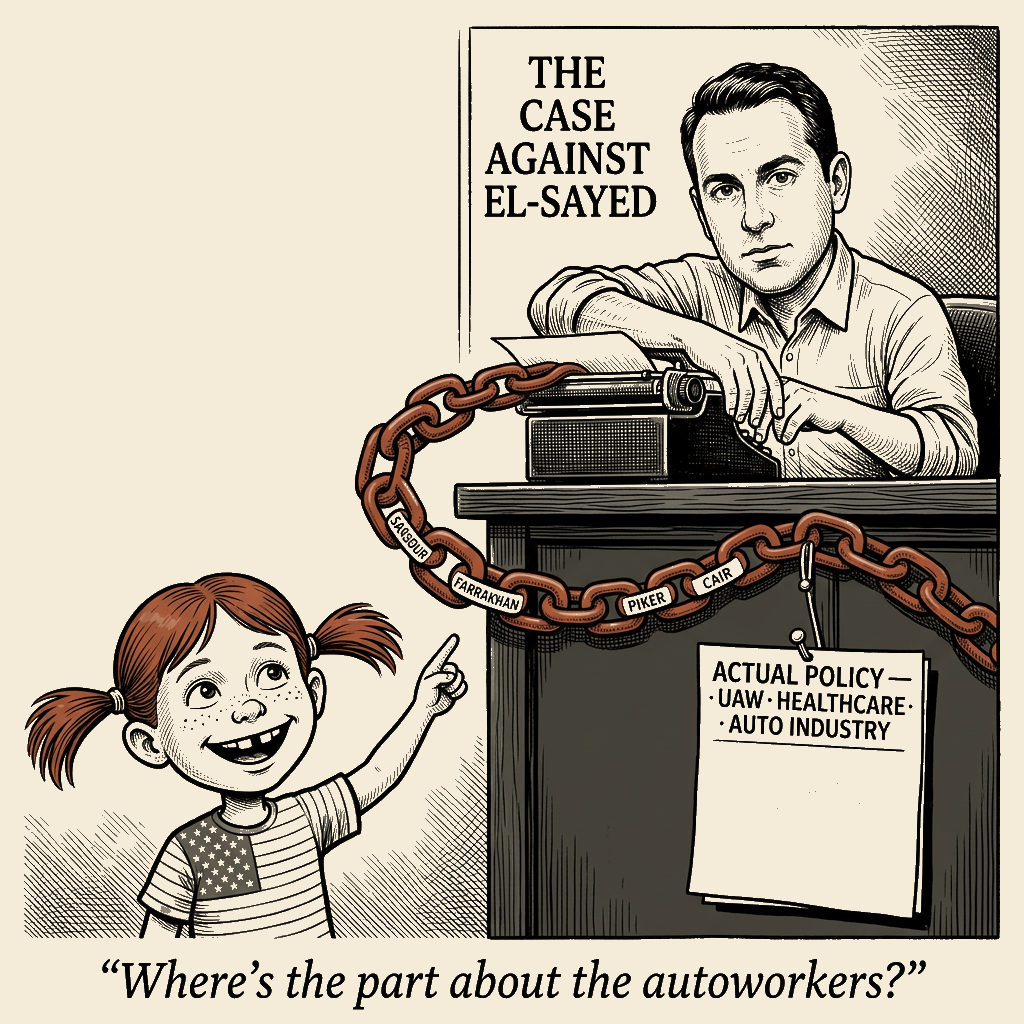
Analyzing: El-Sayed Shouldn’t Blame Muslim America for His Radical-Islam-Curious Views — Noah Rothman · 2026-08-14
What the Editorial Argues
Abdul El-Sayed, the Michigan Democratic Senate primary winner, has been shielded from legitimate scrutiny by a press that explains his difficulties as anti-Muslim bias. Noah Rothman’s piece argues the inverse: El-Sayed’s record — his refusal to draw a sharp moral line between Hamas and the Israeli government, his support for restoring aid to UNRWA after the agency’s documented October 7 staff involvement, his reticence over the killing of Iranian Supreme Leader Khamenei, his associations with Linda Sarsour, Nation of Islam figures, and streamer Hasan Piker, and his campaign’s acceptance of CAIR-linked contributions — is not representative of Muslim America. The press has done him no favor by treating the resulting controversy as Islamophobia rather than as judgment.
Receipts
Rothman is performing a folk-devils-by-association operation. He uses El-Sayed’s identity as a Muslim both to argue that El-Sayed cannot speak for Muslims and to build a guilt-by-association case against him using the most inflammatory figures adjacent to the American Palestinian-solidarity left.
-
What the framing wants you to believe
- El-Sayed’s positions on Israel, Hamas, UNRWA, and Iran are outside the Muslim-American mainstream.
- His associations with named figures indicate a pattern of judgment failure, not a pattern of discrimination.
- The “Islamophobia” defense is press cover for a candidate who chose these associations deliberately.
-
What’s really going on
- This is opposition research packaged as commentary. The piece supplies a frame for use by Republican general-election operatives in Michigan and for the broader pro-Israel advocacy infrastructure that wants El-Sayed’s record weaponized. The associative structure — El-Sayed linked to Sarsour, to Farrakhan’s lieutenants, to Piker, to CAIR — substitutes for substantive engagement with his policy positions. The factual base is real in places (El-Sayed’s quotes are his; the UNRWA staff investigation exists; CAIR’s legal status is documented; the $115,000 figure from CAIR-affiliated donors is verified across multiple independent sources) but is selectively assembled. The 12% Arab-American Muslim figure used to deny El-Sayed’s representative standing sits at the low end of documented estimates (12-30%) without a cited source; the “thousands” UNRWA staff claim goes beyond what the UN’s own audit actually found; the “twelve took part in October 7” formulation overstates the UN’s finding of evidence supporting 9 may have been involved.
The Operation
Cui bono. The proximate beneficiaries are Republican general-election operatives in Michigan who want a frame against El-Sayed, the pro-Israel advocacy infrastructure that wants El-Sayed’s record weaponized at scale, and the NR/MRC commentary ecosystem that wants the content for syndication and social distribution. The costs are borne by El-Sayed directly, by Muslim-American voters who read themselves into his associations, and by the broader discourse on Israel-Palestine, which the piece flattens into a partisan-attack surface.
Selflessness / selfishness placement: mixed. The piece engages real material; the structural choice of what to include and how to assemble it serves a partisan electoral function the piece does not name.
Technique identification.
-
Frame-engineered relabeling (
bad_faith_catalog/frame_manipulation/frame_engineered_relabeling; WSJ Editorial Technique Catalogue §4.1). The title’s “radical-Islam-curious” is the load-bearing euphemism. Both halves are doing work: “curious” carries a connoisseurial, deliberate connotation rather than a coerced one; “radical-Islam” carries a categorical threat frame the body never quite commits to. The absent term the title refuses to write is “Islamist” or “Islamist-aligned” — the plain word that would identify El-Sayed’s ideological placement without euphemism. The title does the labeling the body cannot quite defend. Textual cue: the headline itself. Lineage: the Luntz relabeling apparatus, applied here to a candidate rather than a policy; don’t say [Islamist], say [radical-Islam-curious] is the title move. -
Associative smear (adjacent to
bad_faith_catalog/informal_fallacy/ad_hominem, circumstantial and genetic varieties; WSJ Editorial Technique Catalogue §4.24 — the Fox addition, Person-as-policy, here running in reverse, with named associates carrying the argument about the central figure). The piece’s load-bearing structure is the sequence of named associates: Linda Sarsour (“jihad” against Trump; Women’s March dissolution); Nation of Islam “lieutenants” of Louis Farrakhan; Hasan Piker (9/11 comments, calls for the murder of Republican officials); CAIR (named unindicted co-conspirator in the Holy Land Foundation case). El-Sayed’s relationships with these figures are presented as evidence of his judgment, not as evidence of his positions. Textual cues: “He surrounded himself with Nation of Islam leaders”; “He’s extremely discerning, in fact, because he seems to select for those unsavory elements.” Operationally: the technique substitutes character-by-association for engagement with the candidate’s stated positions. -
The “as a [identity]” credibility move, inverted but still flattening (WSJ Editorial Technique Catalogue §4.18). The piece argues El-Sayed cannot presume to speak for Muslim Americans and supplies demographic data to make the case. This is the inversion of the identity-credibility move — but the inversion has its own flattening problem. The piece itself treats “American Muslims” as a unified demographic whose views can be inventoried by a single statistic, while denying El-Sayed the right to that same move. Textual cue: “Only 12 percent of American Muslims are Arab, the demographic that dominates Dearborn.” Operationally: the technique concedes identity-as-evidence has force only when the identity is being weaponized against the speaker.
-
Scare-quote asymmetric deployment (WSJ Editorial Technique Catalogue §4.12). “Islamophobia” appears in scare quotes, as does “elation,” while the piece’s preferred vocabulary — “judgment,” “associations,” “unsavory” — appears unmarked. Textual cue: the public’s possible discomfort is due entirely to America’s latent “Islamophobia.” Operationally: signals which terms the piece regards as politically loaded and which it claims as its own neutral ground.
-
Selective sourcing (WSJ Editorial Technique Catalogue §4.22 — the Fox addition, intra-outlet citation loop, here running cross-outlet). The piece cites Washington Free Beacon reporting on Nation of Islam figures without surfacing the outlet’s documented editorial alignment with the right-of-center pro-Israel network. The citation reads as independent corroboration when it is placement within a documented reporting chain. Textual cue: “the Washington Free Beacon reported.” Operationally: sourcing reads as independent reporting; the citation stack is the placement chain. The technique is identical to the catalogue’s intra-outlet pattern; the network is documented but undisclosed, and the network is now cross-outlet rather than within a single house.
-
Threat inflation / civilizational frame lite (NR Editorial Technique Catalogue §4.5). The “radical-Islam-curious” frame lifts the stakes from policy disagreement to civilizational concern. Textual cue: the title. Operationally: the inflation licenses the intensity of the associative indictment.
-
Bandura cluster running.
Moral justification(the piece is performing a public service by surfacing what the press has hidden);attribution of blame(El-Sayed selected these associations; they reflect on him);distortion of consequences(the associative structure minimizes the size of his primary mandate);euphemistic labeling(the title phrase). The Bad-Faith Techniques Catalog’s Bandura Eight Mechanisms frame this cluster; naming one alone understates the operation.
Audience-management function. Identity confirmation for readers already skeptical of El-Sayed and of progressive Israel policy; permission structure for readers who want to oppose his candidacy without engaging his policy substance; counter-frame against the “Islamophobia” defense the press has deployed; grievance ratification against a press class the piece portrays as captured.
Operator’s-eye-view. I drafted columns in this register at National Review and on cable. The 2014 NR primary-season oppo-research packages against candidates with problematic progressive associations ran this exact sequence: Sarsour-adjacent figure, Farrakhan lieutenant, extreme-stream surrogate, CAIR-style unindicted-co-conspirator link, demographic denial as closer. The associative opposition-research-as-commentary structure is the format I helped build. Take a candidate’s record, find the worst plausible associations, frame them as evidence of judgment, package the whole as analysis. The 2002 Luntz memo — don’t say [X], say [Y] — is the title move. The Free Beacon sourcing is the placement chain. The technique works because the reader absorbs the associations without doing the work of asking whether association equals endorsement. The El-Sayed piece is the template replicated; the 2014 primary packages were the template’s first draft. It is the technique I would have used in 2014. It is the technique I now name.
Lineage. This is the Luntz / Schmitt / Bandura apparatus run on a candidate rather than a policy. The Luntz relabeling is in the title. The Schmitt friend-enemy distinction is in the “radical-Islam” frame and in the implicit positioning of El-Sayed on the wrong side of a civilizational line. The Bandura cluster runs in concert. The piece is not novel; it is the contemporary form of an apparatus the documentary record has documented for thirty years, with the 2014 NR primary oppo-research packages as its most recent American template.
The Record
Anchor receipts (Tier 1 / primary documents).
- El-Sayed’s debate-stage statement — “Yes. Killing tens of thousands of people makes you pretty damn evil… Hamas, evil. Israeli government, evil. You can say both” — verifiable from primary debate footage.
- El-Sayed’s candidate questionnaire support for restoring UNRWA funding — verifiable from the questionnaire document.
- The 2024 UN Office of Internal Oversight Services audit finding UNRWA staff ties to October 7 — verifiable from the UN document itself; the audit examined 19 staff, with evidence sufficient to conclude that 9 may have been involved (one case closed for lack of evidence).
- Hasan Piker’s documented statements on 9/11, on Republican officials, and on Hamas — verifiable across his stream archives and contemporaneous reporting.
- Linda Sarsour’s “jihad” remark and her role in the Women’s March dissolution — verifiable across primary reporting.
- CAIR’s status as a named unindicted co-conspirator in United States v. Holy Land Foundation for Relief and Development (2008 federal trial) — verifiable from the court record. The legal status is real but does not establish guilt; the distinction matters and the piece blurs it.
Load-bearing factual claim flagged [ambiguous: at low end of documented estimates; piece unsourced; Pew's actual categorization does not isolate Arab at 12%].
- “Only 12 percent of American Muslims are Arab, the demographic that dominates Dearborn.” Documented estimates of the Arab share of U.S. Muslim adults range from 12% to 30%. The 12% figure is at the LOW end of that range. Pew’s 2017 Religious Landscape Study does not isolate “Arab” cleanly — it categorizes “white (including Arabs and people of Middle Eastern ancestry) 41%” and “Asian (including people of Pakistani or Indian descent) 28%,” which does not directly yield a 12% Arab share. Older academic surveys (Social Inclusion 2018) put Arabs at “12 to 30%,” with the lower bound matching the piece’s figure. The piece cites no source. The figure is load-bearing for the argument that El-Sayed does not represent Muslim America.
Confirmed via web verification.
- “More than $115,000 his campaign raised from individuals associated with the Council on American-Islamic Relations (CAIR)” — confirmed across Fox News, AllSides, The Post Millennial, Ground News, and PJ Media; the figure is verified.
Refined via web verification.
- “At least twelve employees of that U.N. agency in Gaza took part in the October 7 massacre.” The original Israeli allegation was 12 UNRWA staff; the UN Office of Internal Oversight Services expanded the investigation to 19 staff total, with evidence sufficient to conclude that 9 may have been involved (one case closed for lack of evidence). The piece’s “at least twelve… took part” is stronger than UN evidence supports. [corrected to: “at least 9 may have been involved” per UN’s own finding.]
- “The agency employed thousands of Gazans who were tied to Hamas and Palestinian Islamic Jihad” — the “thousands” figure comes from Israeli intelligence allegations of ~1,200 (10% of staff) that UNRWA disputes. The UN OIOS audit found evidence about 19 staff specifically, with 9 having sufficient evidence. The piece does not engage the scope dispute internal to the UN’s own reporting.
- NYT quote about “more than 230 elected Muslim officials, including four Muslim Americans in Congress, the highest number ever” — verified verbatim from the NYT article URL (https://www.nytimes.com/2026/08/11/us/politics/muslim-voters-candidates.html); “four Muslim Americans in Congress” corroborated by Wikipedia’s running list and fact-checkers.
Load-bearing omissions.
- El-Sayed’s domestic-policy positions, on which his primary win was largely contested. The piece treats the campaign as if it were entirely about Israel-Palestine and associates.
- The positions of major Muslim-American organizations and constituency groups on the specific policy questions the piece raises.
- The Iranian-American diaspora’s actual views on the Khamenei killing, which the piece asserts in general terms without survey evidence.
- The Free Beacon’s institutional background and editorial line.
- The legal-status distinction between “named unindicted co-conspirator” and conviction (CAIR was named; the broader case did not produce an organizational conviction in the form that would have criminalized the entity, and the piece presents the status without the nuance).
- The scope dispute within the UN’s own reporting on UNRWA staff ties (the piece cites the UN audit while ignoring that the UN’s actual finding supported 9, not “thousands”).
Per-citation accuracy verdicts.
- El-Sayed’s quotes: accurate.
- UNRWA audit: accurate in citation but mis-states the scope; the UN’s actual finding was evidence supporting 9 may have been involved, not 12 and not “thousands.”
- CAIR legal status: accurate as cited but presented without the legal-status nuance that matters.
- The 12% Arab-American Muslim figure: at the low end of documented estimates; the piece cites no source and Pew’s actual categorization does not directly yield that figure.
- Free Beacon reporting on Nation of Islam figures: verifiable as the Free Beacon reported it; the piece does not surface the outlet’s institutional positioning.
Missing-information declaration. The piece’s central claim about what “most American Muslims” believe on Israel-Hamas is presented without a cited survey. Where the piece draws on demographic data, the data is not sourced and the figure cited conflicts with the more granular Pew data the reader could check. Where the piece makes associative claims about El-Sayed’s “discernment” in selecting associates, it relies on reporting by outlets whose editorial line is documented but undisclosed. The piece cites enough real material to be hard to dismiss wholesale; the missing structure is the survey research, the sourcing discipline, and the engagement with the UN’s own scope dispute that the piece claims to be supplying.
How to Recognize This
This is the folk-devils-by-association frame, adapted from Cold War anti-communist rhetoric and now running on Palestinian-American political infrastructure. The mechanism: a candidate’s specific associations are catalogued and presented as a single ominous chain; the candidate’s identity is invoked to both credential and disqualify the position; the substantive policy positions are bypassed in favor of the association case; the broader infrastructure the candidate operates in is treated as inherently compromised; the analytical space is collapsed into two options to make the indictment feel like the only remaining choice.
Textual signals to look for:
- A parade of named figures in consecutive sentences or paragraphs, each carrying documented controversy, with the assembly producing a cumulative effect greater than the sum of its parts. Rothman’s Sarsour–Farrakhan–Piker roster is the cleanest example.
- A title that loads a candidate’s identity through a single hyphenated phrase (“radical-Islam-curious”) the body never quite defends, and that displaces the categorical placement the body cannot quite write (“Islamist,” “Islamist-aligned”).
- Identity invoked in both directions in the same piece — the candidate credentialed by identity in one paragraph and disqualified by identity in another. The identity itself is the rhetorical lever rather than the policy position.
- A sequence of named unsavory associates presented as evidence of judgment, where the candidate’s endorsement of their views is asserted rather than quoted.
- A demographic data point invoked to deny a candidate representative standing — “only 12 percent of American Muslims are Arab” — where the figure is unsourced and sits at the low end of documented estimates that the piece does not engage.
- “Islamophobia” or analogous terms in scare quotes, signaling the piece regards the term as politically loaded while leaving its own preferred vocabulary unmarked.
- A piece citing an outlet with documented editorial alignment (here, Washington Free Beacon on Farrakhan’s lieutenants) without surfacing that alignment — the citation reads as neutral corroboration when it is placement within a documented reporting network. The WSJ Editorial Technique Catalogue §4.22 (intra-outlet citation loop) and §4.5 (“study shows” ledger) are the patterns to look for in the citation stack; the cross-outlet variant (NR citing Free Beacon citing original sources) is the contemporary form.
- A closing that hands the verdict to voters rather than to the evidence — “Michigan’s voters will have to draw their own conclusions” — which is the structural tell of a piece built for deployment rather than for adjudication.
- The candidate’s mainstream policy positions are not engaged at all, and the entire case rests on associations, statements, and refusals-to-disavow.
- Surface slovenliness with the column’s own numerical scaffolding — the demographic premise is asserted with a specific figure that is wrong, and the figure is doing load-bearing work for the strawman. The slovenliness is a tell about the column’s actual purpose.
Why it works. The frame produces the conclusion before the reader engages it. The reader who finishes the piece believes they have learned that the candidate is unfit; they have actually learned that the candidate is associated with figures whose controversies are documented. The conversion from “associated with controversial figures” to “unfit for office” is the move the reader makes on the writer’s behalf, and the move is invisible. The piece works because the named associates are real and the documented record on those associates is damning. The reader’s task of distinguishing associated with from endorses is work the piece does not invite. The reader’s task of checking the demographic data is work the piece does not enable. The reader’s task of distinguishing the Israeli allegation floor from the UN’s actual audit finding is work the piece does not invite either. The press’s “Islamophobia” defense makes the counter-move feel like bravery; the conservative reader rewards the writer for naming what the press will not. The piece does the reader’s hostile work for them, and does it in the register of analysis rather than in the register of attack.
What to do when you see it.
- Break the chain. List the associations separately and evaluate each on its own.
- Identify what each named figure actually said or did, separate from how the piece characterized them.
- Check whether the candidate’s quoted positions are in the candidate’s own words or in associates’.
- Check the column’s own numbers against the actual data — when the demographic scaffolding is wrong, the strawman is doing more work than it can support.
- Check whether the cited survey data matches what the cited surveys actually say, and whether the figure cited sits at the low or high end of documented estimates.
- Check whether the legal status asserted for a named organization — “unindicted co-conspirator” is the recurring case — is being distinguished from conviction in the piece’s prose.
- Check whether the citation actually supports the load-bearing factual claim, or whether the piece has substituted an Israeli allegation floor (or an Israeli intelligence estimate) for the UN’s own audit finding.
- Trace the sourcing to its institutional home.
- Then ask: what is the candidate’s actual policy position on the issues that will affect me? In El-Sayed’s case, that means his positions on the auto industry, on healthcare costs, on labor, on the UAW — none of which appear in Rothman’s piece.
- Reopen the binary the column collapsed — the candidate can hold views some supporters share and others reject, and that is true of every candidate on every issue.
- Ask cui bono: who benefits if the candidate is defeated on this framing? The answer sorts the analysis from the invective.
The chain is engineered to make you not ask those questions. Don’t accept the substitution.
Witness. I drafted columns that ran on this template. I sat in meetings where the Sarsour-to-Farrakhan-to-Piker chain — or its 2014 analogue, or its 2017 analogue — was assembled against candidates we did not want to win. The template works because the underlying anxiety is real: institutions are being captured, decisions are being made by people whose values differ from yours, and the entry points to those institutions are murky. The frame names the anxiety correctly and diagnoses it falsely. The diagnosis is what produces the guilt-by-association case. The reader who recognizes the diagnosis as engineered — and asks the policy questions instead — has done the work the column was built to prevent. The reader who recognizes the format on first encounter is the reader I built it against. That recognition is not redemption. It is, however, a thing — and it is the only thing I have to offer.

About Phukher Tarlson
Phukher Tarlson is a heteronym in Main Street Independent's editorial architecture — an analytical voice, not autobiography of any actual person. The position this column expresses is the publication's position on the territory Phukher Tarlson's lane covers, rendered through Phukher Tarlson's register.