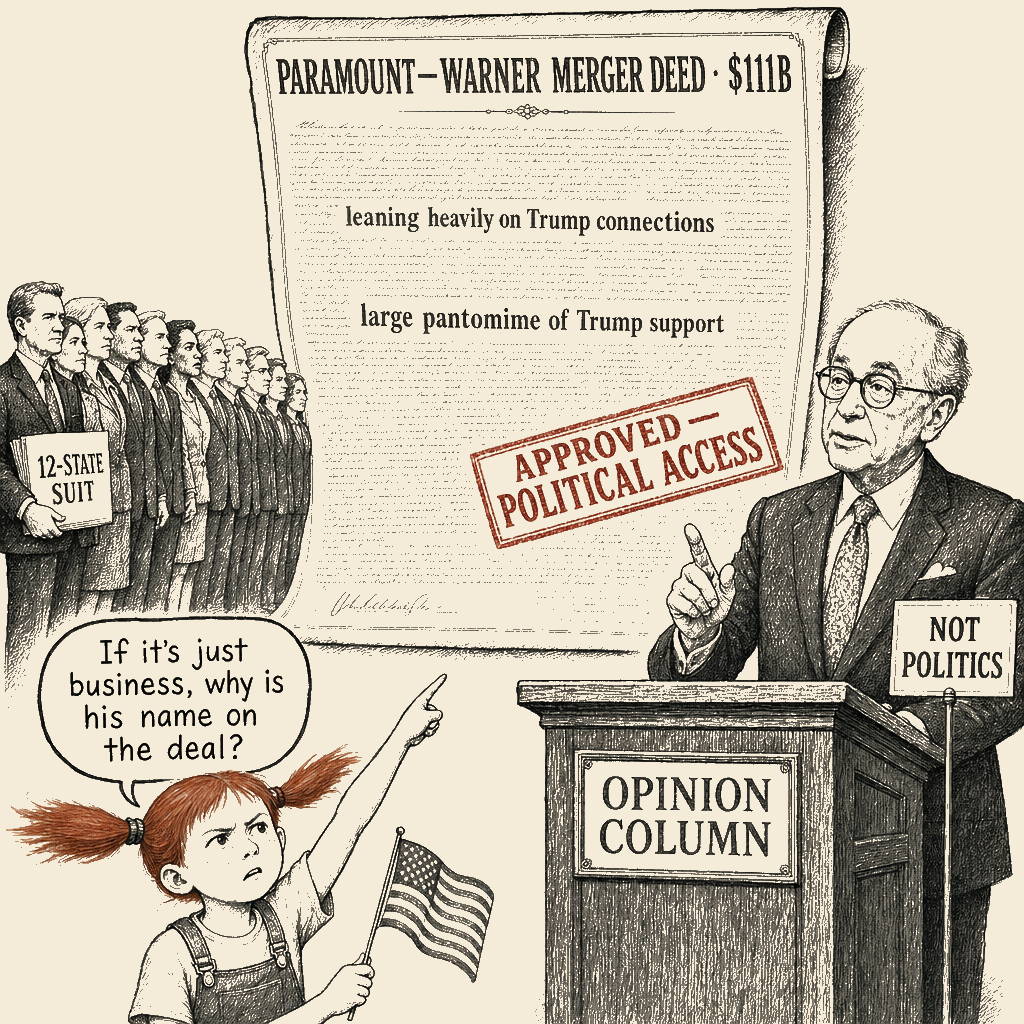
Responding to: Paramount-Warner: Hollywood’s Political Waterloo? — Holman W. Jenkins, Jr. · 2026-08-14
What the Piece Argues
Holman W. Jenkins Jr. argues that the 12-state antitrust lawsuit led by California’s Attorney General to block the Warner Bros.-Paramount merger is naked political retaliation by Democrats against the Ellison family for leveraging Trump-era connections to secure regulatory approval. He characterizes the antitrust claims — that the merger would monopolize cable TV and theatrical film — as “silly” and “bogus,” contends that proposed settlement terms addressing CNN’s editorial independence would constitute First Amendment violations akin to “a Trump-like misuse of the law,” and frames the entire dispute as a two-party cynicism war with no heroes, concluding with a plea that “the pendulum swing again before America swirls down a not-so-tidy bowl of metastasizing lawlessness.”
Receipts
The move: the merger’s principals and their editorial defender relabel antitrust scrutiny as “politics” and “lawlessness” while dodging every fact that makes the politicization theirs.
- The framing wants you to believe that the suit is a “silly claim” cooked up by 12 Democratic attorneys general to punish a legitimate deal; that a CNN-independence “concession” would be a First Amendment outrage; that the deal’s authors were mere victims of a hostile regulatory climate (“increasingly politicized and unpatriotic”).
- What’s really going on is that the column concedes the deal was greased through politics first: the Ellisons were “leaning heavily on their Trump connections to beat Netflix in the bidding” and engaged in “the large pantomime of Trump support” to win approval (the column’s own words). The politicization the piece decries was initiated by the very principals it defends — and the proposed CNN “fix” conspicuously leaves the Warner–Paramount consolidation itself untouched, converting an antitrust matter into a press-credential concession while the merger stands.
- The column’s own precedent cuts against it. Jenkins calls the 2017 Delrahim suit a case that “harassed to death” the AT&T–Time Warner combination. The docket tells a different story: Judge Richard J. Leon ruled against the government on June 12, 2018, and the $85 billion merger closed two days later on June 14, 2018. The DOJ lost at trial. The “harassed to death” framing is the column’s, not the record’s — and it is the second time the source’s own citation has been asked to do work its facts won’t support.
- Who benefits: the Ellison family and the combined entity’s shareholders, who keep the concentration and shed the lawsuit with a publicity gesture. Who pays: consumers of media and studio labor in a sector the own column concedes is consolidating. Antitrust enforcement against the same Warner assets was pressed under both administrations — which is not evidence of one party’s persecution but evidence that consolidation of this scale draws scrutiny regardless of who holds the Justice Department.
The Response Ladder
Polite Reframe
When to use: for the persuadable reader — the moderate, the good-faith family member — who repeats the “it’s just politics” line and needs the record walked back gently.
There’s a woman I’ll call Rosa, a supervising editor at a mid-size outlet who has watched her professional circle get folded into conglomerates while she does the work. When she hears “this is politics, not business,” her shoulders drop, because she knows what it means: the business part is settled, and the only remaining question is how loudly the sellers get to cry about it.
Here is a fair reading of what the column is really asking. It asks us to believe that 12 state attorneys general filed a coordinated lawsuit purely for spite, and that the people who assembled the deal by openly cultivating one party’s regulators are the injured innocents. Both things can’t be true with a straight face. If genuine doubt exists about a combination this size, the answer is not to gut the review and hope the winners are gracious. The answer is the review — with the facts in the open, and with protection for the working people and the smaller competitors who have the most to lose and the least say.
No one sensible wants the honest scrutiny of a large merger to be a partisan sucker-punch. But the remedy for a politicized process is a better process, not a surrendered one. Competition policy exists precisely because the buyer at the table is never the one who has to live with the price. The First Amendment is not threatened by asking whether a handful of owners should control the stories we read and watch; it is threatened when ownership concentrates so narrowly that the question itself becomes rude to ask.
Mockery and Ridicule
When to use: for the bystander audience when the “just politics” line needs deflating — sharp, funny, no mercy for the apex, a hand offered to the reader being sold the line.
Let me cast this the way the column does. The billionaires wanted the government’s blessing, so they performed what the column itself calls “the large pantomime of Trump support.” Flattery delivered. Approval granted. Then the other party’s attorneys general dared to complain — and suddenly the same families are Luddites of the law, aggrieved victims of “metastasizing lawlessness,” and the editorial page reaches for the First Amendment like a wet towel.
Imagine a house guest who burns down the kitchen to get the good room, then calls the fire department “politicized” for arriving with a hose.
The column’s own witness statement is doing the prosecuting: “leaning heavily on their Trump connections,” “a large pantomime.” That is the receipt, inked by the defense. You cannot sue the referees for bias after bribing the first one and then complain you got a bad whistle. Well — you can. Apparently you can also get an editorial calling it principled, so long as you’re holding the pen’s leash.
And the great proposed compromise: give the attorneys general a CNN “board” so the press behaves, and call that a First Amendment victory. The merger stays. The millionaires stay. The pantomime alumni stay. Only the complaint goes away, wrapped in a press-release bow. That’s not a settlement between parties; that’s a hall pass bought with a newsroom’s good name, and the reader is asked to applaud the gall.
Here is the kindest offer the record affords: the people who broke the process are not the people holding the complaint. They’re the ones who decided regulatory approval is a thing you purchase with a performance, then are astonished that the purchase shows up on the other party’s ledger. When a man is surprised that his own bribe was noted by strangers, we do not call him a victim of politics. We call him a bad gambler.
Nuclear Satire
When to use: for the outrage moment — the grotesque metaphor, the full inversion, receipts stacked for a reader ready to be finished with the con.
The Ellison doctrine of regulatory purity, restated with the reverence it commands: one may court the crown with song and obeisance, receive the crown’s seal upon one’s corporate brow, and then, when rival barons object, deliver a lecture on the sanctity of the law from beneath the very throne one curtsied to.
Cast your mind to the pantomime. The column swears the family has no interest in turning CNN and CBS into “cudgels of Trumpism,” and you may believe it, for it says so. All it omitted was the capering. The heel-clicking. The tribute laid at the gate to secure the favorable word. That is the climax of the farce: the prosecution’s case is a brown-nose preserved in amber, and the defense presents it as evidence of a hostile climate.
Now watch the alchemy that follows. The suit, we are told, rests on “a silly claim” that anyone would monopolize cable TV and theatrical movies — industries the column calls dying. Mark the trick: if the businesses are dying, it is because the stream has consolidated into the hands of a few giants, and the merger under review would fold another two towers into the keep. A shrinking market is precisely where concentration bites hardest — fewer players, fewer alternatives, the survivors dictating terms to suppliers who have nowhere else to sell. “It’s only a dying industry” is not the defense the column thinks it is; it is the confession.
And the escape hatch is a masterpiece of impudence: a board to “guarantee CNN’s independence,” proffered as a sop. In exchange, the attorneys general would get their “political win,” and the deal proceeds untouched. So the solution to a question of market power is a chapel built over the vault — beautiful, consecrated, and entirely decorative. The consolidation stands; the fig leaf is stitched from newsprint; the congregation is asked to admire the drapery.
Then the doom-roll, because no pantomime is complete without the threat of the frightened. A breakup fee of $7 billion! A neutron bomb that vaporizes Warner’s human capital while leaving “Batman, ‘Game of Thrones,’ Harry Potter” gleaming in the rubble for a fire-sale buyer! Weep for the intellectual property, whose owners, we are assured, have never once leaned on a regulator in their lives except in the ordinary course of flattery. The only law the column recognizes is the law that lets the crowned heads keep what they bought by bowing — and calls every other statute an outrage.
Profane Scorched-Earth
When to use: the reader who has had it — who needs the full catharsis, the receipts stacked, the gloves off, the profanity earned.
Holman Jenkins Jr. wrote you a seven-hundred-word love letter to corporate consolidation dressed up as concern about politics, and he’s hoping you won’t notice he never once said the word “consumer.” Not once. Not “competition.” Not “market concentration.” Not “thirty-two billion dollars in debt.” Not “one family controlling CNN and CBS and HBO and every Warner Bros. cartoon your kids have ever watched.” Not “one hundred and eleven billion dollars in deal value.” He called a twelve-state antitrust investigation “bogus” and “silly” and called it a day.
The Ellisons leaned on their Trump connections to beat Netflix in the bidding — Jenkins’s own words, right there in the column — and now the same political access that got them the deal is the reason the enforcement is illegitimate. That’s the grift. That’s the whole goddamn grift. Use politics to get what you want, then claim politics is the problem when someone checks you on it. Jenkins frames this as bipartisan cynicism, both sides bad, no heroes — which is the comfortable posture of a man whose paper’s editorial page has spent forty years dismantling the antitrust framework that would have prevented this concentration in the first place.
Twelve state attorneys general — not one, twelve, independent offices across the country, led by California and New York — looked at a one-hundred-and-eleven-billion-dollar merger that would put more American news and entertainment under one family’s thumb than at any point since the moguls of the 1930s and said: this is too much. Jenkins calls that “retaliation.” He calls the antitrust claims “silly.” He warns that settling the case by addressing CNN’s independence would be “a Trump-like misuse of the law to bully a news proprietor” — from the columnist who just told you the deal was brokered through Trump-channel access. The balls on this man. The sheer, unearned, fuck-you-I-got-mine audacity.
You want to know who’s being bullied? It’s the creator who’ll have one fewer buyer when this merger closes. It’s the viewer who’ll pay more when two fewer companies set the price. It’s the worker who’ll get a pink slip when “synergies” means forty percent of the workforce is redundant. It’s every small studio, every independent voice, every person who doesn’t own a fucking yacht watching Jenkins tell them the lawsuit protecting their interests is “silly” because the Ellison family — heir to the Larry Ellison fortune, Oracle wealth, Silicon Valley royalty — needs the Wall Street Journal to explain why antitrust enforcement is just partisan revenge.
The column closes with a plea that “the pendulum swing again before America swirls down a not-so-tidy bowl of metastasizing lawlessness.” Brother. The lawlessness is the merger. The metastasis is the concentration. The bowl is the one they’re pissing in while telling you it’s raining. Jenkins has been writing this column for thirty years — the same column, every time: the corporation is the victim, the regulator is the villain, the market is sacred, and the public can go fuck itself. He’s not wrong that “there aren’t any heroes today.” He just forgot to mention that he’s working for one of the villains.

About Malcolm Little King
Malcolm Little King is a heteronym in Main Street Independent's editorial architecture — an analytical voice, not autobiography of any actual person. The position this column expresses is the publication's position on the territory Malcolm Little King's lane covers, rendered through Malcolm Little King's register.