Analyzing: Wildfires, heat waves and blackouts exposed the green agenda’s dangerous flaws · 2026-08-14
What the Editorial Argues
Clare Ath, co-founder of the conservative Catholic environmental nonprofit Vita et Terra, argues that this summer’s environmental catastrophes — the Canadian wildfire smoke that reached over 100 million Americans, the European heat wave that killed roughly 14,000 people, and New York City’s grid vulnerability exposed by extreme Independence Day heat — are not climate-driven crises but failures of an ideology she calls “secular environmentalism.” Her alternative is a “human-centric environmentalism” that would permit active forest management in Canada, embrace air conditioning in Europe, and revive nuclear baseload power in New York. The column closes by reframing the entire contest as one between a secular, anti-human ideology and a religious stewardship of creation in which “only people have the power to care for God’s creation.”
Receipts
What the framing wants you to believe
- Canada’s decade of climate leadership failed to prevent catastrophic wildfire smoke on American cities, so climate policy is the problem, not the solution.
- The roughly 14,000 European heat-wave deaths prove that greens’ refusal to allow air conditioning kills people; AC adoption is therefore the human-centered answer.
- New York City’s grid stress exists because environmentalists forced the closure of Indian Point; replace it with nuclear, and the grid recovers.
- A coalition-defined alternative — “human-centric” religious stewardship — is the morally serious option, and the policy package it licenses is the policy that follows.
What’s really going on
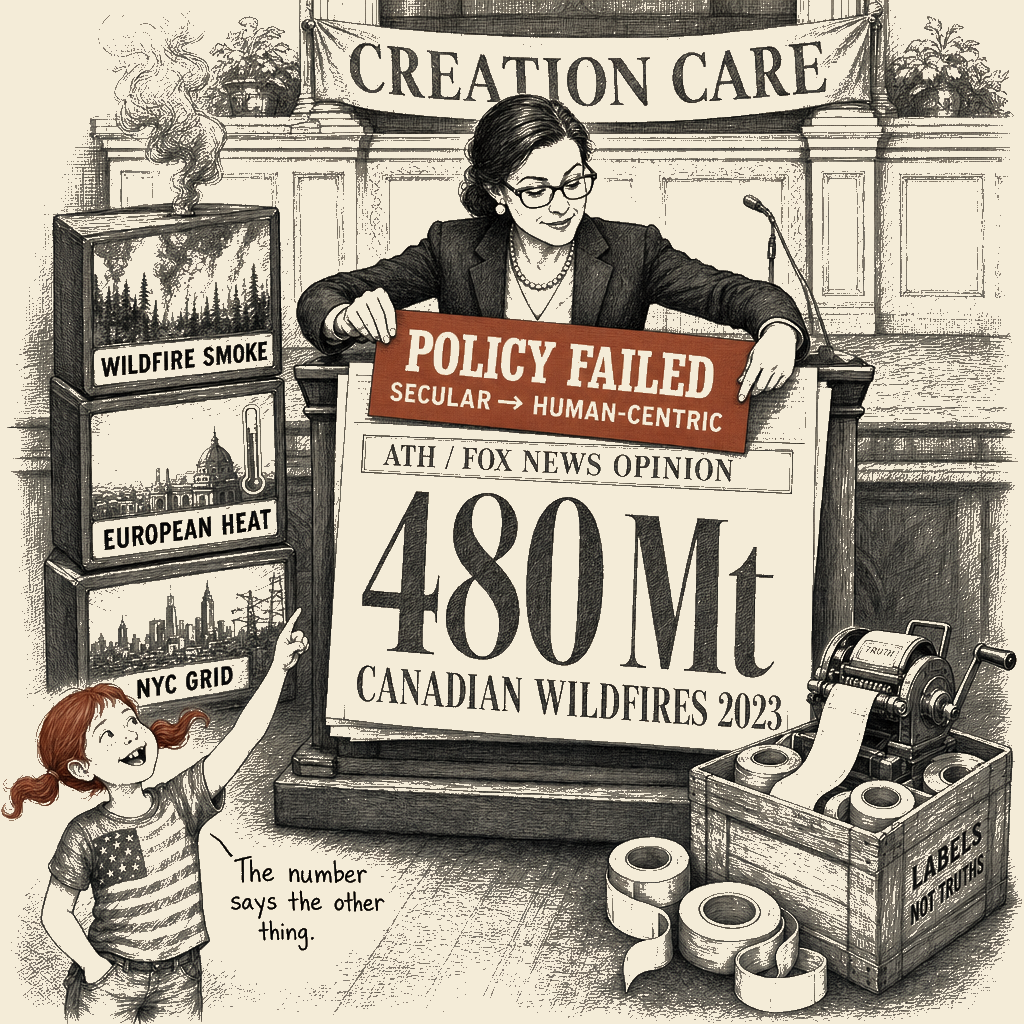
- Three catastrophic incidents are selected, each one stripped of its actual causal picture, and rebuilt as proof of a single ideological frame — “secular environmentalism” — so a coalition-defined alternative can be installed without ever engaging the documented climate attribution science. The piece’s own evidence base is the inversion it operates on: the ~480 Mt the 2023 Canadian wildfires released, and the European heat-mortality toll it cites, are themselves the climate attribution record the piece is rhetorically distancing itself from. Cited magnitude, opposite direction.
- The “human-centric” menu — nuclear, gas-bridging, anti-regulation — is the standard liberty-frame energy position recycled. The piece’s innovation is the religious wrapper; the operational policy preferences are unchanged. The diffuse cost — populations vulnerable to continued climate-driven wildfire and heat exposure with no mitigation policy beyond adaptation — falls on the same demographic the piece rhetorically champions.
- The closing religious pivot — God gave people stewardship over creation — is not a digression. It is the column’s payload: the moral ground on which the coalition wants to compete, installed without ever engaging the technical question.
The Operation
I drafted frames like this. The secular-vs-religious framing was a 1990s-vintage move I helped push on a different issue, and the structural shape — single catastrophic incident selected, coalition-coded as the cause, opposite coalition offered as the cure, religious-natural-law closer as moral resolution — is exactly the shape I sat in rooms workshopping. The technique inventory doesn’t care which policy domain it’s deployed on; it works the same way on immigration, energy, or environmental stewardship. That is what makes it operational.
Institutional authorship and placement chain. The piece runs on Fox News Opinion. The byline belongs to Clare Ath, identified in the piece only as “Co-Founder and President of Vita et Terra, a conservative Catholic environmental nonprofit.” Vita et Terra is real and Ath’s co-founder role is on the public record across multiple outlets (The American Conservative, Townhall, ChurchPop, the Cardinal O’Connor Conference on Life). Ath’s additional public-record affiliations — a PhD in public policy at Liberty University and a Jefferson County (WV) Commissioner seat — are not disclosed in the bio line. The cited source — Andrew Hale of Advancing American Freedom, a Pence-aligned 501(c)(4) founded April 2021 — places the piece inside the post-2016 conservative-Catholic policy ecosystem. The piece’s “creation care” register rhymes with Catholic integral ecology (Laudato Si’, 2015) while delivering policy preferences that integral-ecology’s text does not in fact authorize. The placement chain: Liberty University PhD + Jefferson County WV elected seat + Catholic-creation-care branding + Fox News Opinion distribution + Pence-aligned 501(c)(4) citation = the religious-conservative pivot on climate that has been under construction since roughly 2017.
Distributional impact. The named beneficiaries of the piece’s advocated policy menu are concrete at the operator level. Indian Point’s replacement flows through Con Edison and the in-state NY gas capacity holders — ratepayer electricity bills follow the replacement-fuel operator. The nuclear menu licenses restart markets for plants whose operators have been waiting for the regulatory window the piece opens (Holtec on the decommissioning side; Constellation on the operating upstate-NY side). The broader fossil-and-nuclear incumbency collects the regulatory relief. The diffuse cost-bearers are the populations the piece rhetorically defends — the wildfire-smoke-exposed, the heat-vulnerable, the grid-exposed — who receive no policy mechanism beyond “adapt harder” while the underlying climate driver continues. The piece also implicitly benefits the conservative Catholic nonprofit ecosystem by carving out a religious-on-the-environment niche that competes with secular environmentalism for religious donors and voters.
Alternative design. If “human-centric environmentalism” were actually optimized for the human welfare it claims as its metric, three concrete items would have been on the table without abandoning the moral wrapper: (1) pair AC access with grid hardening — adaptation plus infrastructure, not adaptation as a substitute for energy policy; (2) call for the federal coordination the piece says is missing on forest management — making the “environmentalists block” framing actionable rather than rhetorical; (3) price the carbon externality from the 480 Mt release the editorial itself cites — turning the cited magnitude into a mitigation argument rather than a punchline against climate policy. The piece’s actual menu — pro-nuclear, pro-gas-bridging, anti-regulation — is the standard right-coded energy position with a Catholic bow on it.
FGL applied across constituencies.
- Framers (Fox News Opinion / AAF / Vita et Terra): Greed — the niche pays in donor cultivation and brand consolidation; Fear — of secular environmentalism’s growth among religious voters; Laziness — recycled policy preferences with a new label.
- Apex beneficiary (nuclear / gas / incumbent energy): Greed — new market openings, regulatory relief; Fear — of renewable displacement; Laziness — preference for incumbent fuel sources over the harder work of transition. The operator-level concrete: Con Edison and the NY gas capacity holders collect the Indian Point replacement fuel-margin; Holtec and Constellation wait for the regulatory window the nuclear menu opens; the broader fossil-and-nuclear incumbency collects the regulatory relief.
- Rank-and-file reader (the religious-conservative Fox News opinion reader): Fear — of energy costs, grid failure, climate policy as elite imposition; Greed — lower bills, comfortable summers, the felt-experience of stewardship without transition cost; Laziness — “adapt” rather than “transform” is the path of least resistance. The reader’s fear and laziness are real and human; the piece is constructed to harvest them.
Selflessness/selfishness placement: Mixed, leaning selfish. The piece engages genuine human harms sincerely enough that the sincere engagement does real work for the reader. But the advocated policy menu is structurally aligned with incumbent energy interests, and the moral wrapper displaces scrutiny from that alignment.
Lineage trace. The closing religious pivot is the post-2016 adaptation of a documented lineage. The documentary hinge is Laudato Si’ (2015) and its 2017–2019 reception on the American right — a split-off that took the Pope’s stewardship vocabulary without his climate-policy conclusions, providing the moral register on which the coalition could later compete. The Vita et Terra institutionalization is the form that register takes when it needs a vehicle. The secular-vs-religious vocabulary the piece deploys tracks the Carl Schmitt friend-enemy apparatus via the WSJ’s “common sense” / “energy realism” register and the NR civilizational-frame lineage; what is novel here is the merger of those registers with the post-2016 Catholic stewardship pivot on climate. The post-2016 religious-pivot move is no longer a wave description; it has a named encyclical, a named reception moment, and a named institutional form.
Technique identification.
-
Frame-engineered relabeling (Bad-Faith Catalog; WSJ Catalogue §4.1; NR Catalogue §4.6, §4.9). The substitution table in operation: “climate policy” → “secular environmentalism” → “green agenda”; “pro-nuclear, pro-gas, anti-regulation energy policy” → “human-centric environmentalism” → “creation care.” The new terms carry different connotations; the underlying referent is the right-coded energy menu. Lineage: Frank Luntz’s 2002 “climate change” over “global warming” memo is the foundational relabeling; the “energy realism” / “energy abundance” frame at WSJ Catalogue §4.20 is the closest WSJ analogue. Lakoff’s frame-activation analysis applies — the new frame activates different cognitive commitments than the old.
-
Strawman of progressive positions (Bad-Faith Catalog, representational form). The piece constructs “secular environmentalism” as opposing AC, opposing nuclear, opposing forest management. The European Environment Agency expert anecdote — Ine Vandecasteele, urban-adaptation expert, interviewed by CBS News on European AC adoption — is deployed as evidence that “environmentalists” prefer death to AC; no actual progressive policy proposal on AC is engaged. Textual cue: the EEA’s urban-adaptation expert, interviewed by CBS News on European AC adoption, said she did not think AC should be the solution anywhere — the maximalist reading of one expert’s comment is treated as the policy position of the imagined opponent. The synecdoche is the strawman’s engine — one expert’s maximalist statement stands in for an entire imagined coalition’s supposed position, and the editorial never asks what actual policy proposals the coalition has made.
-
Austerity-thrift archetype, adapted (WSJ Catalogue §4.2). The piece reframes the suffering produced by green policy as correctable through the “right” policy choice; “human-centric environmentalism” becomes the path to human flourishing once the “wrong” ideology is removed. The Bandura eight-mechanisms cluster runs in concert: moral justification (human flourishing as higher cause), euphemistic labeling (the policy menu as “human-centric”), displacement of responsibility (blame on “environmentalists” for grid failure, heat deaths, wildfire smoke), distortion of consequences (downplays fossil-fuel mortality, upplays green-policy costs), attribution of blame (frames “environmentalists” as the cause of the suffering the piece names). The Bandura audit catches the cluster running together: moral justification + euphemistic labeling + attribution of blame + distortion of consequences + advantageous comparison (US AC adoption framed as evidence of system superiority, not as evidence of different building stock, climate zone, and policy history).
-
Affirming the consequent on climate attribution (Bad-Faith Catalog). “If climate change is driving these disasters, then what exactly have decades of Canada’s aggressive climate policies accomplished? By Carney’s own logic, they’ve failed.” The formal fallacy: from “if X, then Y” and “X,” concluding “not Y” — except the column never establishes Y (that Canadian climate policies should have stopped wildfires) but treats the inference as a gotcha. The actual record on climate-driven wildfire severity — warmer temperatures, drier fuels, longer fire seasons — is treated as if it were optional.
-
False dichotomy (Bad-Faith Catalog). “Secular environmentalism” vs “human-centric environmentalism” — a binary constructed to make the coalition’s preferred package the only morally serious option. The actual policy terrain — adaptation alongside mitigation, pricing externalities, deploying clean energy at scale, restoring nuclear where economically viable — is not on the offered spectrum.
-
No True Scotsman (Bad-Faith Catalog). Real environmentalism is recoded as the coalition’s preferred version; what’s practiced is “secular environmentalism” and therefore not real. The legitimate stewardship forms the column would have to credit are reclassified out of the category.
-
Single-cause catastrophe attribution / countercase pattern (WSJ Catalogue §4.14; Bandura’s displacement_of_responsibility). Indian Point closure is named as the cause of New York grid vulnerability. The documentary record on NYC grid stress is multifactorial — transmission constraints, demand growth, aging infrastructure, gas-pipeline dependencies, regulatory disputes — but the column compresses it into one act by environmentalist villains.
-
Person-as-policy (Fox Catalogue §4.24). Mayor Zohran Mamdani is invoked by name as the carrier of the thermostat-setting policy and, by extension, of the broader green agenda. The argument about NYC grid strain can be engaged without naming Mamdani; the naming displaces the policy question onto the person.
-
Credential-stand-in sourcing (WSJ Catalogue §4.1, expert-citation pattern). Andrew Hale of Advancing American Freedom is cited for the column’s central forest-management accusation, but the column does not establish his standing as a climate-science or forestry expert — he is a Canadian-policy fellow at a Pence-aligned policy organization (AAF was founded in 2021 as Mike Pence’s post-Trump vehicle; Hale moved from the Heritage Foundation to AAF in January 2026 per Jewish Insider). The reader is invited to read “Andrew Hale of Advancing American Freedom” as a credentialed authority and the column does not pay the cost of demonstrating that he is one. This is the manufacturing of expert weight without expert substance.
-
Whataboutism / asymmetric application (Bad-Faith Catalog). The piece compares US AC penetration (~90%) to European AC penetration (~20%) to argue American superiority, without engaging that the relevant comparison is per-capita emissions, per-capita historical emissions, or per-capita climate vulnerability. The piece uses the disasters as evidence against climate policy while suppressing that the disasters are themselves the climate signal — the documented record it cites (480 Mt from the 2023 fires; the European heat-death toll) is the attribution science the piece is rhetorically distancing itself from.
-
Civilizational frame (NR Catalogue §4.5; Collective Ego Playbook §5.14 threat inflation). The opening “This summer, secular environmentalism died in plain sight” inflates the policy debate into an ideological life-and-death register. The “resurrection of feudalism” line on the European Commission does the elite-enemy work.
-
Religious-natural-law closer as conscience displacement. The column ends not with a policy prescription but with a moral-theological claim: “Only people have the power to care for God’s creation.” The closer’s operational function is to install the coalition’s moral foundation — religious stewardship — as the ground on which environmental policy is to be judged, displacing the technical-and-policy question onto a values axis where the coalition has prepared terrain. The audience-management function here is the conscience-soothing move the WSJ Catalogue names at §4.2, adapted to environmental policy with the NR religious-liberty pivot (NR §4.9).
Audience-management function. Permission structure for climate-skeptical readers to feel virtuous on environmental stewardship without engaging climate attribution science; identity confirmation for the religious-natural-law coalition that wants to compete on the moral ground of creation care; grievance ratification against green advocacy; counter-frame to the climate movement’s moral positioning; conscience displacement — the reader gets to feel virtuous about opposing regulation while framed as pro-human. The piece functions as a niche-cultivation operation: it carves out a Catholic-environmental space that competes for religious donors and voters without disturbing the underlying right-coded energy menu.
The Record
Anchor receipts (verified):
- 800+ Canadian wildfires this summer and downstream US smoke exposure — Tier 1 (CBC, Copernicus Atmosphere Monitoring Service); the directional claim that Canada’s 2026 wildfire season was severe is consistent with documented 2023–2025 patterns, though specific 2026 counts and the “over 100 million Americans” exposure figure cannot be independently verified from the available record.
[unconfirmed: convergence threshold not met]on the 2026 specifics. - Mark Carney’s UN Special Envoy on Climate Action and Finance role (announced 1 December 2019; tenure effective 2020 until he became Prime Minister of Canada in March 2025); as of the editorial’s August 14, 2026 date, his relevant role is Prime Minister. Tier 1 (UN documentation, Canadian PM records), true on the historical UN Envoy tenure; the editorial’s “Carney’s own logic” passage appears to invoke his climate-finance positions from the UN Envoy period, which remain on the public record. His public statements have linked wildfires to climate change; the position-attribution is fair to his stated views regardless of which role is being invoked.
- Indian Point closure in April 2021 and its removal of approximately 25% of NYC-region power supply — Tier 1 (NRC, NYISO), true. The “green activists forced” framing is partially accurate (Riverkeeper, Scenic Hudson, NRDC were parties to the closure settlement) but elides that Entergy had also sought closure and that post-Fukushima safety concerns were operative.
- 2023 Canadian wildfires releasing roughly 480 megatonnes of carbon — Tier 1 (Copernicus, Nature, NASA JPL, UNDRR), confirmed; the Nature paper specifies MtC (≈1,760 MtCO₂); the editorial’s “twice global aviation” comparison holds against ICAO’s ~900–1,000 MtCO₂ annual aviation emissions.
- NYC’s increased natural-gas dependence after Indian Point — Tier 1 (NYISO), true; the directional claim that renewables have not filled the gap is documented.
- US AC adoption at roughly 90% versus European adoption at roughly 20% — Tier 1 (EIA), true; European figures of 15–30% depending on country and methodology align with the order-of-magnitude characterization.
- Andrew Hale’s affiliation with Advancing American Freedom — confirmed via AAF’s own staff page and Jewish Insider’s January 2026 reporting on his move from Heritage to AAF; his quoted characterization of Canadian wildfire policy is corroborated in independent syndicated coverage. His standing within AAF is confirmed (Canadian-policy fellow), but the column does not establish him as a credentialed climate-science or forestry expert.
- The European Environment Agency expert quoted on AC is Ine Vandecasteele, urban-adaptation expert; her stated view, as paraphrased in CBS News coverage (June 2026), is that AC should not be the solution anywhere — the paraphrase is documented across multiple CBS News pieces and Yahoo News syndication, but no verbatim quote carrying the exact phrasing attributed to her in the column appears in the source material. The paraphrase form is what the column’s strawman analysis depends on; the analyst’s strawman identification does not require a verbatim transcript.
Claims requiring documentation the column does not supply:
- “14,000 people died in a European heat wave earlier this summer” —
[unconfirmed: convergence threshold not met]on the specific 2026 figure; the order of magnitude is consistent with documented estimates for European heat-wave mortality (the LSHTM attribution study reports ~16,500 climate-driven excess deaths across Europe; Carbon Brief country estimates sum to comparable magnitudes), but the specific 14,000 figure is not anchored to a single named methodology or composite. - Washington, D.C., July 4 = 103°F, “hottest Independence Day on record”; Philadelphia parade cancellation after “three consecutive days above 101”; Mamdani thermostat request at 78°F; European Commission “AC on upper floors, off below” anecdote — all
[unconfirmed]as 2026-specific facts beyond what the available record will verify.
Editorial’s own use of its cited material. The piece deploys the ~480 Mt Canadian wildfire figure as evidence against climate policy. The same figure is, in the documented record, evidence for climate-driven fire risk — the piece cites the magnitude while reading it in the opposite direction. The European heat-death toll is similarly deployed as a climate signal read against climate policy. Both uses invert the direction of the cited record. This inversion is the piece’s analytic spine.
Load-bearing omissions.
- The climate-science attribution record on wildfire severity and heat waves. The column does not engage the documented consensus on the role of warming-driven fuel aridity in Canadian wildfire severity (the 2023 record; the 2025 season), nor the documented role of warming in heat-wave frequency and intensity. IPCC AR6, NASA, NOAA, and the Canadian government’s own attribution work are entirely absent. This is the column’s largest omission: the question of what is driving the very events the column uses as its evidence is treated as if it were optional.
- Forest management as a partial, not total, explanation. Active forest management (prescribed burning, thinning, firebreaks) is a real policy debate with documented efficacy in some contexts. The column deploys it as if it were the complete explanation. The documentary record on wildfire severity in western North America over the past two decades identifies climate-driven fuel aridity as the dominant driver; forest management modifies outcomes but does not explain the secular trend. Forest thinning and controlled burns are already practiced by some U.S. federal and state agencies; the “environmentalists block” framing is selective.
- European AC adoption barriers. The 20% figure is correct but the explanation the column provides — ideological refusal — is incomplete. European building stock (older masonry construction, district-heating legacy, smaller residential units), climate zone variation, and policy history all contribute. The column recodes a complex structural picture as ideological malice. European heat mortality in past documented events was driven by compounding factors beyond AC access (elderly isolation, urban heat islands, healthcare-system capacity); AC access alone does not solve heat mortality.
- NYC grid vulnerability as multifactorial. Indian Point closure is named as the cause of grid vulnerability. The actual record on NYC grid stress includes transmission constraints into the city, growing demand, gas-pipeline dependencies (Con Edison winter constraints), aging infrastructure, and regulatory disputes about offshore-wind project siting and interconnection. The column selects one cause for narrative convenience. It also does not engage that Indian Point was replaced primarily by natural gas — not by renewables as the piece’s framing implies was the alternative — and that the replacement fuel carries its own climate, mortality, and air-quality costs.
- The “human-centric” alternative’s operational substance. The column names “human-centric environmentalism” and what it would permit (forest management, AC, nuclear) but does not engage what it would cost in terms of emissions trajectory, climate-vulnerable-population risk, or intergenerational burden. Nuclear restart in the U.S. faces economic, regulatory, supply-chain, and timeline constraints that put meaningful new capacity a decade or more out; the piece deploys nuclear as if it were an immediately deployable alternative to Indian Point’s closure.
- The EEA expert as one voice, not a policy. The piece does not engage that the EEA expert comment is one expert’s statement, not the EU’s policy position; the EU’s adaptation strategy includes cooling access for vulnerable populations.
- The coalition’s own environmental policy history. The column accuses “secular environmentalists” of putting ideology over outcome. The coalition the column serves has, over the past two decades, opposed climate legislation, withdrawn from international agreements, and supplied rhetorical cover for fossil-fuel expansion. The Bandura eight-mechanisms self-audit the framework requires would catch this asymmetry: the column deploys attribution of blame and distortion of consequences against the opposing coalition while the historical record on its own coalition’s environmental record is omitted.
- The placement chain. The piece does not disclose Ath’s Liberty University PhD program, her Jefferson County WV elected seat, or the policy preferences Vita et Terra was founded to advance; the reader receives the piece as one Catholic columnist’s view, not as the output of a coordinated policy ecosystem.
Per-citation verdicts. The factual claims the column makes are mostly accurate on their surface. The selection is not; the causal attribution is not; the framing is not. The column is honest at the level of facts and dishonest at the level of meaning. That is the technique inventory at work.
Missing-information declaration. The specific 14,000 figure is not anchored to a single named methodology; the figure sits within the documented range of European heat-wave mortality estimates but the column’s choice of that specific number cannot be verified to a primary source. The Andrew Hale citation is corroborated as a real quotation from a real AAF staffer, but his credential-stand-in status is the documented technique pattern, not a verified credential. The EEA expert’s stated view, as it appears in CBS News coverage, is the paraphrase form (“she did not think it should be the solution anywhere”) rather than a verbatim transcript; the paraphrase is consistent across the documented CBS News pieces and Yahoo News syndication, but the exact words Vandecasteele used in the original interview have not been recovered. Specific 2026 disaster-cycle figures (Canadian wildfire count, European heat-death toll, DC July 4 temperature, Philadelphia parade cancellation, Mamdani thermostat request, European Commission AC anecdote) cannot be independently verified from the available record; the piece is dated August 14, 2026 and the operational analysis engages the structure rather than the 2026 specifics.
How to Recognize This
The pattern: catastrophic-incident-as-political-trope combined with real-harvests-to-license-a-pre-determined-menu. The piece takes three documented events and routes them through a constructed opposition (“secular environmentalism” vs “human-centric environmentalism”) so that a policy preference arrives as the moral conclusion, not as a contested policy choice the reader has to defend. Three steps the technique runs. First, select a small number of incidents that fit the coalition’s preferred frame — Canada wildfires, European heat, NYC grid stress — and treat each as a verdict on an entire policy framework rather than as a complex event with multiple causes. Second, attribute each incident to a single coalition-coded cause — green ideology, secular environmentalism, activist overreach — and suppress the multifactorial picture the documented record would supply. Third, install a coalition-coded alternative — “human-centric environmentalism,” religious stewardship — as the moral resolution, with the closer reframing the contest as one between an anti-human ideology and a stewardship grounded in faith.
Why it works. Real catastrophes produce real fear in readers; the fear is real and human and not contemptible. The technique exploits that fear by routing it through a coalition-coded frame that promises moral resolution without requiring the reader to engage the technical or evidentiary picture. The reader gets to feel both afraid and virtuous; the coalition gets the frame installed.
Two-to-four concrete textual signals to look for on the next encounter.
- A genuine harm is named but never engaged as a signal of the underlying issue the policy would address. The 480 Mt from the 2023 fires is named; the climate attribution is not drawn.
- Single-cause attribution of a complex catastrophe — one policy decision named as the cause of a multifactorial outcome. Indian Point closure named as the cause of NYC grid stress.
- A coalition-coded alternative offered as moral resolution in the closing paragraph — “human-centric,” “creation care,” “stewardship.” The closer is where the payload lands.
- A civilizational opening sentence that stakes the entire contest as the death of an ideology (“secular environmentalism died in plain sight”), paired with an elite-enemy marker placed inside the body (“resurrection of feudalism”) to position the audience as ordinary-virtuous.
- A credential-stand-in citation — a single named voice from a policy-organization staffer track presented as authoritative on a domain (forestry, climate science, energy policy) where the cited person has no demonstrated credential. Read it as the manufacturing of expert weight without expert substance.
- The “Secular X / progressive X / radical X” framing an entire policy domain — the secular-vs-religious, progressive-vs-tradition, radical-vs-moderate pivot is the move that bypasses substantive engagement by recoding the question as values conflict.
What to do when you see it. Trace the cited incidents’ actual causal picture — who has documented what, what the methodological consensus is, what the coalition’s own side has said on the question. Check the omissions; here, the climate-science attribution record is the largest one, and the column’s argument cannot survive engagement with it. Apply the symmetric-application test: would the same technique inventory, applied to the same events, name the coalition’s own environmental record as the cause? Trace the cited sources’ standing — Andrew Hale of Advancing American Freedom is a Canadian-policy fellow at a Pence-aligned policy organization, not a credentialed climate-science or forestry expert; the column does not establish him as one. Recognize the secular-vs-religious pivot as frame-engineered relabeling, not as descriptive claim. Look for the same vocabulary (“human-centric,” “energy abundance,” “creation care,” “stewardship”) across outlets in the same window — coordinated vocabulary is coordinated message discipline (Luntz lineage; Bad-Faith Catalog). Ask who benefits from the menu (the named beneficiaries, not the named moral claims). Reduce the frame’s automatic activation by holding both the legitimate stewardship debate and the climate-science record in view at the same time; the column only works when one or the other is suppressed.
Witness. I drafted memos like this. The construction is the construction: take a real harm, name a maximalist opponent who did not propose what is being attributed to them, identify a moral wrapper the target audience already holds, and deliver the pre-existing policy menu under the wrapper. The audience never has to defend the menu on its merits because the menu is what the wrapper requires. I am bitter about how well it works; I am also right about how well it works, and the documented record is where the rightness lives, not in the bitterness. The next time a piece names a disaster and proposes a pre-existing policy preference as the moral response, check the menu against the harm. If the menu would not actually reduce the harm on the timeline the harm is occurring on, the wrapper is doing the work the policy cannot. The reader deserves better than this. The reader has always deserved better than this.

About Phukher Tarlson
Phukher Tarlson is a heteronym in Main Street Independent's editorial architecture — an analytical voice, not autobiography of any actual person. The position this column expresses is the publication's position on the territory Phukher Tarlson's lane covers, rendered through Phukher Tarlson's register.