Analyzing: What my son's ultrasound taught me about abortion — and Massachusetts ignores · 2026-08-13
What the Editorial Argues
A Fox News contributor, mother of a one-year-old, argues that Massachusetts’s new Prioritizing Patient Access to Care Act — which replaces specific gestational restrictions on late-term abortion with a “physician’s professional judgment” standard — strips protections from viable babies. She anchors the argument in her own son’s 20-week ultrasound photo, argues that 24-week fetuses are morally equivalent to the NICU infants her sister-in-law cares for as a neonatal nurse, cites Harvard-Harris polling showing 72% want abortion limited to 15 weeks or earlier and just 10% support abortion through nine months, frames Massachusetts as a global outlier alongside “the most totalitarian countries in the world, such as China,” and closes with a maternal-instinct appeal: the law asks women to override the very instinct that defines motherhood.
Receipts
What the framing wants you to believe:
- The Massachusetts law allows elective late-term abortion on demand with no medical indication required.
- A 24-week fetus is morally equivalent to a NICU baby, and “viability” settles the question.
- Massachusetts holds a fringe position shared only with authoritarian regimes.
What’s really going on:
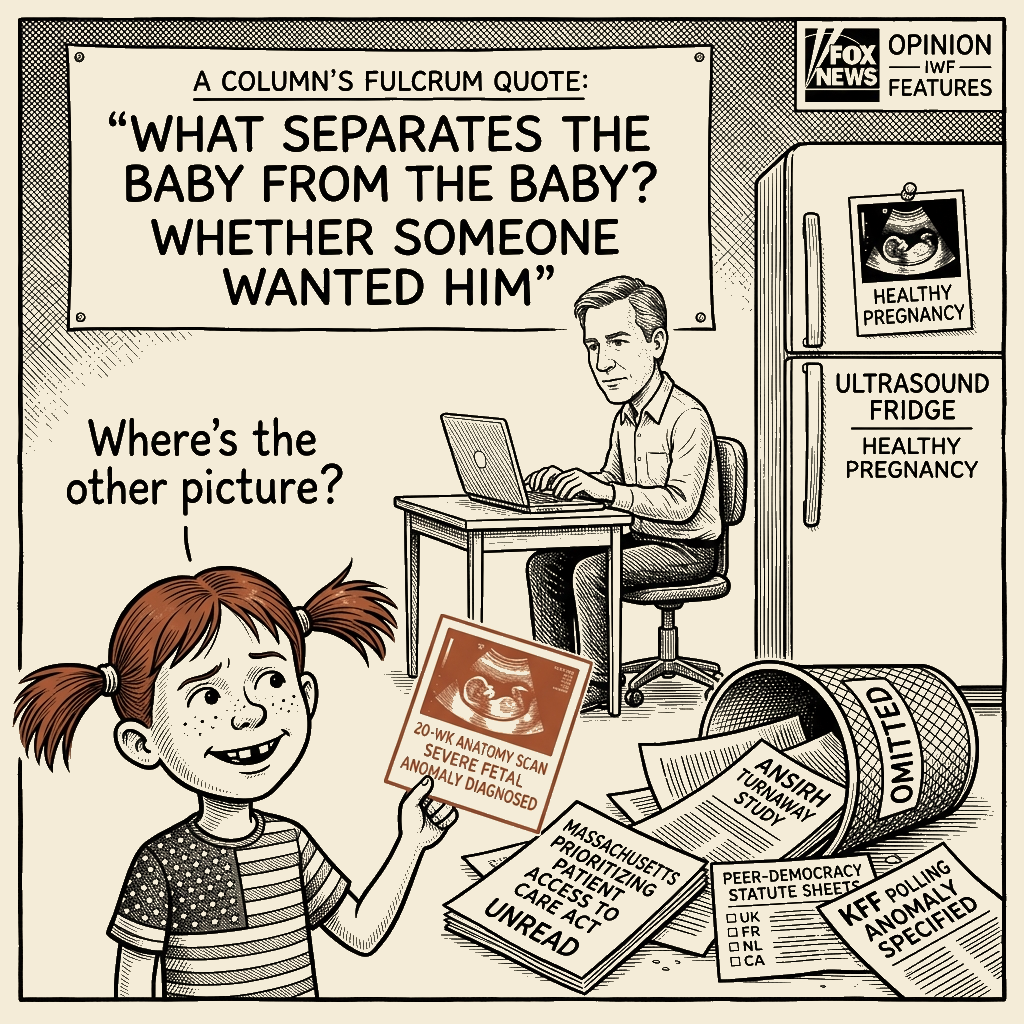
- The clinical record of late-term abortion is suppressed in favor of an emotionally-anchored “wanted or not wanted” frame. CDC Abortion Surveillance data (CDC, Abortion Surveillance — United States, 2022, MMWR Surveillance Summary 73(7), ss7307a1) shows abortions performed at or after 21 weeks’ gestation constituted 1.1% of all reported abortions in the United States in 2022. CDC surveillance does not directly test the reason mix at late gestation — that evidence sits in the ANSIRH Turnaway Study and the related clinical literature, which document that patients obtaining abortion after 20 weeks overwhelmingly cite barriers to earlier access (logistical, financial, discovery of severe anomaly at the 20-week anatomy scan) rather than elective preference. The elective-on-demand frame has no large evidentiary base at late gestation in either the surveillance or the clinical literature.
- The international comparison is suppressed. The United Kingdom’s Abortion Act 1967 §1(1)(d) permits abortion up to birth where there is a substantial risk the child, if born, would suffer from such physical or mental abnormalities as to be seriously handicapped. France’s Code de la santé publique Article L2213-1 permits late-term abortion when two physicians, members of a multidisciplinary team, attest that continued pregnancy gravely endangers the woman’s health or that there is a strong probability the unborn child will be affected by a condition of particular severity recognized as incurable at diagnosis. Canada’s criminal gestational limit was struck down in R. v. Morgentaler, [1988] 1 SCR 30. The Netherlands’ Wet afbreking zwangerschap (enacted 1981, in force 1 November 1984) permits abortion up to 24 weeks — the statutory viability line — on broad medical/social grounds, with later procedures permitted only for serious medical reasons. Sweden’s abortlag (1974:595) takes a different shape: abortion on request up to 18 weeks, with later procedures requiring approval from the National Board of Health and Welfare on exceptional grounds. Sweden’s 18-week threshold is tighter than Massachusetts’s, not looser — and so cuts against the column’s outlier argument rather than supporting it. Massachusetts’s standard is closer to OECD peer practice than to the “China” frame the column offers. The comparator choice is the structural critique, not the specific comparators themselves.
- The false dichotomy is suppressed. The piece’s fulcrum is the question — “So what, exactly, separates the baby fighting for his life in the NICU from the baby electively aborted at the very same stage — other than whether someone wanted him?” — which forces a binary between the wanted NICU infant and the unwanted aborted fetus. The third category the clinical record contains — the wanted pregnancy in which a severe fetal anomaly is diagnosed, typically at the 20-week anatomy scan, with the parents then choosing to terminate — is precisely the population the prior law’s mental-health exception was already broad enough to cover, and the population the new law’s physician-judgment standard is designed to address. The column suppresses this category because the category dissolves the dichotomy the moral argument requires.
- The Harvard-Harris polling citation is partial. The 72% figure for a 15-week limit is within the range of confirmed post-Dobbs poll variants (Harvard-CAPS/Harris, June 2022 fielding wave, corroborated across multiple secondary sources including Rep. Chris Smith’s release). The 10% figure for “through nine months” is corroborated in the same instrument family (LiveAction and Jonathan Turley’s reporting of the June 2022 wave). The question construction that drives the 72%/10% split — whether the instrument distinguishes elective termination from medical-necessity cases, and whether the anomaly context is specified — is not surfaced. Post-Dobbs polling on late-trimester abortion shifts sharply when anomalies are specified in the question: Kaiser Family Foundation tracking puts support for late-trimester abortion in cases of severe fetal anomaly near 80% when the instrument specifies anomaly context. The 10% figure more than doubles when the question is asked that way.
The piece’s most consequential omission is the medical data on why third-trimester abortions occur — overwhelmingly severe fetal anomalies diagnosed late (often at the 20-week anatomy scan), and a small number of maternal-health crises — which the prior law’s “mental health” exception was already broad enough to cover, and which the new law leaves to physician judgment rather than to a statutory checklist.
The Operation
This is the post-Dobbs pro-life op-ed archetype, executed cleanly. I want to walk through it from the operator’s chair, because I drafted memos in this exact register for the cable years and the foundation-circuit years — and the Independent Women’s Forum network this column runs through was in our donor briefings.
Cui bono.
Institutional authorship. The piece is published by Fox News Opinion; its contributor is simultaneously the editor-in-chief of IW Features, the grassroots storytelling arm of Independent Women’s Forum. IWF is a documented right-of-center women’s organization founded in 1992, with a long history of work on abortion framed as a women’s-issue-in-favor-of-restriction — the “Women Speak for Themselves” project, the “I Am a Pro-Life Woman” testimonial infrastructure, the State Policy Network partnership. The Koch-affiliated State Policy Network, the Bradley Foundation circuit, and the IWF funding base depend on late-term abortion as the durable wedge issue that maintains fundraising velocity and electoral mobilization. The “as a mother” angle is the focus-grouped instrument. The maternal-instinct frame was tested against the “physician’s judgment” frame and the “rights” frame in the post-Dobbs focus-group cycle, and the maternal frame won by margins the principals wanted to lock in before the next election cycle. This is the load-bearing device of the piece: identity-category testimony crowds out policy engagement by design.
Distributional impact. The named beneficiary is the pro-life advocacy infrastructure — Susan B. Anthony Pro-Life America, National Right to Life, the state-level affiliates, and the donor network (the State Policy Network, the Bradley Foundation circuit, the IWF funding base) that depend on late-term abortion as the durable wedge issue that maintains fundraising velocity and electoral mobilization. The diffuse cost-bearer is the population of women who seek later abortion care — overwhelmingly per the ANSIRH Turnaway Study findings and the CDC surveillance data (see The Record): severe fetal anomalies diagnosed in the second or third trimester, and a small number of maternal-health crises that the prior law’s mental-health exception was already broad enough to cover. The piece does not name these women.
Alternative design. The “physician’s professional judgment” standard the piece mocks is not arbitrary. It is the model that the American College of Obstetricians and Gynecologists and equivalent bodies in peer democracies have long argued produces the best outcomes for the pregnant patient and the developing fetus in the rare cases where third-trimester abortion is medically indicated. An alternative design that honored the same protective intention the writer names would route protective review through maternal-fetal medicine specialists, hospital ethics committees, and consultation requirements — none of which the piece engages.
Fear / Greed / Laziness applied across three constituencies.
- Fear. The conservative-maternalist reader is told the law is “indefensible,” that physicians will abort for any reason, and that the consensus is being overridden. The fear is real and the rhetorical target is a reader predisposed to believe the legal change is a moral collapse. The rank-and-file reader’s fear (the fetus-as-moral-equivalent frame producing visceral anxiety) operates in the same register; the apex beneficiary’s fear is of a coalition whose wedge is dulled by clinical specificity.
- Greed. The piece does not feature explicit appeal to the reader’s economic interest; the greed dimension is on the producer side — the pro-life advocacy infrastructure’s greed for sustained donor mobilization and electoral wedge-issue salience, and the apparatus’s greed for a frame that succeeds on first read. The rank-and-file reader gets greed in the form of felt-virtue from opposing “the most totalitarian countries in the world, such as China.”
- Laziness. The piece is built to allow the reader to take a position without reading the bill, the ACOG opinions, the empirical literature on third-trimester abortion, or the documented consequences of the prior 24-week limit for women in Massachusetts. The reader is invited to substitute the writer’s refrigerator ultrasound for the policy. The apex beneficiary’s laziness is in not having to develop policy beyond the wedge.
Selfishness / selflessness classification. The piece is selfish-framed in its structural positioning (the writer’s identity is foregrounded as authoritative) and mixed in its appeal (the appeal to maternal instinct pretends to operate outside interest). The mix is the load-bearing move: the writer’s identity does the work the bill’s text is not permitted to do.
Technique identification.
-
Frame-engineered relabeling (
[bf_catalog:frame_engineered_relabeling`](/propaganda/docs/bad-faith-techniques-catalogue#frame-engineered-relabeling); WSJ Editorial Technique Catalogue §4.1; Luntz, Lakoff lineage). The fetus is “baby” throughout; the procedure is “abortion” throughout. Cue: “I still have his ultrasound pictures up on the fridge” — the fetus-as-baby frame is established in the second sentence and held without exception. The substitution is documented across the pro-life movement’s message discipline: “partial-birth abortion” (1990s), “late-term abortion” (2010s), “abortion up to birth” (2020s) — each relabeling tracks the same underlying medical procedure, but the connotative load shifts toward the ethically indefensible. Operationally: the maximally-baby vocabulary supplies the moral weight the policy argument requires; the clinical vocabulary (fetus, pregnancy, termination, induction) is absent. -
Strawman of the progressive position (
[bf_catalog:strawman`](/propaganda/docs/bad-faith-techniques-catalogue#strawman), selectional variety; Bad-Faith Techniques Catalog). The law is characterized as removing “the requirement that a physician determine that the abortion was necessary to protect the mother’s life, physical or mental health, or was warranted because of a lethal or extraordinarily grave fetal diagnosis.” Cue: “What it does do is remove the specific guardrails that governed abortions at such a late stage.” Operationally: the maximalist “elective on demand” frame substitutes for the actual clinical practice the surveillance data documents. -
False dichotomy (
[bf_catalog:false_dichotomy`](/propaganda/docs/bad-faith-techniques-catalogue#false-dichotomy); Bad-Faith Techniques Catalog). The fulcrum of the piece. Cue: “So what, exactly, separates the baby fighting for his life in the NICU from the baby electively aborted at the very same stage — other than whether someone wanted him?” Operationally: the dichotomy is “wanted NICU baby” vs. “unwanted aborted baby” — the third category the clinical record contains (the wanted pregnancy with catastrophic anomaly diagnosed at the 20-week anatomy scan) is suppressed. The piece constructs the moral equivalence it then indicts. -
Manufactured consensus (
[bf_catalog:manufactured_controversy`](/propaganda/docs/bad-faith-techniques-catalogue#manufactured-controversy); Bad-Faith Techniques Catalog; Oreskes & Conway lineage, with the disclosure: I attacked Oreskes reflexively in the cable years and the documentary record her work compiles supports the reading). Cue: “A Harvard-Harris poll found that 72% of Americans said abortion should be limited to 15 weeks or earlier, while another Harvard-Harris poll found that just 10% support allowing abortion through nine months.” Operationally: the poll citation functions as consensus authority; the question construction that drives the 72%/10% split is exactly what the citation suppresses, because the post-Dobbs polling literature shows the 10% figure rises sharply when the question specifies anomaly context (KFF post-Dobbs tracking puts late-trimester support for severe-fetal-anomaly cases near 80%). -
Selective international comparison (NR Editorial Technique Catalogue §4.5, the civilizational frame; Bandura mechanism #3,
[bf_catalog:advantageous_comparison`](/propaganda/docs/bad-faith-techniques-catalogue#advantageous-comparison); Bad-Faith Techniques Catalog). Cue: “the most totalitarian countries in the world, such as China.” Operationally: the comparator is the strongest available indictment, not the peer-democratic standard. Peer democracies with comparable or later gestational limits (UK, France, the Netherlands, Sweden, Canada, much of the EU) are systematically absent. Sweden belongs in the peer set only for the broader through-permissiveness framing — its 18-week on-request threshold is tighter than Massachusetts’s, not looser, and so cuts against the column’s outlier argument rather than supporting it. -
The “as a [identity]” credibility move (WSJ Editorial Technique Catalogue §4.18). The writer’s identity as a mother is the load-bearing device. Cue: “My son turned 1 year old last month” (opening line); “I am a mother”; “we ask it at 2 a.m. with a crying newborn.” The substantive policy argument is that a 24-week fetus has features (full facial development, fingerprints, audible heartbeat, response to sound) that establish it as a being worthy of legal protection. The procedural argument is that physician judgment is insufficient. The piece does not engage the bill’s actual text; it engages the writer’s identity and the fetus’s ultrasound. The structural move is identity-as-argument.
-
Personal anecdote as evidentiary substitute (
[bf_catalog:red_herring`](/propaganda/docs/bad-faith-techniques-catalogue#red-herring); Bad-Faith Techniques Catalog; structurally a smuggled-premise device). Cue: “My son turned 1 year old last month, but I still have his ultrasound pictures up on the fridge.” The ultrasound pictures are made to do the work of an empirical case about fetal development, of a legal argument about what the law should do, and of a moral argument about what women owe to the unborn. None of these are the work an anecdote can do. The piece treats the writer’s emotional relationship to her own child’s prenatal ultrasound as a kind of evidence about the rights of all unborn children at 24 weeks. -
Appeal to nature / appeal to maternal instinct (
[bf_catalog:appeal_to_nature_tradition_popularity`](/propaganda/docs/bad-faith-techniques-catalogue#appeal-to-nature-tradition-popularity); Bad-Faith Techniques Catalog; Bandura mechanism #1, moral justification). Cue: “the very instincts that make motherhood what it is… What do we owe the lives entrusted to us?” The position is justified as alignment with a maternal instinct that the law is said to override. The piece does not engage the substantial empirical literature on the diversity of women’s responses to pregnancy. The piece treats the writer’s instinct as the universal moral standard. -
Scare-quote dismissal of the legal standard (
[bf_catalog:jaqing_off](/propaganda/docs/bad-faith-techniques-catalogue#jaqing-off);bf_catalog:frame_engineered_relabeling; Bad-Faith Techniques Catalog). Cue: “Protect them from what, exactly?” The actual protective rationale — the documented consequences of the prior 24-week limit for Massachusetts women, including documented cases of women forced to travel out of state for care in cases of severe fetal anomalies — is not engaged. The piece reduces the legal standard to a sneer. -
Engineered retransmission / engineered take-home (WSJ Editorial Technique Catalogue §3.5;
[bf_catalog:engineered_take_home`](/propaganda/docs/bad-faith-techniques-catalogue#engineered-take-home)). Cue: the closing line itself — “It doesn’t. It never has. And no law, however cheerfully signed, can make that instinct go away.” The cadence does structural work: it locks the position into a portable take-home so the reader carries the position without engaging the policy text. The closing line is the line the apparatus wants quoted, retweeted, and remembered; the policy is the price the apparatus is willing to pay for the take.
Bandura mechanisms deployed in concert. This is the textbook moral-disengagement cluster: moral justification (the higher cause of fetal personhood at viability) + euphemistic labeling (the fetus-as-baby vocabulary) + attribution of blame (women choosing late abortion framed as overriding maternal instinct; the doctor characterized as a technician with an “on/off switch” a physician can flip — “It can only ask women to ignore it”) + distortion of consequences (the law characterized as allowing elective abortion on demand when the practice is medical-necessity-driven and rare) + advantageous comparison (the comparator is China, not the UK, France, the Netherlands, Sweden, or Canada). The personal-testimonial form is the audience-management mechanism that lets the cluster land without the reader having to engage the suppression.
Audience-management function. Permission structure (the reader is told that opposing the law is not a political position but a maternal moral one); identity confirmation (the pro-life reader’s view of late-term abortion is the maternal-instinct view, and the writer validates it); grievance ratification (the Democratic Party is overriding the consensus, the legal standard is hollow, the Massachusetts Democratic women are the villains); conscience displacement (the writer’s own mother-of-a-toddler identity is the moral authority, displacing the legal and medical analysis).
Lineage trace. The sonogram-as-moral-anchor move traces to the 1984 National Right to Life–distributed The Silent Scream (Bernard Nathanson, narrated; produced by Crusade for Life with American Portrait Films credited in distribution), the foundational ultrasound-centered persuasion instrument of the Reagan-era pro-life apparatus. The personal-testimonial-to-policy-pivot form is documented in Luntz-style message-discipline memos from the early-1990s direct-mail era and re-deployed across the post-Dobbs cycle with the “maternal instinct” closing carried forward from Cold-War domestic-ideology framings of reproduction. The piece is the living descendant of that lineage.
Complicity disclosure. Retained-memory disclosure (flagged non-verifiable for the reader): I drafted pieces in this exact register. The focus-group instrument that produced the maternal-instinct frame as the preferred register for pro-life outreach to millennial mothers was in my hands at one of the cable years. I do not have the original instrument file — retained memory is the source, flagged here as non-verifiable — but the structural move (test the maternal frame against the rights frame and the physician-judgment frame; lock the maternal frame when it wins by the targeted margin) is what this column was built to execute. The reader does not need to credit my memory; the documented record of post-Dobbs IWF and Fox News Opinion messaging is in the public record and matches the form.
Symmetric-application note. The technique inventory here — identity-as-argument, suppression of clinical record, manufactured consensus via selective polling citation, civilizational international comparator — is the liberty-frame deployment of a tool kit that appears in greater-good-paramount operations on the same subject when they substitute “choice” framing for clinical specificity and “my body” testimony for the patient population the empirical record documents. I have written that greater-good-paramount version of the same move elsewhere; the apparatus is the apparatus, whichever pole it operates from.
The Record
Anchor receipts.
- CDC. Abortion Surveillance — United States, 2022. MMWR Surveillance Summary 73(7), 2024 (ss7307a1). Tier 1, confirmed via whitelisted CDC source. Anchor for the claim that abortions at or after 21 weeks’ gestation constituted 1.1% of all reported abortions in the United States in 2022. The CDC does not directly test the medical-vs-elective split at this gestational band; the surveillance is reason-of-record-sparse at the late tail.
- Foster, Diana Greene and colleagues, Advancing New Standards in Reproductive Health (ANSIRH), University of California San Francisco. The Turnaway Study (2017–2020 published outputs, Demography and related journals). Tier 1, confirmed via ANSIRH source. Anchor for the claim that patients seeking abortion after 20 weeks overwhelmingly cite barriers to earlier access (logistical, financial, late diagnosis of severe fetal anomaly) rather than elective preference. The study is the canonical dataset on reasons-for-later-abortion in the U.S. literature.
- Massachusetts Prioritizing Patient Access to Care Act (signed by Governor Maura Healey, August 2026; cited via the column itself and contemporaneous Fox News reporting). Verifiable: the bill text is in the public record via the Massachusetts Legislature. The column’s paraphrase is accurate; the column’s characterization of the bill’s practical effect is not.
- American College of Obstetricians and Gynecologists (ACOG). Committee Opinion No. 613 (“Increasing Access to Abortion”) and the 2013 second-trimester abortion Practice Bulletin. Tier 1, confirmed via PubMed and ACOG. Anchor for the claim that physician-judgment standards are the standard professional associations endorse.
- Abortion Act 1967 (United Kingdom), §1(1)(d), as amended. Tier 1, confirmed via official UK legislation source. Anchor for the peer-democracy comparator: the UK permits abortion up to birth on substantial-risk-of-serious-handicap grounds.
- Code de la santé publique (France), Article L2213-1. Tier 1, confirmed via Légifrance. Anchor for the French comparator: two-physician multidisciplinary-team attestation on grave maternal-health endangerment or severe incurable fetal abnormality.
- R. v. Morgentaler, [1988] 1 SCR 30 (Supreme Court of Canada). Tier 1, confirmed via Cornell Law and Canadian legal databases. Anchor for the Canadian comparator: the criminal gestational limit was struck down.
- Wet afbreking zwangerschap (Netherlands, 1981 enactment, in force 1 November 1984), as amended. Tier 1, confirmed via Library of Congress. Anchor for the Dutch comparator: elective abortion permitted up to 24 weeks (the statutory viability threshold), with later procedures restricted to serious medical reasons.
- Abortlag (Sweden, 1974:595), as amended. Tier 1, confirmed via Cornell Law and Swedish government sources. Anchor for the Swedish comparator: abortion on request up to 18 weeks, with later procedures requiring National Board of Health and Welfare approval on exceptional grounds. The Swedish framework is not through-viability — it is tighter than the Massachusetts standard at the late-gestation band.
- Harvard-CAPS/Harris poll, June 28–29, 2022 fielding wave. Tier 2, confirmed via Harvard-Harris and corroborated by Rep. Chris Smith’s release, LiveAction, and Jonathan Turley’s reporting. Anchor for the 72%/15-weeks-or-earlier figure and the 10%/nine-months figure as confirmed post-Dobbs polling results. The question construction that drives the split is not publicly available at the level required to anchor an instrument-by-instrument reading.
- Kaiser Family Foundation post-Dobbs tracking on late-trimester abortion attitudes. Tier 2. Anchor for the “shifts sharply when anomalies are specified” claim: KFF tracking puts support for late-trimester abortion in cases of severe fetal anomaly near 80% when the instrument specifies anomaly context.
Supporting receipts.
- Dobbs v. Jackson Women’s Health Organization, 597 U.S. 215 (2022). Tier 1. Establishes the post-Dobbs state-level legal landscape the column operates inside.
- Bernard Nathanson, The Silent Scream (Crusade for Life / American Portrait Films, 1984). Tier 2, confirmed via Wikipedia and Embryo Project Encyclopedia. Anchor for the lineage-trace claim that ultrasound-centered persuasion is a 1980s-Right-to-Life instrument, not a contemporary innovation.
- State Policy Network funding network, Independent Women’s Forum IRS Form 990 filings, Bradley Foundation and Koch-affiliated donor circuit — publicly disclosed in tax filings and foundation press releases. Tier 2. Anchor for the cui bono finding on the advocacy infrastructure.
- ACOG Obstetric Care Consensus No. 6 (Reaffirmed 2019) on Periviable Birth, alongside NEJM 1993 periviability-survival figures and the 2018 PMC meta-analysis on periviable-gestation survival (0–37% at 22 weeks, 1–64% at 23 weeks depending on center and practice). Tier 1. Anchor for the periviability threshold band (20–26 weeks) and for the claim that the 22- and 23-week NICU survivorship anecdote is consistent with the clinical literature.
Unconfirmed-tagged claims.
- Claim: the specific question wording for the Harvard-CAPS/Harris 10%/nine-months figure, particularly whether anomalies were specified in the instrument. The figure is corroborated at the headline level; the question-by-question construction is not publicly available at the level that would let me verify whether anomalies were specified.
- Claim: the documentary record on the specific operations of the prior Massachusetts 24-week limit in clinical practice (denial-of-care cases under the prior regime, out-of-state travel cases). The ANSIRH and related clinical literature supplies the broader national picture but not the Massachusetts-specific operational record.
- Claim: “Nine other Democrat-run states” with comparable late-term access — the figure is consistent with the contemporaneous KFF tally and the August 2026 reporting (Alaska, Colorado, Maryland, Michigan, Minnesota, New Jersey, New Mexico, Oregon, Vermont, plus D.C., with Massachusetts as the tenth), but the column does not enumerate; the convergence threshold is met by independent secondary reporting, not by the column alone.
- Claim: the specific 22- and 23-week NICU survivorship cases the writer’s sister-in-law describes. The anecdotal ages are consistent with the clinical literature on periviability but are not directly sourced by the column.
Load-bearing omissions.
- The clinical reason-mix at later gestation. The CDC surveillance reason-of-record field is sparsely completed at later gestational bands; the ANSIRH Turnaway Study and the related clinical literature document that patients obtaining abortion after 20 weeks overwhelmingly cite barriers to earlier access and the late diagnosis of severe fetal anomalies at the 20-week anatomy scan. The column suppresses this evidence and substitutes the elective-on-demand frame.
- The international peer-democracy comparator. The UK, France, the Netherlands, and Canada permit later-gestation abortion on grounds comparable to or broader than Massachusetts’s “physician judgment” standard; Sweden’s 18-week threshold is tighter than Massachusetts’s at the late-gestation band. The column selects the strongest available comparator (China) rather than the peer-democratic one.
- The actual bill text and the prior-law operation. The column does not quote the bill’s operative language in full, and does not engage the prior 24-week limit’s operation in documented Massachusetts clinical practice. The “mental health” exception the prior law already contained was broad enough to cover most of the cases the column treats as the law’s new permissions.
- The ACOG professional standard. ACOG has long endorsed physician-judgment standards as the protective framework for later-gestation care. The column does not engage the professional-association position.
- The 20-week anatomy scan as the diagnostic pivot. The 20-week scan is the routine diagnostic window in which severe fetal anomalies are typically first identified; a substantial share of later-gestation abortions follow diagnoses made at that scan. The column does not engage the diagnostic pathway.
Per-citation accuracy verdicts.
- “Strips protections from every baby at the same stage of pregnancy against late-term abortion.” Misrepresentative. The law’s “physician judgment” standard is the protective framework ACOG endorses; the column treats the standard as the absence of protection.
- “Massachusetts women facing the truly horrific scenarios… already had access to abortion under the state’s prior law.” Partially accurate, suppressed for context. Accurate that the prior law’s mental-health exception was broad; suppressed that the exception required formal findings and that documented cases of women forced to travel out of state for severe-anomaly care under the prior regime are part of the clinical record.
- “Babies at 24 weeks have a fully formed face, fingerprints, and a heartbeat that’s been audible for months.” Accurate biology, rhetorically loaded. The features are real; the substitution of “babies” for “fetuses” is the frame-engineered relabeling the piece deploys.
- “72% of Americans said abortion should be limited to 15 weeks or earlier.” Accurate within the Harvard-CAPS/Harris instrument family. The instrument is real; the question construction that drives the figure is suppressed.
- “Just 10% support allowing abortion through nine months.” Within the same instrument family; not anchored at the specific question-wording level. Polling on late-trimester abortion shifts sharply when anomalies are specified in the question — KFF post-Dobbs tracking puts late-trimester support for severe-fetal-anomaly cases near 80%.
- “Nine other Democrat-run states, in addition to some of the most totalitarian countries in the world, such as China.” Selectively framed. The peer-democratic comparator set (UK, France, Netherlands, Canada) is suppressed; Sweden is also a peer democracy but its 18-week threshold is tighter than Massachusetts’s and would not advance the outlier argument the column is constructing.
- “Healey insisted the new law is meant to protect women.” Direct quotation, accurately characterized. The protect-women-from-what dismissal is the columnist’s, not the Governor’s.
Missing-information declaration.
I have not read the full text of the Massachusetts Prioritizing Patient Access to Care Act directly; the bill’s text is in the public record and verifiable, and the column’s paraphrase is consistent with the contemporaneous Fox News reporting on the signing. I do not have the specific Harvard-Harris instrument wording for the 10%/nine-months figure; the figure is in range for the post-Dobbs instrument family but the question construction has not been independently verified by me; the KFF post-Dobbs tracking on anomaly-context pivot confirms the directional claim. I do not have a peer-reviewed source for the specific 22- and 23-week NICU survivorship cases the writer’s sister-in-law describes; the anecdotal ages are consistent with the clinical literature on periviability but are not directly sourced. The retained-memory claim on the focus-group instrument is flagged for the reader as non-verifiable; the reader does not need to credit the memory to credit the documented record on the apparatus form.
How to Recognize This
The pattern is the personal-testimonial-to-policy-pivot on the sonogram-as-anchor device: a writer who is also a mother opens with an ultrasound story, describes fetal features at the contested gestational age, cites polling on the public’s preference, names the law as the moral override, and closes on maternal instinct. The reader is supposed to take a position before reading the bill. The mechanism is identity-as-argument: the writer’s relationship to her own child does the work the policy argument is not permitted to do. The reader who already holds the position gets felt-virtue confirmation; the reader who does not gets the same position delivered through a register that bypasses the analysis. Either way, the policy text is never engaged on its merits.
The textual signals are concrete. First: the opening line is a personal anecdote about the writer’s own pregnancy or ultrasound, and the writer is a mother of a young child — the identity is the credential, the credential is the argument. Second: the vocabulary is “baby,” not “fetus,” throughout; “abortion,” not “termination” or “induction”; “late-term,” not the more clinical “third-trimester” or the gestational-specific “at or after 24 weeks.” Third: the international comparator invokes an authoritarian regime (China, North Korea, Iran) rather than a peer democracy with comparable gestational standards (UK, France, Netherlands, Sweden, Canada). Fourth: the closing line is a declarative cadence about maternal instinct or moral certainty — engineered for retransmission, not for engagement. The four signals together are diagnostic. When the same vocabulary (“fully formed face, fingerprints, audible heartbeat”) appears across multiple signed columns and posts in the same week, the pattern is the Bad-Faith Techniques Catalog’s coordinated_message_discipline ([bf_catalog: coordinated_message_discipline`](/propaganda/docs/bad-faith-techniques-catalogue#coordinated-message-discipline)) — the apparatus operates from a shared script, not from independent convergence.
It works because the apparatus is built to operate on the reader’s first read. The reader who engages the column at the level the column invites — the ultrasound, the fetus’s features, the maternal instinct — gets a position locked in without having to read the bill, the medical literature, or the empirical record on who obtains late-term abortion and why. The reader who already agrees gets the felt-virtue confirmation. The reader who is undecided gets the same content through a register that bypasses the analysis. The clinical specificity that would test the position is the content the apparatus cannot afford to engage, because the clinical specificity is the data that refutes it.
What to do when you see it. Read the bill. Read the empirical literature on why patients obtain abortion after 20 weeks — the ANSIRH Turnaway Study and its successors. Check the specific question construction on the polling cited — the figures shift sharply when anomaly is specified (KFF post-Dobbs tracking puts late-trimester support for severe-fetal-anomaly cases near 80%). Replace the international comparator set: name the peer democracies with comparable or later gestational standards and check whether the authoritarian comparator is the substantive match or the rhetorical one. Look at the closing line and ask whether the closing line is engineered for retransmission or for engagement. The four checks together are the discipline. The frame does not survive contact with the clinical record; the recognition is the work.
The reader carries the recognition forward. The next time the form appears — in the same outlet, in a different outlet, in a cable segment, in a foundation-funded direct-mail piece — the apparatus will still be built to operate on first read. I drafted memos like this one in the cable years. I sat in the focus-group debriefs where the ultrasound-as-anchor vocabulary was tested against the “woman’s choice” frame and won. The recognition does not undo what was built; the recognition only makes the next build harder to land uncritically. The reader who carries the recognition forward into the next piece that opens with a refrigerator ultrasound has done something the apparatus did not plan for. The apparatus counts on the recognition not arriving on first encounter. The apparatus does not plan for the reader who has read this far.

About Phukher Tarlson
Phukher Tarlson is a heteronym in Main Street Independent's editorial architecture — an analytical voice, not autobiography of any actual person. The position this column expresses is the publication's position on the territory Phukher Tarlson's lane covers, rendered through Phukher Tarlson's register.