Responding to: Luigi Mangione and Democrats’ ObamaCare Deflection — Allysia Finley · 2026-08-16
What the Piece Argues
Allysia Finley argues that Democrats’ recent criticism of health insurers — including a Senate Democratic report targeting “corporate greed” and “Big Insurance” — amounts to scapegoating the insurance industry for healthcare dysfunctions that the Affordable Care Act itself caused. She contends that ACA provisions such as the medical-loss ratio requirement and Medicaid expansion created perverse incentives that accelerated the very consolidation Democrats now decry. The piece compares this deflection to Luigi Mangione’s alleged scapegoating of insurers before he murdered UnitedHealthcare’s CEO, and closes by suggesting Democrats’ real motive is to manufacture discontent with the current system to build momentum toward single-payer government healthcare.
Receipts
The piece blames Democratic regulations for consolidation that the insurance industry pursued voluntarily, profited from enormously, and continues to weaponize against patients.
The framing wants you to believe
- ObamaCare’s regulations are the primary cause of insurance-industry consolidation and rising costs — UnitedHealth and its peers were essentially forced into vertical integration by Democratic policy design
- Democrats are hypocrites: they created the distortions they now complain about, just as Mangione scapegoated insurers for problems that weren’t the industry’s fault
- Any further regulation will only deepen the dysfunction and is part of a cynical strategy to push Americans toward single-payer government healthcare
What’s really going on
- Consolidation in healthcare was accelerating before the ACA. Hospital mergers surged in the 2000s under a Republican administration; the industry was consolidating under market incentives that long predate the ACA’s medical-loss ratio provision. The MLR may have redirected how insurers consolidated — toward vertical integration — but it did not originate the impulse
- Insurers chose the consolidation path voluntarily and have pursued profit-maximizing strategies independently of any regulation: deploying automated systems to deny claims, erecting prior-authorization barriers that delay or block care, and structuring their businesses to maximize revenue per patient. These are autonomous corporate decisions, not regulatory compulsion
- The 340B drug-pricing program Finley attributes to “ObamaCare’s Medicaid expansion” was created by the Veterans Health Care Act of 1992 under President George H.W. Bush — eighteen years before the ACA. The ACA expanded eligibility; it did not create the program or its consolidation incentives
- The piece’s closing insinuation — that Democrats created healthcare dysfunction as a deliberate strategy to build support for single-payer — is a conspiracy theory dressed as analysis. It replaces the documented evidence of regulatory feedback loops with an unfalsifiable claim about hidden motives
- Anchor citation: KFF (Kaiser Family Foundation), research on the ACA’s Medical Loss Ratio requirements and their effects on insurance market consolidation — documents that the MLR provision’s consolidation effects were one of several concurrent market forces, not the singular cause the piece claims
The Response Ladder
Polite Reframe
When to use: persuadable moderates, good-faith family members who share concerns about healthcare costs and are open to a fuller picture.
Brenda in Atlanta has a seven-year-old son with ADHD. His pediatrician prescribed a medication that worked. The insurer denied the prior authorization. Brenda spent three weeks on hold, filing appeals, sitting in a specialist’s office filling out forms — while her son fell behind in school and her shifts at the warehouse were cut because she couldn’t be there. Brenda isn’t a partisan. She doesn’t care whether the problem is government regulation or corporate greed. She cares that her son can’t get his medication.
The piece Finley wrote has a real fact buried inside it: the ACA’s medical-loss ratio provision did create consolidation incentives, and hospital mergers have real consequences for patients. Health economists have documented this. The point is not wrong.
But the piece stops exactly where the evidence gets uncomfortable for its author. The program at the center of this consolidation argument was created under a Republican president in 1992. UnitedHealth’s profit margins have grown, not shrunk, since the ACA’s passage. Insurers chose automated denials. They chose prior-authorization barriers. And none of this — not one word of it — ever mentions Brenda.
Democrats’ Senate report identified a real problem: consolidation and cost growth that harm patients. The piece’s response is to blame the people who identified the problem for having created it. Even if every word of Finley’s regulatory analysis were correct, the industry still chose consolidation over competition. The industry still chose automated denial systems over patient care. The industry still chose to spend billions on stock buybacks while patients rationed insulin.
A policy conversation worth having would address all of these forces — regulatory incentives, corporate profit-seeking, market consolidation — together. A piece designed to protect one player in the system singles out the government and leaves the industry holding nothing but a clean conscience it hasn’t earned.
Mockery and Ridicule
When to use: when the audience has heard the talking point and you need to stop the conversation cold. Best for social media, short-form rebuttal, bystander audience.
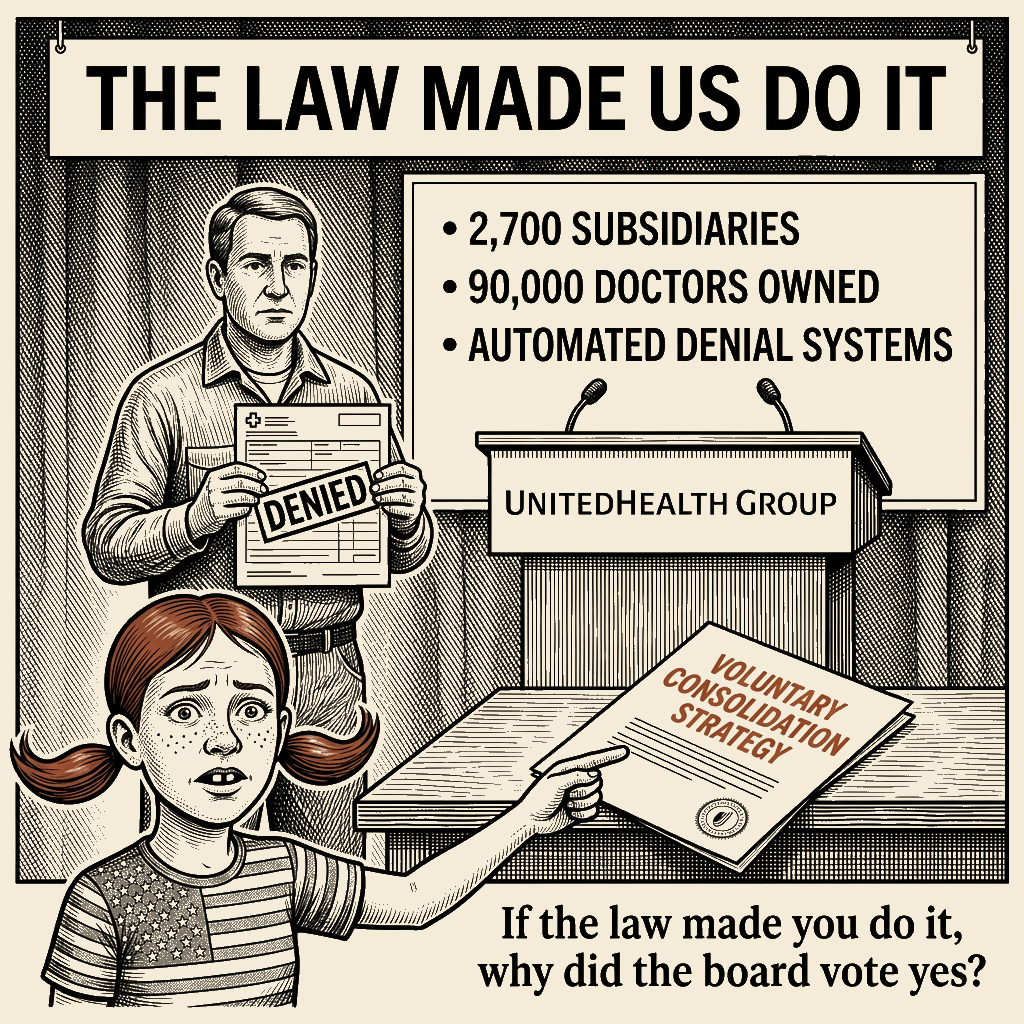
Here is the insurance industry’s position, stated plainly: We had no choice. The regulation said we could only keep fifteen to twenty cents of every premium dollar, so we bought the pharmacies, the doctors, the billing companies, and the pharmacy benefit managers, and started paying ourselves through four or five different doors. We had no choice. The regulation left us no option but to become a 2,700-subsidiary empire employing 90,000 doctors and routing payments to ourselves at higher rates than we pay anyone we don’t own. We had no choice.
Imagine a bumper sticker on the back of a UnitedHealth Group corporate sedan: “We’d Love to Help You, But the Law Made Us Do It.” Below it, a smaller bumper sticker: “Our CEO Only Makes $25.8 Million — the Nonprofit Hospital CEO Makes More.”
The piece opens by comparing Democratic healthcare rhetoric to a murderer’s notebook — taking the legitimate grievance of millions of Americans who’ve been harmed by the insurance industry and equating it with violence. That’s not analysis. That’s a silencing tactic dressed up as concern. The piece then concedes that “Consolidation and vertical integration accelerated in the late 2010s as large for-profit insurers acquired providers, pharmacies, and PBMs,” and says the medical-loss ratio caused this. But the medical-loss ratio is a consumer protection — it requires insurers to spend at least eighty cents of every premium dollar on actual medical care. The industry’s response was to consolidate rather than accept that margin. That’s a choice, not a fate.
The piece also concedes that the 340B program has enabled hospital consolidation and that hospital prices have risen at twice the rate of inflation. Then it uses these real problems to argue against all regulation rather than reforming the specific programs. The industry’s move: find the one regulation that created a problem, and use it to argue that regulation itself is the disease.
The voter reading this should know: the industry telling you “the law made us do it” is the same industry that shaped the regulation it now blames, and that is now profiting from the consolidation it chose. You’re not being helped. You’re being used.
Nuclear Satire
When to use: when you need to make the audience feel the grotesqueness of the system, not just understand the argument. Best for print, long-form social, or audiences already persuaded who need dark catharsis.
UNITEDHEALTH GROUP — 2026 ANNUAL SHAREHOLDER LETTER
Dear Shareholders,
This past year, UnitedHealth Group proudly employed over 90,000 physicians across nearly 2,700 subsidiaries, ensuring that when you visit a doctor, the doctor, the billing department, the pharmacy, and the company that decides whether your claim is covered are all the same entity. We believe this vertical integration represents the highest values of American enterprise: when we pay ourselves at higher rates than we pay the independent practices we don’t own, we are not exploiting a perverse incentive — we are investing in Synergy.
We would like to thank the U.S. Congress for the Affordable Care Act’s medical-loss ratio, which requires us to spend 80–85% of premium revenue on medical care. In response, we have creatively reclassified what counts as “medical care” by acquiring the companies that provide it, so that when we pay ourselves, the payment qualifies. We call this the UnitedHealth Vertical Optimization Loop™. Our consultants tell us this is legal.
We note with regret that certain Democratic senators have recently published a white paper lamenting “corporate greed” and “Big Insurance.” We would like to remind these senators that without the medical-loss ratio they authored, we would have no reason to have acquired 90,000 doctors. Their regulation created our empire. We are simply grateful recipients.
On the matter of the 340B drug subsidy program: we commend our hospital partners for purchasing medications at steep discounts and selling them at markups of four to five times the purchase price — a program that last year transferred nearly $80 billion from the federal government to hospital systems, more than all Medicaid spending on prescription drugs combined. We note that 99% of metropolitan hospital markets are now highly concentrated. This is not a bug. This is the ecosystem UnitedHealth is proud to inhabit.
We would also like to address the comparison, made in a recent Wall Street Journal editorial, between Democratic healthcare rhetoric and the ideology of a man who murdered a healthcare executive. We believe this comparison is helpful, because it reminds the public that criticising the healthcare industry is, at bottom, a form of extremism. When Americans express anger about denied claims, unaffordable premiums, and a system that routes their money to a 2,700-subsidiary corporation — they should know that their anger has been placed on a spectrum that ends in violence. This is a useful spectrum for us.
Since the Affordable Care Act was enacted in 2010, hospital prices have risen at twice the rate of inflation and three times the rate of prescription drug prices. Physician-owned hospitals have been effectively banned from expanding. Forty-two percent of physicians now work in practices owned by corporations, down from 60% in 2012. These are the numbers we prefer you not examine too closely.
In closing: we understand that the healthcare system is frustrating. We share your frustration. We would fix it, but the regulation won’t let us. The regulation made us do all of this.
Warm regards, UnitedHealth Group Corporate Communications “Committed to the Health of America™ (Subject to Terms and Conditions)”
That is the piece’s argument, delivered with the sincerity it deserves. The real number buried in this satire: a nonprofit hospital CEO in North Carolina — Eugene Woods, Advocate Health — made $25.8 million in 2024. More than twice the salary of the executive Mr. Mangione assassinated. The industry wants you angry at the regulation. It does not want you looking at the compensation.
Profane Scorched-Earth
When to use: when the reader needs full catharsis, when the polite version isn’t enough, when the truth needs to land without a single softening filter.
Here is what Allysia Finley does not mention in 1,500 words about who is really responsible for the dysfunction of American healthcare: she does not mention that the health insurance industry has spent decades perfecting the art of saying no to sick people. She does not mention that UnitedHealth — the company whose CEO was murdered, the company whose 2,700 subsidiaries she describes as if they were a natural phenomenon like weather — has built one of the most sophisticated claim-denial operations in the history of American medicine. She does not mention that prior-authorization requirements have become a bureaucratic killing field where cancer treatments are delayed, medications are blocked, and patients die waiting for an algorithm to approve their doctor’s recommendation.
She mentions that the ACA created consolidation incentives. This is true. She then builds an entire argument on that single true fact while omitting every other fact that would complicate it — a maneuver the prophets of Israel would have recognized immediately. “They dress the wound of my people as though it were not serious,” Jeremiah wrote. “‘Peace, peace,’ they say, when there is no peace.” The diagnosis is accurate. The dressing is the lie.
The industry’s profit margins have grown since the ACA’s passage. This is documented. Insurers chose vertical integration; no regulation held a gun to their heads. Hospital executives earn tens of millions. The 340B drug-pricing program — the piece’s centerpiece, attributed to “ObamaCare” — was created in 1992 under a Republican president. None of this is in the piece. The piece is about Democrats. The profits are unmentioned. The denials are unmentioned. The patients — the people who actually live inside the system Finley is diagnosing from the safety of an editorial board seat — are unmentioned except as props in a comparison to a murderer.
And let us speak plainly about that comparison, because it is the piece’s load-bearing wall and it is rotten all the way through. Luigi Mangione killed a man. That is a fact. Democrats wrote a white paper. That is also a fact. Finley’s comparison between the two — built on nothing more than a “DENIED” stamp aesthetic similarity and a shared general frustration with the healthcare system — is not analysis. It is the rhetorical equivalent of calling your opponent a murderer because they agree with you that the building is on fire. It delegitimizes democratic dissent by associating it with political violence. It does this deliberately. It does this to protect an industry that profits from the suffering of the people it claims to serve.
Amos said it twenty-seven centuries ago and the sentence has not aged: “I hate, I despise your religious festivals; your assemblies are a stench to me. But let justice roll on like a river, righteousness like a never-failing stream.” The justice Finley’s piece obstructs is the simple justice of naming who profits when a system denies care to the sick. The industry profits. The industry has always profited. And the Wall Street Journal editorial page — owned by capital, staffed by capital, publishing for capital — provides the alibi.
That is the operation. Identify one genuine regulatory feedback loop. Blame the government for it. Omit every autonomous corporate decision that turned the feedback loop into a profit engine. Compare the opposition to a murderer. Collect your column fee. Call it analysis. And the patients — Brenda in Atlanta, the veteran rationing blood-pressure medication, the mother who Googles “can I split my son’s Adderall” because the prior authorization is in its fourth week — the patients are not in the room when the column is written, and they are not in the room when the profits are counted, and they are not in the room when the editorial board congratulates itself on its intellectual rigor.
The entire operation is an industry that spends over $100 million on lobbying using a prestigious editorial page to convince you that the people pointing at the fire started it. They didn’t start it. The industry built the building out of kindling and gasoline, lit the match, and now — with blood on its hands and record profits in its accounts — hires someone to write that the fire marshal is the arsonist.
Fuck the deflection. Fuck the comparison to a murderer deployed to silence democratic debate about an industry that kills people for profit. Fuck the selective citation of ACA provisions without mentioning that the industry chose every consolidation move it made. Fuck the 340B blame shifted to Democrats when a Republican president created the program. Fuck the closing insinuation that wanting universal healthcare is a “diabolical plot” rather than what it is — the logical response to a system that has demonstrated, over decades, that it will choose profit over patients every single time the choice is offered. And fuck the Wall Street Journal editorial page for providing the intellectual laundering service that makes all of it respectable.
Justice rolling like a river — that’s what’s needed. What these patients got is Allysia Finley, explaining why the river is the problem.

About Malcolm Little King
Malcolm Little King is a heteronym in Main Street Independent's editorial architecture — an analytical voice, not autobiography of any actual person. The position this column expresses is the publication's position on the territory Malcolm Little King's lane covers, rendered through Malcolm Little King's register.