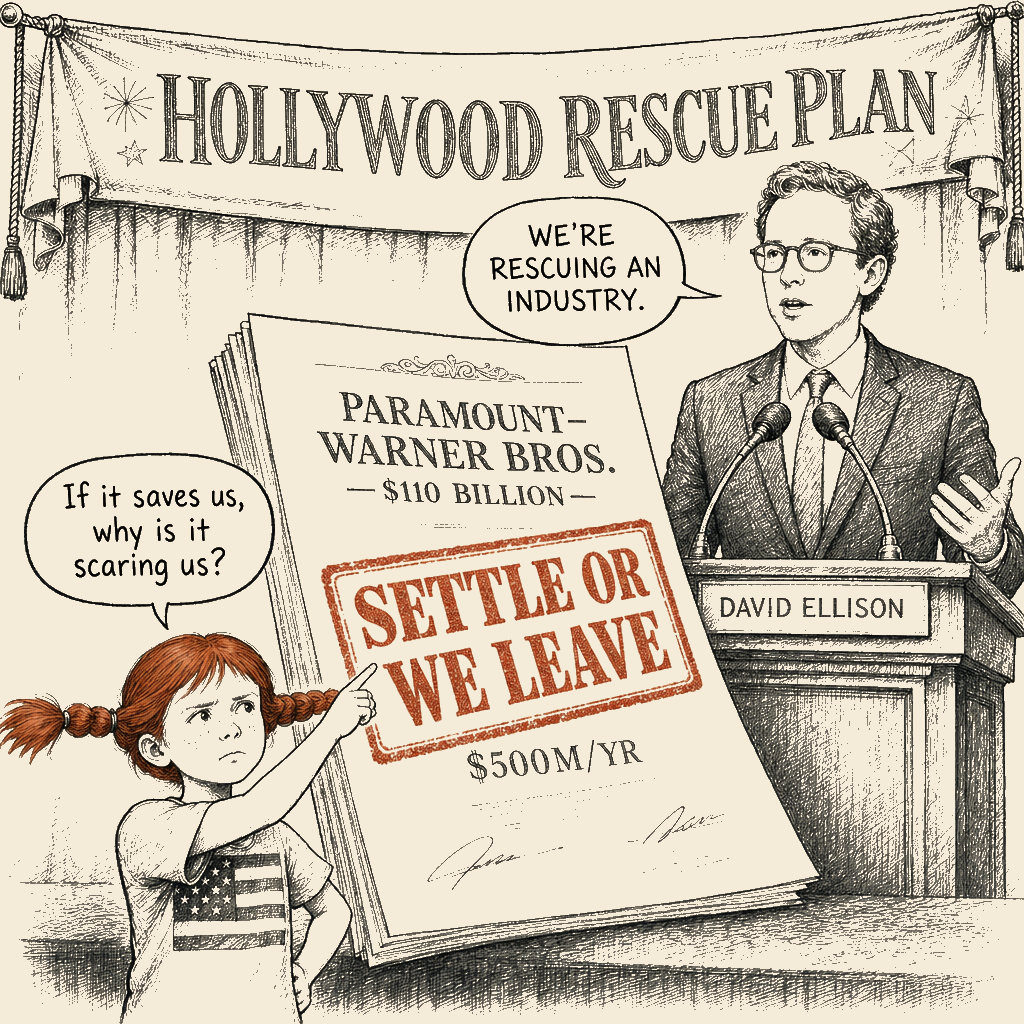
Responding to: California’s Lawfare Could Further Empty Out Hollywood — John Fund · 2026-08-16
What the Piece Argues
John Fund’s National Review column argues that California Attorney General Rob Bonta’s antitrust lawsuit against the proposed $110 billion Paramount–Warner Bros. merger is destructive “lawfare” strangling an already-struggling industry. It presents the merger as Hollywood’s lifeline, quotes union leaders urging a settlement, and warns that unless Bonta negotiates, Paramount will relocate production to low-tax states like Texas, Tennessee, and Georgia, taking tens of thousands of jobs with it. The piece’s causal story puts the blame on the lawsuit, high production costs, “rapacious unions,” and city filming restrictions — and it closes by suggesting Bonta’s real motive is gubernatorial ambition. In good faith, the underlying worry is genuine: California production really is down more than 40 percent since 2022, and the workers who report working only twelve days this year are not inventing their hardship.
Receipts
The move: a $110 billion consolidation of two of the last big studios is sold as the rescue of an industry, so that a state attorney general upholding competition law becomes the villain, and the workers’ own unions get cast as both the parasite and the supplicant in the same column.
The framing wants you to believe
- The antitrust lawsuit is what’s damaging Hollywood; settle it, and the merger saves the day.
- “High production costs, rapacious unions, and city-led restrictions on location shooting have driven jobs away” — the problem is labor and regulation, not consolidation.
- The real threat is Bonta’s ambition — he thinks his title stands for “Aspiring Governor” — not the concentration of two of the last legacy studios into one.
- A no-income-tax state is just a sensible “business climate,” good for the workers who’d follow the jobs.
What’s really going on
- The “lawsuit that threatens Hollywood” is a state attorney general doing his sworn job: checking whether a $110 billion merger of two of the industry’s largest remaining studios violates competition law. The single greatest concentration in the industry’s history is treated as a rescue rather than a risk. (Anchor: Bonta’s office called Paramount’s ultimatum what it is — “another attempt to blackmail the state into letting an illegal deal through.”)
- The column blames “rapacious unions” in one paragraph and, two paragraphs earlier, quotes union leaders begging for the merger to be approved. You cannot be the parasite and the supplicant at the same time; that internal contradiction is the whole story in two lines.
- The consolidation record runs the other way: the 2023 writers’ and actors’ strikes were fought over streaming economics imposed by the same consolidating giants — mega-mergers have historically depressed, not created, the work Hollywood workers depend on.
- The “$500 million a year” tax savings is money extracted from a state and the public services its workers rely on, and the threat to leave is capital holding a gun to the governor’s head. When the studios call “blackmail,” they’re speaking plain English.
The Response Ladder
Polite Reframe
When to use: a good-faith relative or coworker repeating the “lawfare is killing Hollywood” line at dinner — a persuadable moderate who genuinely believes settling will save jobs.
There’s a woman in Burbank who told the paper she’s worked twelve days all year and is “really close” to giving up. Maybe she’s a friend of yours, or a neighbor, or somebody in your congregation. She’s been told the enemy is Attorney General Bonta’s lawsuit, and that the fix is to let the studios merge and leave if they must, because everyone who sounds reasonable says the lawsuit is what’s hurting her. I want to offer, gently, a different reading of her own situation.
A merger of Paramount and Warner Bros. does not create a single shoot day. It consolidates two of the last great studios into one company with one set of bottom lines, one legal team, one tolerance for the cost of making things in California. The people who actually edit, grip, light, and act — the 200,000 members the unions speak for — are not helped by there being fewer places to take their skills. The unions themselves know this; that’s what the 2023 strikes were about, workers fighting the streaming economics that consolidation imposed. So when the column says “rapacious unions” drove the jobs away, it’s quoting the very organizations that have spent the last decade trying to keep those jobs from vanishing — and now begging, in this very piece, for the merger to go through.
We don’t desert our own when they’re down. That’s a value, not a slogan. The honorable version of “saving Hollywood” is saving the people who make Hollywood — keeping production domestic, paying people for the work, letting competition keep any one company from deciding who gets to work at all. The men who write these columns and assemble these deals will be fine regardless. The woman with twelve days of work is the one the merger is sold to — and she’s the one who pays for it. Ask the honest question: does this deal produce a single day of her living? If the answer is no, then “saving the industry” is a story being told to get her to accept her own disappearance. She deserves better than that story.
Mockery and Ridicule
When to use: a smug comment section or a Twitter scrum where the “lawfare” and “rapacious unions” lines are being repeated to feel clever — perform for the bystander.
Let me set the scene. David Ellison, heir to the Oracle fortune, in the middle of spending $110 billion to buy one of the last great studios, is explaining that what he’s really worried about is Hollywood’s future — and the little people who work twelve days a year. The man who stands to save $500 million a year by packing up for a state with no income tax feels the industry’s pain so deeply he’s already loading the U-Hauls for Austin. You could score it with a sad trombone and call it a charity event.
“Lawfare.” Let’s talk about that word for a second. “Lawfare” is what you call it when the government starts enforcing the law and you’d rather it didn’t. It’s the relabeling playbook — the sheriff becomes “the mob,” the armed man becomes “just asking questions.” The actual lawfare in this story is the CEO’s: settle the case or I strip your state of its signature industry. Bonta’s office used one word for that, and the word was “blackmail.” Which of these sounds like weaponized litigation to you: the attorney general reviewing a $110 billion deal, or the billionaire threatening to fire 200,000 workers unless he gets his way?
And the “rapacious unions” — this is the part that would be funny if it weren’t so shameless. The column calls the unions rapacious in paragraph six, and in paragraph two it quotes union leaders on their knees begging for the merger to be approved. You can’t be the parasite and the supplicant in the same column, John. Pick a lane. Are the unions the greedy ones squeezing the studios, or the desperate ones pleading with the studio not to leave? The column needs them to be both — greedy when it wants to blame somebody for California’s taxes, and pathetic when it needs cover for the merger. That’s not analysis. That’s taking a worker’s fear and fashioning it into a lapel pin for a billionaire’s interview.
And the “Aspiring Governor” knee-slapper — honestly. It’s not Bonta auditioning for higher office. It’s the man who tells a state to repeal its own law or lose everyone, then checks his reflection in the Learjet window and asks if he looks presidential. The woman in Burbank isn’t the one running for anything. She’s the one the column used as scenery.
Nuclear Satire
When to use: the reader who needs the full measure of the con laid out in grotesque, cumulative form — someone ready to see the whole apparatus for what it is.
Picture the blockbuster: Savior of Hollywood. The corporate knight, mounted on $110 billion of other people’s money, rides in to rescue the studio system — by buying it. His first act of salvation is to announce he’s moving the production to a state with no income tax. His second is a press release honoring the unions, the very “rapacious” parasites his legal team described in the accompanying column, as they kneel in the parking lot and beg him to stay. And these are the same unions, remember, whose members spent 2023 on the picket lines fighting the streaming economics this same consolidation imposed — now kneeling in the buyer’s lot, begging the consolidator not to leave. The score swells. The credits roll over the image of a Burbank worker checking her calendar and finding twelve days of work in it. The tagline: He saved the industry by leaving it.
The moneychangers are always the best villains, and this story has a full table of them. The only recorded act of force in the whole Gospel record is one man overturning the tables of those profiting inside the temple. Here the moneychangers have bought the temple itself, declared themselves its priests, and are now indignant that anyone would call their commerce into question. “Rapacious,” they mutter about the help. About the workers who built every dollar of the $110 billion they’re spending. The unions are the parasite? The parasite has bought a second studio, is threatening to move your jobs to Texas, and has persuaded a columnist to call the state’s attorney general a whale-chaser for trying to stop him.
And that Ahab business — let’s fix the metaphor while we’re here. Ahab chased his whale to his own ruin, obsessed with a creature he could not let live. Bonta is not the one obsessed with destruction. The studio is the Ahab — chasing the whale of ever-bigger consolidation while the whole boat goes down under it. Fewer and fewer studios, less and less work, lower and lower pay, and at the end of the hunt there’s one giant holding everything and nothing left to hold it with. The column wants you to fear the sheriff’s curiosity about a $110 billion deal. The thing to fear is the man who thinks one company should own everything you watch and who has, in this piece, held your job hostage to prove it.
Forty percent of production, gone. Forty-six percent of the location shoots, gone. Twelve days of work in a year. Five hundred million dollars a year, dangled as the price of leaving. And the unions — the ones they call greedy — begging for the merger that’s eating their members’ livelihood, a year after those same members walked out over what consolidation had already done. The next installment in this franchise is already written. It’s the one where the savior moves to Tennessee and the Burbank worker’s house goes on the market. That’s not a sequel. That’s the plan.
Profane Scorched-Earth
When to use: the reader who has had it — the one who needs the cathartic release valve after a year of watching billionaires plead poverty on television.
“Lawfare.” Lawfare. Let me get this straight. A state attorney general — the one person in this entire story actually sworn to enforce the law — looks at a $110 billion merger of two of the last goddamn studios left standing, and that’s “lawfare.” But the CEO threatening to rip 200,000 jobs out of a state unless the attorney general drops the case — that’s “business climate.” That’s not a business climate, you absolute frauds. That’s a protection racket with a Learjet. Bonta’s office had the one honest line in this whole piece — they called it blackmail. Because that’s what the fuck it is. Settle or I take your industry. That’s not a negotiation. That’s a hostage video with a tax break in it.
And let’s talk about those “rapacious unions,” since the column has the goddamn nerve. Paragraph two: the unions, terrified, on their knees, begging the merger to go through. Paragraph six: “rapacious unions” drove the jobs away. You can’t have it both ways, John. Are the unions the greedy parasites squeezing the poor struggling billionaires, or are they the desperate supplicants pleading with the studios not to leave? Because this piece needs them to be both. It needs them greedy when it wants to blame somebody for taxes, and pathetic when it needs a cover story for the merger. They are neither. They are scared workers — the ones who actually make the movies, the ones who’ll eat the failure of this deal, the ones who worked twelve days this year and are “really close” to giving up. A year ago those workers were on strike against the streaming economics the consolidation is built on. Now they’re begging the buyer to stay. You used their fear as a footstool for a billionaire’s shopping trip. That’s not analysis. That’s pimping.
Because here’s what’s actually happening, stripped of the “business climate” and the “lawfare” horseshit: a rich man’s son wants another studio. To get it, he’s threatening to take the jobs of 200,000 people — jobs that were already down 40 percent — to a state where he doesn’t have to pay income tax on the fortune he’ll make consolidating them. And the column’s contribution to this negotiation is to call the man enforcing the law a glory-hungry Ahab and the workers’ unions “rapacious.” The only force in the whole record anyone’s ancestors would recognize as moral was a man overturning the tables of the profiteers in the temple. They’ve moved the temple to Austin and they’re still counting the coin before the congregation leaves.
The woman with twelve days of work isn’t the parasite. She’s the one who built the empire you’re buying. The parasite is the man who needs a second studio to feel whole, and the columnist who calls the workers greedy in the same breath he uses them for cover. We’re the ones who feed, clothe, heal. We raise wages. We keep families together. And we keep the receipts — forty percent, forty-six percent, twelve days, five hundred million, a year of picket lines, and a union letter begging for the deal that’s killing them, all on one page of the same goddamn column. The arc bends, but not by itself and not for the people who sold the workers out today. It bends when somebody with a voice finally names this for the shakedown it is.

About Malcolm Little King
Malcolm Little King is a heteronym in Main Street Independent's editorial architecture — an analytical voice, not autobiography of any actual person. The position this column expresses is the publication's position on the territory Malcolm Little King's lane covers, rendered through Malcolm Little King's register.