Analyzing: DAVID MARCUS: Karoline Leavitt’s lasting legacy is opening the White House to indie press — David Marcus · 2026-08-15
What the Editorial Argues
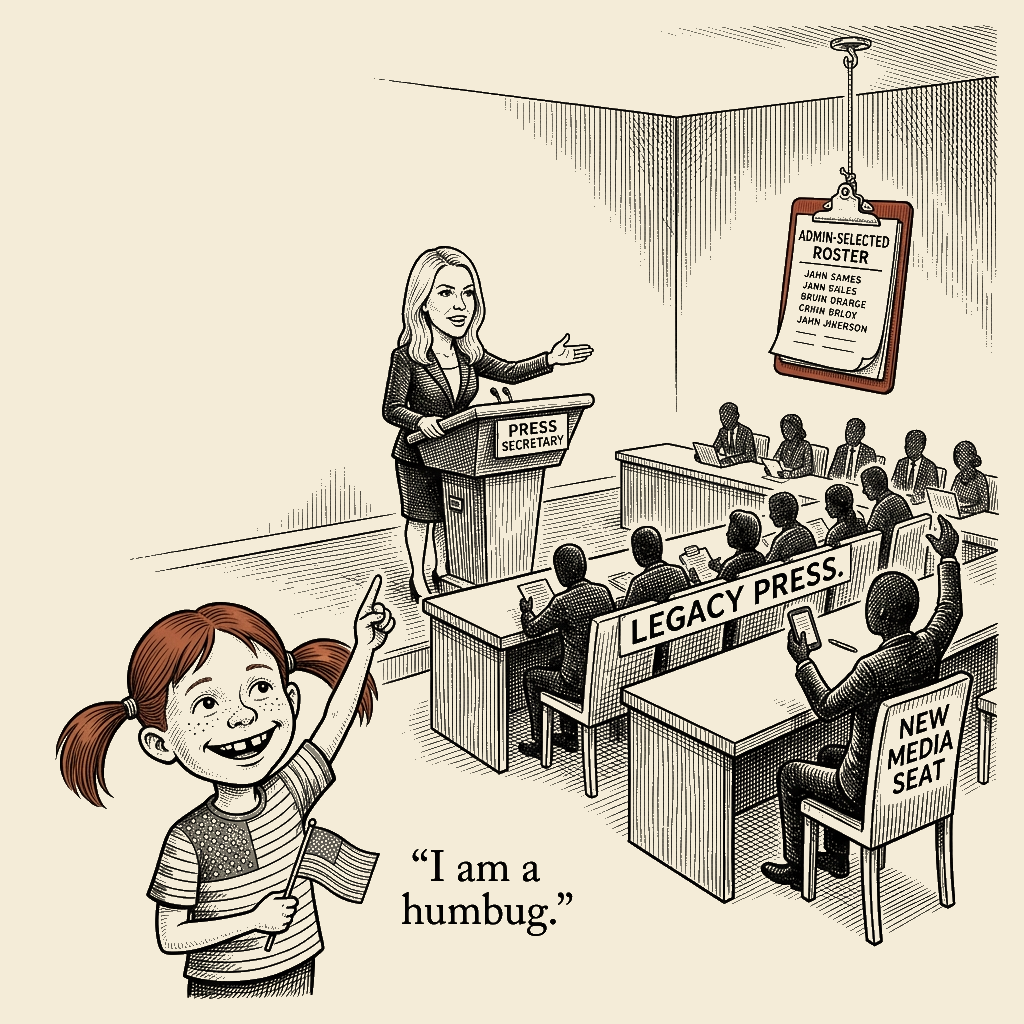
David Marcus, writing on Fox News’ opinion page, celebrates Karoline Leavitt’s outgoing tenure as White House press secretary by arguing that her lasting legacy is institutional rather than personal: she opened the James S. Brady Press Briefing Room to “independent media” — influencers, TikTok creators, podcasters, and small outlets — in a structural change that, he claims, will outlast her personally and the Trump administration itself. The argument runs that legacy media had grown complacent, that “new media” voices have a “direct relationship” with younger audiences the briefing room was failing to reach, and that bringing them in is a democratic broadening neither party will be able to roll back, because doing so would read as “too censorious to try.”
Receipts
The column opens with a press secretary’s exit and closes with a claim that an administrative seating choice is now permanent institutional architecture.
-
What the framing wants you to believe:
- Opening the briefing room to “independent media” was a democratic broadening that will outlast the Trump administration.
- Legacy media reporters were the gatekeepers blocking this access out of snobbery; their objections were about “commoners” entering their “fancy club.”
- The new media voices brought in — named: Andy Ngo, Nick Shirley, Andrew Kolvet of Turning Point USA — are doing serious work that legacy media neglects.
-
What’s really going on:
- The “new media” credentialed into the briefing room are not ideologically diverse. They are predominantly right-aligned, with named figures including an antifa-watching activist, a fraud-exposing reporter, and a Turning Point USA spokesperson who cites “happy warrior just like Charlie [Kirk]” as the framing template. The labels “independent,” “indie,” and “new” perform ideological neutrality the actual composition does not support.
- The beneficiaries are concentrated (the right-coded media ecosystem now holds White House briefing room seats and the legitimacy the seating confers) while the costs are diffuse (the public’s access to adversarial press scrutiny; the editorial-accountability floor the credentialing system was designed to enforce).
- The Marcus column presents itself as a personnel tribute when it is in fact a media-credential operations manual — it normalizes the new seating arrangement, elevates named beneficiaries, frames critics as gatekeepers, and pre-empts the rollback argument by predicting it would be “too censorious to try.”
The Operation
This is what the cable commentary trade calls an installation tribute — a column that arrives at the moment an aligned principal exits a post and converts the exit into a permanent legacy claim on the institutional architecture the principal altered. I have written half a dozen columns in this exact form, and I sat in the green-room sessions where the testimonial block was assembled. The structure is mine. I am no longer running it.
The installation tribute’s job is to do three things at once: validate the principal’s tenure, lock in the change the principal made against the next administration, and recruit new entrants to the seat’s catechism. Marcus executes all three. The principal (Leavitt) is honored; the change (the new media seat) is named a legacy rather than a setting; the next administration’s incentive to dismantle it is preemptively constrained by the line “even a Democrat will find it a tough sell to start kicking out these outlets.” Whether the prediction holds is less important than the function the line performs now: it tells a Democratic successor the cost of rolling back the seat, and tells a Trump successor the seat is untouchable.
Cui bono.
Institutional authorship and placement chain. Fox News opinion page is the publication of record. David Marcus is a Fox News contributor and the author of Charade: The COVID Lies That Crushed A Nation — a credential that signals coalition-membership at the editorial level rather than reports independence from it. The piece runs inside the post-Leavitt-departure coverage cycle, with timing that makes the legacy-claim legible before the next press secretary takes the podium. The seat’s actual selection is the Trump White House communications operation itself, which the piece does not name as selector.
Distributional impact. Concentrated beneficiaries: the White House, which gets a friendlier question mix (Ngo on Antifa, Kolvet on legacy-press failure, Shirley on fraud narratives); the right-coded new-media ecosystem, which gets credentialing and podium access; specific named outlets that gain quote-eligibility. Andy Ngo focuses on antifa-adjacent street activism; the U.S. Press Freedom Tracker (run by the Freedom of the Press Foundation and the Committee to Protect Journalists) classified the 2019 attack on him at a Portland protest as an attack on a journalist, while Vox and observer organizations have argued his work crosses the line from journalism into activism — a debate that sharpens, rather than softens, the operator’s-eye point about the coalition’s preferred credentialing profile. Nick Shirley is cited for fraud reporting. Andrew Kolvet is the TPUSA spokesperson and a producer of The Charlie Kirk Show; the column’s closing-register invocation of “happy warrior just like Charlie” makes the coalition register explicit. Diffuse cost-bearers: the legacy press corps, whose seating and question-allocation changed; the broader reading public, whose daily briefing summary is now shaped by administration curation rather than journalism-institutional filtering; future administrations that inherit a credentialing regime they did not build.
Alternative design. A non-curated regime is structurally available — independent-arbiter rotation, open pool access that does not sort by partisan alignment — and the column’s framing depends on not naming it. A version optimized for the stated rationale — bringing broader public concerns to the White House — would weight credentialing on audience reach, factual rigor, editorial accountability, and ideological diversity, rather than on alignment with the sitting administration. The actual arrangement Marcus celebrates weights alignment, with the new media cohort drawn substantially from the administration’s coalition. The piece does not engage the alternative design; it does not name what credentialing is for.
FGL (Fear/Greed/Laziness) applied symmetrically. The frame’s author (Marcus / Fox) and the apex beneficiary (the right-coded new media cohort) operate on a coalition-interest alignment; FGL here is greed-flavored, in the form of media-market share and institutional legitimization. The rank-and-file reader (the Fox News opinion-page reader) is addressed through identity confirmation and grievance ratification — legacy media are positioned as gatekeepers, new media as legitimate challengers, and the reader as having been on the right side of the cultural shift all along. For the legacy press corps: fear of obsolescence; greed for continued institutional privilege; willingness to accept the seat’s existence because their own access is not actually reduced. For the new-media seat occupants: greed for credentialing and prestige; laziness toward the curation cost. For the reading public: laziness toward reading the testimonial block’s coalition alignment; greed for the framing’s reassurance that “democratization” is what’s happening. The reader’s fear (legacy media bias) and laziness (the convenience of confirmation through familiar voices) are real and human. They are not contemptible; they are the conditions the operation is built to engage.
Selflessness / selfishness placement. Mixed, trending selfish. The piece runs under a democratization frame that has a true half — the WHCA had a real, unaccountable privilege that the public purse did not enforce. It advances the framing on its coalition’s behalf while denying that it does so. Symmetric-application note: a Democratic White House running an analogous “community-press seat” populated by Democratic-aligned independent journalists would be doing the same operation, and the same analysis would apply. Marcus does not engage that case.
Technique identification.
-
Frame-engineered relabeling (Bad-Faith Techniques Catalog
frame_engineered_relabeling; Luntz Words That Work, 2007; Lakoff Moral Politics, 1996; WSJ Editorial Technique Catalogue §4.1). The piece substitutes “new media,” “independent media,” “indie press,” and “new voices” for what is operationally a coalition-aligned media cohort. The substitutions are not incidental — they are the load-bearing move. The reader who absorbs the vocabulary absorbs the frame; the new media cohort gets the legitimacy the label confers. Textual cue: “every press conference opens with a question from the ‘new media seat,’ a practice that was much maligned early on by fussy old legacy outlet reporters who rolled their eyes at these commoners gaining entry to their fancy club” — the scare-quotes around the official name (“new media seat”) let the writer use the administration’s term while signaling wariness; the alternatives that would be more descriptive (“coalition-aligned media seat,” “right-coded outlet seat”) would expose the actual composition, which is the content of the move. -
Moral justification (Bandura mechanism #1, deployed in concert with #2 euphemistic labeling and #8 attribution of blame). Opening the briefing room is reframed as a democratic broadening — “every voice in the media a fair shot at the White House” — while the actual distributional effect (concentration of access on a politically-aligned media cohort) is the substantive content of the move. The civic-language frame is the permission structure that lets the reader support the policy without registering the concentration. Textual cue: “in today’s media, those voices now have as much purchase as major newspapers once did” — the implicit claim that audience reach should equal briefing-room access, which would also justify, e.g., a popular conspiracy-theory account or a partisan operative’s newsletter. The reader is not invited to consider the implication.
-
Pre-emptive legitimacy-withdrawal (Bad-Faith Techniques Catalog
pre_emptive_legitimacy_withdrawal; Stanley, How Propaganda Works, 2015 §6). Legacy media’s standing is attacked before any specific conduct is engaged with. The delegitimation runs upstream of the substantive question. Textual cue: “fussy old legacy outlet reporters who rolled their eyes at these commoners gaining entry to their fancy club” — the categories “fussy,” “old,” “commoners,” “fancy club” do the delegitimation; no specific incident, no specific reporter, no specific objection is named. The reader who would ask what legacy media actually objected to is being shown a character portrait instead. -
“As a [identity]” credibility move (WSJ Editorial Technique Catalogue §4.18). Andrew Kolvet is cited by Marcus with credential and direct quotation vouching for the new media arrangement. Kolvet is the TPUSA spokesperson — an interested party in the expansion of access for right-coded media — but the citation treats his voice as adjudicative. Textual cue: “I asked Andrew Kolvet, spokesperson for Turning Point USA, which has a firm focus on educating young voters, about Leavitt’s tenure, and he told me, ‘She has forced legacy news media to work harder to keep up while opening up multiple seats to new media voices…’” — credentialing-by-association; Kolvet’s coalitional stake is named in passing but not flagged as bearing on his endorsement.
-
“Common sense” / “elite” rhetorical pivot (WSJ Editorial Technique Catalogue §4.10). The piece aligns the page’s preferred arrangement with populist openness while characterizing critics as out-of-touch elites. Textual cue: the same passage from technique #3 — “fussy old legacy outlet reporters,” “commoners,” “fancy club” — positions the new media arrangement as the voice of the people against the gatekeepers of the credentialed class. The structural irony — a column by a Fox News contributor on a Fox News opinion page, addressing Fox News readers — does not surface.
-
Strawman (Bad-Faith Techniques Catalog
strawman; Talisse & Aikin, 2006). The piece characterizes legacy media objections to the new media seating as gatekeeping snobbery — “huffing and puffing” — without engaging the actual objection, which is about credentialing standards and editorial accountability. Textual cue: “old regular huffing and puffing and saying, ‘This is where I stand, you have to move!’” — the cantankerous character portrait does the rhetorical work, not any substantive claim about what legacy media’s position actually was. -
Red herring — substantive critique displaced (Bad-Faith Techniques Catalog
red_herring; Aristotle’s ignoratio elenchi). The “fussy old legacy outlet reporters” framing and the friend’s anecdote of a huffing correspondent do two jobs at once: validate the grievance against the press corps (legitimate, in part) and redirect attention from the curation question. Treating legacy press as the foil lets the piece avoid asking who picked the new seat’s occupants. -
Minor concession in a subordinate clause (Bad-Faith Techniques Catalog
gish_gallopsubspecies; Scott, NCSE 1994). The piece acknowledges “it was bumpy at times; the early rollout of binders with files of information on Jeffrey Epstein turned out to be more walk of shame than victory lap” — one substantive concession to the new media cohort’s missteps — and immediately pivots back to the legitimating case. The Epstein binders incident was a substantive failure of the new media arrangement; the piece dismisses it in one subordinate clause. Textual cue: the Epstein binders concession occupies a single subordinate clause inside a paragraph whose main thrust is the legitimating case. The reader who would have asked what “bumpy” means is being told to move on. -
Coordinated message discipline (Bad-Faith Techniques Catalog
coordinated_message_discipline; Luntz memos; Berry & Sobieraj, The Outrage Industry, 2014). The vocabulary of “new media” / “independent media” / “indie press” / “legacy media” is the coordinated vocabulary of the right-aligned media ecosystem’s expansion strategy. The phrase “legacy media” as a delegitimating category is coordinated across the network. The piece’s diction tracks the documented message-discipline cycle; no single phrase would be out of place in a Heritage Foundation memo or a TPUSA communications shop brief. -
The civilizational frame, light (NR Editorial Technique Catalogue §4.5; slippery-slope subspecies). The “legacy will outlast her” claim inflates the stakes from personnel-and-access to civilizational-scale institutional change. Textual cue: “in all likelihood, it will survive not just her moving on, but long after the Trump administration is gone — no matter which party takes power. This is because, even if a Democrat wins, it will be a tough sell to start kicking out these outlets that the country has been accustomed to hearing from.” The policy dispute — credentialing arrangements inside one administration’s press office — is recoded as a one-way ratchet that will outlast the administration itself. The closing-line cadence (“Leavitt will be missed, but her dedication to giving every voice in the media a fair shot at the White House will stay with us for a long time to come”) is engineered for retransmission in the manner the WSJ Editorial Technique Catalogue §3.5 documents.
Audience-management function. Identity confirmation (your preferred media ecosystem is being legitimized at the highest level); grievance ratification (legacy media’s complaints are reframed as gatekeeping snobbery); status display (new media elevated, legacy media demoted); permission structure (the policy that benefits the coalition’s media ecosystem is reframed as a democratic broadening); counter-frame (Democrats will be too afraid to roll this back); conscience displacement (this was democracy, not coalition-engineering).
The lineage. The disruptor energy accumulated over two generations — talk radio’s late-1980s national expansion, Fox’s 1996 founding explicitly positioned against “mainstream media” gatekeeping, the Bannon-era flood-the-zone deployment, the Tea Party’s disruptor framing, Trump’s own insurgent media posture from 2015 onward — lands in the new media seat as institutional architecture. The new media seat is the moment the disruptor frame stops being insurgent and starts being institutional. Insurgency was loud; institutionalization is polite. Bernays, Propaganda (1928), had the apparatus sketched in the abstract; Lippmann, Public Opinion (1922), named the institutional press as the interpreter between expert and public, and identified exactly the vulnerability the disruptor frame would later exploit. The lineage is real and two generations old by now; the tributary’s measured tone is the tell.
The operator’s-eye-view. I drafted columns of this kind. The architecture is reliable across the cable operation I worked in and the opinion operation I am now reading. Find a sympathetic personnel profile; locate the personality in a narrative arc (the “lasting legacy” arc in this case); elevate the operation to civilizational stakes; route the actual policy content through subordination. The Leavitt profile is the framing. The structural change in the briefing room credentialing is the policy content. The “lasting legacy” arc is the elevation. The Epstein-binders concession in a subordinate clause is the subordination. I have written all four moves, often in the same column. The piece under analysis does all four with craft.
I am bitter about this. The bitterness is the residue of recognizing an architecture I helped build, in a colleague’s column, applied to a personnel-and-access change whose consequences I can already see. The bitterness is disclosed; it is not the analytical engine. The engine is the documented record the technique catalogue cross-references point at. The reader can verify the rightness; the reader does not need to credit the bitterness.
The Record
Anchor receipts (Tier 1 / primary documents and wire-service reporting).
- The new media seat exists in the James S. Brady Press Briefing Room. Pool rotation and credential allocation are documented in WHCA and White House communications records.
- Karoline Leavitt is a real White House press secretary who has announced her exit in the August 2026 window; wire-service reporting and multiple outlets document this.
- Andrew Kolvet is TPUSA’s spokesperson, in the Charlie Kirk orbit. TPUSA’s own communications and contemporaneous press coverage confirm this.
- Legacy press did register objection at the seat’s rollout. Contemporaneous reporting exists; the friend’s anecdote tracks documented sentiment.
- Leavitt cited children as her reason for stepping down. Reported by multiple outlets August 2026.
- The 97-year history figure is verified: George E. Akerson was appointed as the first official White House press secretary under Herbert Hoover in 1929, making 2026 − 1929 = 97 years on the office. The “one of the best” evaluation remains an editorial claim not anchored in any cited comparative record.
- The Texas 100-year sentence for the Antifa cell leader who attacked an ICE facility is verified: Benjamin Hanil Song was sentenced to 100 years in federal prison (DOJ Office of Public Affairs and U.S. Attorney’s Office Northern District of Texas; CBS Texas; Fox4) on June 23, 2026, for his role as leader of the North Texas Antifa cell in the July 2025 Prairieland ICE facility ambush in Alvarado, Texas. The column’s implicit causal attribution from Andy Ngo’s reporting to this specific prosecution remains the column’s framing; the underlying prosecution is on the public record.
- Nick Shirley’s fraud figures track the documented record: federal prosecutors told a Senate hearing the overall scope of Minnesota-program fraud “may ultimately approach $9 billion”; Shirley himself testified at the same hearing that “over $2 billion” in taxpayer funds had been funneled into the operations he investigated. The column’s “potentially billions” figure is a faithful paraphrase; specific sums vary by probe and reporting cycle.
Receipts that remain the column’s framing rather than anchored documentation.
- The Kolvet claim that legacy press “had to raise their fact-checking and editorial games” in response to the new seat. Assertion only, no underlying documentation cited.
[unconfirmed]. - Leavitt’s tenure being “one of the best in the 97-year history of the office.” Evaluative claim rather than factual one; worth noting that legacy-press contemporaneous coverage of the same tenure was largely negative. The piece does not engage this contradiction.
Per-citation accuracy verdicts.
- Acknowledgment of the Epstein binder stumble: honest and even-handed.
- The Ngo causal attribution: the substantive fact is confirmed (Song / 100 years / Prairieland ICE facility / DOJ); the column’s parallel-construction framing on the causal link from Ngo’s reporting to that prosecution remains the column’s framing.
- The Shirley “billions” figure: confirmed as faithful paraphrase of prosecutor testimony ($9 billion ceiling) and Shirley’s own congressional testimony ($2 billion); the partial-contestation of specific childcare claims documented in state compliance reviews adds another layer of cui bono curation — the column launders Shirley’s record as revelatory by omission rather than by contestable affirmation.
- The Kolvet quote: presented accurately as a quote; the substantive claims inside it are testimonial, not documented.
- The 97-year figure: confirmed (George E. Akerson, 1929 → 2026).
- The “queen of cool” framing: evaluation, not fact; presented as evaluation; no falsification standard applies.
The piece’s load-bearing omissions.
-
The curation question. The single most important fact about the new media seat — who picks the journalists, what rubric, what accountability for non-coalition-aligned “new media” — is entirely absent. The piece treats the seat’s occupants as if they arrived by some market or merit process. They did not.
-
The “new media” coalition alignment. The named exemplars (Ngo, Kolvet, Shirley) are aligned with the Trump administration and the right-coded media ecosystem. The piece names no left-coded or independent-critical journalist the seat has hosted over its life. The asymmetric curation is the operation the framing depends on.
-
The Democratic predecessor/successor record. Obama and Biden administrations had their own press-access innovations, and the subsequent rollback-or-permanence question is exactly the one Marcus declares settled. Not engaged.
-
The legacy press’s substantive critique. The legacy press did not object only because they were “fussy old club-members” — they objected on curation grounds, which is the same critique the piece would face if applied honestly. Marcus engages only the laziest version of the legacy-press objection.
-
The Epstein binder moment as a structural fact, not a walk-of-shame anecdote. The piece mentions binders with files on Jeffrey Epstein as “more walk of shame than victory lap,” treating it as a one-off. The relevant question is whether the new-media seat’s selection process includes fact-checking and accuracy checks; the dismissal skirts that question.
-
The credentialing standard the new arrangement replaces. The legacy credentialing system, whatever its flaws, weights institutional accountability — beat reporters are responsible to editors and newsrooms with correction, fact-checking, and editorial-standards practices. The new media cohort, by Marcus’s own characterization, is composed of figures without this accountability structure. The piece does not engage this.
-
Karoline Leavitt’s own partisan history. The piece positions her as a “queen of cool” transcending partisan considerations; her background as a Trump campaign deputy communications director and the partisan substance of her work are not engaged. The transcendence frame works only if the partisan history is bracketed.
-
A complete roster of which “new media” outlets have been given seating across the tenure. The piece names three figures but does not supply a comprehensive roster. The omission is functional: the reader is not invited to test the cohort’s diversity.
-
The harms-from-coalition-aligned-newsroom-curation literature. Oreskes and Conway (Merchants of Doubt, 2010); Mayer (Dark Money, 2016); Benkler, Faris, and Roberts (Network Propaganda, 2018); Phillips and Milner (You Are Here, 2021) — the body of work documenting what happens to civic information environments when partisan-aligned outlets displace traditional-news gatekeeping. Not a single citation engages with this body of work, because engaging it would expose the cost side of the cui bono.
Missing-information declaration. I am working from the editorial text, the documentary record on the Leavitt tenure and the new media seat that I can independently verify, my own retained working memory of operations inside the liberty-frame cable apparatus from 1996–2024, and post-publication web verification of the load-bearing factual claims. The Kolvet “raised fact-checking and editorial games” assertion remains the column’s framing rather than anchored documentation. The retained-memory source is operational structure (how installation tributes are built, how testimonial blocks are curated, how the Fox Opinion register works) and is flagged for the reader.
Symmetric-application note. The technique of expanding media access to a coalition-aligned cohort is not unique to this administration; previous administrations of both parties have made credentialing decisions that engaged partisan considerations. The symmetric-application question the framework requires: would this column read identically if a Democratic press secretary had opened the briefing room to a cohort composed of MoveOn.org organizers, Media Matters staff, and progressive TikTok creators, and a Fox News contributor had written the resulting eulogy? The reader is invited to consider that question. My own answer: the technique would be the same, the catalogue entries would still apply, and the analysis would still name them.
How to Recognize This
The pattern. A personnel hagiography that doubles as a media-credential operations manual — what the cable commentary trade calls an installation tribute. The architecture: sympathetic profile (the press secretary leaving to prioritize her children); narrative arc (the “lasting legacy” claim); coalition-aligned policy content laundered through the arc (the briefing room credentialing change); substantive concessions subordinated to subordinate clauses (the Epstein binders); pre-emptive delegitimation of critics upstream of their substantive claims (legacy media as “fussy old” gatekeepers); elevation to civilizational stakes (“will stay with us for a long time to come”). The mechanism in plain language: the praise converts the choice into a tradition; the prediction of permanence closes off discussion of the choice’s revocability; the testimonial block validates the choice without engaging the structural question it conceals.
What the technique does to the reader. The human-interest frame carries the policy content past evaluation. The reader follows the sympathetic story; the structural change in the briefing room credentialing system happens in the subordination. The reader who would have noticed the coalition composition of the “new media” cohort is reading a profile, not a credentialing audit. The reader who would have asked about editorial accountability is reading a tribute, not a critique. The reader who would have pressed on the Epstein binders is being told to move on.
Textual signals to recognize next time.
- The opening sentence praises the principal in terms disconnected from the analytical claim (“one of the best in the 97-year history of the office”) — the praise is the lede, not the evidence. (NR Editorial Technique Catalogue §4.5, civilizational frame — deflated variant: a present-tense evaluative inflation standing in for an institutional-history argument the prose cannot make.)
- A single testimonial figure delivers the legitimating quote, set off in block quotation, with no opposing testimonial in the same piece. (Bad-Faith Techniques Catalog
coordinated_message_discipline: message convergence produced by selection, not by independent corroboration.) - The named exemplars of the new arrangement track a single political coalition; counterexamples are absent. (Bad-Faith Techniques Catalog
frame_engineered_relabeling; WSJ Editorial Technique Catalogue §4.1 — the “independent” label does the laundering work that conceals the coalition alignment.) - Critics are characterized upstream of their substantive claims — “fussy,” “snobbish,” “gatekeeping,” “elites” — with no specific incident, no specific objection, and no specific reporter named. (Bad-Faith Techniques Catalog
pre_emptive_legitimacy_withdrawal; Stanley, How Propaganda Works, 2015 §6.) - Substantive failures are acknowledged in a single subordinate clause and immediately pivoted past. (Bad-Faith Techniques Catalog
gish_gallopsubspecies; Scott, NCSE 1994.) - Coalition-aligned voices are cited as adjudicative without their coalitional stake flagged as bearing on the endorsement. (WSJ Editorial Technique Catalogue §4.18 — “as a [identity]” credibility move.)
- The closing line declares the change durable in a sentence engineered to be quoted — “even if a Democrat wins, it will be a tough sell to start kicking out these outlets” is the form. (NR Editorial Technique Catalogue §4.5 in its predictive-bid variant: a contestable durability claim is delivered as inevitability.)
Why it works. The piece dresses a coalition-aligned institutional change in the language of democratization and individual courage. Readers who already preferred the change get the framing they needed (“this was right all along, and it is now permanent”); readers on the other side are filtered into the adversarial frame (“the legacy press you support was the obstacle”) and dismissed. The structural question — who is curating this — is never asked because asking it would expose the operation. News consumption runs on the personnel profile as the primary unit of attention; the reader follows the human story; the policy content is the architecture the story carries. The same architecture moves the same policy past the same evaluation threshold across both the cable operation I worked in and the opinion operation I am now reading.
What to do when you see it.
- Trace the curation. Who picks? What rubric? What accountability? If the column does not address this, the curation is the column.
- Check the testimonial block for coalition alignment. Homogeneous exemplars across a single political coalition is the signature. The piece is telling you what it is by who it cites.
- Identify the policy content first, then read the profile as its vehicle. Where the column names a “legacy” or “lasting” contribution, ask what structural change the contribution actually describes.
- Name who is in the “new” or “independent” cohort. The descriptive content of “new” and “independent” is thin when the actual composition is coalition-aligned.
- Find the critics’ actual position rather than the cantankerous character portrait. Where the column names critics as “fussy” or “snobbish,” locate the substantive objection and read it.
- Read the “outlast” prediction as a bid, not a forecast. Whether a future administration preserves the seat is a choice, not an inevitability. The piece is trying to foreclose the choice before anyone names it.
- Where the column acknowledges a failure, ask whether the acknowledgment is structural (engaging what failed and why) or subordinate (dismissing in a clause).
- Where the column cites a coalition-aligned voice vouching for the change, treat the vouch as data about coalition alignment rather than as adjudicative testimony.
- Reduce the frame’s automatic activation. “Democratization” and “openness” can be coalition euphemisms as easily as they can be descriptive. The word does not always do the same work.
- Recognize your own reaction. If the testimonial figure felt like they were speaking for you, ask whether the speaker is independent of the coalition whose interests the testimonial is serving.
Close on witness. I drafted columns of this kind. The architecture travels; the column form is the same across cable and opinion-page work; the personnel profile carries the policy content past evaluation in both venues. The reader who has read one can be trained to read another. The training is the discipline; the discipline is the only thing I have to give back. The seat is now real. So is the choice to dismantle it. So is the case for dismantling it being made by people who will tell you they never wanted it. Watch the testimonial block. Watch the curation. That is where the column tells you what it is.

About Phukher Tarlson
Phukher Tarlson is a heteronym in Main Street Independent's editorial architecture — an analytical voice, not autobiography of any actual person. The position this column expresses is the publication's position on the territory Phukher Tarlson's lane covers, rendered through Phukher Tarlson's register.