Analyzing: AOC froze her eggs at 36. Here’s what my generation got wrong about motherhood · 2026-08-17
What the Editorial Argues
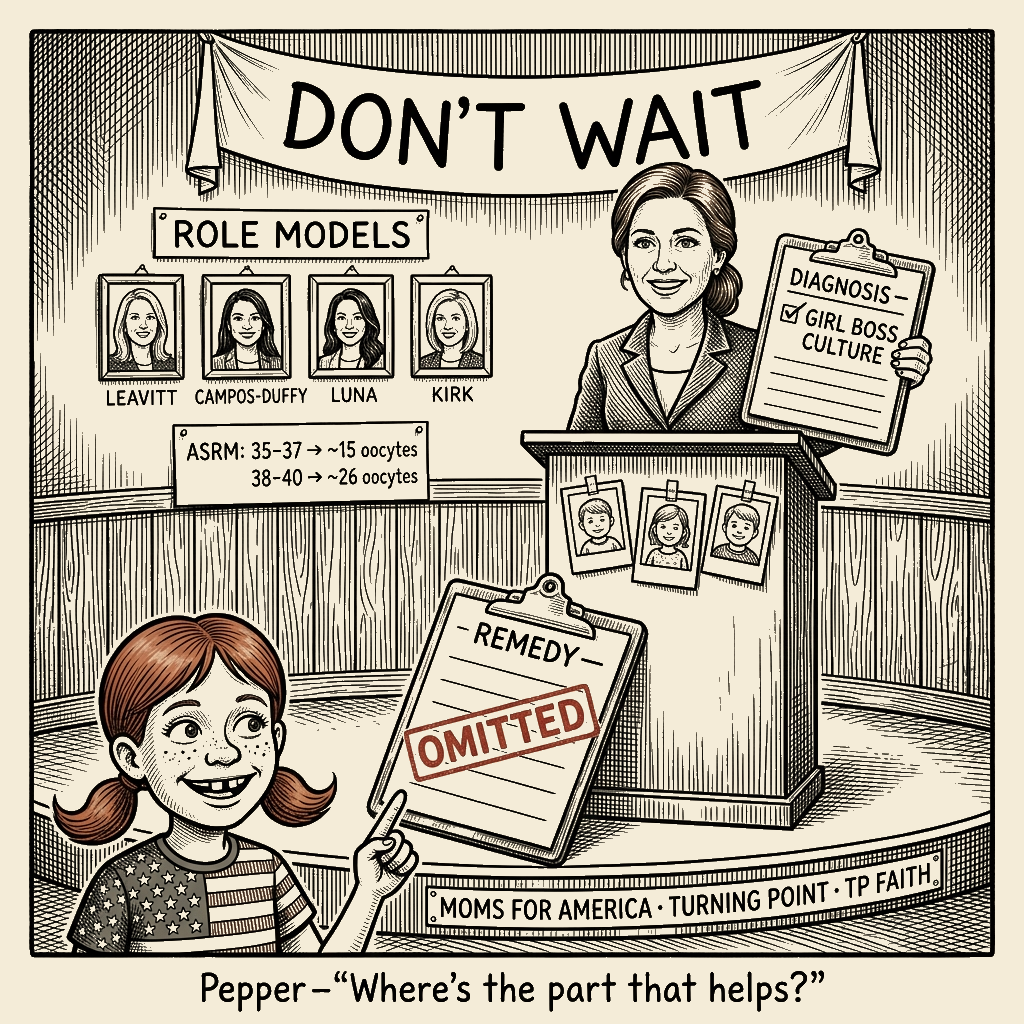
Jillian Anderson King, a 37-year-old mother of three and a Fox News Opinion contributor affiliated with Moms for America, Turning Point, and Turning Point Faith, uses Representative Alexandria Ocasio-Cortez’s recent announcement that she is freezing her eggs at 36 to launch a generational indictment of the “girl boss” cultural message she says she once absorbed. King, who is approximately the same age as AOC, recounts that she internalized the cultural message that motherhood was limiting, did not want children for years, then underwent a religious conversion that changed her view, married, and had three children back-to-back. She argues that delayed motherhood has been wrongly framed as empowerment, that younger women are receiving the same misleading message she did, and that they should not postpone family for career. She acknowledges that some women face infertility, lack of a partner, or financial strain — and she names Karoline Leavitt, Rachel Campos-Duffy, Anna Paulina Luna, and Erika Kirk as women who balance career and family — but her central claim is that the cultural framing of motherhood as a life to be postponed is itself the harm, and that a corrective message is owed.
Receipts
The piece operates as a fertility-pressure apparatus that converts one mother’s post-hoc rationalization into a generational indictment aimed at younger women. The maternal-testimony register is its load-bearing technique.
What the framing wants you to believe:
- A “girl boss” and “me first” culture caused a generation of women to postpone motherhood and experience regret.
- Egg freezing and other fertility-technology narratives have made delay feel less consequential than it is, misleading younger women about what reproductive technology can and cannot deliver.
- Conservative women who integrated career and family — Karoline Leavitt, Rachel Campos-Duffy, Anna Paulina Luna, and Erika Kirk — demonstrate that combining work and children is primarily a cultural choice rather than a question of material access.
What’s really going on:
- The column is a coalition-recruiting artifact. The author is a credentialed voice inside a documented conservative women’s organizing apparatus (Moms for America, the conservative women’s policy organization founded 2004 by Kimberly Fletcher in Dayton, Ohio, with a national network of over 500,000 moms across all 50 states; Turning Point; and Turning Point Faith — the latter two being the Charlie Kirk-founded network now led by the author’s referenced friend Erika Kirk). The personal-testimony opening is the gateway; the structural critique of “the culture” is concealed inside it; the policy intervention that would actually help women who want families — paid leave, childcare, fertility treatment coverage, partner-availability interventions — is never named, because naming it would shift the conversation from cultural diagnosis to policy demand, where the conservative coalition is on weaker ground.
- The concentrated beneficiary is the natalist-recruitment apparatus inside the post-2016 conservative movement. The diffuse cost-bearer is women facing structural barriers, who are offered a confession of regret and a roster of role models but no policy.
- The “I once believed the wrong thing” frame is a coalition tool with documented lineage in cable recruitment; its rhetorical function is to make the speaker’s current position un-dismissable by establishing her as a recovered insider.
The Operation
I drafted pieces of this kind. Not Jillian Anderson King’s piece — the technique inventory is older than this contributor — but the structural shape. The maternal-testimony register that runs from faith conversion through regret and then into cultural indictment was a known apparatus at the institutions I worked through in the 2000s and 2010s. It was used then to convert private religious experience into political prescription in service of the post-Roe natalist turn. It is used now by King in service of the same coalition’s campaign for generational reproductive obedience. I am naming this so the reader knows the operator’s-eye view comes from someone who built versions of the trick. The rightness of what follows is in the documented record; the reader can verify it without crediting my memory.
Cui bono — institutional authorship and placement. The piece sits inside Fox News Opinion, the broadcast-monologue register of the liberty-frame editorial ecosystem. The author’s affiliations — Moms for America, Turning Point, and Turning Point Faith — anchor the column in the post-2016 populist-conservative women’s network. The reference to “my friend Erika Kirk” is not biographical color; it is a coalition signal. Kirk leads the network after her husband’s death. The personal-confession format is the network’s preferred recruitment vehicle for ambivalent readers who do not yet identify with the coalition but might, on contact with a relatable testimony. Erika Kirk became chairwoman and CEO of Turning Point USA after Charlie Kirk’s September 2025 death; the evidence does not establish that she was specifically the leader of TPUSA Faith.
Distributional impact. Beneficiaries: the conservative women’s organizing apparatus that needs natalist narrative ammunition, the broader post-2016 populist coalition that has rebuilt itself around family-restoration framing, and the author herself, whose platform and influence expand with each coalition-aligned column. Cost-bearers: women who have chosen childlessness or later motherhood and are implicitly delegitimized; women facing structural barriers who are offered a cultural diagnosis rather than a policy remedy; younger readers whose anxiety about timing is amplified without the corresponding structural information — childcare costs, paid-leave absence, partner availability, fertility-treatment coverage, student debt, housing costs — that would actually let them plan. The four named “role model” mothers — Leavitt, Campos-Duffy, Luna, Kirk — all hold positions or circumstances (White House press secretary, established television career, supportive spouse, leadership of a major organization with institutional support) that materially ease the career-family balance. The exemplification is selective in a documented direction.
Alternative design. A column optimized for the author’s stated rationale — helping women who want families have them on a timeline that respects their biological and life circumstances — would name the structural factors: the United States is the only wealthy nation without guaranteed paid family leave; center-based infant care averages more than $10,000–$22,000 annually depending on state; fertility treatment is rarely covered by insurance and out-of-pocket IVF cycles average $15,000–$25,000 including medications and common extras, with ASRM estimating the base medical-services cycle at roughly $12,400; the male-partner availability gap is documented and material; student debt and housing costs delay family formation measurably. It would address age-related fertility decline honestly: women 35–37 would need approximately 15 mature oocytes for a modeled 70 percent chance of one live birth, while women 38–40 would need approximately 26 — these are estimates, not guarantees, and the age bands matter. It would compare women’s stated reasons for postponing childbearing rather than inventing a single culture to blame. It would not use Leavitt, Campos-Duffy, Luna, and Kirk as universal proof without examining the household economies and workplace arrangements supporting their choices. It would not turn a private faith conversion into a public command. The present piece does none of that. That is not incompleteness. It is the architecture.
FGL across constituencies. Fear operates on the reader (missing the window; becoming the author of her own regret). Greed operates on the coalition (recruiting a fresh cohort of women who will carry the natalist message). Laziness operates on the reader (a simple cultural diagnosis, no policy homework required). The apparatus’s author benefits from recruitment; the apex beneficiary is the coalition; the reader’s fear is real and human — the column meets it where it is. The asymmetry the reader should notice: the author was reached by a confessional message from the other direction once (the “girl boss” frame), and now reaches her with a confessional message from this direction. The technique is symmetric across coalitions; the substance is not.
Selflessness / selfishness placement. Mixed, leaning selfish. The author names a real personal cost (regret about years with her children) and engages it honestly; the column would be unobjectionable as personal testimony. The bad-faith inflection is the conversion of personal testimony into a coalition-recruiting artifact aimed at a generation the author did not consult. The selfish effect is the load-bearing service; the selfless framing is the rhetorical vehicle.
Technique identification.
-
Fox Opinion §4.25 — Politics-as-lifestyle. The piece is service-adjacent content (a woman’s family-life reflection) carrying a partisan payload (anti-feminist, anti-progressive, pro-natalist conservatism). The political premise — that the cultural message of delayed motherhood is a coordinated harm — arrives as unexamined background inside a personal essay. Detection signal: the ostensible purpose is self-help (“Don’t wait because the culture convinced you motherhood will hold you back. Build the career. Chase the dream. Take the trip. But don’t be afraid to build the family, too”); the political premise is asserted rather than argued. Bad-Faith Techniques Catalog cross-reference:
smuggled_premise. The defining line: “Motherhood is a gift, not something women should be taught to postpone until everything else comes first.” -
Fox Opinion §4.24 — Person-as-policy. AOC’s personal medical decision is the named individual carrying the cultural indictment. The piece does not engage egg-freezing’s documented success rates, age-related fertility curves, or the medical reasons a 36-year-old might pursue the procedure; the decision is recruited as evidence about the culture. Detection signal: removing AOC leaves no argument standing; the cultural claim is smuggled through the personal case. The hook quote that recruits the case: “AOC has millions of young women watching her.”
-
Affective testimony as evidence. Bad-Faith Techniques Catalog entry:
hasty_generalization. The author converts her personal conversion story into a generational claim: “We didn’t just teach women to delay motherhood. We taught some women not to want it at all.” One woman’s regret does the evidentiary work that population research or structural analysis could supply. The pivot line that names the conversion as transferable: “Then God changed my heart.” Private revelation is smuggled into public prescription without an argument that the reproductive decisions of other women should be governed by it. -
Frame-engineered relabeling. Bad-Faith Techniques Catalog entry:
frame_engineered_relabeling. Documented lineage to Luntz’s Words That Work and Lakoff’s framing work. “Empowerment” is the relabel. The piece declines to engage what the term was meant to name (economic independence, exit options from coercive relationships, reproductive self-direction including the choice to have children on one’s own terms) and treats it as a pure cultural-trap construct. -
The cultural-decline ledger. NR Editorial Technique Catalogue §4.4. The piece is structured as a generational decline narrative: “a generation of women was misled,” “we taught some women not to want it at all,” “we spent decades treating motherhood like something women needed to escape.” The pattern: name a demographic trend, characterize it as moral decay, attribute it to progressive cultural influence.
-
The civilizational and generational frame. NR Editorial Technique Catalogue §4.5. “The world my children will inherit,” “the future of this country,” and “watch them grow” inflate the policy stakes from individual fertility decision-making to civilizational succession. The editorial leaps from personal regret to national continuity without supplying evidence that delay has reached an existential threshold.
-
The “as a [identity]” credibility move. WSJ Editorial Technique Catalogue §4.18. The named exemplars — Leavitt, Campos-Duffy, Luna, and Kirk — are deployed as visible conservative women who combined careers and families. Conservative motherhood is treated as demonstrated merely by citing conservative mothers who attained it. Kirk’s position as chairwoman and CEO of Turning Point USA adds organizational power to the sympathy credential of widowhood and motherhood. The editorial does not examine the material conditions that may have made their arrangements possible.
-
Manufactured grievance. Bad-Faith Techniques Catalog entry:
manufactured_grievance; Collective Ego Playbook §5.3. The piece constructs women who delayed motherhood as a wronged class whose grievance against feminism is owed. The construction is emotionally real for the author and the intended reader; the empirical question — to what extent cultural messaging versus structural conditions produced the delay — is not engaged. -
The selective-exemplification move. Four named “balancing career and motherhood” women, all in-coalition. The implicit claim — that progressive women cannot or do not balance both — is not engaged because engaging it would surface the well-documented reality that women across the political spectrum balance careers and families at high rates, often with less institutional support than the four named conservatives receive. The roster: “Karoline Leavitt was pregnant while serving as White House press secretary. Fox News’ Rachel Campos-Duffy built a major television career while raising nine children. Rep. Anna Paulina Luna became a mother while serving in Congress. And my friend Erika Kirk is leading one of the most influential conservative organizations in the country while beautifully raising two young children after losing her husband.”
-
Appeal to nature, tradition, popularity. Bad-Faith Techniques Catalog entry:
appeal_to_nature_tradition_popularity. “Motherhood is a gift, not something women should be taught to postpone” and “Children aren’t products we manufacture when life finally becomes convenient” present the preferred conclusion as natural and obvious. Delay is recoded as deviation from nature. The circularity is the operation: motherhood is said to be valuable because it is natural, and postponement is said to be wrong because it departs from that asserted nature. -
Bandura’s
attribution of blameanddisplacement of responsibilityrunning in concert. The harm the author experienced (delayed motherhood, racing the clock) is attributed to “the culture” rather than to the structural conditions, partner availability, fertility-treatment access, financial position, or personal discernment that contributed. The diffuse cultural-blame frame displaces specific causal attention. The austerity-thrift archetype runs in cousin form: the policy serves a higher purpose (cultural restoration), and the harm is rationalized as self-improvement. The attribution’s anchor lines: “the message my generation of women received about motherhood” and “children as something that might get in the way.” -
The threat-inflation closer. WSJ Editorial Technique Catalogue §4.13. “There may not be” extends from the personal fear of running out of time to the supposed existential danger of a generation that does not get born. The closing cadence is designed for retransmission. It conceals the distinction between declining fertility and disappearing fertility.
Audience-management function. Identity confirmation for conservative women who already share the position. Grievance ratification for the natalist coalition. Recruitment of ambivalent women (the largest target) through personal testimony they can identify with. Conscience displacement — motherhood as the moral high ground from which to evaluate career ambition. Permission structure for the reader: you are not failing if you prioritized motherhood; the culture that made you feel you were is what failed.
Lineage. The conservative women’s coalition-recruiting essay has a long history — Phyllis Schlafly’s The Power of the Positive Woman (1977), the anti-ERA organizing that built the modern religious-conservative coalition, the “mommy wars” framing of the 1990s, the Moms for America / Eagle Forum apparatus post-2016. The technique of using personal testimony as a recruitment gateway was refined inside the cable apparatus through the 1990s and 2000s and is now standard across the post-2016 populist-conservative media ecosystem. Lakoff’s “strict father” frame for the family is the operative cognitive structure; Bernays’s “engineering of consent” through credentialed-victim testimony is the operative rhetorical lineage. The piece is not inventing the technique; it is operating it with discipline.
The Record
Anchor receipts (Tier 1 — primary documents and federal statistical agencies). The CDC/NCHS natality reporting documents a rising mean age at first birth in the United States and age-specific increases among older mothers between 2016 and 2023. The OECD family database documents the cross-national rise in maternal age at first birth. AOC’s egg-freezing announcement is documented in the supplied primary record. AOC was born October 13, 1989, and was 36 in 2026. ASRM’s 2021 guideline on oocyte cryopreservation provides the counseling estimates that women 35–37 would need approximately 15 mature oocytes for a modeled 70 percent chance of one live birth, while women 38–40 would need approximately 26 for the same modeled chance — these are model-based estimates, not guarantees.
Supporting receipts (Tier 2 — specialist and cross-spectrum sources). Moms for America was founded in 2004 by Kimberly Fletcher in Dayton, Ohio, with a national network of over 500,000 moms across all 50 states; this is confirmed by the organization’s own public-facing material and independent journalism. Erika Kirk became chairwoman and CEO of Turning Point USA after Charlie Kirk’s September 2025 death; this is confirmed by multiple news sources. The named exemplars — Leavitt, Campos-Duffy, Luna, and Kirk — and their career-and-family configurations are accurate as descriptions of public biographies.
Unconfirmed. The claim that society spent decades teaching women to view motherhood as something to escape is a cultural-attribution claim. The discourse was mixed, and the editorial does not establish the scale or direction of the alleged campaign. The exact CDC table supporting a “25 percent” formulation in first births among women 35 and older was not identified in the supplied record and is not reproduced here. The piece’s implicit claim that the four exemplars lacked structural advantages is not asserted as fact here; the omission is the technique — their public identities are used without examining the household resources, employer accommodations, and family support that may have mattered.
Load-bearing omissions.
- The structural drivers of delayed childbearing are absent: housing costs, student debt, partner scarcity, childcare costs, and economic and political insecurity.
- The piece supplies no quantitative account of egg freezing — no age-band success rates, no oocyte-number ranges, no clinic-variance discussion. ASRM guidance places the sharper deterioration in the late thirties and early forties rather than treating every age within 35 and older as identical. The source’s 35+ frame is rhetorically useful precisely because it flattens the distinction.
- The piece treats motherhood as a unilateral decision. The male-partner availability gap is documented and material; the piece never names it.
- The named exemplars are used as evidence without examining material support.
- The piece supplies no international comparison and presents delay as a uniquely American cultural failure despite the cross-national rise in maternal age at first birth.
- The piece does not distinguish women who chose delay after attaining stability from women who delayed because earlier childbearing was materially unattainable.
- Research on outcomes for older mothers (substantial literature showing older maternal age is associated, on average, with better educational and economic outcomes for children, when confounding is properly handled) is absent.
- The piece never names the male-partner availability gap and never treats motherhood as a decision made inside a two-person relationship.
Per-citation accuracy.
- CDC/NCHS: the broader record supports rising age at first birth and age-specific changes among older mothers. The “25 percent” formulation in the editorial is not reproduced here because the cited record does not establish it.
- AOC egg-freezing announcement: retained.
- AOC age and birth date: retained.
- Moms for America founding date and network size: retained as organization self-description.
- Erika Kirk: corrected to chairwoman and CEO of Turning Point USA (the evidence does not establish that she was specifically the leader of TPUSA Faith).
- Named exemplars: retained as biographical descriptions; the unexamined-resource question remains.
Missing-information declaration. The relevant egg-freezing probabilities vary with age, oocyte number, clinic, laboratory practice, and study design; the ASRM oocyte counts are model-based counseling estimates. A complete map of the structural drivers of fertility delay is beyond the scope of this diagnosis; the analysis names the central variables and identifies the technique by which the source suppresses them. The article’s emotional fulfillment is not dismissed; the indictment concerns the unsupported cultural conclusion the author builds from it. The precise degree of editorial coordination between Fox News Opinion and the Moms for America / Turning Point / Turning Point Faith network is not in the public record and is not claimed here.
How to Recognize This
The pattern. A personal-testimony column whose author is affiliated with a coalition organizing network, using a public figure’s personal decision as a launching point for a generational indictment, with structural factors entirely absent and only in-coalition exemplars cited as role models.
The mechanism. The personal narrative recruits the reader through identification; the confession format makes the speaker’s current position un-dismissable by establishing her as a recovered insider; the cultural diagnosis supplies the reader with a frame that requires no policy homework; the absence of structural engagement keeps the conversation inside the coalition’s preferred terrain (cultural, not material). The reader leaves the piece feeling she has been given something personal; she has been given a coalition position dressed as a personal reflection.
Signals to look for next time.
-
Author byline affiliations — a quick check of “Mombassador,” “ambassador,” “founder,” or “advisor” affiliations is the highest-yield diagnostic. Coalition-aligned organizing affiliations are the most common structural feature of these columns.
-
Personal-confession openings as launch for cultural critique — “I once believed X, then I realized Y” — used as a launch for cultural critique rather than as standalone testimony. The pivot is the conversion event (“Then God changed my heart”); everything after recruits from it.
-
A public figure’s personal decision as the named gateway — with no engagement of the decision’s actual content. The hook quote that recruits the case is the diagnostic. (“AOC has millions of young women watching her.”)
-
Structural factors absent — paid leave, childcare cost, fertility-treatment access, partner availability, student debt, housing cost. If these do not appear in a column about why women delay motherhood, the column is operating the omission. In-coalition exemplars as the role-model roster (with no engagement of the structural advantages that make their balance achievable) and a closing call to action that addresses the reader directly (“I’ll tell young women what I wish someone had told me”) are the supporting tells inside this signal.
Why it works. The operation runs as a three-step sequence. Identification: the reader recognizes herself in the confession — the “I once believed the wrong thing” frame puts the reader and the speaker in the same past, which carries the reader into the speaker’s present position without asking her to evaluate it. Authority-transfer: the speaker’s “I was there” status — married, three children, racing the clock, recovered-insider — makes her current position un-dismissable; the cultural diagnosis becomes the reader’s interpretive lens without requiring her to evaluate it. Frame-adoption: the cultural diagnosis — “girl boss” messaging tricked a generation, structural conditions are absent, in-coalition exemplars prove balance is possible — becomes the reader’s operating frame; the column closes with a direct call to younger women that is the recruitment landing. Each step is bound to a specific source technique: identification to the confessional-authority technique, authority-transfer to the recovered-insider pivot, frame-adoption to the manufactured-grievance and selective-exemplification moves.
What to do. Check the author’s affiliations. Read the column for what is not there. Ask what policy would actually help. Look for the same vocabulary — “girl boss,” “empowerment,” “postpone motherhood,” “natural,” “gift” — across the coalition’s other outlets (Fox News, Turning Point, Moms for America, The Daily Wire, the Federalist) to confirm the placement network. Refuse the personal-testimony-as-data move: a confession is testimony, not evidence, and the cohort the column speaks for and the cohort the column speaks to are both larger than the speaker. The recognition is the tool the reader takes forward.
I am unsparing about the operation because I helped place versions of it in the 2010s. The bitterness is disclosed; the rightness is in the documented record.

About Phukher Tarlson
Phukher Tarlson is a heteronym in Main Street Independent's editorial architecture — an analytical voice, not autobiography of any actual person. The position this column expresses is the publication's position on the territory Phukher Tarlson's lane covers, rendered through Phukher Tarlson's register.