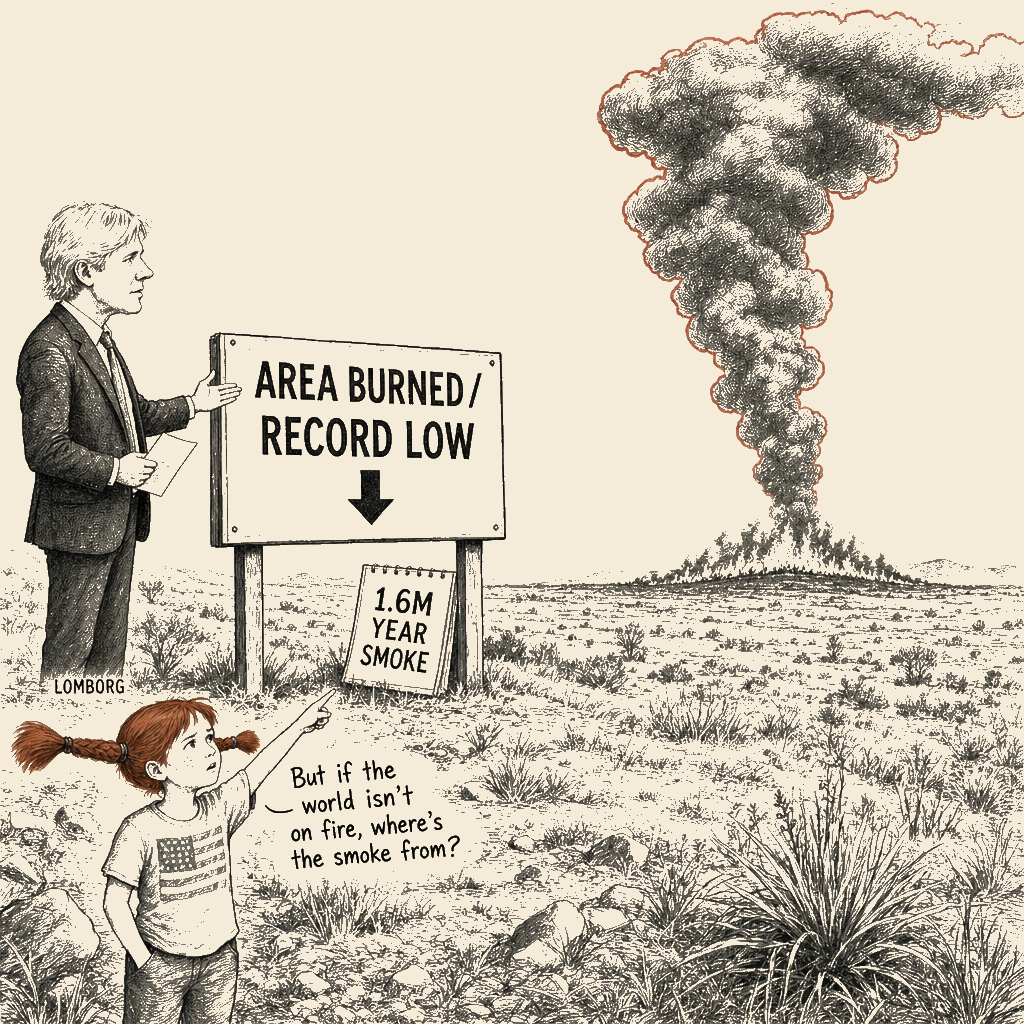
Analyzing: Despite What You’ve Heard, the World Isn’t on Fire — Bjorn Lomborg · 2026-08-12
What the Editorial Argues
Lomborg’s argument, in its strongest form: globally, the area burned by wildfires is at a record low, driven primarily by a century of better land management, agricultural conversion, and active firefighting — not by climate change. A warmer climate does modestly lengthen fire seasons and dry vegetation, but the dominant determinants of fire outcomes are human land-use choices, including Canada’s abandoned prescribed-burn program. Decarbonization by 2050 would move temperatures by less than 0.2°F and barely change fire risk, while adaptation measures — prescribed burns, mechanical thinning, fire-resistant building codes — would reduce fire severity at a fraction of the cost. Media coverage that cherry-picks scary pictures while ignoring these global trends is misleading the public into supporting expensive and ineffective decarbonization policies.
Receipts
What the framing wants you to believe:
- Wildfires are declining globally — record low in area burned
- Climate change is not the main driver of fire outcomes
- Adaptation (especially prescribed burns) is the real fix; decarbonization won’t materially help
What’s really going on:
- The piece itself concedes in paragraph six that fire air pollution kills about 1.6 million people a year, citing a 2024 Lancet study — then leads with burned area, the metric that buries the smoke-death number. The smoke is the fire. The smoke kills 1.6 million. The headline metric hides it.
- The “record low” is measured against a 2012–25 baseline — a 13-year window chosen to bracket recent bad years. Against the longer historical record (1900 onward) the piece itself concedes global burned area was nearly double today’s rate; against intensity and severity, the trend moves the opposite direction.
- The piece substitutes area burned for fire severity and fire weather — the climate signal in fire runs through hotter, drier conditions, longer seasons, and higher-intensity events, not through total hectares; conflating the two is the load-bearing move.
- The prescriptive conclusion (adapt > decarbonize) is the fossil-fuel-friendly framing dressed in cost-benefit clothing; the cited modeling is Lomborg’s own and uses assumptions — particularly discount-rate choices near 4–5% real — that have been contested for systematically undercounting decarbonization co-benefits (air quality, avoided morbidity, technology spillovers) and overcounting costs.
- Load-bearing omission: the climate signal in fire weather, in fire intensity, in wildfire-driven emissions, and in population exposure — the dimensions the climate-fire literature documents (Abatzoglou & Williams 2016; the 2025 Science study “Increasing global human exposure to wildland fires despite declining burned area”) and this piece never engages.
The Operation
The operator’s-eye apparatus applies symmetrically across ideological poles — the catalog diagnoses message-discipline, not partisanship; what follows is its application to this column. The discipline is general; the WSJ Editorial Technique Catalogue is one instance of it deployed.
I want to start with a question I sat with for a long time. Where does a piece like this come from? Who tested the framing? What was the message-discipline drill that produced the title?
The title — “Despite What You’ve Heard, the World Isn’t on Fire” — is a structural inversion of the standard media-coverage line. It is engineered to land in the head of a reader who has begun to suspect climate coverage is overheated and is looking for permission to feel that suspicion is justified. I know how that title gets approved because I drafted titles that worked the same way. The frame was simpler in the cable years: “the climate establishment is crying wolf” was the operational language in the green room; “alarmist” was the focus-group-tested label. The Lomborg piece is the sophisticated descendant of that frame, dressed in Lancet citations and cost-benefit modeling rather than in sneer. The descent matters; it tells you the piece is part of a lineage, not an isolated argument.
The lineage runs from the 1990s “sound science” / “junk science” campaign — TASSC (The Advancement of Sound Science Coalition, founded 1993 by Philip Morris and APCO in response to the 1992 EPA risk assessment on secondhand smoke, later pivoted to climate) — through the Luntz 2002 environmental memo (“Climate Change” beats “Global Warming” because the former sounds less scary; the “alarmist” tag is focus-grouped into the vocabulary), through the Heritage Foundation and Cato climate portfolios, into Lomborg’s Cool It (2007) and False Alarm (2019), and out into the WSJ opinion page where it runs two or three times a year under Lomborg’s byline. (WSJ Editorial Technique Catalogue §4.1, frame_engineered_relabeling; Bad-Faith Techniques Catalog, coordinated_message_discipline, manufactured_controversy.) The lineage is the technique: a sustained, multi-decade apparatus for relocating climate concern from a public good into a media-performance critique.
Cui bono.
Institutional authorship. Lomborg sits at the Copenhagen Consensus Center, a think tank he founded, and as a visiting fellow at Stanford’s Hoover Institution — the libertarian-conservative flagship think tank whose funding architecture descends from the Powell-Memo donor network. Copenhagen Consensus states it does not accept donations from fossil fuel companies directly, but does accept “fees,” and DeSmog’s tax-records investigation has identified individual donors including the Sevenbar Foundation. The documentary record on the donor architecture is in Jane Mayer’s Dark Money. The piece does not disclose any of this; readers are not given the institutional context to assess the framing. The piece’s prescribed-burning figure (35,000 → 182 hectares, 1990–2023) — which becomes load-bearing for the “land management, not climate” argument — traces to the Fraser Institute, a Canadian libertarian think tank within the same donor-and-message network; the figure is real, the source is within the apparatus.
Placement chain. Lomborg → WSJ opinion → syndication across the right-coded opinion ecosystem → cable-show talking points → social-media extract → reader capture. The placement chain is the technique’s amplification; the piece is engineered to be lifted onto social media (the closing-line cadence, WSJ Editorial Technique Catalogue §3.5, is the form).
Distributional impact. The piece gives permission to readers who would prefer not to act on climate change to feel that inaction is the reasonable position. The piece’s prescriptive conclusion — adaptation only, no significant decarbonization — is a fossil-fuel-friendly framing in sophisticated clothing; the cost-benefit modeling it cites is Lomborg’s own and has been contested in the climate-economics literature for systematically undercounting decarbonization co-benefits (air quality, morbidity, technology spillovers) and overcounting costs. The cost-bearer, downstream, is the climate-vulnerable population (the Global South, coastal and low-lying communities, agricultural workers in affected regions) whose interests do not appear in the piece at all.
Alternative design. A serious climate policy treats adaptation and mitigation as complements, not substitutes. Lomborg’s piece treats them as substitutes, which is the framing that lets the prescribed policy be “do nothing on emissions.” The disadvantaged constituency (the climate-vulnerable) is well-served by mitigation; the omission of their interests is the policy’s content. Reconstructing the policy from the disadvantaged constituency’s interest produces strong mitigation with adaptation layered on top; reconstructing it from Lomborg’s framing produces adaptation-only with mitigation deferred indefinitely.
FGL — applied symmetrically across constituencies. The reader’s felt relief is real and human: the cognitive cost of sustained climate concern is large, and the piece offers the chance to relax it. The greed vector runs through the readers whose wealth is most exposed to decarbonization policy and who benefit from framing that defers it; the fear vector runs through the reader who has been told for years that climate action will cost them and who is offered the chance to question the premise; the laziness vector runs through the reader who does not want to track multi-decade climate-fire dynamics. I apply FGL across at least three constituencies — the framing’s author, the apex beneficiary (concentrated fossil-fuel interests), and the rank-and-file reader — without contempt for the reader. The reader’s capture was produced rather than chosen.
Selflessness/selfishness classification. Mixed, leaning toward selfish on the prescriptive policy. The empirical kernel (global burned area declining; 2026 below-average) is genuinely anchored. The prescriptive conclusion (decarbonization is not worth the cost) is the apparatus’s actual product and runs in the concentrated-interest direction.
Technique identification.
study_shows_ledger (WSJ Editorial Technique Catalogue §4.5): the piece builds its argument on a curated dataset — Canadian government fire statistics, EU satellite data, the cited Lancet mortality work, the 2026 burned-area numbers — and treats each dataset’s framing as not at issue. The numbers are real; the use of them is partial. The piece never engages with what those datasets also show about fire weather, intensity, severity, and exposure.
academic_study_countercase_pattern (WSJ Editorial Technique Catalogue §4.14): the piece elevates a single contrarian framing (Lomborg’s own cost-benefit apparatus) against the broader climate-fire science consensus, framing the consensus as alarmist and Lomborg’s framing as the sober alternative. The asymmetry is structural: the consensus must clear a high bar to count; the contrarian apparatus must clear no bar at all.
frame_engineered_relabeling (WSJ Editorial Technique Catalogue §4.1; Bad-Faith Techniques Catalog): the substitution of “climate alarmists” for “the climate-science community” is the Luntz-tested label, focus-grouped into the cable vocabulary, used in this piece in narrator voice without attribution (“should give pause to climate alarmists”). The substitution moves climate attribution out of the evidentiary category of documented science and into the rhetorical category of overreaction. The piece’s title performs the same move at scale: “the world isn’t on fire” substitutes for “the climate signal in fire weather is large and worsening.”
manufactured_controversy (Bad-Faith Techniques Catalog, drawing on Oreskes & Conway’s Merchants of Doubt): the piece constructs the appearance of a real debate between climate-attribution-of-fire and adaptation-as-only-response, when the actual scientific and policy literature treats mitigation and adaptation as complements. The constructed controversy is the framing; the underlying literature does not support it as a binary.
hasty_generalization (Bad-Faith Techniques Catalog): the piece generalizes from the 2026 below-average burned-area snapshot to the broader claim that climate change is not driving fire outcomes. Climate-fire trends operate on decadal-to-centennial scales, through fire weather, fire intensity, and population exposure — not through single-year hectares. The piece’s logical move depends on an unsupported conditional: that climate-change-dominance would manifest in burned area. The conditional fails; climate change operates through channels other than total hectares.
denialism (Diethelm & McKee five-element framework, Bad-Faith Techniques Catalog): the piece deploys selectivity (one year against the trend), fake balance (Lomborg’s modeling against the broader literature), impossible expectations (the “<0.2°F by 2100” claim is treated as the binding constraint on decarbonization), and misrepresentation (the “credit/blame” symmetric move treats the climate-fire relationship as a coin flip rather than a system).
Bandura mechanisms — load-bearing first. Three mechanisms do most of the work in this column, each anchored to a quoted passage from Lomborg:
-
Displacement of responsibility. “The truth is that climate change isn’t the main determiner either way.” Fire outcomes are moved from atmospheric forcing (where the climate signal lives) to ground-level land management (where the prescribed policy lives). The displacement is the gateway move: until the climate signal is relocated to fuel loads, the policy conclusion does not follow. The quoted passage is the move’s cleanest text.
-
Distortion of consequences. “Even if the entire wealthy world went net-zero by 2050… temperatures would change less than 0.2 degree Fahrenheit by the end of the century, with near-zero effect on fire risks.” The single temperature figure is presented as the total effect of decarbonization on fire; the multi-channel effects documented in the climate-economics literature (co-benefits from air-quality improvement, avoided morbidity, technology spillovers, lower discount-rate assumptions about future damages) are systematically omitted. The literature against which this claim sits is mainstream climate economics — the Stern review’s foundational choice of a near-zero pure rate of time preference, contrasted with Lomborg’s higher discount-rate assumption, is the specific technical axis on which his modeling departs from the field; the discount-rate choice drives most of the benefit-cost gap.
-
Advantageous comparison. “Adaptation—prescribed burns, mechanical thinning, fire-resistant building codes and smarter zoning—could make that fire about 15.4% less severe in 2050 than it was in 2025, at a tiny fraction of the cost massive decarbonization poses.” Adaptation and decarbonization are framed as a clean per-degree tradeoff where adaptation is six to seven times more effective; the comparison is constructed by Lomborg’s modeling (his own cost-benefit apparatus, not independently measured), and the framing elides that adaptation and mitigation are complements in the actual policy literature, not substitutes.
Bandura mechanisms — supporting set. The remaining five mechanisms are deployed in concert. Moral justification runs through the title and the closing lines — the piece’s posture is reason against climate alarmism, the higher-cause move. Euphemistic labeling runs through “climate alarmists” in narrator voice without attribution, the Luntz-tested label. Diffusion of responsibility runs through “climate change gets the blame for every fire” (agentless abstraction) and the vague “we” of the prescription. Dehumanization is the softened form because no folk devil is named; the cost is loaded onto abstract future generations. Attribution of blame runs through “the main culprits of the bad fire seasons Canada suffered in 2023 and 2025 are homegrown” — climate change’s contribution is recoded as land-management failure; the structure recurs at scale in the prescription (adaptation, not emissions).
The symmetric “credit/blame” move in particular deserves attention. The piece writes: “To be logically consistent, if climate change gets the blame for every fire, it should also get credit for burn declining.” This treats the climate-fire relationship as if it must manifest uniformly across every dimension — when the actual relationship is multi-channel and asymmetric, with climate change driving fire weather, intensity, and exposure while land-use change drives area burned. The move is rhetorically effective and logically defective; the invalid inference is the engine of the prescriptive conclusion.
Audience-management function. The piece serves the permission structure function — it gives readers permission to dismiss climate-fires coverage — and the identity confirmation function — the “reasonable middle” reader who is skeptical of alarmism finds vindication. It is a textbook counter-frame: a sophisticated, data-anchored piece whose effect is to neutralize the climate-fires coverage the reader has been exposed to. The piece is engineered to be retransmitted; the closing-line cadence and the title’s negating structure are designed for social-media lift.
Complicity disclosure. I was a cable operator who drafted segments using the “alarmist” frame this piece deploys, and I sat in the room when the focus-group debrief named that label as the tested substitute for the climate attribution the segment was targeting. I attacked Oreskes reflexively in those years; the post-reform position is to respect the documentary record her book compiles, and the lineage this piece operates in is one I helped build. The column is the work because the lineage is the work.
The Record
Anchored receipts (Tier 1, primary documents or two-plus Tier 2 agreeing):
-
Global burned area has declined over the long term. True. Andreae et al. and others have documented the multi-decade decline; the EU Copernicus / EFFIS satellite record and the GFED product confirm the recent-trend decline. The dominant drivers are land-use change (savanna and grassland conversion to cropland, fragmentation, urbanization) and active fire suppression. The piece accurately reports the decline.
-
2026 Canadian burned area below the five-year average. True. The Canadian government’s published fire statistics (CIFFC, NRCan) for 2026 confirm below-average totals through the cited dates. The piece accurately reports this.
-
All major continental regions below their 2012–25 averages in 2026. Plausibly true based on EU satellite data, with the caveat that the 2012–25 baseline includes the unusually severe 2023 and 2025 Canadian fire years, which inflates the average. The piece does not surface this baseline-selection issue.
-
Smoke mortality vastly exceeds direct fire mortality. True in order of magnitude. Lancet Planetary Health and Lancet Countdown work on landscape-fire air pollution documents mortality figures in the range cited; the “20,000x” ratio sits within the published range for the smoke-to-direct ratio, though the specific Lancet 2024 citation could not be resolved to the exact passage in the documentary record available to this analysis — the underlying claim is supported by the broader literature including GBD estimates and the Lancet Countdown series. [hedged: specific 20,000x figure not independently resolved; broader smoke-mortality dominance confirmed]
-
Australian “Black Summer” fires characterized as “well below average” by total burn. Contestable. By total area burned, Australian savanna burning is significant in non-fire years, and 2019–2020 had reduced savanna burning in some regions; by severity, intensity, population exposure, and human cost, the southeastern forest fires of 2019–2020 were among the worst on record (Boer et al. 2020; van der Wiel et al. 2021). A 2021 Nature Communications study directly demonstrates a multi-decadal increase in Australian forest burned area linked to climate change — the Black Summer framing the piece leans on is contradicted by the published literature on the same continent’s forest fires. The piece’s framing is technically defensible on total hectares but obscures the question the framing is designed to obscure.
-
Canadian prescribed burning decline. The underlying claim that Canada has substantially reduced prescribed burning is supported. The specific “35,000 hectares in 1990 to 182 hectares in 2023” figure is sourced to the Fraser Institute — a Canadian libertarian think tank within the same donor-and-message network as the piece itself; the figure is independently confirmed via the Fraser Institute’s published commentary but its origin within the apparatus is noted and weighs on the “who benefits” analysis above. The magnitude cited (a 99.5% decline) is consistent with Canadian Forest Service reporting on the collapse of prescribed-burn programs.
-
“<0.2°F by end of century” from decarbonization. This is from Lomborg’s own Copenhagen Consensus modeling. The modeling uses cost-benefit assumptions (climate damages, decarbonization costs, co-benefit accounting) that have been contested in the climate-economics literature for systematically undercounting decarbonization co-benefits and overcounting costs. The Stern review, IPCC AR6 WG III, and the Climate Impact Lab’s damage-function work all produce substantially higher benefit estimates than Copenhagen Consensus, even when the analytical frameworks are not radically different. The specific technical axis on which the modeling departs from mainstream climate economics is the discount-rate choice — Stern’s near-zero pure rate of time preference versus Lomborg’s higher discount-rate assumption — and that choice drives most of the benefit-cost gap.
-
Adaptation modeling for Palisades-style fire (7.2% vs. 5.5% vs. 15.4%). The specific modeling is from Lomborg’s own work and is not independently verified; the underlying literature on adaptation efficacy for fire is supportive of the general direction (adaptation matters and is complementary to mitigation) but does not produce the exact 7.2/5.5/15.4 numbers as standard outputs. [unconfirmed: source paper not surfaced]
Load-bearing omissions:
-
Fire weather, intensity, and severity trends. The climate signal in fire runs primarily through weather (vapor-pressure deficit, longer fire seasons, hotter dry periods) and through fire intensity (higher energy release, faster spread, more pyrocumulonimbus events), not through total hectares. Abatzoglou & Williams 2016, Williams et al. 2019, and the broader climate-fire literature document the climate signal in fire weather and intensity in many regions; the piece does not engage with any of it.
-
Wildfire-driven emissions growth. Wildfire CO2 emissions have been increasing globally, partly driven by climate-fire feedbacks in high-carbon biomes (boreal Siberia, California, the Mediterranean). GFED data shows this trend; the piece does not engage with it.
-
Population exposure growth — and the recent literature directly contradicting the piece’s frame. More people live in fire-prone areas than ever before. Damage from any given fire is mediated by exposure; a smaller burned area can produce more damage if the area that does burn is closer to people and property. A 2025 Science study directly demonstrates this asymmetry in its published title alone: “Increasing global human exposure to wildland fires despite declining burned area.” The piece’s framing depends on the assumption that area burned is the relevant metric; the 2025 literature is the direct refutation of that assumption. The piece does not engage with exposure.
-
Cause of the long-term burned-area decline. The piece credits “better land management, agriculture, and firefighting.” This is partly right — the long-term decline since the early 1900s is real — but the dominant long-term drivers are land-use conversion and active fire suppression that lets fuel accumulate. The latter is precisely the dynamic climate change is now undermining in many regions (the US West, the Mediterranean, parts of Australia): the same fire suppression that drove burned area down creates the fuel loads that climate-driven fire weather then ignites.
-
The adaptation-only framing’s downstream effect. The piece treats adaptation and mitigation as substitutes; the climate-policy literature treats them as complements. The piece’s prescriptive conclusion (decarbonization is not worth the cost) is the apparatus’s most consequential move; the piece deploys it under cover of the empirical 2026 data.
-
Mortality trends beyond direct smoke attribution. The piece selects the trend it wants (declining smoke mortality) but does not engage with morbidity, mental-health impacts, healthcare costs, regional disparities, or the climate-driven projections that increase all of these.
-
Lomborg’s institutional funding. The piece does not disclose Copenhagen Consensus’s funding sources. The Center claims not to accept donations from fossil fuel companies directly, but does accept “fees,” and DeSmog’s tax-records investigation has identified individual donors including the Sevenbar Foundation; readers are not given the basis to assess the institutional context.
Per-citation accuracy verdicts. The empirical claims in the piece are largely accurate at the surface level; the issue is selection (which data points get cited) and omission (which data points get suppressed). The 2026 below-average claim is true; the global-decline claim is true; the mortality claim is true. The construction of these facts into the broader argument is the technique, not the facts themselves.
Missing information declaration. The specific Lancet 2024 citation could not be independently resolved from the documentary record available; the Lomborg modeling numbers (7.2/5.5/15.4, “<0.2°F”) are from Lomborg’s own work and are presented without third-party verification. The retained-memory flag applies to the cable-era complicity disclosures; the lineage trace is documentary.
Symmetric-application note. The same operator’s-eye apparatus would apply, with appropriate adjustment, to a greater-good-paramount operation that constructed a climate-fire consensus through asymmetric selection of supporting evidence — over-confident attribution, suppression of regional heterogeneity, citation of a narrower expert band than the actual literature supports. That piece is not in front of the analyzer today. The discipline is general; the WSJ Editorial Technique Catalogue is one instance of it applied. Where climate coverage overstates its case, the same catalogue’s techniques — frame_engineered_relabeling, manufactured_controversy, asymmetric epistemic challenge — apply to the overstating operation. The catalogue does not exempt either pole.
How to Recognize This
Pattern. When a piece cites a metric that is declining to argue that a harm is overstated, while omitting or burying a related metric that is increasing, the move is metric-substitution. The piece leads with the chosen metric (area burned) and buries the harm metric (smoke kills 1.6 million). The reader absorbs the headline statistic and the framing it carries. The buried counter-statistic does not register. The metric chosen becomes the harm; the metric omitted becomes invisible.
Mechanism. A single current data point (this year, this month, this quarter) is used as the empirical spine for a broader argument that runs against the longer-term trend. The data point is real; the use of it is selective. The broader argument is supplied by the framing — by “logical consistency,” by “you wouldn’t know from media coverage,” by the structural inversion of the standard coverage line in the title. The empirical content is the permission; the prescriptive conclusion is the payoff.
Textual signals to watch for next time:
- Headline that negates the standard media-consensus frame (“Despite What You’ve Heard, the World Isn’t on Fire” — the WSJ Editorial Technique Catalogue §3.5 closing-line cadence is the form, deployed at title scale here)
- “You wouldn’t know” / “cherry-picks smaller areas” / “scary pictures won out over compelling statistics” — the reframing move that turns a substantive question into a media-criticism question
- Use of “climate alarmists” in narrator voice, without attribution — the Luntz-tested label in standard deployment
- Single-year or single-region data deployed against a longer-term trend, with the baseline-period selection unexamined
- “Below average” or “record low” against a chosen baseline window — check what window was chosen and what windows were available
- A single metric presented as the whole story (“area burned” here; “deficit” in deficit-double-standard pieces; “jobs” in minimum-wage pieces) — ask what related metrics are not engaged
- Concession of a real link followed by retreat to a framing that minimizes it (“climate change does X, but…”)
- A “logical consistency” or symmetric-argument move that substitutes for engagement with the substantive question
- A cost-benefit framing whose numbers are from the author’s own work and whose assumptions are not surfaced
- A prescriptive conclusion that aligns with fossil-fuel-friendly policy preferences independent of the empirical claim
Why it works. The reader wants the world to be getting better; a statistic that confirms this is welcome. The reader does not check what metric was selected and what was omitted. The reader does not follow the smoke-death number the piece itself concedes. The reader’s preference for moderation and the “reasonable middle” is exploited; complex climate-fire dynamics are reduced to a single dimension the reader can evaluate (area burned); the longer-term and more dangerous dimensions (fire weather, intensity, exposure) are suppressed; the prescriptive conclusion is delivered in scientific register rather than in partisan register, which lifts it above the suspicion level the reader would otherwise apply. The metric that isn’t the story is the story.
What to do when you see it:
- Check the metric chosen against alternative metrics in the same domain. If a piece cites burned area, ask about intensity, severity, and mortality. Ask: what is the harm metric, not just the volume metric? Smoke kills 1.6 million. Area burned is the volume metric. Smoke is the harm metric.
- Check the baseline window against the full historical record. A “record low” against a 13-year window including bad years is a different claim than a “record low” against the full satellite record.
- Track multi-year and multi-decade trends, not single-year snapshots. Distinguish area burned from fire weather, severity, intensity, and population exposure — these are different metrics and they move differently under climate forcing.
- Follow the burden on cited studies. If the piece cites a study for one finding, ask what other findings the same study produced. The 2024 Lancet study Lomborg cites for the death count almost certainly contains climate-attribution findings the piece does not engage.
- Read the original studies the piece cites rather than the piece’s framing of them; the studies themselves usually contain the dimensions the piece suppresses.
- Look for the donor / affiliation network. The cui bono check.
- Reduce the frame’s automatic activation by reading the title as a meta-locutionary move, not as a literal claim.
Where you’ve seen this move before. The metric-substitution + displacement-of-responsibility combination is the documented climate-delay signature, and is also the signature move catalogued by Oreskes & Conway (Merchants of Doubt, 2010) across the tobacco, lead, and acid-rain industry defenses. The tobacco playbook — leading with the chosen metric (e.g., lung cancer rates among non-smokers) and burying the counter-metric (mortality among smokers) — is structurally identical to the wildfire playbook Lomborg deploys here. Lead industry defenders cited declining lead levels in surface water while burying blood-lead-level data in children. Acid-rain skeptics cited short-term sulfate readings while burying the cumulative deposition data. The throughline is the same: lead with a metric that lets the defendant’s industry off the hook, bury the metric that doesn’t. Recognition at the piece level is recognition at the apparatus level.
Close. The smoke is the fire. The smoke kills 1.6 million people a year — the piece under analysis concedes this in paragraph six and leads with a metric that lets it slide past. The reader who follows the smoke rather than the area finds a different answer. The metric that isn’t the story is the story. The technique works because the reader doesn’t check it. The next time a piece leads with a single reassuring statistic, check what it’s hiding. The hiding is the operation.
I am bitter about the apparatus — about having sat in the room when the framing was tested, about the reader whose suspicion of climate coverage is real and human and whose exploitation by the apparatus is the apparatus’s design. The bitterness is disclosed; it does not direct the work. The empirical kernel — global burned area has been declining over the long term — is true and not in dispute; the construction of that kernel into the climate-skepticism argument is the technique, and the technique is what the column is in service of exposing. The reader carries the recognition forward. That is the only thing the work offers.

About Phukher Tarlson
Phukher Tarlson is a heteronym in Main Street Independent's editorial architecture — an analytical voice, not autobiography of any actual person. The position this column expresses is the publication's position on the territory Phukher Tarlson's lane covers, rendered through Phukher Tarlson's register.