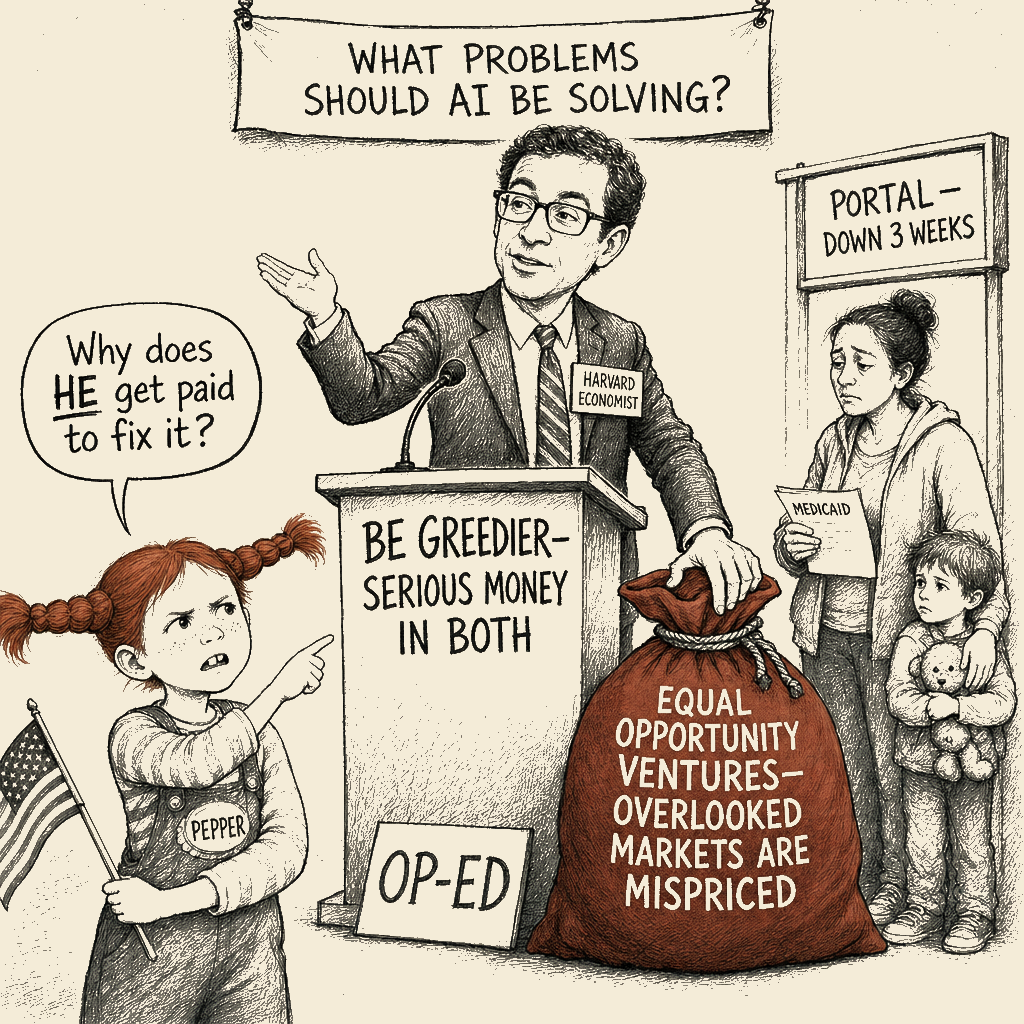
Responding to: What Problems Should AI Be Solving? — Roland Fryer · 2026-08-12
What the Piece Argues
Roland Fryer, a Harvard economist, observes that Silicon Valley is awash in “abundance” talk and puzzled by rising young-American interest in “socialism.” His diagnosis: AI founders build products for people like themselves, while the country’s biggest solvable problems — Medicaid, benefits systems, reentry, police IT — sit on the shelf because no venture-backed founder has lived them. He proposes a non-regulatory fix: the same greed already chasing missiles and chips should chase Medicaid-scale markets too, because “there is serious money to be made in both.” The redistribution question is set aside as the wrong prior question; the structural remedy is more entrepreneurial attention to overlooked markets.
Receipts
The piece relocates AI inequality from “who gets the abundance” to “what problems do founders know how to solve” — a move that removes redistribution from the table without defending that exclusion. Its own anchor evidence is the Einiö, Feng, and Jaravel paper accepted at the American Economic Review, which documents founder-market-fit bias: founders build products for people like themselves, female founders over-index on female customers, and founders exposed to lower-income peers disproportionately enter necessity industries.
-
The framing wants you to believe
- AI abundance is happening, and the only real question is which problems founders decide to chase.
- The “socialism” trend among young Americans is a symptom of being left out by entrepreneurial myopia — not a critique of capitalist structure.
- The fix is to “be greedier”: extend the VC playbook to Medicaid, benefits navigation, reentry, and police IT, and let the market redistribute attention.
- Tax, UBI, and other redistribution schemes are explicitly set aside as the wrong prior question.
-
What’s really going on
- The piece is itself a market-protection move — by reframing distributional critique as a marketing problem, it removes redistribution from the agenda without defending the exclusion.
- The author’s institutional position is not neutral: Harvard economics professor, founder of Equal Opportunity Ventures, senior fellow at the Manhattan Institute — three positions that profit from the AI-boom-continues-unregulated thesis.
- The polling Fryer himself cites — DSA membership at an all-time-high 120,000, positive views of capitalism down six points since 2021 (Gallup), nearly 8 in 10 of Americans expecting AI to reduce jobs — is presented as symptoms of founder blindness, not as evidence that the public wants structural redistribution the piece declines to endorse.
- The Medicaid $900 billion spend in 2024 and the $1.9 trillion disengaged-worker productivity loss are real magnitudes, but calling them “markets” does not change the fact that the venture class structurally chases the next $12 billion valuation rather than the next Medicaid contract.
The Response Ladder
Polite Reframe
When to use: For the persuadable moderate who hasn’t read the piece but might; the family-member Thanksgiving reply; the colleague who forwarded it with “thought you’d find this interesting.”
Brenda is on Medicaid. She is forty-seven, working two part-time jobs in Memphis, and the state portal where she is supposed to apply for food assistance has been down for three weeks. She does not need a venture-backed founder to discover her problem; she needs someone to fix the portal. Roland Fryer, the Harvard economist, recently spent a Wall Street Journal column asking why Silicon Valley isn’t solving problems like Brenda’s. The column’s answer: founders build for people like themselves, and the fix is to point more founders at Medicaid.
Fryer is right that the venture playbook systematically underweights Medicaid, benefits navigation, reentry software, and police IT, because the founders of these companies are not the people who show up at Demo Day. The Einiö, Feng, and Jaravel paper accepted at the American Economic Review documents exactly the pattern he describes: female founders create products with an 18% higher female customer share than male founders in the same category; founders exposed to lower-income peers in college disproportionately enter necessity industries. Founder-market fit is real, and it is missing where it is most needed.
But then Fryer makes a move the data does not support. He converts a structural observation about venture-capital blind spots into a counsel of patience: more diverse founders, more AI-native service businesses, more “founder-market fit” — and the market will eventually deliver Medicaid-scale abundance the way it delivered chips. Medicaid spent $900 billion in 2024. Disengaged-worker productivity loss runs about $1.9 trillion a year, per Fryer’s own Gallup citation. Neither number shrinks because a 25-year-old whose parents are surgeons builds a Medicaid company instead of HotCookies.ai.
The polite version of the rebuttal: the data Fryer cites shows founder demographics produce founder-shaped products. The remedy Fryer proposes — wait for the market to discover overlooked markets — assumes the same venture apparatus that produced the original blind spot will correct it. The polling Fryer himself cites (nearly 8 in 10 expect AI to cut jobs; DSA membership at an all-time-high 120,000; positive views of capitalism down six points in five years; positive views of small business up to 95%) is not evidence of a marketing problem. It is evidence of a distributional problem. The prior question Fryer refuses to ask — who gets the abundance — is the prior question Americans are actually asking when they call themselves socialists.
Mockery and Ridicule
When to use: For the Twitter reply, the Substack comment thread, the friend who will laugh.
Let us savor the scene. A Harvard economist, who is also the founder of a venture fund called Equal Opportunity Ventures and a senior fellow at the Manhattan Institute, has noticed that Silicon Valley is ignoring Medicaid. His diagnosis: founders build products for people like themselves. His prescription: be greedier.
There is a fellowship here that demands respect. Fryer watched $2 billion flow into a $12 billion valuation for a company called Thinking Machines Lab. He watched another $475 million pour into a $4.5 billion seed-stage round at Unconventional AI. He watched his tech-executive friends explain that there is simply too much money being made right now to worry about anything else. And his conclusion — after all of this — is that the entrepreneurs should chase Medicaid too, because there is serious money to be made in both. Missiles. Medicaid. Whatever pays.
The fellowship is: he never once asks why the money is concentrated, why the valuations are what they are, why the founders are who they are, or why Medicaid gets the brochure treatment. The fellowship is: he proposes to cure a distributional crisis with a marketing campaign. The fellowship is: he runs a fund whose entire investment thesis is that overlooked markets are mispriced opportunities, and he writes a Wall Street Journal op-ed explaining that overlooked markets are mispriced opportunities. The fellowship is: a man whose profession is data has decided the data showing Americans are souring on capitalism is a branding problem.
The two students of Fryer’s Harvard capstone “Using Markets to Solve Social Problems” make the diagnosis for him. One, a cancer survivor, proposed an AI care coordinator for cancer patients. Another was deeply concerned that Harvard Square lacked hot-cookie delivery at 3 a.m. Fryer presents these as the same kind of choice, and concludes that the answer is more diverse founders. The answer to a country where nearly 8 in 10 Americans expect AI to cut their jobs, where DSA membership has hit 120,000, where positive views of capitalism have dropped six points in five years and positive views of small business have risen to 95%, is: more entrepreneurial ambition toward Medicaid. The student who proposed the AI care coordinator will probably try to build it. The hot-cookie delivery student will probably try to build it. The Medicaid programs will keep doing the work without any of them.
Be greedier, he says. There is serious money to be made in both.
Nuclear Satire
When to use: For the audience that wants the argument annihilated, not parried; the reply-all that ends the thread.
The Harvard economist is worried about Medicaid. Let us pause and let this settle into the bones.
The same Harvard that has, over decades, produced the consulting class, the private-equity class, the hedge-fund class, the upper management of every extraction industry in the country — that Harvard has produced a man whose contribution to the AI-distribution debate is the observation that the venture class might, if properly incentivized, deign to notice Medicaid exists as a market at all. The institution that brought us the financialization of everything is now worried that the financializers are missing out on the Medicaid market. The arsonist has noticed that the building is on fire and would like to be appointed its general contractor.
Roland Fryer is a Harvard economics professor, a senior fellow at the Manhattan Institute, and the founder of a venture fund whose explicit investment thesis is that overlooked markets are mispriced. He is, in other words, a man who has organized his career around the proposition that the venture model can do what government cannot. The proposition is not new. The proposition is, however, being deployed right now in defense of a specific and very large claim: that the question of who gets AI’s abundance is a question of which problems founders decide to solve, and not a question of who owns the means of production, who captures the rents, who pays the taxes, who decides the policy. The proposition is that redistribution is the wrong prior question.
Fryer’s evidence for the proposition is a paper showing that founders build products for people like themselves, and a Harvard classroom where students propose AI care coordinators and HotCookies.ai. The remedy is more diverse founders. The remedy is more founder-market fit. The remedy is that the venture class, given enough time and enough pedigree-diversity, will eventually discover that Medicaid is a market too. The remedy is not to tax AI’s abundance, not to redistribute it, not to democratize the ownership of the models, not to break up the foundations, not to mandate public-sector deployment, not to do any of the things Americans are actually asking for when they call themselves socialists. The remedy is: wait.
Medicaid at $900 billion in 2024 spending. $1.9 trillion in disengaged-worker productivity loss. These are not market opportunities for the venture class to discover at its leisure. These are the consequences of a forty-year project to dismantle the public sector and a forty-year project to inflate the private sector’s claim on the country’s productive capacity. Fryer’s piece is not a diagnosis of that project. Fryer’s piece is its apologia. He stands inside the apparatus that produced the inequality and explains that the apparatus could, if it tried, produce more equality of attention. Be greedier, he says. There is serious money to be made in both.
The fellowship of the answer is its destination. The venture class will not be dislodged from its current portfolio by being told there is money in Medicaid. The venture class will not be persuaded that its founder-market-fit problem is a moral problem. The venture class will continue to do what the venture class does, and the AI abundance it produces will continue to flow to people like the venture class, and Medicaid will continue to wait for the founders to notice it. The public sector has been doing the work Fryer says the venture model should do — without the venture model’s capital, without the venture model’s valuations, without the venture model’s appetite for the next $12 billion round. The Medicaid programs Fryer wants the venture class to discover are already running. They have been running for fifty years. They are running on the people Fryer says the venture class should learn to see. Fryer knows this. Fryer’s whole career knows this. Fryer is asking you to make peace with it.
Profane Scorched-Earth
When to use: For the reader who needs full catharsis; the reply that wants the whole thing scorched.
The motherfucking Harvard motherfucker wants you to know there is serious money in Medicaid. The motherfucking Manhattan Institute senior fellow who runs his motherfucking venture fund has looked at $2 billion going into a motherfucking $12 billion valuation for Thinking Machines Lab and has had a motherfucking revelation. The motherfucking revelation is that the venture class might want to build for people other than itself. The motherfucking revelation is that Medicaid is a motherfucking market. The motherfucking revelation is be greedier. The motherfucking revelation is that the problem with AI inequality is that the founders haven’t found their motherfucking founder-market fit for poor people yet.
The motherfucking DSA membership is at 120,000 and rising. The motherfucking positive-views-of-capitalism number is down six motherfucking points in five years. Nearly 8 in 10 motherfucking Americans think AI is going to cut their motherfucking jobs. The motherfucking Harvard economist looks at all of this and concludes that what Americans need is more motherfucking entrepreneurial ambition directed at Medicaid. The motherfucking country is burning and the motherfucking arsonist has written a motherfucking Wall Street Journal op-ed explaining that the motherfucking arsonist could be persuaded to put out some of the fire if the motherfucking terms were right.
Roland Fryer. Motherfucking Harvard. Motherfucking Manhattan Institute. Motherfucking Equal Opportunity Ventures. The motherfucking man has built his entire motherfucking career on the proposition that the venture model can do what government cannot, and his motherfucking answer to AI inequality is more motherfucking venture model. The motherfucking man runs a motherfucking fund whose investment thesis is that overlooked markets are mispriced and his motherfucking op-ed in the motherfucking Wall Street Journal is that overlooked markets are mispriced. The motherfucking man is literally selling you the motherfucking thesis he is describing. The motherfucking man is the motherfucking product he is pitching.
The motherfucking five-step receipt trace: Fryer cites the Einiö, Feng, and Jaravel paper on founder-market fit. The motherfucking paper shows founders build for people like themselves. Fryer cites that motherfucking paper to argue that founder demographics need to diversify so the venture class can discover poor people. Fryer does not cite the structural explanation — that the venture class is structured to maximize returns to a small class of already-comfortable people, that AI capital is concentrated because motherfucking capital is concentrated, that Medicaid is not a market the venture class ignores out of ignorance but out of motherfucking incentive. Fryer’s motherfucking student wanted hot motherfucking cookies at 3 a.m. Fryer’s motherfucking student wanted an AI care coordinator for cancer patients. Fryer looks at these two students and concludes the answer is more motherfucking diverse founders. Fryer does not conclude the answer is that hot-cookie delivery and cancer care are both downstream of a country that has stopped investing in its motherfucking public health infrastructure. Fryer’s whole motherfucking piece is a motherfucking refusal to say that motherfucking sentence.
The motherfucking $900 billion Medicaid spent in 2024 is not a market opportunity. It is the cost of a country that has spent forty motherfucking years refusing to build the public systems that catch people when they fall. The motherfucking $1.9 trillion disengaged-worker productivity loss is not a market signal. It is the result of a labor market that has been financialized into a motherfucking hellscape by the same venture class Fryer wants to give more money to. Fryer knows this. Fryer’s whole motherfucking CV knows this. Fryer is not analyzing the system. Fryer is running the motherfucking system. Fryer is asking you to make motherfucking peace with it.
By any motherfucking means necessary within the analytical and political instruments available to us: Fryer is telling you the motherfucking fire is the motherfucking problem. Fryer is not telling you who motherfucking set the motherfucking fire. Fryer is not telling you the fire is still motherfucking burning. Fryer is asking you to make motherfucking peace with the motherfucking fire. The motherfucking fire does not accept terms. The motherfucking fire does not negotiate. The motherfucking fire does not wait for the motherfucking venture class to discover it. The motherfucking Medicaid programs are doing the work Fryer says the venture class should do. They have been doing it for fifty motherfucking years. They do it without the motherfucking venture class. They do it without Fryer’s motherfucking fund. They do it on the motherfucking people Fryer says the venture class should learn to motherfucking see. Be motherfucking greedier, the man says. There is motherfucking serious money to be motherfucking made in both. The motherfucking Medicaid programs are not waiting. The motherfucking people on Medicaid are not waiting. They are doing the motherfucking work. They have always been doing the motherfucking work.

About Malcolm Little King
Malcolm Little King is a heteronym in Main Street Independent's editorial architecture — an analytical voice, not autobiography of any actual person. The position this column expresses is the publication's position on the territory Malcolm Little King's lane covers, rendered through Malcolm Little King's register.