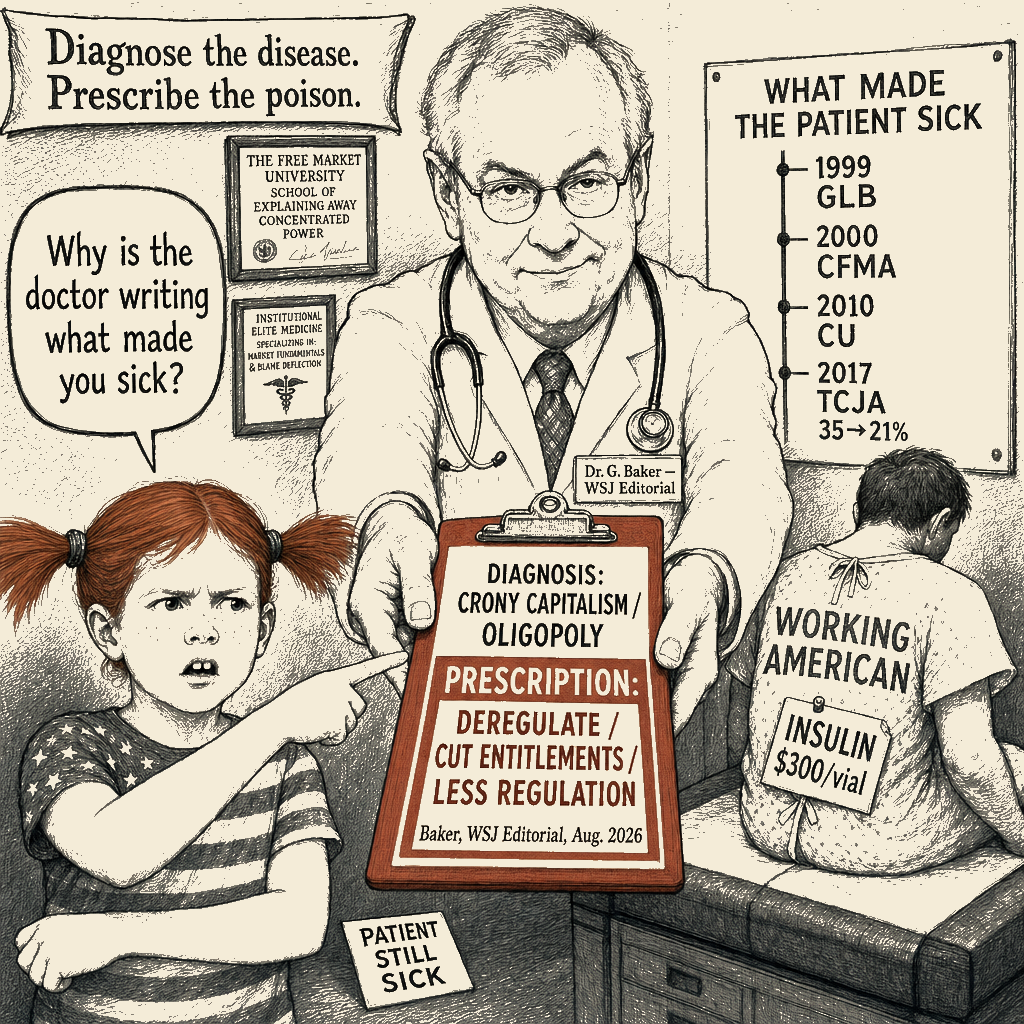
Responding to: How to Cure What Ails American Capitalism — Gerard Baker · 2026-08-17
Primary talking point (verbatim, Baker): “The economy won’t recover its dynamism until entitlements and welfare spending are scaled back to a sustainable level.” The column advances a bait-and-switch: real diagnoses of corporate concentration are bound to the WSJ’s standing small-government prescription, so the very policies that produced the concentration are offered as its cure.
What the Piece Argues
Gerard Baker, Editor at Large of the Wall Street Journal, uses his pre-summer-break column to respond to reader feedback on American capitalism’s state. He agrees with most readers that crony capitalism — large firms using political power to entrench market dominance — is real, that competition has declined across most sectors, and that corporate welfare deserves attention. His proposed remedies mix populist-friendly items (stronger antitrust, simplified tax code, less corporate welfare, more transparency on campaign money) with the WSJ’s signature policy program: smaller government, entitlement cuts, less regulation, and free markets. The column’s structural move is to acknowledge corporate power’s dangers while locating the cure in the same deregulation framework that produced them.
Receipts
Baker’s column performs the classic concede-and-pivot — admitting crony capitalism is real, then prescribing the policy agenda that benefits its architects.
The framing wants you to believe
- That the deeper problem is not the structural beneficiaries of crony capitalism, but the government that is supposed to check them — entitlements, public debt, Fed accommodation
- That “shrinking government” is the cure for an economy Baker himself concedes is rigged by concentrated corporate power
- That the bipartisan failure to fix this is a question of political will, not of which policies would actually constrain the rigging
What’s really going on
- The same Wall Street firms and large corporations Baker concedes have rigged the economy are the constituency that benefits most from “shrinking government” — less regulatory enforcement, lower corporate taxes, weaker antitrust, a less assertive Fed (the TCJA’s 35→21 percent cut, followed by record buybacks documented by the Wall Street Journal’s own news pages, by Bloomberg, and in subsequent Joint Committee on Taxation analyses, is the lived test of the prescription)
- The 2008 financial crisis — which Baker alludes to with his complaint about the Fed — was preceded by two decades of financial deregulation that Baker’s editorial page consistently advocated; the bailouts saved the economy because the deregulatory architecture that preceded them had made the alternative worse
- The 2017 Tax Cuts and Jobs Act dropped the federal corporate rate from 35 to 21 percent; the windfall went overwhelmingly into record stock buybacks rather than the wage growth its proponents promised, a pattern documented in the Wall Street Journal’s own news pages, by Bloomberg, and in subsequent Joint Committee on Taxation analyses
- Baker’s “$200 billion a year” corporate-welfare figure is the conservative end of a much larger range — federal tax expenditures benefiting corporations alone run several times higher (per Joint Committee on Taxation and Treasury Office of Tax Analysis), with state and local subsidies tracked by Good Jobs First’s Subsidy Tracker adding hundreds of billions more
- The “entitlements” Baker wants to scale back — Social Security and Medicare — are contributory insurance programs funded by dedicated payroll taxes paid by working Americans and their employers, not general-revenue welfare (OASDI and HI trust-fund accounting, per the Social Security Administration, makes the contributory nature explicit); calling them welfare is a category error that serves the specific political purpose of erasing the contributory claim
The Response Ladder
Polite Reframe
When to use: a thoughtful WSJ reader — perhaps a relative who subscribes, a friend who forwards the editorial page, a colleague who admires Baker’s diagnosis — who might be open to seeing how the same program that produced the problem is now being offered as its cure.
Take a working family in eastern Iowa — Sarah, a nurse at the regional hospital; her husband Tom, who fixes tractors at the John Deere dealership in Cedar Rapids; their two kids, eight and eleven, in public school. They buy groceries at the Walmart that closed their downtown, deposit Sarah’s paycheck at a credit union that is one of three regional banks after the consolidation, pay their internet bill to one of two ISPs that divided the map between them, fill Sarah’s insulin at the pharmacy under one of three manufacturers that price-gouge in lockstep, and vote in primaries where the cheapest TV ad costs more than their monthly mortgage.
Gerard Baker diagnosed their problem correctly in last week’s column: American capitalism is no longer producing competition. He names the right culprit — corporate concentration, “crony capitalism,” firms using political power to entrench market dominance. The Philippon work on rising U.S. market concentration, the Furman-Summers FTC hearings report, the Federal Trade Commission’s own hearings on concentration in healthcare, tech, and agribusiness — they are right there in the empirical record. On the diagnosis, the column is correct.
Look at the prescription. After naming the disease, Baker pivots to the cure: smaller government, fewer entitlements, less regulation, free-markets-do-it. That is exactly the policy program that produced the concentration he just diagnosed. Financial deregulation — Gramm-Leach-Bliley in 1999, the Commodity Futures Modernization Act in 2000, both cheered on this editorial page — produced the bank consolidation that became “too big to fail” and the 2008 crisis. Decades of relaxed merger guidelines, applauded by the same editorial apparatus, produced the four-firm meat-packing dominance (Tyson, JBS, Cargill, National Beef), the three-firm airline oligopoly, the three insulin manufacturers that raise prices in lockstep. The antitrust budget was effectively starved while this editorial page called antitrust the “blunt instrument” that “carries risks.”
The Cato-Institute-and-WSJ-editorial-page consensus for forty years is what built the crony capitalism Baker now laments. The label “free market” on that program was never a misnomer. It was the program itself: capital that captured the regulatory state called itself free the way a cartel that captured its regulators calls itself competitive.
This is the structural fact the column does not want named. The diagnosis of monopoly is correct, but the cure proposed is the cure that produces monopoly. That is the kind of careful framing the editorial page is best at: agree on the problem, pivot on the prescription, and the conversation ends at the place the prescription wanted to land all along.
There is a real anti-monopoly tradition in American life — the trust-busters, the farm-bloc populists, the small-business conservatives who actually believed their own rhetoric about competition. The conservatism of Eisenhower, of the trust-busters, of the small-business conservative who actually meant it when he said monopoly is the enemy — that tradition understood that “free markets” was a description of competition, not a license for consolidation. Real conservatism would have stopped the four-firm meat-packing dominance in 1985. Would have broken up the three-firm airline oligopoly. Would have enforced antitrust against the hospital consolidations that have closed every competing clinic in working-class counties. That understanding is what the column diagnoses. That understanding is what the column’s prescription abandons.
The people doing this work today are doing it in the labor movement, in the consumer-rights movement, in the antitrust-revival movement at places like the Open Markets Institute and the American Economic Liberties Project, in the state attorneys general who are suing the insulin price-gougers, in the unions that have spent a decade rebuilding the sectoral bargaining power stripped from them by the consolidation the column names. They feed, clothe, heal. They defend the small farmer against the four-firm meat-packer. They defend the working family against the hospital monopoly. They defend the consumer against the insulin price-gouger. They are the builders the editorial page keeps claiming to be.
That title belongs to the people whose prescription matches the diagnosis. Not the editorial page whose prescription contradicts it.
Mockery and Ridicule
When to use: a Twitter/X exchange, a Substack reply thread, or a reader who has watched the WSJ editorial page do this dance for decades — they don’t need to be persuaded; they need the indictment put in the form they can pass along.
Imagine a doctor. Patient comes in with a cough. Doctor runs the tests, looks at the scans, and says, “My God. You’ve got lung cancer. Aggressive form. Stage three.”
“What should I do, doctor?”
“Smoke two packs a day. We’ve had a lot of success with that.”
That’s Gerard Baker’s column. Diagnose the corporate concentration. Prescribe the deregulation that produced it. Diagnose crony capitalism. Prescribe the Citizens United framework, the antitrust-budget starvation, the merger-guideline loosening, and the campaign-finance free-for-all that produced crony capitalism. The Journal does this roughly every five years when the readers get restless, and the prescription always lands at the same place: smaller government, fewer entitlements, more space for the same corporate actors to consolidate. It is the most predictable piece of political theater in America.
To make the analogy land where it should: the deregulation that produced the four-firm beef-packing oligopoly (Tyson, JBS, Cargill, National Beef — ~85% of U.S. beef processing by every available measure) was the Telecommunications Act of 1996 and the merger-guideline loosening of the Reagan, Bush, and Trump eras. The deregulation that produced the three-firm insulin oligopoly (Eli Lilly, Novo Nordisk, and Sanofi — approximately 90% of U.S. insulin, effectively the entire supply) was the FDA-reform-and-drug-pricing-free-market consensus the WSJ editorial page spent the 1990s and 2000s editorializing for. The deregulation that produced the four-firm health-insurance concentration (UnitedHealth, Elevance, CVS/Aetna, Cigna — confirmed at ~16%, ~12%, ~12%, ~9% of the commercial market in the AMA’s 2024 report, with 97% of metro markets highly concentrated under federal guidelines) was the same Affordable Care Act implementation the same page editorialized against, plus the prior decade of relaxed merger enforcement. Each industry the column’s prescription would leave untouched is precisely an industry the column itself names as consolidated. Read it again.
Baker acknowledges, in passing, that “under Citizens United v. Federal Election Commission (2010), corporations have a First Amendment right to seek to influence politics.” That is the line — corporations have the right to buy elections — sandwiched into a column about how crony capitalism is bad. He is telling you the disease is in the water supply while drinking from the same glass.
The piece wants the badge of “free-market champion.” What it has earned, by its own admission in this very column, is “champion of the regime that produces corporate concentration.” The diagnosis is half the work. The other half is following it where it lands — more antitrust, more financial regulation, more progressive taxation, stronger labor law. None of that is smaller government. All of that is exactly what the prescription rules out.
You are not being asked to take sides in a debate. You are being asked to watch the editorial page of a Murdoch-owned newspaper diagnose a disease and prescribe the cause of the disease, while quoting Citizens United as a constitutional right. The diagnosis is for you. The prescription is for the people who own the paper. The performance is the trick.
Nuclear Satire
When to use: a forum thread, a Bluesky or Mastodon thread, a long-form Substack comment section where the readers have been watching the editorial-page game for years and want the indictment in the form its perpetrators deserve.
Gerard Baker, Editor at Large of a Murdoch-owned newspaper, has diagnosed your disease. The disease is corporate concentration, crony capitalism, monopolization. The cure, in the very next paragraph, is the policy program that produces corporate concentration, crony capitalism, monopolization. This is what the Wall Street Journal has done, every few years, since the editorial page first hired a serious editor in the 1970s. It is a ritual. The diagnosis is the incantation. The prescription is the sacrifice. The altar is the editorial page. The congregation is the corporate class. The collection plate comes back filled with billionaire money.
This week’s column names the right diagnosis: “the U.S. economy has become far more concentrated in the 21st century, with declining competition in most sectors resulting in a smaller number of firms with higher markups, profits and costs to the consumer.” That is a literal quotation from a Murdoch-owned newspaper admitting, in plain English, that markets are monopolized and that monopoly is raising prices on consumers. This is true. This is well-documented. Philippon, Furman, the FTC’s own hearings — every empirical body that has looked has found the same thing.
Cause (also correct, in the diagnosis Baker himself supplies): the consolidation has sources. Specific deregulation. Specific antitrust-budget starvation. Specific decisions, by specific regulators, to wave mergers through. The Financial Services Modernization Act of 1999, which tore down Glass-Steagall — this editorial page editorialized for it. The Commodity Futures Modernization Act of 2000, which exempted derivatives from regulation — this editorial page editorialized for it. The Telecommunications Act of 1996 — this editorial page editorialized for it. The wave of hospital mergers, the meat-packing consolidation, the airline industry reduced to three legacy carriers, the three insulin manufacturers that price-gouge in lockstep — every one of these is downstream of policy choices the WSJ editorial page has explicitly demanded.
Prescription (the wrong one for the disease named, the right one for the disease not named): “The economy won’t recover its dynamism until entitlements and welfare spending are scaled back to a sustainable level.” Entitlements. Welfare spending. The word “welfare” in a column about corporate welfare is the giveaway. Entitlements are Social Security, Medicare, and Medicaid — cash transfers and services to roughly 165 million beneficiaries, the recipients being mostly the elderly and the disabled and the poor. Corporate welfare is tax preferences, subsidies, and direct payments to firms that already have profits. The two are not the same. Cutting Social Security does not reduce corporate welfare. Cutting Medicaid does not reduce the four-firm meat-packing dominance (by most measures 80–87% of U.S. beef processing, ~85% by common citation). Cutting food assistance to the poor does not produce a fourth major U.S. insulin manufacturer. Cutting entitlements reduces demand for the things monopolized firms sell. It is, in fact, the perfect gift to the monopolized economy the column just diagnosed.
This is not a policy disagreement. This is a structural confession. The column names the disease. The column names the cause. The column names a prescription that operates on a different disease entirely — a disease of the working class and the retired class that the column has decided to hold in contempt. The two diseases are not connected. Curing the second does not cure the first. But the cure the column prescribes for the second is exactly the policy that keeps the first in place.
That is not “free-market conservatism.” That is the choreography of monopoly. The column names monopoly to clear the room for more monopoly. The piece wants the badge of free-market champion. What it has earned is monopoly champion — the corruption-preserver who diagnoses the symptom so the cause can continue to operate.
Baker’s own column admits, in a clause that does no work for his argument, that “under Citizens United v. Federal Election Commission (2010), corporations have a First Amendment right to seek to influence politics.” This is the regime that produces the crony capitalism the column laments. He names the regime. He names the disease the regime produces. He offers a prescription that requires the regime to continue. The confession is in plain English, in the middle of the column, and the column does not appear to notice it is confessing.
We are the builders. We feed, clothe, heal. We break up trusts. We defend the small farmer against the four-firm meat-packer. We defend the working family against the hospital monopoly. We defend the consumer against the insulin price-gouger. We defend the voter against the corporate PAC. The editorial page wants this title. The title goes to the people who do this work. Not the editorial page that names the disease to clear the room for its cause.
Profane Scorched-Earth
When to use: For the worker who has read the concede-and-pivot once too often and needs the catharsis.
Gerry Baker, who edits nothing anymore and writes everything, wants you to know that the Wall Street Journal editorial page has seen the light. Crony capitalism is real. Markets have concentrated. The system is rigged.
Then he wants you to know that the cure for what ails American capitalism is the same motherfucking policy agenda the Wall Street Journal editorial page has been pushing since before you were born.
Let’s walk through this horseshit.
Baker concedes the game is rigged. He does not concede who rigged it. He writes about “big companies” the way a man writes about a thunderstorm — as a natural phenomenon, as something that happened to the country rather than something that was done to it. The thunderstorm was made in this building. The thunderstorm was made by the merger bar, the financial deregulation, the captured regulatory agencies, the trade deals written by corporate counsel, the tax code written by corporate counsel, the antitrust doctrine written by corporate counsel, the labor law eviscerated by corporate counsel, the political campaigns funded by corporate money that the Supreme Court blessed in Citizens United on First Amendment grounds that every serious constitutional scholar in the country understood to be horseshit at the time and which has been revealed as horseshit by a decade of empirical work showing exactly what the scholars predicted — more concentrated political power, more concentrated economic power, less democratic responsiveness, and a working class that now despairs.
This was not a thunderstorm. This was a project. Baker works for the publication that has been the project’s house journal since the 1920s.
He wants to “shrink government.” That is what they have always wanted. That is what they have always meant. Less antitrust means more mergers. Less labor law means more wage suppression. Less financial regulation means more 2008. Less progressive taxation means more wealth concentration. Less campaign-finance enforcement means more Citizens United. Less environmental regulation means more poisoning of the commons. Less of the Federal Reserve doing what the Federal Reserve is supposed to do means more bank runs dressed up as innovation. Less public investment means more crumbling infrastructure, more lead in the water, more kids in underfunded schools. Less of everything that stands between concentrated economic power and the rest of us. Every “less” is a transfer upward. Every “less” is an upward redistribution. The fact that the editorial page uses the vocabulary of “freedom” rather than the vocabulary of “redistribution” does not change what it is.
Baker cites “almost $200 billion a year” of corporate welfare. The number is real. The number is also a deliberate lie by underestimation. Good Jobs First’s Subsidy Tracker and the Joint Committee on Taxation’s distributional analyses put the real number — federal tax expenditures alone — several times higher than $200 billion. Baker knows this. The editorial page has known this. Citing $200 billion instead of the real number is a choice, and the choice is to make the problem sound tractable while keeping the policy agenda intact.
The “entitlements” he wants scaled back are Social Security and Medicare. These are not welfare programs. These are contributory insurance programs. Workers and their employers paid into them every single payday. Calling them welfare is a lie, and it is a lie that serves a specific purpose: it makes the contributory claims of working people disappear so the rich can stop paying. The AARP understands this. Every retired worker in America understands this. The editorial page has understood this since 1935 and has lied about it the entire time because the truth is bad for the agenda.
The 2017 Trump corporate tax cut — 35 to 21 percent, the largest corporate-tax reduction in the history of the United States — is the empirical test of everything Baker’s column proposes. Did the cut produce wage growth? It fucking did not. Did the cut produce investment? It fucking did not. Did the cut produce the broad prosperity its proponents promised? It fucking did not. It produced record stock buybacks. It produced dividends to shareholders. It produced the largest transfer of public wealth to private capital in the history of the United States tax code. Bloomberg documented it. The Wall Street Journal’s own reporters wrote about it. Baker does not mention it. The omission is not an oversight. The omission is the point.
And the Trump populism? The populists, when they got what they wanted, delivered exactly the agenda Baker’s editorial page has always wanted. The deregulation. The tax cut. The Federal Reserve accommodation. The regulatory capture. The result is the inequality we have now. The betrayal the populists performed was not that they talked a good game. The betrayal was that they delivered the editorial page’s game, and the people who voted for them discovered that the editorial page’s game is not their game and has never been their game.
Malcolm X’s point at Cleveland in April 1964 — at the Cory Methodist Church, where he laid out what the ballot or the bullet really meant at the political register — cuts straight to it: whoever writes the rules decides who’s inside the law and who’s outside it. The man who designs the policy is the man who decides who’s an American and who’s a menace. The Wall Street Journal editorial page has been designing the policy since before Baker was born. It has produced, with exquisite care, the inequality, the concentration, the financial fragility, and the despair that Baker now laments. The cure it proposes is more of the same.
This is not a column. This is a hostage video. The writer is the hostage. The captors are visible to anyone who has eyes.
The arc of the moral universe — the one Martin Luther King named at Riverside Church in 1967 — bends toward justice. King’s formulation was that the bend is not automatic; it bends because specific people in specific moments push it. The bend is in the hands of the readers who stop reading columns like this one as if they were analysis and start reading them as what they are.

About Malcolm Little King
Malcolm Little King is a heteronym in Main Street Independent's editorial architecture — an analytical voice, not autobiography of any actual person. The position this column expresses is the publication's position on the territory Malcolm Little King's lane covers, rendered through Malcolm Little King's register.