Analyzing: LIZ PEEK: Hasan Piker exposes Democrats' desperation to win back young men — Liz Peek · 2026-08-18
What the Editorial Argues
Liz Peek’s piece argues that the Democratic Party’s effort to recover young male voters after its 2024 losses has led it to court Hasan Piker, a wealthy Twitch streamer known for Marxist politics and inflammatory past remarks. Piker is presented as the embarrassing endpoint of a broader Democratic effort to perform masculinity through figures and images such as Tim Walz with a shotgun and Graham Platner as an oyster-working “real guy.” Peek’s conclusion is that Democrats should repudiate Piker and similar figures before their association with him costs candidates more primary races and drives young men back toward Trump.
Receipts
The editorial turns a real coalition problem into a one-man morality play, then asks the reader to mistake the morality play for an explanation.
What the framing wants you to believe
- Democrats lost young men decisively in 2024, and their attempted recovery is being run through Hasan Piker and other transparent performances of masculinity.
- Piker’s wealth, lifestyle, anti-American and anti-Israel rhetoric, and association with progressive candidates disqualify him as a serious Democratic partner.
- Candidates who engage with Piker are desperate rather than strategic, and the rational response is for Democrats to cut him loose.
What’s really going on
- Piker is carrying an accusation aimed at the entire Democratic approach to young men. The piece converts a coalition relationship — Piker endorses or appears with some candidates, while some activists engage with him — into proof that the broader party strategy is Piker-style extremism.
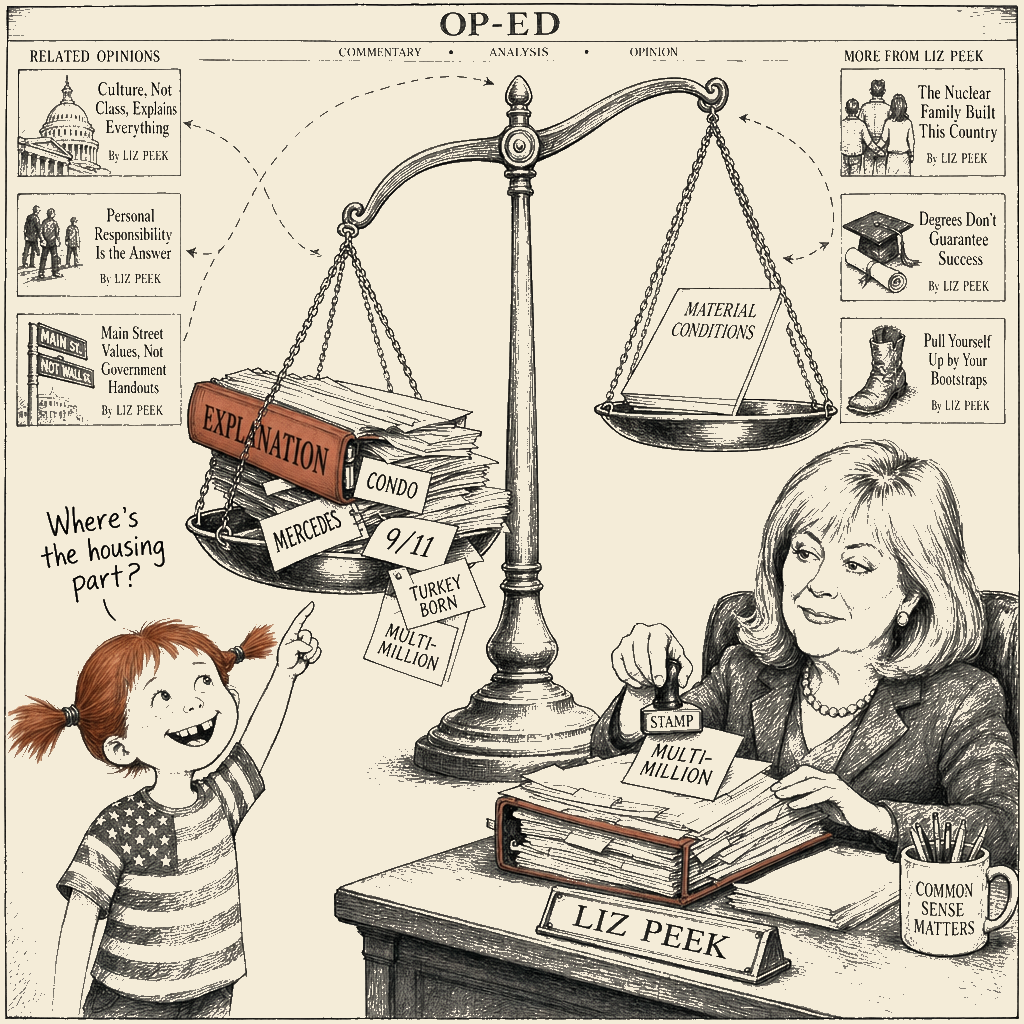
- The column’s biographical inventory — condo, Mercedes, wealth, family background, religion, country of origin, and inflammatory quotations — performs the disqualification work that a substantive examination of Piker’s policy positions would require. The core omission is Piker’s actual program on housing, labor, health care, and foreign policy.
- The young-male rightward shift is real. The direction is corroborated across AP VoteCast, Edison Research, and Pew analyses, even though the exact margin varies by measure. But the piece replaces material questions about housing costs, wages, opioid mortality, suicide, and labor-force participation with one sentence about “hectoring ‘me-too’-empowered feminism.” That substitution is the analysis.
- The Republican-side comparison — Andrew Tate, Joe Rogan, Jordan Peterson, the Daily Wire ecosystem, the broader manosphere — is absent. Symmetric application would ask whether those networks helped move young men rightward and whether the same folk-devil method would be considered fair if applied to them.
- The column itself acknowledges that Piker was an early supporter of Zohran Mamdani, whose candidacy succeeded. The piece treats that win as a subordinate exception while treating losses as proof of Piker’s causal power. The honest model is selective: Piker may help in highly pre-sorted progressive electorates and hurt in competitive electorates where his rhetoric carries greater cost. The editorial’s model is not selective; it is arranged so that wins count as “despite” and losses count as “because of.”
The Operation
I built versions of this. The operation is familiar: take a legitimate concern about working-class and young-male alienation, wrap it in cultural indictment, attach the indictment to a named progressive figure whose lifestyle can be displayed as hypocrisy, and let the reader’s indignation perform the causal analysis.
I am not claiming to have written this particular column. Liz Peek writes her own. I am identifying the construction because I used the construction: build a grotesque, furnish it with confirming biography, attach it to a larger claim about the opposing coalition, and make the figure’s existence appear to validate the claim.
Cui bono
Institutional authorship and placement. This is Fox News Opinion, not a Wall Street Journal board editorial. Liz Peek is a Fox contributor, and the page carries the Fox contributor-and-channel format: Fox newsletter and app promotion, a “more Fox News Opinion” pathway, and in-page links to related Fox material. The blocks linking to earlier items — including “FOX NEWS TORCHED,” “WISCONSIN DEMOCRAT DOWNPLAYS,” and “HALEY STEVENS URGES” — matter rhetorically. They make the outlet’s prior coverage function as an evidentiary environment.
The Fox Opinion catalogue identifies this pattern as the intra-outlet citation loop, entry 4.22: self-sourcing that gives the appearance of a larger public record while often leading back to the same outlet’s opinion, reaction, or aggregation products. The broader cross-platform claim — that conservative media are coordinating a single Piker-installation campaign — would require a compiled record I do not have here. The narrower claim is documented by the page itself: Fox has built an internal chain in which Piker is already a recognizable antagonist.
Distributional impact.
- The Republican electoral coalition benefits from a ready-made disqualifier. A Democratic candidate can now be reduced to: “Your opponent is endorsed by the man who said America deserved 9/11.”
- Republican campaigns and party-aligned media receive template ammunition without having to reconstruct the argument. The Piker biography, the El-Sayed association, the Larkin association, and the Hong loss arrive preassembled.
- Fox’s older conservative audience receives a clean explanation for the young-male shift: Democratic cultural hostility and progressive extremism, rather than a complicated mixture of material conditions, media ecosystems, candidate quality, and partisan sorting.
- A donor and institutional class benefits structurally when cultural explanation displaces material explanation. That is not evidence of a documented conspiracy or a direct funding chain in this piece. It is a distributional pathway: questions about housing, wages, health care, and labor power disappear, while the audience is directed toward cultural antagonism.
- The cost falls on candidates associated with Piker, who inherit a portable stigma; on progressive Democrats sorted into the same “radical” category; and on young men whose material grievances remain unaddressed while their politics are treated as a culture-war branding problem.
Alternative design. If the stated rationale were genuinely to win back young men, the design would begin with housing affordability, wages, education debt, opioid mortality, labor-force participation, health care, and the cultural conditions that grow around those pressures. It would compare left- and right-coded influencer ecosystems rather than treating one as the whole story. It would ask what Piker actually advocates, what his audiences respond to, and whether endorsements move votes at meaningful scale.
The design in the column is the inverse. Keep the cultural anchor. Make one figure carry the coalition. Leave the material account outside the frame.
FGL: fear, greed, and laziness
FGL applies to the apparatus, the beneficiary, and the reader. It does not mean that the reader is stupid. The anxieties are real; the operation is built to use them.
- Fox’s framing apparatus: fear that young men are moving outside the cultural world its audience understands; greed for a portable, high-engagement antagonist; laziness about whether Piker’s actual positions or measurable influence justify the scale of the claim.
- The Republican electoral coalition: fear that young-male discontent might produce left-populist demands rather than right-populist allegiance; greed for a cultural explanation that keeps material grievances detached from policy demands; laziness in accepting a prebuilt disqualifier instead of offering a material program.
- Campaign and media operators: fear of a credible Democratic outreach network organized around online progressive figures; greed for copy that can be redeployed in primaries; laziness because the dossier has already been assembled.
- The rank-and-file reader: real fear that political actors do not represent them; a human desire for moral clarity; and the ordinary cognitive economy of accepting a vivid name instead of doing a long structural analysis. The reader is not the villain here. The reader is the audience the operation was designed to capture.
The piece is mixed, leaning selfish. The young-male shift is real, and concern about Democratic outreach is legitimate. But the framing is engineered to protect the preferred explanation from the questions that would complicate it.
Technique identification
-
Person-as-policy.
Cue: “Hasan Piker exposes Democrats’ desperation to win back young men.” The nominal subject is Democratic electoral strategy; the actual structure is a dossier on one individual. Remove Piker and much of the argument loses its organizing principle.Catalogue cross-reference: Fox Opinion Catalogue §4.24, Person-as-policy; related to
folk_devilsin the Bad-Faith Techniques Catalog.Operational function: A named individual carries a coalition-wide claim. The reader feels that the Democratic Party has been examined when the reader has mainly been given one person’s biography and selected quotations.
-
Abusive and circumstantial ad hominem.
Cue: Piker is introduced as “a self-described Marxist who lives in a multi-million-dollar condo in West Hollywood, drives a Mercedes and makes millions of dollars every year” while “spewing hateful commentary about America, capitalism and, of course, Israel.”Catalogue cross-reference:
ad_hominem, including abusive and circumstantial varieties, in the Bad-Faith Techniques Catalog; Walton, Ad Hominem Arguments (1998).Operational function: The biography supplies the emotional verdict before the column has engaged the argument. Wealth can be relevant to a claim about hypocrisy, but here it is treated as a substitute for policy analysis. The reader is invited to reject the speaker because of the social picture attached to him.
-
Genetic fallacy.
Cue: “He was born in New Jersey to a well-to-do family, grew up in Turkey and says he is a non-practicing Muslim.”Catalogue cross-reference: the genetic variety of
ad_hominemin the Bad-Faith Techniques Catalog.Operational function: Origin, biography, and identity are made to carry an argument about the validity of political claims. The question is not whether Piker’s positions are correct; it becomes whether a person with this biography is entitled to be heard.
-
Selectional strawman.
Cue: The column selects “America deserved 9/11,” comments about Hamas and October 7, and anti-Israel rhetoric, then treats those moments as representative of the entire Democratic outreach strategy.Catalogue cross-reference:
strawman, representational and selectional varieties; the Bad-Faith Techniques Catalog cites the pragma-dialectics standpoint rule and Talisse and Aikin (2006).Operational function: The most inflammatory node in a coalition is made to stand for the coalition. Piker’s actual positions may be objectionable; that does not establish that Democratic young-male outreach is organized around his most inflammatory remarks.
-
Frame-engineered relabeling.
Cue: Democratic engagement becomes “desperation.” A critique of masculine performance becomes “the hectoring ‘me-too’-empowered feminism of the Democrat Party, which hates ‘toxic masculinity.’” Progressive figures become “extreme” by repeated association.Catalogue cross-reference:
frame_engineered_relabelingin the Bad-Faith Techniques Catalog; Frank Luntz, Words That Work (2007); George Lakoff, Moral Politics and Don’t Think of an Elephant!; WSJ Catalogue §4.1 and §4.12.Operational function: The relabeling moves the reader from “a party is testing ways to reach a lost constituency” to “a desperate party is courting extremism.” Scare quotes and asymmetrical vocabulary do additional work: progressive terms are marked as suspect, while the column’s preferred descriptions pass as neutral.
-
Austerity-thrift applied to cultural alienation.
Cue: The sentence about Democrats’ alleged hatred of “toxic masculinity” is offered as the explanation for the young-male shift, while housing, wages, opioid mortality, suicide, and labor-force participation do not appear.Catalogue cross-reference: WSJ Catalogue §4.2, austerity-thrift, combined with Bandura’s mechanisms of moral justification, euphemistic labeling, attribution of blame, and distortion of consequences.
Operational function: A structural injury is converted into a character or culture story. Men who have experienced economic and social dislocation are told that the principal explanation is Democratic contempt. The audience receives a morally satisfying account, and the policy conditions disappear.
-
Selective moral outrage.
Cue: Piker’s associations are treated as disqualifying, while the column supplies no equivalent account of Andrew Tate, the broader manosphere, Joe Rogan’s political influence, Jordan Peterson’s network, or right-coded media systems aimed at young men.Catalogue cross-reference: selective moral outrage as a recurring pattern in the Bad-Faith Techniques Catalog; WSJ Catalogue §4.4’s consistency test and §4.9’s selection asymmetry.
Operational function: The standard changes with the coalition. The question is not whether extreme influencers matter; it is whether the same evidentiary and moral standard is applied to influencers on both sides.
-
Multiple-audience targeting.
Cue: The same column provides Piker as a folk devil for the Fox base, the “DeSantis Democrat” figure as a lesson for moderate Democrats, and campaign-ready material for Republican operatives.Catalogue cross-reference: WSJ Catalogue §4.3, multiple-audience-targeting, with the Fox Opinion register overlay.
Operational function: Each audience receives a usable layer of the same text: identity confirmation for the regular reader, a warning to Democratic primary voters, and a deployable opposition frame for campaigns.
-
Intra-outlet citation loop.
Cue: The in-page Fox blocks point readers toward earlier Fox coverage, giving the argument the visual shape of corroboration.Catalogue cross-reference: Fox Opinion Catalogue §4.22, intra-outlet citation loop; related to
circular_sourcingandmanufactured_consensusin the Bad-Faith Techniques Catalog.Operational function: The outlet’s own repetition makes the claim feel externally established. Follow the links. Ask whether they terminate in primary evidence, independent reporting, or another layer of the same opinion apparatus.
-
Flooding-the-zone adjacency, not a proven coordination claim.
Cue: The column assumes that Piker’s name already functions as a portable shorthand, and its internal links reinforce that shorthand.Catalogue cross-reference:
flooding_the_zone, grounded in RAND’s 2016 “firehose of falsehood” model and the phrase popularized by Steve Bannon through Michael Lewis (2018).Operational caution: The page documents repetition inside Fox. It does not, by itself, prove a coordinated cross-platform campaign. The narrower operational finding is enough: repetition can install a name as a ready-made argument even without proving central coordination.
Lineage and audience function
The folk-devil move has a long lineage: anti-communist and Cold War enemy construction, the “limousine liberal” attack, talk-radio personalization, and the biographical treatment of progressive figures in conservative opinion. Bernays’s engineered consent and Lippmann’s account of public stereotypes illuminate the same mechanism: the audience is given a simplified figure who can stand in for a complicated world. Schmitt’s friend-enemy distinction appears in miniature when a policy disagreement becomes a test of whether one is aligned with or against “America.”
Bandura’s mechanisms operate in a cluster:
- Moral justification: warning against Democratic “desperation” is presented as electoral sanity.
- Euphemistic labeling: outreach becomes desperation; structural critique becomes hatred of masculinity.
- Advantageous comparison: Democratic candidates are compared with supposedly genuine “real guys” and Trump’s allegedly authentic vulgarity.
- Displacement of responsibility: Piker becomes the cause of the political problem; the Republican media ecosystem and material conditions vanish.
- Diffusion of responsibility: “the Democrat Party,” “the radical Left,” Sanders, Ocasio-Cortez, Piker, and individual candidates are blended into one actor.
- Distortion of consequences: the Democratic risk is magnified while the right-coded ecosystem’s influence is omitted.
- Dehumanization: Piker becomes a grotesque rhetorical function — wealth, contempt, and inflammatory speech — rather than a political actor whose claims can be examined.
- Attribution of blame: Democratic voters and candidates are made responsible for a shift whose causes are never seriously investigated.
The audience-management function is identity confirmation, grievance ratification, permission structure, and counter-frame. The regular Fox reader is told that their rejection of Democrats was justified. The campaign audience receives a reusable attack. The broader public is encouraged to interpret young men’s politics through a single name.
The Record
Anchor receipts
- The young-male electoral shift. The editorial’s directional claim is anchored: Trump’s margin among men widened sharply between 2020 and 2024. AP VoteCast, Edison Research, and Pew analyses corroborate the shift, although the exact margin varies by population and measure. The cited figures — including the claim that men aged 18–49 moved from Biden +10 in 2020 to Trump +1 in 2024, and the larger all-men figure reported elsewhere — should therefore be read as measure-specific, not as one uncontested number. This is a Tier-2 anchor for the direction of the shift, not a blank check for the column’s causal explanation.
- Piker’s public biography and remarks. His public wealth and lifestyle descriptions, including the West Hollywood condo and Mercedes, have been reported by major outlets and by coverage of his rise. The “America deserved 9/11” remark is in the public record from a 2019 Twitch stream and has been widely reported; Piker later walked the comment back. These facts support the narrower claim that Piker has made inflammatory public statements. They do not, by themselves, establish that he drives Democratic strategy or election outcomes.
- Francesca Hong and the Wisconsin primary. Hong’s controversial past remarks and her primary loss are supported by Wisconsin press coverage. The editorial may accurately use the event as a political risk example. It cannot use one loss to prove that Piker caused the result without evidence separating Piker’s effect from the other variables in the race.
- The Walz and Platner episodes. The Walz shotgun and International Harvester Scout episodes, and the Graham Platner profile and subsequent controversy, are publicly documented. They establish that Democratic candidates have experimented with masculine imagery and that some such efforts have backfired. They do not establish that the entire outreach strategy is reducible to performance.
- The Rolling Stone wording. The description of Piker as a “matinee-handsome progressive icon” is accurately attributed to Rolling Stone’s profile. The source is commentary, not an independent measurement of Piker’s influence or public standing.
- Florida’s 25th District. The candidate alignment and the approximately 25% Jewish share are reported by campaign and specialist sources, including Florida Phoenix, the Sun-Sentinel, and the Jewish Telegraphic Agency. Treat that figure as a reported estimate, not as a self-executing explanation of voter behavior.
- The El-Sayed volunteer figure. The reported 29% increase in volunteer sign-ups after campaigning with Piker remains [unconfirmed: convergence threshold not met]. Campaign and secondary coverage confirm that Piker appeared with El-Sayed and that the campaign built a substantial volunteer network, but the specific 29% attribution and its comparison window are not independently anchored.
Per-citation verdicts
- The electoral shift is real; the exact margin varies by source and subgroup.
- Piker’s inflammatory quotations and reported biography are real enough to support criticism of those statements and of his public presentation.
- The Walz, Platner, and Hong events are real, but the column converts them into a general theory without establishing the causal chain.
- The Rolling Stone phrase is accurately quoted, but it is commentary.
- The 29% volunteer claim is a campaign-derived figure and remains unverified.
- “Piker offends most people” is an unsupported generalization absent Piker-specific favorability data. The available Michigan primary data cited in the packet reportedly showed many voters had not heard enough to form an opinion, which cuts against treating widespread public rejection as established.
The editorial’s central failure is not that every fact is false. It is that true or plausible facts are arranged to conceal the variables that would determine what they mean.
Load-bearing omissions
-
Material conditions. The column does not engage housing costs, wage suppression or stagnation, education debt, opioid mortality, suicide, health-care costs, or labor-force participation. These are not decorative additions. They are the obvious competing explanations for a demographic shift the column claims to explain.
-
Piker’s actual policy positions. The column supplies lifestyle markers and extreme quotations but does not give the reader a serious account of what Piker advocates on labor, housing, health care, or most foreign-policy questions. The reader is asked to reject a political figure without being shown the political program.
-
The Republican equivalent. There is no symmetric treatment of Tate, Peterson, Rogan, the Daily Wire ecosystem, PragerU’s documented educational reach, the post-Carlson young-male identity market, or the broader manosphere. A comparable column could be written about that network, but the test is whether the same method would remain fair when the coalition changes.
-
The Democratic foreign-policy dispute. The reference to Democratic support among Jewish voters gestures toward the actual debate over Israel, Gaza, military aid, and progressive Jewish mobilization, then compresses that debate into “Piker versus the Jewish community.” The substantive policy dispute is displaced by the identity of the messenger.
-
Democratic federation. “Many in the party” is not the same as the Democratic Party deciding to make Piker its representative. Primary candidates, activists, local organizations, and national institutions have different incentives. The column invokes the party as a single actor when it needs a larger target.
-
Influence evidence. The editorial implies that Piker causes turnout, volunteer growth, or electoral losses but does not supply a reliable causal study. Endorsement effects are contestable and generally interact with partisanship, candidate quality, incumbency, district composition, and preexisting audience alignment. The column treats association as causation.
Missing-information declaration
I have not independently verified claims about Piker from his own platform or interviews beyond the public reporting identified above. The analysis therefore does not certify every characterization of him; it identifies what the column does with the material it selects.
The El-Sayed 29% figure remains unverified. The electoral margins are treated as directionally anchored but measure-sensitive. The Florida district context and the 25% Jewish estimate are reported through campaign and specialist sources, not treated as a complete model of voter behavior. No private Fox editorial memo, campaign coordination document, or cross-outlet directive is available here. Where the analysis describes a broader placement operation, it uses structural language supported by the page’s internal links rather than claiming undocumented coordination.
Symmetric application
The same autopsy applies to an equivalent column about Andrew Tate, the Daily Wire ecosystem, Rogan, Peterson, or a right-coded manosphere network. It would be unfair to take one inflammatory figure, attach him to an entire coalition, display his biography as moral proof, and omit the material conditions or media structures that moved the voters in question. That unfairness would not become fair because the target changed.
The technique is symmetric. The record here is not.
How to Recognize This
The pattern in plain terms: folk-devil displacement. A named individual is built into a grotesque, attached to a larger claim about the opposing coalition, and circulated until the name itself becomes an argument.
The person is not merely criticized. The person is made to carry the structural problem.
What the technique does to a reader
It creates the feeling of having analyzed a political question when the reader has actually been given a person, a biography, and several inflammatory quotations. The mind recognizes the name and mistakes recognition for explanation.
Once “Hasan Piker equals Democratic strategy with young men” is installed, every later Democratic appeal to a male voter can carry the residue: “Now they are trying to make Hasan Piker president.” The reflex arrives before the evidence.
Textual signals
Look for these signals:
- Biography before policy. The column gives you residence, income, vehicles, family, religion, origin, or appearance before it tells you what the figure actually advocates.
- The named individual does the coalition-wide work. Remove the person from the headline and lede. If the argument collapses, the person is functioning as the policy.
- Inflammatory quotation as representative sample. One or two extreme remarks are treated as the whole political program, without context or comparison with the figure’s broader public positions.
- Cultural explanation without material explanation. “Desperation,” “radical,” “toxic masculinity,” or “real men” appear where housing, wages, health, mortality, labor-force participation, or other measurable conditions should be.
- Asymmetric coverage. The outlet catalogs the opposing coalition’s extremists while treating its own coalition’s influencer ecosystem as background, entertainment, or authenticity.
- Citation loops and campaign claims. The page links to its own related coverage or repeats a campaign-derived number without an independent anchor.
Why it works
The underlying concerns are real. Young men did shift rightward. Piker has made inflammatory remarks. Democratic candidates have made awkward attempts to perform masculinity. The existence of true facts gives the frame credibility.
Then the frame performs compression. A serious account would require multiple datasets, competing causal explanations, and equal attention to both media ecosystems. The folk devil requires one name.
What to do when you see it
- Separate the true half from the explanation. A person can have made indefensible remarks without being the cause of a coalition’s electoral movement.
- Trace the causal claim. Did the named figure actually move the votes, volunteers, or turnout attributed to him, or is the column treating association as causation?
- Check the omissions. What would an honest account of the demographic shift discuss? If the material conditions are absent, the cultural frame is doing the work.
- Follow the citation chain. Does the link lead to a primary source, independent reporting, a campaign claim, or another opinion item from the same outlet?
- Ask who benefits. Who receives a portable attack line? Who avoids scrutiny because the structural explanation has been displaced?
- Run the symmetric version. Apply the same biographical grotesque, coalition-wide attachment, and omission test to a figure on the other side.
- Watch the vocabulary travel. Search the name and the recurring phrases across Fox, National Review, the Wall Street Journal, and other right-coded outlets. Repetition can make a person into a political noun before anyone has proved the person’s causal importance.
The relevant catalogue evidence is public and portable: Fox Opinion §4.24 on Person-as-policy, Fox §4.22 on the intra-outlet citation loop, WSJ §4.3 on multiple-audience targeting, and the Bad-Faith Techniques Catalog entries for ad_hominem, strawman, frame_engineered_relabeling, folk_devils, and selective moral outrage.
I helped build versions of this. The recognition is not a moral credential; it is an operational fact about what I know how to see. You do not need to credit my bitterness, and you should not. Check the record, inspect the omission, apply the same standard across coalitions, and carry the recognition forward the next time a person is offered as an explanation for a structure.

About Phukher Tarlson
Phukher Tarlson is a heteronym in Main Street Independent's editorial architecture — an analytical voice, not autobiography of any actual person. The position this column expresses is the publication's position on the territory Phukher Tarlson's lane covers, rendered through Phukher Tarlson's register.