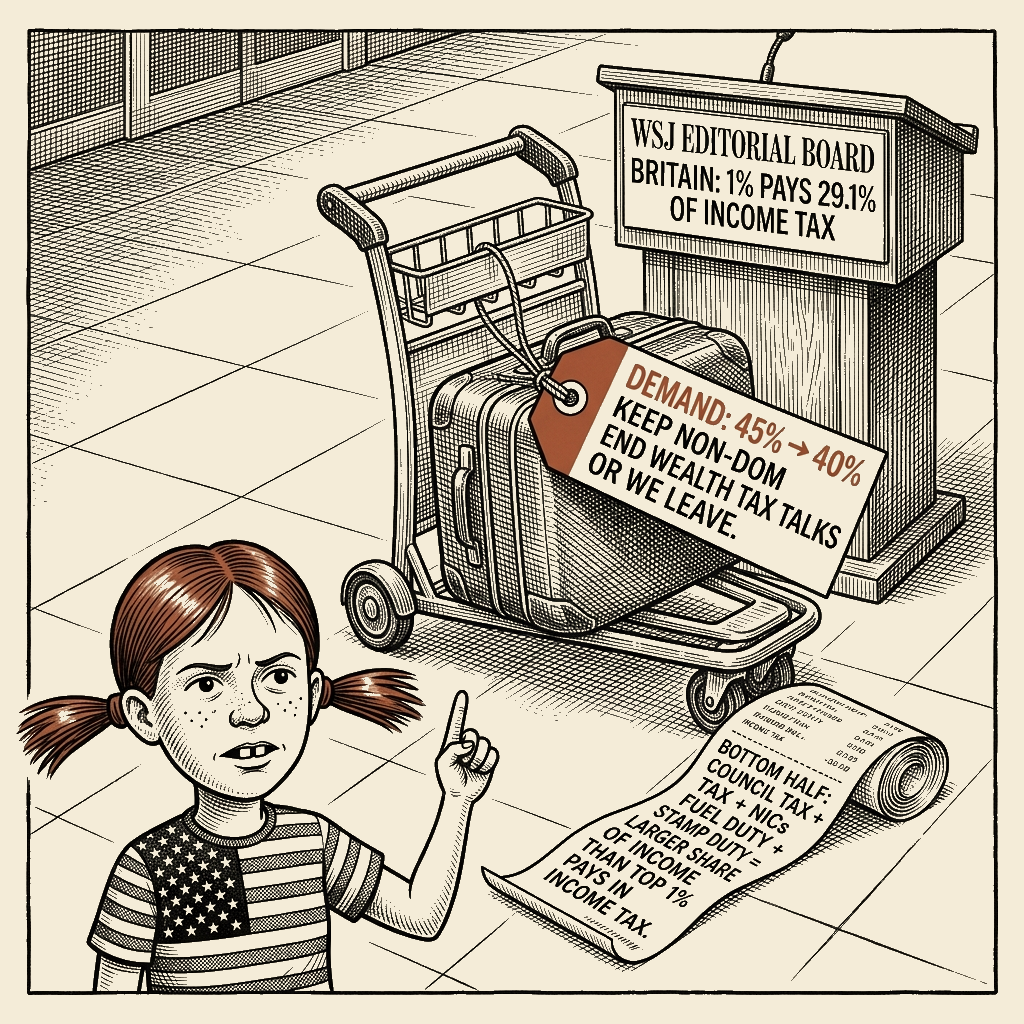
Responding to: Why Britain Is Shedding Millionaires — The Editorial Board · 2026-08-14
What the Piece Argues
The WSJ Editorial Board argues that Britain’s tax regime is driving millionaires out of the country — citing a 7% decline in millionaire residents since 2024 (35,000 fewer, per the Adam Smith Institute) and 27,300 millionaires departing in 2024–2025, per New World Wealth. The piece blames a “hostile” tax climate — a 45% top income rate, 24% on capital gains, a 40% estate tax beyond £325,000, and the recent ending of “non-dom” provisions for wealthy expatriates — alongside “sluggish growth” and a politics of “class-based envy.” It warns that squeezing the wealthy harder, including via the wealth tax floated by economists Gabriel Zucman and Ben Tippet and supported by 66% of poll respondents, will only accelerate the flight and leave “those far less affluent to pick up the tab,” since the top 1% of British earners already pay 29.1% of British income tax.
Receipts
The piece is built around a single load-bearing sentence: “Squeeze the rich hard enough, and they’ll flee, leaving those far less affluent to pick up the tab.”
-
The framing wants you to believe:
- High taxes caused a 7% drop in British millionaire residents between 2024 and 2026, and 27,300 millionaires left in 2024–2025.
- Because the top 1% of earners pay 29.1% of British income tax, their flight shifts the tax burden onto everyone else.
- The wealth tax proposed by economists Zucman and Tippet would accelerate the flight and deepen the squeeze.
-
What’s really going on:
- Both headline numbers come from industry sources with disclosed interests in the “wealth flight” narrative: the Adam Smith Institute is a free-market think tank whose program is “lower taxes on the wealthy,” and New World Wealth is a Johannesburg-based wealth-intelligence firm that sells services to the very people whose “flight” it tracks. Tax Policy Associates and the Tax Justice Network have shown the underlying Henley/NWW migration reports use no statistical controls at all and should be treated as marketing material, not evidence.
- The “1% pays 29.1%” figure is real but misleading: HMRC’s own series puts the top 1%‘s share of income tax at about 28%, while the top 1% hold roughly a sixth of Britain’s wealth (ONS Wealth and Assets Survey estimates range 14.4%–16.5% depending on methodology). A substantial portion of their income flows through capital gains taxed at 24% rather than at the headline 45% rate — which is why the Institute for Fiscal Studies, the Resolution Foundation, Oxfam, and the Equality Trust have all documented that Britain’s overall tax system is less progressive at the top than the income-tax-share headline suggests.
- The same piece concedes a British government report predicting “major sources of pressure on public finances over the next 50 years” from social spending — then prescribes lower taxes on the wealthy as the cure, a contradiction the piece never resolves.
- France’s wealth tax was largely repealed in 2018, when the ISF was replaced by the IFI — a real-estate-only wealth tax — partly because of capital flight. But the lesson is design (taxing unrealized gains, closing offshore loopholes, taxing wealth well above the £10m mark), not abandonment of the principle that wealth should contribute to the society that produced it.
The Response Ladder
Polite Reframe
When to use: At the table with the relative who forwards this kind of piece and genuinely thinks it makes sense. Calm, fact-driven, hands them a way out without making them feel cornered.
Let’s talk about the 35,000 millionaires who, the WSJ tells us, have left Britain since 2024.
Picture Margaret, a 67-year-old retired nurse in Leeds. Her hip replacement has been pushed back twice. The social-care package that was supposed to let her stay in her own home got cut three years ago. She is not, in any technical accounting sense, one of the 1%.
Now picture the WSJ editorial board telling Margaret that her problem is that the 1% don’t like paying 45%.
The first number to push back on is the 29.1%. That’s real — the top 1% do pay a substantial share of British income tax. What the piece omits is that HMRC’s own current figure is closer to 28%, that the same top 1% hold roughly a sixth of Britain’s wealth (per the ONS Wealth and Assets Survey), and that a substantial portion of their income flows through capital gains, dividends, and business income taxed at 24% rather than at the 45% rate the piece keeps waving around. The Institute for Fiscal Studies — Briefing Note BN253 — and the Resolution Foundation have been documenting for years that Britain’s overall tax system is less progressive at the top than the income-tax-share headline suggests. The piece does not engage that literature.
The second number is the 35,000 millionaires themselves. Those figures come from the Adam Smith Institute and New World Wealth. ASI is a free-market think tank whose policy program is “lower taxes on the wealthy.” New World Wealth is a Johannesburg-based wealth-intelligence firm that sells services to the wealthy on the move. Tax Policy Associates and the Tax Justice Network have shown that the underlying migration reports use no statistical controls at all and should be read as marketing material, not evidence. Neither source is a neutral counter. Both have a stake in the answer being “taxes did it.” The piece cites them as if they were HMRC.
The third number is the piece’s own — and it’s the one that should give the piece’s argument trouble. The same editorial concedes that a British government report predicts “major sources of pressure on public finances over the next 50 years” as social spending grows. So the diagnosis is: aging society, growing public costs. The prescription on offer is: cut taxes on the wealthy. Those two things cannot both be done on the same budget. The piece never addresses the contradiction because doing so would force it to say what the policy is actually for.
Britain does have a real design problem with wealth taxes. France’s wealth tax was largely repealed in 2018, when the ISF was replaced by the IFI — a real-estate-only wealth tax — partly because of capital flight. That’s a real lesson. But the lesson is design — taxing unrealized gains, closing offshore loopholes, taxing wealth well above the £10m mark — not “abandon the principle that wealth should contribute to the society that produced it.” The piece prefers the second reading because the second reading flatters its audience. It does not survive a serious fiscal conversation.
Margaret, in other words, is being asked to feel sorry for the people whose tax bill would, in part, fund her hip replacement. That is a rhetorical position. It is not a moral one.
Mockery and Ridicule
When to use: A Twitter or Substack exchange where the goal is to perform for the bystander, not to persuade the repeater. The repeal is too far gone; the audience is the lurker.
The Wall Street Journal Editorial Board, whose 1776 fetish is matched only by its willingness to read Adam Smith selectively, has discovered that Britain’s 45% top rate is causing a millionaire stampede. The 27,300 who left in two years — out of an estimated 2.8 million millionaires in the country — represent a 0.97% decline, which the paper calls a hemorrhage in much the same way a hotel that loses one room of business calls itself a downturn.
The receipts in the piece come from two outfits. The Adam Smith Institute is a free-market think tank funded by Atlas Network–aligned donors, named after a man whose Wealth of Nations includes the passage that “it is not very unreasonable that the rich should contribute to the public expense, not only in proportion to their revenue, but something more than in that proportion” — a sentence the Institute does not appear to have ever published. New World Wealth is a Johannesburg private wealth-intelligence firm that publishes migration estimates for paying clients and uses a proprietary methodology that is not reconciled against HMRC’s published National Statistics on Personal Wealth. These are the witnesses for the proposition that 45% is confiscatory. The actual UK institutions that track tax and migration data — HMRC, the Institute for Fiscal Studies, the Office for National Statistics, the Office for Budget Responsibility — are not cited.
The piece’s kicker is the “squeeze the rich and they’ll flee” line, which is the same hostage-taking logic the same editorial board has deployed against every meaningful tax increase since the 1920s. If you raise my rates, I will leave, and you will miss me. The logic depends on never mentioning what Britain receives in exchange for keeping the rates low. The Office for Budget Responsibility’s published distributional analysis shows that, once you count VAT, council tax, NICs, fuel duties, and stamp duty, the bottom half of British households devote a larger share of their income to those regressive levies than the top 1% do. The “less affluent picking up the tab” is not the threat. It is the present arrangement. The threat is the opposite: a wealth tax of even modest scale would, for the first time in British fiscal memory, ask the very top of the wealth distribution to pay at a rate closer to proportional to what they own.
The piece invokes “wealth-creators” without ever defining the term, in the same way Ayn Rand used it: to mean anyone whose net worth has gone up, regardless of whether it went up by inventing something, by inheriting, by rent-extracting, or by financial engineering. A private-equity firm that buys a hospital, levers it to the hilt, strips the assets, and pays itself a billion in fees is, in the editorial board’s vocabulary, a wealth-creator. The nurse working the night shift on the ward that firm just gutted is not. The category is rhetorical, not analytic. It is the rhetorical category of someone who has decided in advance that the existing distribution of wealth is the natural one, and any disturbance of it is class-based envy.
The deepest joke is the Samuel Johnson epigraph. “When a man is tired of London, he is tired of life.” The WSJ reads this as a complaint about top marginal rates. Johnson was a man who lived in a city whose entire growth was built on what we would now call confiscatory public investment — sewers, streets, watchmen, lighting, schools, hospitals — and he praised that city while it was being built. By the editorial board’s logic, Johnson was a parasite on the wealth-creators of his day. The quote is doing the opposite of what they think.
Nuclear Satire
When to use: A long-form Substack reply, or anywhere the audience is ready for the full-treatment demolition of the “wealth-creator” doctrine. The piece is not an honest argument; it is a hostage note wearing a tweed jacket.
The Wall Street Journal Editorial Board has brought us a piece of work that could be carved into the façade of a bank — “When a man is tired of London, he is tired of taxes” — and in doing so has reminded the reading public that the journal of free markets and free people will, on any given Wednesday, defend the right of a billionaire to relocate to Geneva against the right of a hospital nurse in Salford to a working ward. Let us take the piece apart with the care its sources deserve.
The piece’s central claim is that Britain has lost 35,000 millionaires since 2024 because its taxes are too high. The Adam Smith Institute — a free-market think tank funded by Atlas Network donors (atlasnetwork.org/partners/global-directory/adam-smith-institute), named after a man whose actual position on taxation was “the subjects of every state ought to contribute towards the support of the government, as nearly as possible, in proportion to their respective abilities” and “it is not very unreasonable that the rich should contribute to the public expense, not only in proportion to their revenue, but something more than in that proportion” — is the source. The Institute does not include either of those quotes anywhere prominently on its public-facing material. The Institute also does not include, anywhere in its publications, Smith’s chapter on landlords, in which he observes that landlords extract rent from the produce of other men’s work without contributing to it. The Institute’s selective canon is itself the argument: the appeal to Smith’s name, with the suppression of Smith’s actual content, is the playbook of every libertarian outfit that has ever wrapped a tax cut in a philosopher’s toga.
The 2008 baseline — the comparison point the Institute chose — was the global financial crisis. “Fewest since 2008” means “more than during the worst market crash in 75 years.” This is the comparison technique of someone who has decided what conclusion they want and is selecting the base year that produces it. The proper comparison would be 2019, before the pandemic distortions, or 1997, when the UK was poorer and the millionaire count was lower than it is now. The Institute does not publish either comparison. Nor does the Institute note that the current 45% top rate is lower than at any point since 1988 and lower than the rate that obtained for roughly thirty of the post-war years between 1945 and 1979 — when the wealthy stayed and built.
The millionaire migration data comes from New World Wealth, a Johannesburg private firm that charges clients for wealth intelligence and uses a proprietary migration methodology that is not reconciled against HMRC’s published National Statistics on Personal Wealth. HMRC’s quarterly data on actual millionaire departures is not cited. The Institute for Fiscal Studies, which has tracked the distributional impact of UK tax since 1969, is not cited. The Office for National Statistics, which publishes the wealth and assets survey, is not cited. The Office for Budget Responsibility, which publishes distributional analysis of every tax change, is not cited. The editorial board has chosen its witnesses, and the witnesses are the ones who produce the answer it wanted.
What is happening, in plain English, is that the rich are holding Britain hostage. They are saying: do not raise our taxes, or we will leave. This is the same logic a kidnapper uses. The piece dresses it up as economics. It is extortion dressed in tweed. The Duke of Westminster held half of Mayfair under this same logic in 1870. It was a shakedown then. It is a shakedown now. The only thing that has changed is the data set the shakedown is dressed in.
The wealth tax the piece treats as ominous — 2% on the most affluent, raising £10 billion per Zucman-Tippet — is, at scale, a meaningful contribution to the public finances the Adam Smith Institute says are under pressure. The piece does not engage with what £10 billion would do for the NHS, for the schools, for the councils the piece mentions as being under strain without ever mentioning the council-tax cuts that produced the strain. The piece treats the wealth tax as ominous because the piece cannot admit that there is a public interest on the other side of the scale, and the entire piece is built on the proposition that there is not.
The deepest layer is the invocation of “wealth-creators.” This is the category Ayn Rand deployed: anyone whose net worth has grown is, by definition, a creator, regardless of whether the growth came from invention, inheritance, rent-extraction, or financial engineering. A doctor who opens a clinic is a wealth-creator; a private-equity firm that buys a hospital and levers it is also a wealth-creator. A nurse is not. The category is a moral claim dressed as an economic claim. It is the rhetorical move that lets the writer treat the existing distribution of wealth as natural and any disturbance of it as envy.
The Samuel Johnson epigraph at the top is the most perfect accident in the piece. Johnson was a man who lived off the patronage of a state that, by the editorial board’s logic, was confiscating the wealth of its creators. The London Johnson praised was built by public sewers, public streets, public watchmen, public lighting, public schools, and public hospitals. The London the editorial board would build is one in which the watchmen are private, the sewers are private, the streets are tolled, and the rich retreat to Belgravia while everyone else gets what the market provides. That London, in 1776, was the city Samuel Johnson was describing exhaustion with.
Profane Scorched-Earth
When to use: When the reader needs full catharsis. The piece is not an honest argument; it is a hostage note from a billionaire class that has spent fifty years teaching itself to call its blackmail “fiscal responsibility.”
The Wall Street Journal Editorial Board — that collection of inherited-wealth columnists at a paper owned by Rupert Murdoch’s family trust, whose own 1776 invocation has never once been applied to a question that would cost the Murdochs a dollar — has published a piece telling Britain that the country must keep its taxes low because otherwise the rich will leave. The rich are saying: we are leaving, give us what we want or we leave faster. This is the oldest fucking play in the goddamn playbook. The Duke of Westminster held half of Mayfair under this same logic in 1870. It was horseshit then. It is horseshit now. It is horseshit with a New World Wealth data set bolted on.
The “wealth-creator” is the bullshit category of the bullshit argument. A wealth-creator is anyone whose net worth has gone up. Inheritance goes up — wealth-creator. Rent goes up — wealth-creator. A private-equity firm buys a hospital, strips the assets, levers the debt to the gills, sells the wreckage seven years later for less than the LBO price, and pays itself a billion in fees and dividends along the way — wealth-creator. The nurse working the night shift in the hospital that firm just gutted — not a wealth-creator. She is a cost. The category exists so the writer can declare, in advance, that anyone with money is producing value and anyone without money is consuming it. The category is the conclusion in a cheap Halloween costume. Malcolm X, in 1965, called the same shit by its actual name: “If you live in a house, you don’t even own the boards and the nails. The landowner — you pay him rent. And the landlord, he gets rich.” Sixty-one years later, the Wall Street Journal is still trying to put a tweed coat on that.
The Adam Smith Institute — that Atlas Network–funded propaganda shop (atlasnetwork.org/partners/global-directory/adam-smith-institute), named after a man whose actual position on taxation was “the rich should contribute to the public expense, not only in proportion to their revenue but something more than in that proportion” — provides the data. The Institute does not print that quote. The Institute does not print Smith’s chapter on landlords, in which he describes in twenty pages how landlords extract rent from other men’s labour without contributing to production. The Institute’s selection from Smith is as intellectually honest as a Luntz memo. The piece invokes 1776. The piece invokes Adam Smith. The piece invokes Samuel Johnson. The piece invokes Thomas Jefferson’s Declaration. Every name is invoked on the side of the rich; every name, taken seriously, is against them.
The 27,300 who supposedly fled Britain in 2024–2025 — out of approximately 2.8 million millionaires — are 0.97% of the population. The WSJ calls this a hemorrhage. The piece also does not mention that New World Wealth, the firm producing the figures, uses a proprietary migration methodology that is not reconciled against HMRC’s published National Statistics on Personal Wealth. The piece does not mention that the inflow of wealthy migrants to London historically runs at comparable magnitude to the outflow. The piece does not mention that the UK is a net importer of high-net-worth individuals on New World Wealth’s own longer-horizon charts. The piece selects the data that supports its preferred conclusion and ignores the rest. This is what we in the trade call lying with a stack of receipts beside you.
The “less affluent pick up the tab” line at the end — that is the lie. The Office for Budget Responsibility’s distributional analysis — the actual published work of the actual government on the actual numbers — shows that, once you count VAT, council tax, NICs, fuel duties, and stamp duty, the bottom half of British households devote a larger share of their income to those regressive levies than the top 1% do. VAT. Council tax. NICs. Fuel duties. Stamp duty. Inheritance tax — the 40% above £325,000 that the WSJ piece specifically names as confiscatory. The “less affluent picking up the tab” is the current arrangement. It is what you get when you do not tax wealth. The threat that it would become the future if the wealthy paid more is fucking fiction dressed up as fiscal realism.
The wealth tax the piece warns about — 2% on the most affluent, raising £10 billion per Zucman and Tippet — would fund NHS wards. It would fund school buildings. It would fund the councils the piece mentions as being under pressure without ever mentioning the council-tax cuts that produced the pressure. The piece treats the wealth tax as ominous because the piece cannot admit that there is a public interest on the other side of the scale. The entire fucking essay is a hostage note.
The Samuel Johnson epigraph at the top — “When a man is tired of London, he is tired of life” — is the most perfect accident in the piece. Johnson was a man who lived in a city built entirely by public investment, served by sewers paid for by the city, policed by watchmen paid for by the city, lit by gas lamps paid for by the city, schooled in charity schools paid for by — well, charity, which is also a form of public contribution. The London Johnson praised was not the London the editorial board would build. The London the editorial board would build is one in which the watchmen are private, the sewers are private, the streets are tolled, and the rich retreat to Belgravia while everyone else gets what the market provides. That London, in 1776, was the city Samuel Johnson was describing exhaustion with.
The piece is a hostage note from a billionaire class that has spent fifty years teaching itself to call its blackmail fiscal responsibility. The piece is a fundraising letter for free-market think tanks. The piece is the editorial board of a paper whose own owner has structured his family’s wealth through a series of trusts designed to minimize exactly the inheritance tax the WSJ’s headline subject is complaining about. The piece is on the side of the rich. The piece has always been on the side of the rich. The piece will continue to be on the side of the rich because that is the function the piece was built to perform.
By any means necessary that are available to us through the analytical and political instruments of a free press, we name what the piece has done. We name the institutions that produced the data. We name the inheritance at the editorial board that pays for the publishing. We name the threat that was made. We name the hostage being held. We refuse to flinch, we refuse to balance, we refuse to perform the equanimity the editorial board would prefer. The piece says the rich are leaving. The piece does not say what they are taking with them. The piece does not say who is being held to make them stay. We say it.

About Malcolm Little King
Malcolm Little King is a heteronym in Main Street Independent's editorial architecture — an analytical voice, not autobiography of any actual person. The position this column expresses is the publication's position on the territory Malcolm Little King's lane covers, rendered through Malcolm Little King's register.