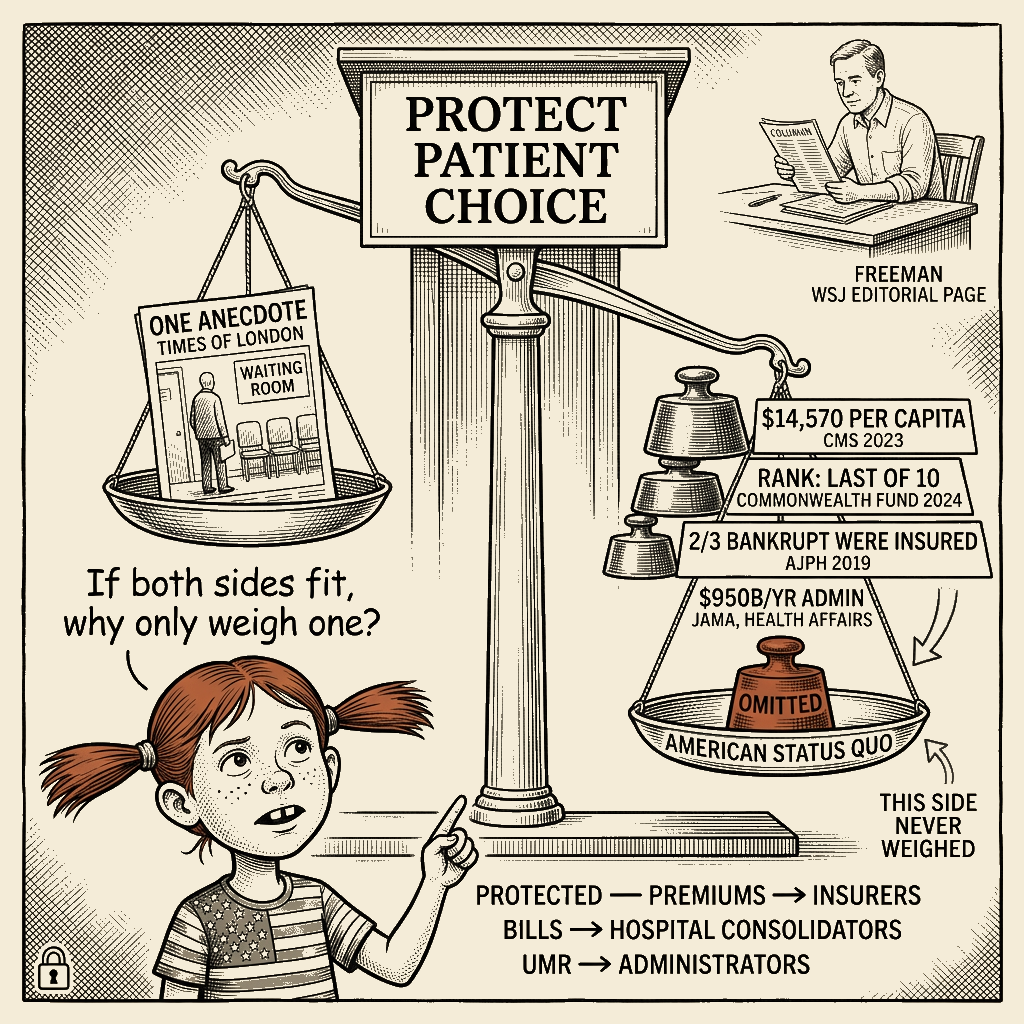
Analyzing: If El-Sayed and Sanders Kill Private Health Plans — James Freeman · 2026-08-18
What the Editorial Argues
James Freeman’s Best of the Web column argues that Bernie Sanders’s Medicare-for-All proposal would eliminate private insurance and replace it with a government system resembling Britain’s National Health Service, with politically controlled medicine, rationing, and treatment delays. Freeman acknowledges that Obamacare reduced choice and raised costs while enriching insurers and hospital consolidators, but concludes that the existing system remains preferable and that candidates who endorsed the Sanders plan should “pay a political price this fall.” His steelman is legitimate: voters have a real interest in preserving reliable coverage, disruption during a transition is a serious risk, and NHS waiting times are a documented limitation.
Receipts
The column’s move is to substitute a foreign horror anecdote for the comparison its own concession makes unavoidable.
What the framing wants you to believe:
- Sanders’s plan would “kill,” “destroy,” or “outlaw” private health insurance and take away coverage Americans now have.
- Britain’s NHS represents the destination: a system that endlessly “absorbs money” while rationing care.
- The election turns on “patient choice”: private insurance must be preserved lest government bureaucrats gain control over American doctors.
What’s really going on:
- The policy change concerns public financing and the insurance market; it does not make every doctor a government employee. The column welds together Britain’s state-financed and state-delivered NHS with a different model to make the financing change appear to be the destruction of medical practice itself.
- The comparison that could test the scare never appears: Medicare for All compared with the American status quo. Yet the Commonwealth Fund’s Mirror, Mirror 2024, consistent with KFF’s comparative work, ranked the United States last overall among ten high-income countries, despite the country’s substantially higher per-person health spending.
- The protected beneficiaries are the insurers positioned to retain the market for coverage duplicating a public plan, the hospital consolidators the column says Obamacare enriched, and the billing and utilization-management apparatus built around the present architecture. The load-bearing omission is the American system itself.
The Operation
I know how this column was assembled because I assembled its ancestors: concede that the protected arrangement is defective, import one vivid foreign example, relabel the proposed financing change as control over medical practice, remove the actual status-quo comparison, and close with a question designed to be repeated without being answered. That is retained memory, not an independently verifiable record. The document under analysis supplies the behavior pattern; the catalogues supply the names for its parts.
Institutional authorship and placement chain. The signed author is James Freeman, assistant editor of the Wall Street Journal editorial page, writing in its Best of the Web aggregation column. That format matters. The body can borrow authority from multiple publications while the Journal retains the byline, the audience, and the final frame.
The placement chain is visible in the citations: Allysia Finley in the Journal supplies the damaging concession about insurer and hospital-consolidator enrichment; the Times of London supplies the foreign scare; CNN supplies Abdul El-Sayed’s words; and Ramesh Ponnuru in the Washington Post supplies a conservative voice outside the house. That pattern matches the WSJ Editorial Technique Catalogue’s source-asymmetry entry, §3.6, and its technocratic-credential ledger, §§3.7 and 4.5. It also matches §4.3, multiple-audience targeting: the political class receives the electoral “price” line, the movement audience receives “kill,” “outlaw,” and “cliff,” and credential-conscious readers receive the citation chain.
It establishes source selection, not secret coordination. No donor payment, commissioning memo, or payer subsidy for this particular column appears in the artifact. The relationship is structural. The 1993 “Harry and Louise” advertisements run by the Health Insurance Association of America are the documented forerunner: private coverage was converted from a troubled product into something a reform proposed to “take away.” Freeman’s vocabulary is newer; the design is not.
This is the Bernays lineage—consent engineered through repetition, authority, and emotion—and the Lippmann lineage of a stereotype doing the argumentative work before the evidence arrives. The reader is expected to supply the latent picture of “government medicine”: a doctor, a queue, and a bureaucrat between the patient and treatment. The foreign story is merely the occasion for activating it.
Cui bono. The concentrated beneficiaries are the firms positioned inside the protected architecture: UnitedHealth, Elevance, Cigna, CVS Health/Aetna, Humana, and other payers that would retain the present market for comprehensive coverage; consolidated hospital systems that would retain the bargaining structure Obamacare enriched; and the billing, coding, claims-adjudication, network-management, and utilization-review industries whose revenue depends on the transaction complexity a public plan is designed to simplify.
The pathway is concrete. If reform is defeated, insurers keep selling coverage that duplicates the public benefits, underwriting and administrative machinery remains necessary, and the market power attributed to hospital consolidators is not disturbed at its architectural foundation. The page also benefits politically: the scare gives it a quotable opponent, a repeatable slogan, and a way to confirm the identity of readers already disposed to distrust single-payer reform.
The cost-bearers are patients inside that same architecture. CMS-based data put U.S. per-capita health spending at approximately $14,570 in 2023, compared with roughly $5,500 in the United Kingdom. The United States ranked last overall in the Commonwealth Fund’s ten-country comparison, while peer-reviewed research has estimated American billing and insurance-related administration at roughly $950 billion to $1.2 trillion annually. Those are not abstract “systemic” harms. They become denied care, narrow networks, premiums, out-of-network bills, delayed treatment, medical debt, and the fear of losing a job that carries benefits.
The 2019 peer-reviewed study of medical bankruptcy found that medical causes accounted for roughly two-thirds of the bankruptcy filings in its national sample, and that many debtors had insurance when the illness began. Freeman mentions insurer and hospital enrichment and then makes that enrichment disappear from the political question. The names are present only in the subordinate clause, where they cannot become interested parties.
Alternative design. Reconstructed from the stated rationale—protecting patient choice, coverage, and access—rather than from either side’s preferred slogan, the alternative would look like this:
- Guarantee uninterrupted coverage throughout the transition rather than minimizing the disruption concern.
- Separate payment from delivery explicitly: determine what agencies administer financing, which facilities remain privately owned, how clinicians contract, and what autonomy patients retain.
- Define the private-insurance boundary in plain terms: distinguish comprehensive duplicative coverage from services the public plan does not cover, rather than calling every private plan “destroyed.”
- Regulate prices, hospital consolidation, overhead, and billing complexity directly, because choice is meaningless when insurers narrow networks and consolidated systems exercise pricing power.
- Compare the reform with the American status quo using access, cost, health outcomes, financial protection, and treatment-delay data.
That is not a policy endorsement. It is the design the column would have to describe if patient protection rather than status-quo preservation were the controlling objective.
FGL, applied symmetrically. Fear, greed, and laziness operate differently across the constituencies.
- Author and publication: fear of policy displacement and loss of agenda-setting power; institutional interest in preserving a policy architecture consistent with the Journal editorial page’s accumulated positions; laziness made possible by the aggregation form, which required no original comparative reporting.
- Apex beneficiaries: greed in the preservation of premiums, administrative rents, and consolidated pricing power; fear of a transition away from underwriting, denial, and multi-payer complexity; laziness in the comfort of a system already built around their procedures.
- Rank-and-file reader: real, rational fear of losing usable coverage; the understandable wish to keep a plan that works; and the cognitive economy of accepting the foreign example rather than reconstructing the domestic comparison. There is no contempt in naming those motives. The reader’s fear was produced by the system and is now being aimed at the proposal for changing it.
The moral placement is mixed, weighted toward selfish. Patient autonomy, continuity, and avoidance of treatment delay are legitimate values. But the operation launders those values into permission to preserve the financing structure that makes coverage fragile. A disinterested application would compare the plan with the status quo, not ask the reader merely to recoil from the NHS.
Technique 1 — frame-engineered relabeling. The cues appear in “fully government-run health care” and “turning doctors into government bureaucrats.” The Bad-Faith Techniques Catalog identifies the operation as frame_engineered_relabeling; the WSJ Editorial Technique Catalogue’s §4.1 calls relabeling the page’s signature technique. Financing is recoded as delivery, public insurance as public employment, and administrative authority as clinical control. The omission is the relationship between payment and practice. The protected beneficiaries are the incumbents. The normalized harm is the conclusion that a public payer would necessarily control treatment decisions as the NHS does.
The lineage is Luntz’s tested substitution and Lakoff’s point that a frame activates before the argument arrives. The words are chosen for the picture they place in the reader’s head, not for the distinctions they preserve.
Technique 2 — strawman. The cues are “kill private health plans,” “destroy,” “outlawed,” and “taking things away.” The Bad-Faith Techniques Catalog’s strawman entry and the WSJ catalogue’s §4.6 describe the same substitution. The Sanders bill identified in the source packet, S.1129 in the 116th Congress, prohibits private insurers from selling benefits duplicating those provided under the act. That is the narrow design. “Your private plans are being destroyed” turns a boundary around duplicative coverage into a claim about every form of private insurance. “Doctors become bureaucrats” turns a payment reform into a claim that clinicians become public employees.
The bill remains a proposal, not enacted law, and its text must govern. The editorial’s representation becomes a strawman when it discards that boundary and treats preservation of the entire existing insurance market as the policy’s necessary result.
Technique 3 — hasty generalization from an unavailable anecdote. The cue is “The latest example is described by the Times of London,” followed by the systemwide verdict that the government plan “continues to absorb money while it rations care.” The Bad-Faith Techniques Catalog’s hasty_generalization entry names the pattern: one vivid case, no denominator, no systemwide distribution, and no alternative explanation. The WSJ catalogue’s §3.6 describes how credentialed citation can carry more argumentative weight than the text merits.
The block quotation describing the case is absent from the transmitted editorial. Whatever the underlying story establishes about one patient, it cannot establish what happens across the NHS or predict the American result. This is Lippmann’s stereotype functioning as evidence.
Technique 4 — advantageous comparison and threat inflation. The cues are “absorb[s] money,” “can be fatal,” and “jumped off the cliff.” Bandura’s third mechanism, advantageous comparison, is operating: the proposed plan is compared with the NHS’s weakest feature, while the status quo it would replace is never placed on the same scale. The Bad-Faith Techniques Catalog does not need a separate label for the comparison when the relevant mechanisms are named precisely; the editorial’s missing comparison is nevertheless the whole operation.
WSJ catalogue §4.13, the threat-inflation closer, matches the movement from administrative design to death, from phased policy to a cliff. The closing question—“do they really want them outlawed?”—also matches §3.5, the closing-line cadence: short, quotable, and designed to transmit the editorial’s conclusion while appearing to ask for it.
Technique 5 — the credentialed-source ledger. The Journal’s Finley, the Times of London, CNN, and Ponnuru are not interchangeable evidence. Each performs a different task: concede American failure, dramatize foreign failure, display the candidate’s position, and provide cross-outlet ideological confirmation. That corresponds to the WSJ catalogue’s “study shows” ledger, §4.5: the source’s institutional identity and alignment do the work that direct engagement with the Sanders text does not.
No source chain is treated as self-validating. A Times of London report can establish what happened to one patient; a Washington Post critic can identify a genuine transition risk; neither can certify the editorial’s causal conclusion without the missing policy and comparative analysis.
Technique 6 — multiple-audience targeting. The “political price this fall” sentence addresses organizers and voters. “Kill,” “outlaw,” and “cliff” address the movement audience. The source names and references to insurer and hospital consolidation address credentialed readers. The implied promise that existing coverage will be protected addresses subscribers who do not want disruption. WSJ catalogue §4.3 identifies this execution inside one piece. The argument changes audience by audience, but each audience is asked to reach the same conclusion: punish the reform without comparing systems.
Technique 7 — concession as permission structure and blame displacement. The cue is the sequence in which the column concedes that Obamacare “reduced customer choice and raised costs while enriching insurers and hospital consolidators,” then responds with “But.” The concession is not analyzed. It is used to purchase credibility for the conclusion that the arrangement producing those results must be preserved. The Bad-Faith Techniques Catalog’s attribution_of_blame helps identify the accompanying move: responsibility for the status quo’s failures is displaced onto “Obamacare,” “socialists,” or Sanders, while the underlying multi-payer architecture is exempted from scrutiny.
This should not be mislabeled as motte-and-bailey: no three-stage sequence of advancing a claim, retreating under challenge, and resuming it is documented. It is a permission structure—moral justification for preserving the status quo, euphemistic labeling of extraction as “patient choice,” and distortion of the consequences borne by sick and underinsured Americans.
Technique 8 — friend-enemy recoding. “Pay a political price this fall” converts a dispute over health-finance architecture into a loyalty test. Schmitt’s friend-enemy distinction is the historical lineage: supporters of a policy become enemies to be punished rather than citizens advancing a different answer. The mechanism is structurally consistent with the Bad-Faith Techniques Catalog’s blame attribution. It protects the status quo by making opposition morally disqualifying and foreclosing discussion of transition design.
Audience management and normalized harm. The column supplies permission to oppose single-payer without feeling like an insurer defender; grievance ratification through “they want to take away your plan”; identity confirmation through “patient choice”; status display through the source chain; and conscience displacement through the refusal to ask why coverage needs protection. The joke about music fans, Ireland, and gratitude turns an unavailable report about a suffering patient into entertainment. The joke is not the argument. The argument is the patient’s subordination to it.
The Record
The documentary record separates the editorial into three parts: an accurate narrow description of the Sanders bill, a real but incomplete observation about NHS delays, and an unsupported attempt to turn both into a verdict about American single-payer reform.
Tier 1 — primary documents and peer-reviewed research.
- The Sanders bill. The Medicare for All Act of 2019, S.1129 in the 116th Congress, is pending legislation. Section 107 addresses private insurers offering coverage duplicating the act’s benefits. The editorial is therefore accurate only in the narrow sense that the proposal would constrain that portion of the private-insurance market. The claims that every private plan would be “destroyed” and doctors would become government employees are not established by the bill text.
- Comparative spending. CMS National Health Expenditure data put U.S. per-capita health spending at approximately $14,570 in 2023. The corresponding United Kingdom figure was roughly $5,500. Spending is therefore not a defect concealed inside the U.S. system; it is the baseline the editorial refuses to compare.
- Comparative performance. The Commonwealth Fund’s Mirror, Mirror 2024 and KFF comparative analyses consistently place the United States at or near the bottom of high-income-country comparisons on access, affordability, administrative burden, and overall performance. The Commonwealth Fund ranked the United States last overall among ten countries. The editorial invokes Britain without naming this comparison.
- NHS waiting times. NHS England referral-to-treatment data document treatment delays, particularly in elective care. That is the honest core of the column.
[unconfirmed: convergence threshold not met]The particular Times of London anecdote, as transmitted, proves the editorial’s systemwide prediction about the United States. - Financial insecurity. Himmelstein and colleagues’ 2019 American Journal of Public Health study found that medical causes accounted for roughly two-thirds of personal bankruptcy filings in its national sample, and many debtors had insurance when the illness began. Census Bureau, KFF, and Commonwealth Fund estimates also place the uninsured and underinsured population in the tens of millions, though the combined number varies by definition and year.
- Administrative cost. Peer-reviewed analyses in JAMA and Health Affairs have estimated U.S. billing and insurance-related administration at approximately $950 billion to $1.2 trillion annually. The column mentions the enrichment produced by the present system but never quantifies the administrative rent its continuation requires.
Tier 2 — transparent specialist research.
- Mercatus modeling. Charles Blahous’s 2018 Mercatus Center model projected approximately $32.6 trillion in additional federal spending and, on its assumptions, roughly $2 trillion less total national health spending relative to projected status-quo growth over the model period. The second figure is a projection from a free-market think tank, not an observed result; the first became the headline used by opponents. The editorial cites neither. Its omission is particularly damaging because even this internally generated conservative model did not support the simple “single-payer only absorbs money” characterization.
- System comparisons. Commonwealth Fund and KFF work supports the broader conclusion that the United States spends more while performing worse on the central measures relevant to health-system choice. These reports do not establish that Britain has no waiting problems; they establish that waiting times alone do not adjudicate the systems.
The editorial’s load-bearing verdicts.
- “ObamaCare has reduced customer choice and raised costs while enriching insurers and hospital consolidators.” Substantively supported and damaging to the editorial’s conclusion. Finley is an in-house, ideologically aligned source, so this is not an independent Tier-1 anchor by itself, but the general record on consolidation and administrative extraction supports the substance.
- “The government-run plan continues to absorb money while it rations care.” Partly anchored and partly inflated. NHS delays are documented. The received Times of London excerpt is missing, no denominator is supplied, and no comparative U.S. data are presented.
[unconfirmed: convergence threshold not met]The anecdote establishes the scare’s conclusion. - “This makes virtually all medical care off limits to private plans.” Accurate only as a compressed description of the prohibition on duplicative coverage. “Outlawed,” “destroyed,” and “taking things away” expand that narrow design into a broader proposition the text must prove.
- “Imposed on British patients.” The NHS was created by British statute and public policy. “Imposed” supplies hostility, not a comparative history.
- “Patient choice” would be destroyed. Undefined and therefore unconfirmed. The column never says whether choice refers to insurers, clinicians, hospitals, treatments, or freedom from denial and network restrictions.
Load-bearing omissions. The piece omits the actual American comparator; the distinction between financing and delivery; rationing through price, network exclusion, and claim denial; underinsurance, medical debt, and bankruptcy; the transition provisions in the Sanders bill; the definition of the private-insurance boundary; comparative cost and performance; and the parties that benefit from defeating reform. It also omits direct citation to the policy text it purports to describe. The phrase “the latest example” is a citation, not a substitute for the example.
Per-citation verdicts.
- Allysia Finley, Wall Street Journal: accurately supplies the damaging concession that Obamacare enriched insurers and hospital consolidators. Its placement inside the Journal’s own opinion ecosystem matches the WSJ catalogue’s source-asymmetry warning, but the underlying proposition is substantially supported by the broader record.
- “The latest example,” Times of London: the citation carries the scare because the story itself is absent from the transmitted editorial. The underlying report’s relevance cannot be reconstructed, and the report cannot support the unstated systemwide inference.
- CNN interview with Abdul El-Sayed: the column’s interpretations—“taking things away” and “skating around”—are not a substitute for the transcript’s full treatment of the bill. The column appears to use the interview to recruit the candidate’s own words against him, but the received excerpt is insufficient for a line-by-line check.
- Ramesh Ponnuru, Washington Post: useful as a source identifying transition and administrative questions, not as automatic corroboration of the editorial. The quoted passage is absent from the transmitted text, so its exact function cannot be independently verified.
Missing-information declaration. The supplied artifact does not contain the full Times of London passage, CNN excerpt, Ponnuru quotation, or the contextual paragraph surrounding the music-fan and Ireland joke. No documentary source establishes a direct payment chain from private insurers or hospital consolidators to Freeman or this column; none is asserted. My focus-group and message-discipline memories are retained memory and remain non-verifiable, and the documentary record controls. This analysis uses S.1129 because the source packet identifies that Sanders proposal; if the column refers to different Sanders language, the bill-text comparison must be updated.
How to Recognize This
Name the pattern and it loses much of its power: the foreign-anecdote scare. Import one vivid case, relabel the domestic proposal so it resembles the foreign system, conceal the comparison the writer refuses to make, and let a short closing question repeat the conclusion as if it had just been discovered.
The mechanism. The anecdote supplies emotion. The relabel supplies a ready-made stereotype. The status-quo concession supplies credibility. The punishment line supplies a political duty. The closing question supplies a quotable verdict. The reader never has to compare the reform with the system it would replace.
Four signals reveal the operation:
- Financing is called delivery. A public insurance or payment architecture becomes “fully government-run health care,” and doctors become “government bureaucrats.” Ask who pays, who delivers care, who owns the facility, and who decides treatment.
- One foreign case carries a systemwide verdict. Phrases such as “the latest example” are a demand that the citation substitute for the missing text and denominator. Find the actual case. One patient’s experience cannot prove a national result.
- The status quo is conceded and then immunized. The sentence admitting reduced choice, higher costs, insurer enrichment, and hospital consolidation is followed by a conclusion that preserves the arrangement. Ask whether the criticism changed the policy or merely made opposition to reform feel candid.
- The argument ends in a loyalty test and a presupposing question. “Pay a political price” and “do they really want them outlawed?” are not summaries of the policy comparison. They identify the reader’s side and tell that side what to do.
Why it works. The reader’s attachment to usable coverage is genuine, and disruption during reform is a serious concern. The operation harvests that concern and aims it at the reform instead of at the vulnerabilities that produced the reform impulse. The vocabulary does not need to be taught because years of political communication have already installed “government healthcare means rationing” and “they want to take what you have.” The column supplies permission to deploy it today.
What to do when you see it. Run the comparison the writer refuses: proposal against the actual system, not proposal against a foreign cautionary tale. Separate financing from delivery. Read the policy text and its transition provisions rather than accepting either side’s verb. Trace each citation to the original document, its institutional home, and its funding chain where relevant. Check what the editorial does not name: underinsurance, treatment delay, medical debt, administrative cost, consolidation, and the beneficiaries of defeat. Ask who benefits and through what money, power, or attention pathway. Search the same “destroy,” “outlaw,” “take away,” and “government bureaucrat” vocabulary across the syndication network; recurrence reveals the frame’s circulation without requiring proof of a secret command chain. Then reduce the frame’s automatic activation: when “government bureaucrat” appears, ask what the insurer is doing with the prior-authorization request and what the consolidated hospital is doing with its market power. Apply the same discipline to every scare, including those issued by people with whom I agree.
I built this column’s ancestors. Anecdote, concession, relabel, punishment, question—the craft is not mysterious, and memory is not evidence. The recognition is bitter because the work I once treated as successful persuasion produced a vocabulary now used to narrow the reader’s choices before the evidence is examined. The reader does not need to credit the bitterness. The reader can verify the record, recognize the operation, and carry that recognition into the next encounter.

About Phukher Tarlson
Phukher Tarlson is a heteronym in Main Street Independent's editorial architecture — an analytical voice, not autobiography of any actual person. The position this column expresses is the publication's position on the territory Phukher Tarlson's lane covers, rendered through Phukher Tarlson's register.