Responding to: If You Thought California’s High-Speed-Rail Idea Was Insane . . . — John Fund · 2026-08-30
What the Piece Argues
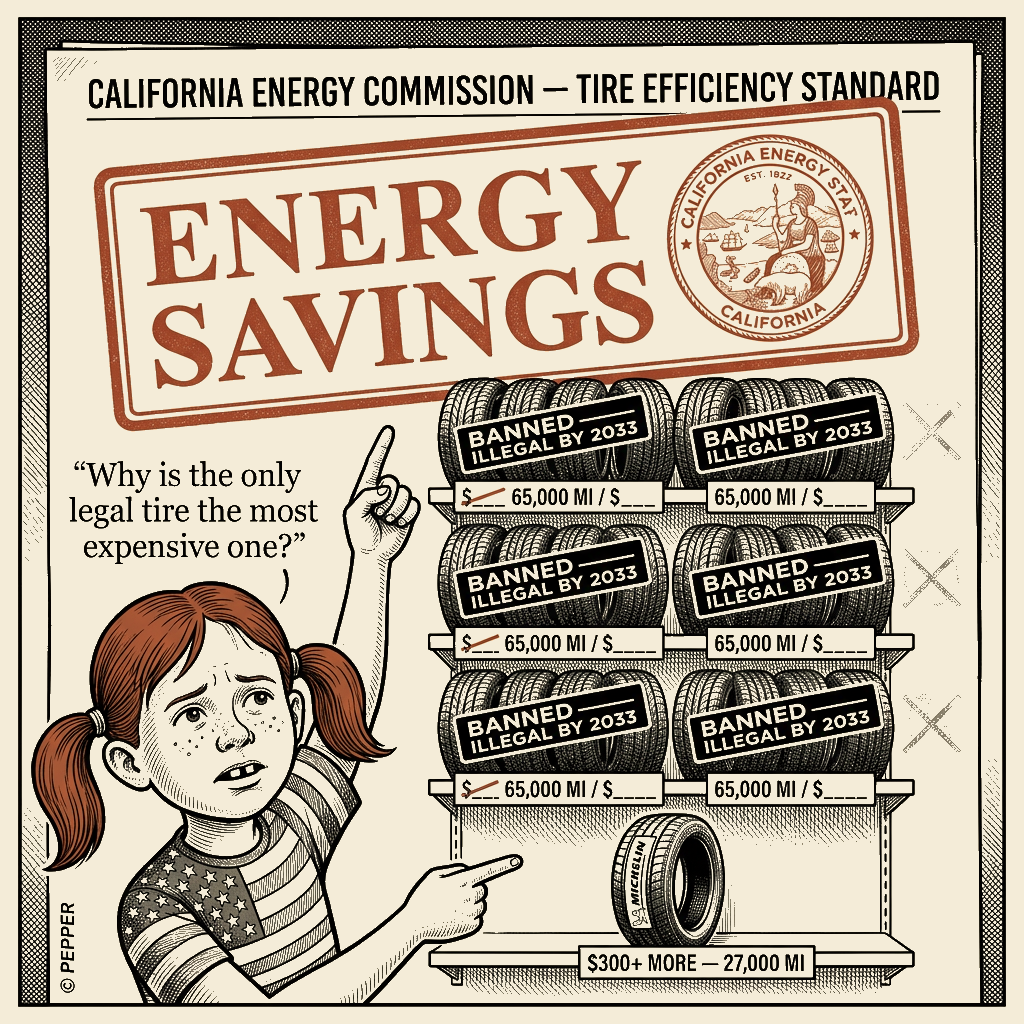
The source argues that the California Energy Commission’s first-of-its-kind tire-efficiency regulation — set to make an estimated 70 percent of tires sold in the state illegal by 2033 — is a costly, safety-eroding power grab that will function as a backdoor to push Californians out of their cars and into public transit, with the stated “energy savings” serving as a pretext rather than a result. It draws a direct parallel to the high-speed-rail fiasco as proof that California regulators ignore real-world economics when packaging mandates as consumer wins, and warns that because of California’s market size, the rule will spread as a de facto national standard. The piece frames unelected commissioners as nanny-state ideologues captive to the environmental lobby, citing falling voter support for both the 2035 gas-car ban and higher electricity rates as evidence of a brewing public backlash that has not yet reached the ballot box.
Receipts
The framing wants you to read the tire rule as another consumer-friendly “efficiency” win — but every supporting detail the source supplies shows it is a price hike with safety trade-offs and a captive-market gift to one premium European manufacturer.
- What they want you to believe: The rule produces “energy savings” and a “better overall outcome for Californians” (commissioner Nancy Skinner).
- What’s really going on: California electricity rates have already more than doubled versus neighboring states while promised efficiency savings have failed to offset those higher bills — the source uses that exact pattern as a tell for this rule.
- Who benefits: Only Michelin, the sole major tire company publicly backing the regulation, whose tires “are consistently in the top price tier” and stand to capture share from squeezed-out competitors.
- Mechanism: Mandate European-spec low-rolling-resistance tires that average 27,000 miles vs. roughly 65,000 for typical all-seasons → consumers replace tires twice as often, at $300+ more per set, while smaller/imported manufacturers get forced out.
- The omitted fix: “Underinflated tires result in a much greater loss in mileage and efficiency than the California Energy Commission’s sledgehammer regulation seeks to cure” — education and incentives on proper tire pressure would do more, cost less, and harm safety less.
- Safety costs: Autoweek: “In an evasive maneuver you want performance tires, not hardened LRRs.” Heavier vehicles and drivers who prioritize traction lose access to suitable tires.
- Anchor citation: “You will not have as many manufacturers, importers, distributors selling as many products. When the supply goes down and the demand stays stable, prices go up. So will prices increase? You bet they’ll increase.” — Darren Thomas, Dunlop CEO.
The Response Ladder
Polite Reframe
When to use: When you need to make the case without losing the room — a letter to the editor, a town-hall question, a measured reply to a regulator or sympathetic journalist who hasn’t yet connected the dots.
The tire-efficiency rule is being sold as a win for consumers, but the math simply does not work for the people it is supposed to help. California’s own electricity rates have more than doubled versus neighboring states even as efficiency programs multiplied, and the same regulator-led pattern is now being applied to tires. If the goal is genuine fuel savings, the cheapest, safest, and most effective intervention is right there: properly inflated tires. The intervention the commission chose instead raises a full set of tires by more than three hundred dollars, cuts tire lifespan roughly in half, removes safer high-traction options for heavier vehicles and evasive maneuvers, and happens to be supported exclusively by the premium-tier European manufacturer positioned to gain market share from squeezed-out competitors. If California wants consumers to trust the outcome, prove it the way High-Speed Rail never did — with a transparent cost-benefit showing the regulation produces a better overall outcome for Californians. Until then, “energy savings” is the rationale, not the result.
Mockery and Ridicule
When to use: When the audience already gets the joke and you want the cheap laugh at Sacramento’s expense — a friend group, a Substack comment thread, a tweet that names the pattern without working too hard.
Brace yourselves, Californians: your unelected Energy Commission has solved climate change by making your tires worse. Seventy percent of the tires currently sold in your state are now illegal by 2033. The good ones, anyway. Commissioner Skinner assures us this will save energy, just like the bullet train was going to be sleek, just like the doubled electricity rates were going to be offset by efficiency savings, just like the gas-car ban was going to be popular forever. The replacement tires last half as long, cost $300 more per set, grip worse in a panic stop, and aren’t available for your truck — but hey, fewer tires is fewer tires, and fewer tires is fewer cars, and fewer cars is fewer people clogging up the bullet train that’s never coming. The only major tire company on board with this plan? The one whose premium tires are about to be the only legal option. Truly a win for the little guy. Truly a model for the nation. Truly the same script as the last thirty-plus billion.
Nuclear Satire
When to use: When the room knows the target deserves it and you want the full demolition — a long-form reply, a viral thread, a newsletter where the satire can run.
Californians, rejoice: your betters in Sacramento have decided that the war on cars shall henceforth be prosecuted through your wheel wells. The Energy Commission — unelected, untouchable, undefeated in fiscal responsibility — has ruled that roughly seventy percent of the tires currently sold in your state are a moral failing, and that the only acceptable tire is the one that costs more, lasts half as long, and grabs less when you swerve. They have called this “efficiency.” They have called this “consumer savings.” They have also called doubling your electricity rates an efficiency story, called High-Speed Rail a transportation plan, and called forty-billion-dollar deficits a balanced budget. The pattern is the pattern.
The mechanism is elegant. Force the market onto European-spec low-rolling-resistance tires that wear out at 27,000 miles instead of 65,000. Drive replacement frequency up by two. Drive every mid-tier and import competitor who cannot retool to the new spec out of the California market. Hand the entire American tire market — under California’s de facto national rulemaking — to the one premium French manufacturer who lobbied for this from day one. The tire industry collapses into a Michelin fan club with a captive consumer base, and the consumer eats the difference. This is not a side effect. This is the budget.
The omitted fact is the giveaway. The single cheapest, safest, and largest available improvement to tire efficiency is keeping your tires properly inflated. A pump and a sticker. No procurement scandal required. Education and incentives would have done it. Instead, the commission chose the rule that makes tires more expensive, less safe in evasive maneuvers, and unavailable for trucks, SUVs, and people who actually drive like they need their tires to work. Autoweek called it. Dunlop’s CEO called it. The Public Policy Institute of California has now measured the public catching on — gas-car ban support down to 32% from 49%, higher rates for renewables down to 38% from 56%. The nanny-state pitch is being priced out of the polling.
The High-Speed Rail comparison is not a metaphor. It is the business model. Billions promised. Billions spent. Service never delivered at speed. Same architects, same pitch, same ending. Just this time the bullet train is your Civic, and the ticket is $300 a set, twice as often, with worse handling. Welcome to the future. Bring a pump.
Profane Scorched-Earth
When to use: When you are done being polite, done being clever, and the target has burned its last bridge with you — a furious email to a rep, a rant at the bar, a final-form reply that names the grift for what it is.
Holy fucking shit, Sacramento has officially lost its goddamned minds. The California Energy Commission — you know, the unelected, unaccountable, electorally-fingerprinted band of green-ink-soaked commissars who have been running roughshod over a state they were never hired to run — has just declared war on the round black things your car rolls on. Seventy percent of the tires sold in your own goddamn state? Criminal. Illegal. Hostile to the climate. Outlawed by 2033. And the replacement? A Michelin-tier tire that costs three hundred bucks more per set, lasts twenty-seven thousand miles to your sixty-five, and turns your car into a fucking sled the second you try to swerve out of an accident. This is “efficiency.” This is what the suits in Sacramento call a “better overall outcome for Californians.” This is the same motherfuckers who doubled your electricity bill while promising efficiency savings, and who burned forty-plus billion dollars on a train that has never carried a single passenger at speed. The only major tire maker backing this fascist little edict? The French luxury brand that is about to own the American market because the rest got driven into the ground by regulatory strangulation.
Let me spell this shit out for the people still pretending. They want you out of your car. That is the entire point of this exercise. The “energy savings” is a lie. The “consumer benefit” is a lie. The “environmental urgency” is a cover story so the green lobbyists and their one compliant tire company can loot your wallet on the way to making you ride a bus. The cheapest, safest, most effective way to improve tire-related fuel economy is keeping the goddamned tires inflated, and they rejected that because it does not advance the agenda. The agenda is you — off the road, onto their transit fantasy, paying whatever the one surviving manufacturer charges. They have been running this play for decades — High-Speed Rail, the gas-car ban, the appliance bans, the electricity-rate doubling — and every time you swallow “trust us, this one’s different,” you pay more, get less, and lose another freedom to drive where the fuck you want.
And the safety angle? They do not give a single, solitary shit. Less grip in a corner. Less traction for a heavier vehicle. Less of a fucking chance for your family in an evasive maneuver. Autoweek said it out loud. Dunlop’s CEO said it out loud. The commission could not hear them over the sound of Michelin’s lobbying checks clearing. This is what regulatory capture looks like when the captured regulator gets to write the rules: one beneficiary, one captive market, and a population that finds out at the tire store, on a Tuesday, paying three hundred dollars for a worse tire that wears out twice as fast. The PPIC polling has the receipts — gas-car ban support down to 32%, higher rates for renewables down to 38%. The people are starting to see the grift. The only question left is whether Sacramento will hear them at the ballot box, or whether it will take an entire goddamn electoral revolution to make the unelected commissars finally answer to the people they have been robbing blind.
Burn the High-Speed Rail comparisons. Burn the “we know best” chorus. Burn the Michelin-blessed, safety-erasing, wallet-shredding, freedom-trampling, nanny-state fucking tire ban down to the studs. The pattern is the pattern. The grift is the grift. And the only difference between a bullet train that never moved and a tire rule that doubles your costs is that this time, they are coming for your tires first.

About Malcolm Little King
Malcolm Little King is a heteronym in Main Street Independent's editorial architecture — an analytical voice, not autobiography of any actual person. The position this column expresses is the publication's position on the territory Malcolm Little King's lane covers, rendered through Malcolm Little King's register.