Responding to: Fears of a Canadian trade war are overblown. So far, it’s more of a skirmish · 2026-09-01
What the Piece Argues
Heritage Foundation economist E.J. Antoni argues in Fox News Opinion that fears of a U.S.-Canada trade war are overblown, framing recent Section 338 tariffs as a “skirmish” affecting only about 5% of bilateral trade. He acknowledges a January 2026 escalation to 50% tariffs on autos and auto parts that could push the dispute past $100 billion, but treats that future scenario as a separate, avoidable problem if Canada “backs down.” The piece simultaneously critiques specific tariff structures that punish USMCA-compliant firms while defending the underlying tariff regime, blaming Canada’s dairy lobby and Chinese transshipment for the breakdown rather than U.S. policy choices.
Receipts
The piece wants you to believe this is a “skirmish” you can shrug off, but the math and the author’s affiliations tell a very different story.
- The framing: “Au contraire: Anyone who checks the numbers can see this is merely a skirmish.”
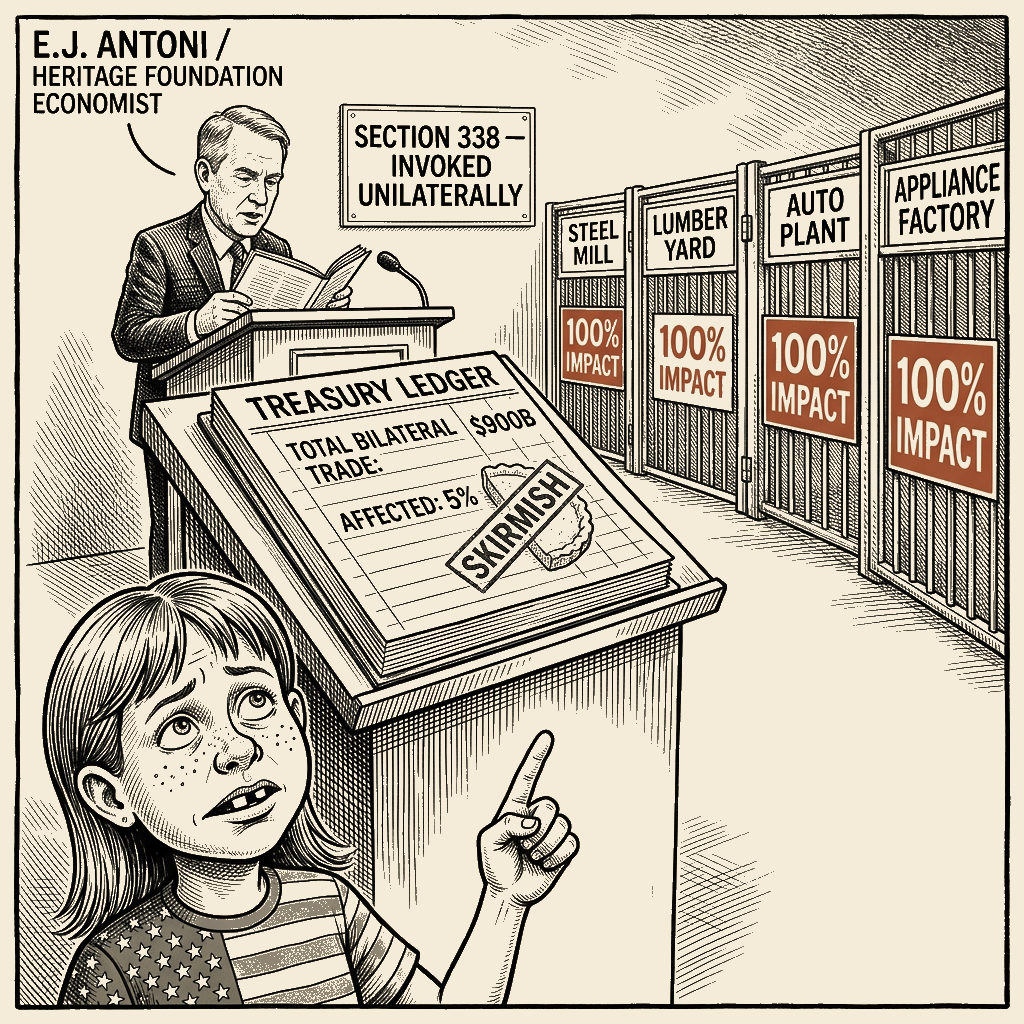
- The sleight of hand: $20 billion in tariffs is divided by $900 billion in total bilateral trade to arrive at “only 5%” — but the 5% is concentrated in steel, lumber, autos, and appliances, sectors where entire communities absorb 100% of the impact.
- The author’s own contradiction: The piece admits January will bring 50% tariffs on $100 billion of trade including autos. By the author’s own scale, that is not a skirmish.
- The omitted actor: Section 338 was invoked unilaterally by the U.S. administration. The piece never names a Canadian action that triggered these tariffs.
- The omitted affiliation: The author is a Heritage Foundation economist (Trump’s widely reported pick for BLS Commissioner), writing in defense of an administration that just torched a trade deal it negotiated three years ago.
- The controlled burn: The critique of specific tariff structures (USMCA-compliant firms penalized harder than Shenzhen competitors) is technically accurate but functions to let the author oppose the worst tariff excesses while leaving the regime itself intact.
- The imperial closer: “Hopefully, Canada realizes it has more to lose than the U.S. and backs down before both sides incur more casualties.” Translation: the bigger party should dictate terms.
- Anchor citation: “Listening to most of the media and Canada’s prime minister, you’d think the U.S. and its northern neighbor were in a full-blown trade war after new tariffs were announced days ago. Au contraire: Anyone who checks the numbers can see this is merely a skirmish.” (Fox News Opinion, Sept. 1, 2026)
The Response Ladder
Polite Reframe
When to use: A coworker or family member shares the piece as a sober, numbers-driven take and you want to push back without escalating.
The “skirmish” framing holds up only if you divide the affected $20 billion by total bilateral trade and stop there — but $20 billion isn’t a skirmish when it’s concentrated in autos, steel, and lumber, sectors where whole regional economies absorb the full hit. The author himself concedes January will bring 50% tariffs on $100 billion of trade, including cars and trucks, which by his own scale is no longer a skirmish but a war. The piece also faults Canada’s dairy lobby and Chinese transshipment for the breakdown while never once naming a Canadian action that triggered Section 338, because Section 338 is invoked unilaterally by the U.S. And the author is a Heritage Foundation economist writing in defense of an administration that just voided a trade agreement it signed three years ago — so the “Au contraire” confidence is doing a lot of work to make unilateral American protectionism sound like reasonable reciprocity.
Mockery and Ridicule
When to use: The piece gets posted in a group chat or on social media and you want to dunk on it without going full scorched-earth.
Ah yes, “it’s just a skirmish,” says the Heritage Foundation economist whose employer takes Koch money to convince you that tariffs your team imposed are actually fine while the parts of the tariff regime that hurt compliant firms are the only real problem. The guy literally admits in his own column that January will bring 50% tariffs on $100 billion of autos and auto parts, but please, do keep calling it a skirmish because 95% of aggregate transactions are still flowing — never mind that the 5% that’s disrupted is destroying steel towns and auto plants. And the kicker: he blames Canada’s dairy lobby and Chinese transshipment for the dispute while never mentioning that the United States chose to invoke Section 338 with no Canadian provocation on the record. The “Au contraire” energy here is doing heroic work to make a unilateral American tariff hike sound like a reasonable response to Canadian aggression that never actually happened.
Nuclear Satire
When to use: You’re writing a longer rebuttal, a newsletter post, or a thread and want to make the structural absurdity of the argument unmistakable.
The Fox News Opinion page brings us a “skirmish,” which the author helpfully defines as a 50% tariff on $20 billion of Canadian goods, escalating to $100 billion in January, where a Canadian steel input makes an American washing machine more expensive than a Chinese one, where USMCA-compliant firms get punished harder than Shenzhen competitors, and where the proposed remedy is for Canada to “back down” because it has “more to lose.” This is, by the arithmetic the author himself supplies, the largest bilateral trade disruption in decades, dressed up in “Au contraire” French because invoking Napoleon makes protectionism sound sophisticated. The author is a Heritage Foundation economist widely reported as Trump’s pick for BLS Commissioner — meaning this op-ed is essentially a job application dressed as analysis. The “skirmish” framing isn’t economic reasoning; it’s brand management for an administration that just torched a trade agreement it negotiated three years ago. The piece critiques specific tariff structures (correctly) while defending the tariff regime itself (absurdly) — a both-sides bind that protects no one except the think tank that wrote the playbook. And the imperial closer, telling Canada to “back down” because it “has more to lose,” isn’t economic analysis. It’s a conqueror’s framing dressed up in “anyone who checks the numbers” rhetoric.
Profane Scorched-Earth
When to use: The piece is being deployed to shut down debate, demonize critics, or excuse obvious economic harm to working-class communities — and the gloves are off.
This fucking “skirmish” horseshit is a Heritage Foundation hack telling you that 50% tariffs on $20 billion of Canadian goods — escalating to $100 billion on your fucking cars and trucks in January — is no big deal because the aggregate bilateral trade number is $900 billion. That’s like telling a burn victim the house fire is “a skirmish” because 95% of the rooms are still standing. The 5% that’s disrupted? Those are steel towns, auto plants, lumber counties, and appliance factories where entire communities absorb 100% of the impact while this clown waves an aggregate trade number at you like a magic wand. And the fucking cherry on top: this dickhead works for a Koch-funded dark-money outfit, is Trump’s widely reported pick to run the Bureau of Labor Statistics, and writes this puff piece to convince you that unilateral American protectionism is actually Canada’s fault because of dairy lobbies and Chinese transshipment. The U.S. chose to invoke Section 338. The U.S. chose to torch USMCA. The U.S. chose to impose these tariffs with no Canadian provocation on the record. And now this asshole is telling you Canada needs to “back down” because it “has more to lose” — a phrase straight out of the imperial conqueror’s playbook that the founders of this country were supposed to have overthrown. The “Au contraire” isn’t French sophistication; it’s the sound of a bootlicker wrapping Trump policy in faux-economic gravitas for a Heritage paycheck. Fuck the Heritage Foundation. Fuck this “skirmish” framing. And fuck anyone who uses this bullshit to explain away $100 billion in economic damage to working-class communities that already lost their factories once and are about to lose them again.

About Malcolm Little King
Malcolm Little King is a heteronym in Main Street Independent's editorial architecture — an analytical voice, not autobiography of any actual person. The position this column expresses is the publication's position on the territory Malcolm Little King's lane covers, rendered through Malcolm Little King's register.