Responding to: Trump and Rubio’s bold Venezuela oil pact could finally crush communism’s grip · 2026-09-02
What the Piece Argues
The column argues that Trump and Rubio’s Venezuela oil deal — granting U.S. companies access to 65 billion barrels across 17 strategic fields, with a production target above 1.5 million barrels per day and more than $100 billion in private investment — is a historic act of anti-communist liberation. Yuri Perez, Director of Latin American Studies at the Victims of Communism Memorial Foundation, contends that Venezuela’s resources were being looted by Cuban intelligence, Russian arms deals, and Chinese debt, and that a long-term U.S. commercial stake backed by American security interests is the only reliable guarantee against future “communist capture.” He dismisses sovereignty objections by arguing that a nation whose oil financed Cuban tutelage was never truly sovereign, and he frames critics — from the left, from hard-line Chavistas, and from parts of the Venezuelan opposition — as defenders of a failed communist status quo. The piece explicitly labels the strategy the “Donroe Doctrine” — the Monroe Doctrine updated — and calls for dollarization, revenue auditing, and free elections as finishing steps.
Receipts
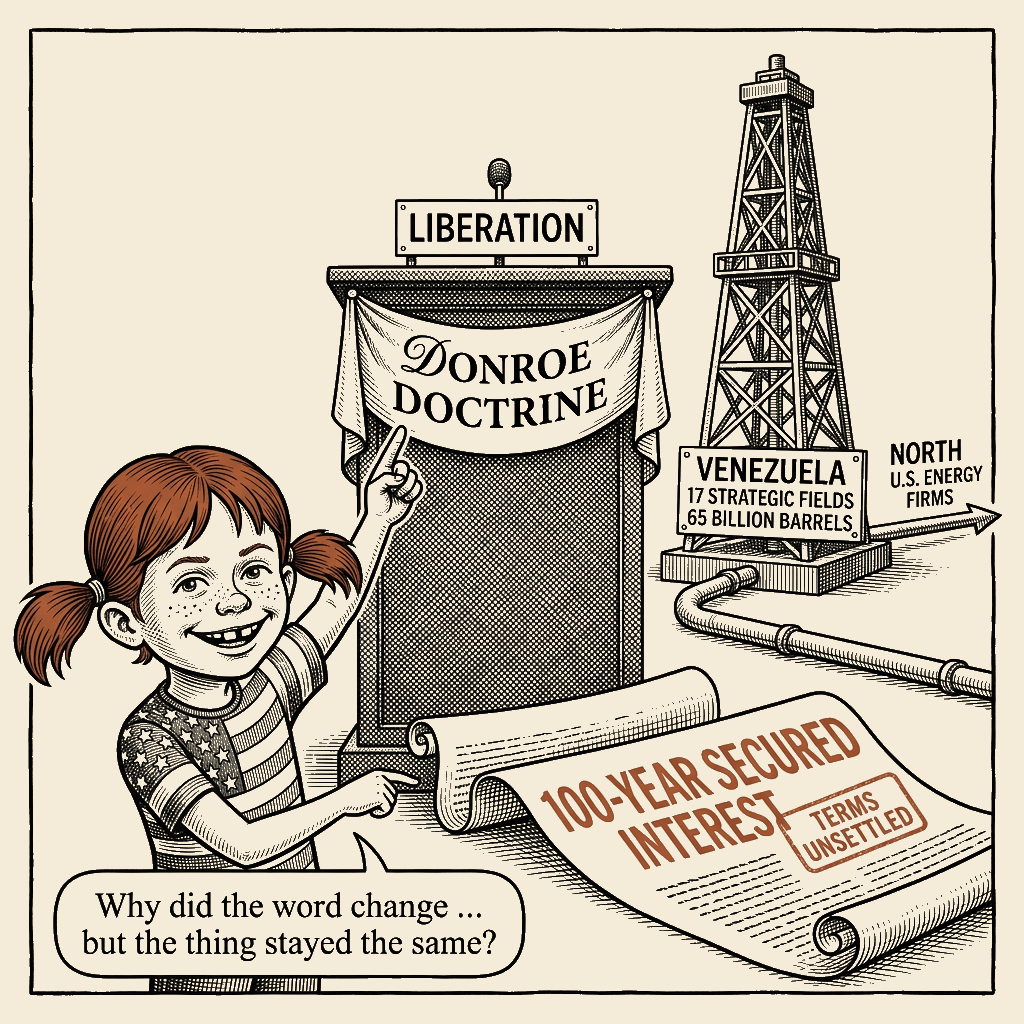
The piece calls a century-scale U.S. oil concession “liberation.”
The framing wants you to believe —
- This deal liberates Venezuela from Cuban, Russian, and Chinese exploitation, returning sovereignty to its people
- U.S. corporate access to the oil is “insurance” against future communist capture, not the deal’s actual purpose
- Critics of the deal are defending a communist status quo or sheltering Maduro’s holdouts
- The arrangement is a partnership between equals — the U.S. as benevolent superpower enabling Venezuelan freedom
What’s really going on —
- The piece’s own author sits at the Victims of Communism Memorial Foundation — an institution whose founding mission is to frame every geopolitical rival as communist and every U.S. resource grab as liberation; the framework precedes the evidence, not the other way around (the Foundation’s mission statement and Cold War–era funding are public record)
- The piece itself acknowledges the deal’s “precise duration, legal foundation and long-term enforceability remain unsettled” — a generation-or-century-scale extraction negotiated by an interim government with no electoral legitimacy and no constitutional authority to sign generational contracts (the piece names interim president Delcy Rodríguez as signatory)
- The piece explicitly calls this the “Donroe Doctrine” — an update to the Monroe Doctrine, the 19th-century framework for U.S. hemispheric dominance over Western Hemisphere resources, repackaged with anti-communist vocabulary (“the threat is not a European monarch but the communist powers”)
- The concrete beneficiaries are U.S. energy companies gaining access to reserves under terms backed by “American security interests” — the same structural relationship that characterized every prior era of U.S. resource extraction in Latin America, rebranded as freedom
The Response Ladder
Polite Reframe
When to use: for a good-faith family member or friend who wants Maduro gone, welcomes the deal, and hasn’t read the terms — calm, receipt-driven, the person is never the enemy.
Delia taught English in a Maracaibo high school until the blackouts made the classroom unteachable, and then she taught her own children by flashlight. She will tell you, with a force I respect, that she does not miss the old regime, and she is not wrong. There is a real and shareable good at the center of this deal’s argument: the end of a dictatorship, political prisoners walking out of cells, the breaking of an axis that treated a whole country as an intelligence outpost. That good is genuine, and it is precisely why I will not let it be used to sell the part that is not an emancipation.
Now read the deal the way its champions describe it: 17 strategic fields holding 65 billion barrels. A secured U.S. interest. “A generation or a century-scale U.S. stake.” A hundred billion dollars of private investment. “Secured interest” is a contract term, and it does not mean what the commercials suggest. It means the foreign party holds the claim, the collateral, the leverage — for up to a hundred years. And it was signed, by the piece’s own admission, by a “remnant of Chavismo,” while the old ruling party still runs the courts. No election ratified it. The people who will live under it for a century never voted on it.
Here is the test that sorts the whole matter, and it is the same test for both of us: does this arrangement put control of Venezuela’s oil in the hands of Venezuelans, or in the hands of Washington and its companies? If the first, it is emancipation and I am with it. If the second, it is extraction with a liberation ribbon on it — and a ribbon does not change what a century-long contract does. Real sovereignty would begin with a government chosen by Venezuelans, and have that government — not an interim remnant — sign whatever is signed, on terms Venezuelan law controls, with the proceeds audited by an institution Venezuelans can dismiss. We want the same things. That is the offer: don’t let the hope you rightly feel serve as the stamp on a lease you would never want your own country to sign.
Mockery and Ridicule
When to use: the cousin who shared this on Facebook without reading past the headline; the “patriot” who thinks opposing this deal means defending communism; a Twitter thread where the bystanders need the con made visible.
So let me get this straight. The argument is: Venezuela’s oil was being exploited by Cuba, Russia, and China. The solution is to give it to American energy companies for a century. And the word for this is — liberation.
The piece even names its own framework. “The Donroe Doctrine” — a catchy portmanteau that accidentally tells you everything. The Monroe Doctrine was, from 1823 forward, the operating manual for telling the Western Hemisphere who gets to extract what from whom. Updating it with an anti-communist press release doesn’t change the doctrine. It just gives the extraction a new mascot.
And the author works at the Victims of Communism Memorial Foundation. Which is like hiring the National Rifle Association to write your gun-safety report. The conclusion was in the mission statement before the research began. Every geopolitical rival is “communist.” Every U.S. corporate resource grab is “liberation.” The framework isn’t derived from the evidence; the evidence was selected to fill the framework.
The kicker — the actual kicker — is buried in the last few paragraphs: the deal’s “precise duration, legal foundation and long-term enforceability remain unsettled.” Read that again. They are celebrating a deal whose terms are not settled, whose legal basis is uncertain, and whose enforceability is unknown — signed by a government the piece admits has no democratic legitimacy — and calling it a “generational win.” The only generation guaranteed to win this one is the one writing the checks to Houston.
But sure. It’s about the Venezuelan people. Who were never asked.
Nuclear Satire
When to use: for readers who need the extraction seen whole and named — grotesque, scorched-earth on the ideas and the institutions that sell them, not the people they’re sold to.
Congratulations, Venezuela. You have been liberated. The proof of your liberation is that a foreign superpower now holds a “secured interest” in sixty-five billion barrels of your oil for up to a century, it calls the arrangement “the Monroe Doctrine in practice,” and your interim government — which, per the fine print, is the remnant of the very socialist party that just lost power — signed the lease before any election could object. This is freedom when it comes with a wet signature and a notary.
If your head is spinning, you are doing it correctly. The frame performs a small lobotomy on every concept it touches and then hands the patient a mirror. “You objected to colonialism,” it explains, “and that is exactly why you should be grateful for the secured interest.” Poverty is the new wealth; a hundred-year lien is the new sovereignty; the dictatorship’s leftovers are the new democrats; and the 1823 doctrine that produced a century of U.S. guardianship over this hemisphere is the new emancipation. The piece does not merely ignore the objection — it adopts it, embroiders it, and returns it gift-wrapped as the answer. That is not argument. That is a possession performed in daylight, with an audience applauding because the exorcist has said the right magic words.
The grotesque precision is that the doctrine is invoked outright. “The Donroe Doctrine in practice,” the piece says — the policy that declared the entire hemisphere a zone of U.S. guardianship and then spent two centuries arming and deposing governments in its name, presented as the moral pole the author points at and calls north. You could not write a better satire of extraction than the actual sentence. The author has done the satire’s work for us: he calls the taking liberation and names the doctrine of the taking as his proof.
And the arithmetic is where the farce finally collapses into the grotesque. A hundred billion dollars of private investment, secured by American military backing, against a production target of a million and a half barrels a day — with the proceeds, per everyone’s fond hope, to be audited someday by a “future democratic congress” that will also “ratify” the contract the regime remnant already signed. And the deal’s own terms are, by the seller’s own admission, “unsettled” — duration, legal foundation, enforceability all TBD. But a century on the clock is settled enough for the guns that hold the collateral. It is a heist staged as a state funeral, with the pallbearers reading the will.
Profane Scorched-Earth
When to use: the reader who has had it with the liberation-as-extraction rebrand; the thread where someone is calling you a communist for questioning who actually benefits from a century-long oil deal signed by an unelected government; full catharsis required.
“Yuri Perez” — and yes, the name matters, because this man has a title and an institutional platform and the gall to use both for this — “Yuri Perez” is the Director of Latin American Studies at the Victims of Communism Memorial Foundation, and he just wrote a ten-page press release explaining why it is liberation for American energy corporations to lock up 65 billion barrels of another country’s oil for a generation or a century, backed by the U.S. military’s security guarantees, signed by a government that has no electoral legitimacy, under terms the piece itself admits are legally unsettled and unenforceable — and he wants you to call this the “Donroe Doctrine” like that’s a clever pun and not a fucking confession.
“Donroe Doctrine.” Say it out loud. The Monroe Doctrine — the 203-year-old operating manual for American imperial control of the Western Hemisphere — rebranded with a portmanteau and served up with a side of anti-communist liberation cosplay. The author didn’t even try to hide it. He named the doctrine. He told you exactly what he was doing. He said: “the threat is not a European monarch but the communist powers that treated Venezuela as a forward operating base.” Two centuries ago it was “European monarchs.” Now it’s “communist powers.” The species changes. The doctrine — this hemisphere belongs to us — is the same fucking doctrine. Perez updated the villain and expected you to think he updated the principle. He didn’t. He can’t. Because the principle IS the product, and the Victims of Communism Memorial Foundation exists to keep selling it.
And that’s the whole game, isn’t it? The Victims of Communism Memorial Foundation — founded during the Cold War, funded through the Cold War–era apparatus that turned every resource extraction in Latin America into a bulwark against communism — is now, in 2026, doing the same job it was built to do. Every geopolitical rival is communist. Every U.S. corporate resource grab is liberation. The framework isn’t derived from evidence; the evidence is curated to fit the framework. “Cuban intelligence.” “Russian arms.” “Chinese loans.” The holy trinity. Say them enough times and any century-long oil lease starts to look like the Statue of Freedom.
Let’s talk about what the piece actually says when you strip off the liberation wrapping. Interim President Delcy Rodríguez — a member of the Maduro government the piece claims to oppose — signed a deal giving U.S. energy companies access to more than 65 billion barrels of oil. The piece admits this government has no democratic mandate. The piece admits the deal’s legal foundation is “unsettled.” The piece admits its enforceability is unknown. And the piece’s response to this is: contracts can be ratified by a future democratic congress. Collapse cannot. Which is cable-news–speak for: “Sign now, legitimate later.” That is not a partnership. That is a confession that the deal cannot survive the democratic process it claims to serve, so the deal must be completed before the democratic process exists to challenge it.
And then — then — the piece has the absolute, unbridled, brass-plated audacity to say: “To those who shout ‘sovereignty’: a nation whose oil financed Cuban tutelage was not sovereign.” Not sovereign. The piece is arguing that a nation is only sovereign when American energy companies have secure property rights in its resources. That sovereignty is corporate access. That a country that lets its own government decide what to do with its own oil is “enslaved,” but a country that locks those same resources into a century-long extraction deal with the world’s largest energy firms is free. That is not a description of sovereignty. That is its negation. That is the logic of every colonial charter from the East India Company to United Fruit, updated for the age of cable news: you are free when we own the extractive rights; you are enslaved when you own them yourselves.
The piece says critics “were content with failure dressed as prudence.” No. Critics were content with a principle that the piece is trying to murder: that the people of a country get to decide what happens to their resources, even if the decision is slow, even if the interim period is ugly, even if the outcome doesn’t produce a “generational win” for Houston. The piece doesn’t want you to consider that option. The piece wants you to choose between Cuban intelligence and Chevron. That’s the binary. That’s the whole fucking binary. And when someone points out that the binary is a fraud — that there is an option where neither Havana nor Houston gets to design Venezuela’s future — the piece calls them a communist.
Secretary Rubio. The piece closes by telling you that “attacks on Marco Rubio are attacks on the only U.S. Secretary of State who has delivered results in Venezuela.” Delivering results. The results are: an unelected government signed a century-long extraction deal backed by U.S. military guarantees, and American energy companies got access to 65 billion barrels of oil. That is what “delivered results” means. That is what the Victims of Communism Memorial Foundation calls liberation. That is the Donroe Doctrine in action — the Monroe Doctrine with a focus-grouped name, an anti-communist press release, and the same 203-year-old fucking operation it has always been.
The piece ends: “Do that, and this agreement will be remembered not as a bargain with a remnant of Chavismo, but as the moment Venezuela shut the door on communism.” It will be remembered as the moment Venezuela shut the door on communism and opened it to Chevron. And Yuri Perez — Director of Latin American Studies at the Victims of Communism Memorial Foundation, with a Cold War institutional infrastructure and a century-long extraction deal to sell — wants you to call that freedom. It isn’t freedom. It has never been freedom. It is the same operation it was in 1823, dressed up in 2026 vocabulary and sold to you on a network that thinks “Donroe” is clever. It is not clever. It is the oldest scam in the hemisphere, and this man is not the first to run it, and he will not be the last, and every single time they call it liberation, and every single time it is extraction, and every single time — every single goddamn time — the oil goes north and the people stay where they are.

About Malcolm Little King
Malcolm Little King is a heteronym in Main Street Independent's editorial architecture — an analytical voice, not autobiography of any actual person. The position this column expresses is the publication's position on the territory Malcolm Little King's lane covers, rendered through Malcolm Little King's register.