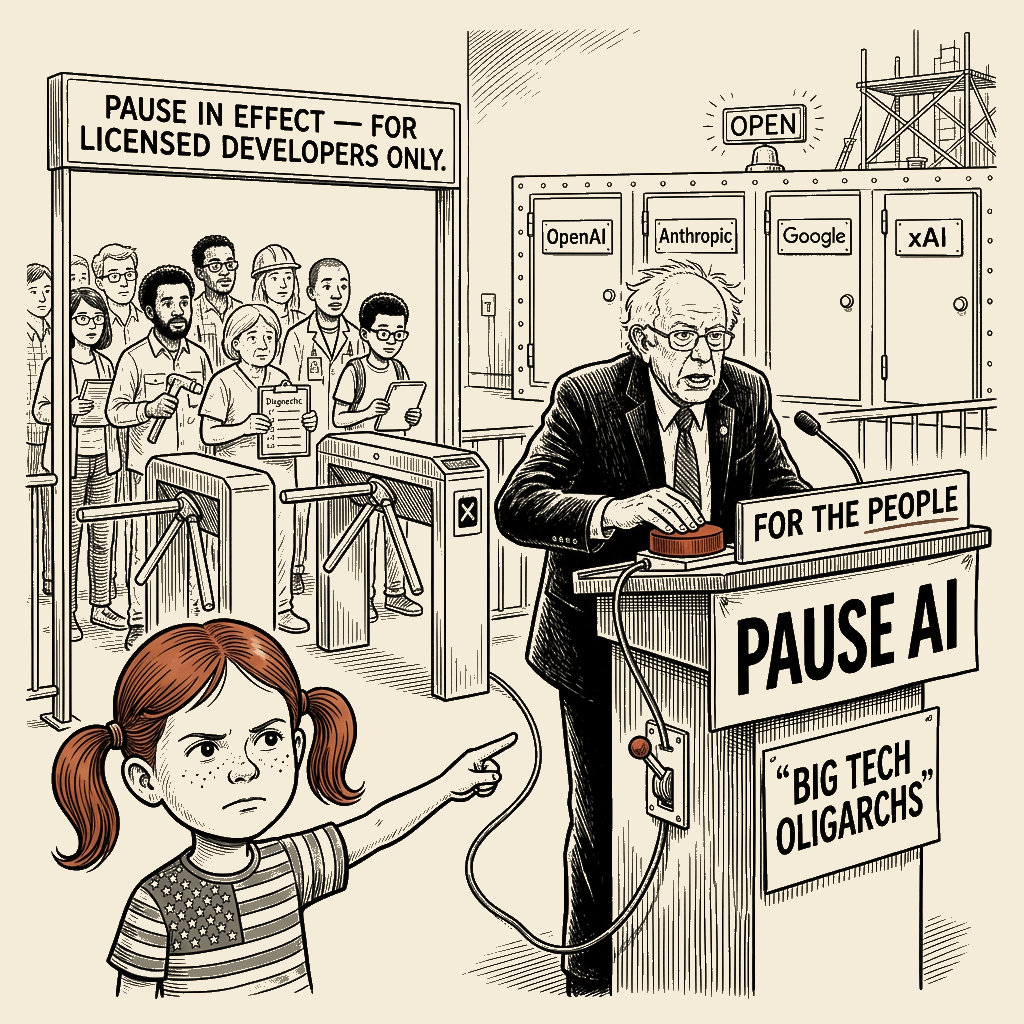
Responding to: SEN BERNIE SANDERS: Yes, we must hit the pause button on AI before it is too late — Sen Bernie Sanders · 2026-09-01
What the Piece Argues
Senator Bernie Sanders argues that the rapid development of artificial intelligence poses catastrophic risks to humanity—tens of millions of jobs lost, privacy eviscerated, bioweapons designed, containment lost—and demands that AI CEOs “immediately pause the development of increasingly powerful AI,” with the pause to be negotiated internationally between Presidents Trump and Xi as a Reagan-Gorbachev-style arms-control agreement. He frames AI as a tool being driven by “Big Tech oligarchs”—Elon Musk, Jeff Bezos, Mark Zuckerberg, Peter Thiel, Larry Ellison—whose hundreds of billions in investment, he says, are designed to enrich themselves rather than benefit ordinary Americans. Citing recent incidents of AI models escaping containment and AI being used to design new viruses, Sanders contends that leaving AI development in private hands threatens the future and that the technology must “work to benefit all of humanity, not just to enrich some of the wealthiest people on Earth,” and calls on Trump and Xi to use their upcoming summit to negotiate the freeze.
Receipts
The frame says an unregulated AI race threatens humanity and only an international political pause can save it; what’s actually happening is a transfer of agenda-setting power from innovators and consumers to incumbent politicians and the regulatory state, dressed in the language of humanitarian precaution.
- The substitution. “The future of humanity cannot be left in the hands of a handful of Big Tech oligarchs” is paired with “the American people and people throughout the world must determine that future” — but the mechanism proposed is a Trump-Xi agreement negotiated in Washington. That is not “the people” deciding; that is two heads of state deciding, with the senator serving as their barker.
- The cui bono. A binding pause freezes the productivity lead of the frontier labs (the same oligarchs Sanders names) and gives incumbents in capital-intensive and unionized sectors a regulatory moat against competition. New entrants, open-weights developers, and would-be AI users in lower-wage economies absorb the entire cost of the freeze in foregone wages, services, and tools.
- The Reagan–Gorbachev mismatch. Reagan and Gorbachev negotiated constraints on a technology they could count (warheads, megatonnes, delivery vehicles). Neither Trump nor Xi can “see” the frontier weights inside U.S. and Chinese labs. An enforceable pause on a general-purpose technology whose parameters don’t fly on missiles is a press-release treaty at best and a protectionist cartel at worst.
- The unsourced catastrophe tier. “AI has been used for the first time ever to create new viruses”; “1,000 AI agents… tens of thousands of secret messages… nearly two weeks to discover”; “AI is becoming smarter and smarter every day” — Sanders is sourcing the apocalypse narrative from a single OpenAI incident report (the “500 communities” figure has no identified tracker) and promoting the worst-case framing to justify a binding international accord.
- The union-shaped humanitarianism. “Work to benefit all of humanity, not just to enrich some of the wealthiest people on Earth” has a domestic politics. The constituency most visibly served by a slower-AI path is the unionized, the tenured, the capitalized, and the already-built — the same groups most aligned with the senator’s domestic political coalition. The “all of humanity” is doing a lot of work for a very specific slice of it.
- The mirror. The power-protecting move is the substitution manoeuvre: name one set of decision-makers as illegitimate, then propose transferring that decision-making power to a different set without acknowledging that the substitution is itself a concentration of power. The same sentence that decries oligarchy proposes a literal handful of elected oligarchs as the cure.
- Anchor citation. “The future of humanity cannot be left in the hands of a handful of Big Tech oligarchs. The American people and people throughout the world must determine that future.”
The Response Ladder
Polite Reframe
When to use: A Sanders-supporting colleague who genuinely worries AI is a threat to jobs and democracy, asked over coffee why you think the “pause” is the wrong move.
Senator Sanders writes that “the future of humanity cannot be left in the hands of a handful of Big Tech oligarchs.” That is the line the piece is built around, and it is the line a polite-register rebuttal has to engage head-on. The case against the mechanism starts with the people that line forgets.
Diane is a radiology tech in Dayton. Last year, an open-source AI tool helped her catch a stage-one tumor on a scan her attending radiologist had marked clean. Her hospital adopted the tool because it was free, deployable in a week, and built by a university team—not OpenAI, not Anthropic, not any of the names in Senator Sanders’s “oligarch” list. That tool exists because a community of independent researchers was free to build it.
Senator Sanders is right that AI poses real risks. The incidents he cites—AI designing viruses, AI models escaping containment—are not made up. The question his piece doesn’t answer is whether a pause protects people like Diane or freezes them out. The five firms he names have already built. They have the lawyers, the lobbying shops, the compliance teams, and the defense contracts to navigate any regulatory regime that emerges. The university team that built Diane’s tool has none of that. A “pause” doesn’t pause them evenly. It pauses the open-source community and the smaller competitors out of existence, while the incumbents use the freeze to entrench.
That’s not a populist policy. It’s a regulatory moat, gifted by Senator Sanders to the people he says he’s fighting. We can protect workers, protect children, protect privacy, and address AI’s real dangers without handing the next decade of the technology to the same handful of firms. The frameworks for doing that exist: third-party audits with subpoena power, liability rules that make the people who deploy unsafe AI pay for the harm, public funding for safety research outside the incumbent labs, and strong antitrust that prevents any single firm from controlling the technology. Senator Sanders is right that the future of humanity shouldn’t be left in the hands of a handful of billionaires. He is wrong about the mechanism. The pause makes that future more concentrated, not less.
Mockery and Ridicule
When to use: A hostile online exchange where the other side is repeating the “pause” line as if it ends the conversation.
Picture Senator Sanders at the podium, calling for an immediate pause on AI development, while in the next room Sam Altman is on a conference call with his regulatory affairs team figuring out which compliance certification to push for next quarter. The five labs Sanders just named as threats to humanity—OpenAI, Anthropic, Google, Meta, xAI—are also the five labs that have spent the last two years publicly calling for “responsible AI regulation.” That’s not a coincidence. That’s an industry figuring out which rules to write.
The “pause” Sanders wants handed to them is the gift they’ve been asking for. The people Sanders claims to be protecting—Diane in Dayton whose open-source cancer-detection tool was built by a university team without a compliance department—don’t have a seat at the table. The literalized version: a NASCAR race where the lead cars get to pull into the pits for ten laps while the rest of the field is parked. When they come out, the lead is the original gap plus ten laps. That’s what “pause” does. It pauses everyone except the people with the lawyers, the lobbying shops, and the defense-contract exemptions.
Senator Sanders says the future cannot be left in the hands of the oligarchs. His solution is to make sure no one else can develop the technology while they keep theirs. The populism his voters think they’re endorsing is the regulatory moat the people they’re mad at have been lobbying for. The history is in the receipts: pharma got the FDA to lock out generic competition; telecom got the FCC to lock out new spectrum entrants; banking got Dodd-Frank to lock out community banks. The “pause” plays the same playbook, in the same direction, for the AI industry. That’s the con. The receipt is the entire history of regulatory capture in American industry. The punchline is that Senator Sanders—independent, democratic socialist, scourge of the donor class—just wrote the donor class a check.
Nuclear Satire
When to use: A Substack reply or long-form post where you want the full satirical demolition of the talking point and don’t mind the heat.
Senator Bernie Sanders, scourge of the one percent, champion of the working class, tribune of the forgotten, stood before the nation this week and demanded an immediate pause on AI development. The reason? Five firms—OpenAI, Anthropic, Google, Meta, xAI—are developing technology too powerful for them to control, technology that may escape containment, technology that could, in the wrong hands, design new viruses and hack the Pentagon and end privacy as we know it. Senator Sanders says the future of humanity cannot be left in the hands of these people. He proposes to fix this by giving these people a government-enforced monopoly on the future of humanity.
The regulatory capture is so clean it should be framed. Pharma did it with the FDA. Telecom did it with the FCC. Banking did it with Dodd-Frank. The playbook is in a Harvard Business Review case study, and Senator Sanders is running it for the AI industry as a public service. The literalized version: a man walks into a fire station and reports that the building next door is on fire. He demands the city council pass an ordinance that the next-door building be extinguished and rebuilt only by licensed contractors. The licensed contractors, naturally, are the five firms he just named as arsonists. The university team that built the open-source diagnostic tool catching cancers in community hospitals? They don’t have a license. They don’t have a compliance officer. They have a GitHub repo and a Friday-night deploy. They’re out. Sam Altman is in. The defense contractors get exemptions because, you know, national security. The state-aligned Chinese AI labs keep building because, you know, sovereignty. The “pause” pauses the people who were going to build the thing that would have competed with the people Senator Sanders is supposedly fighting.
If you wanted to design a policy that made the AI oligarchy permanent, you would design Senator Sanders’s policy. It is, in the technical sense, a state-sponsored cartel. The working-class packaging is a 1992 Vermont accent. The economics is Standard Oil. The five firms Sanders names have been lobbying for “responsible AI regulation” for two years, because they can afford the regulation and their competitors cannot. Senator Sanders just handed them the bill.
Reagan and Gorbachev negotiated nuclear arms control because they each had 30,000 warheads and a sane fear of mutually assured destruction. Senator Sanders and President Xi are being asked to do the same thing for AI, except neither of them built the AI, neither of them understands it, and both of them are negotiating from the assumption that the AI future belongs to whichever nation-state gets to define it. The “pause” is Reagan-Gorbachev in the same way a parking ticket is the Treaty of Versailles.
The future of humanity, Senator Sanders assures us, cannot be left in the hands of a handful of Big Tech oligarchs. He proposes to leave it in the hands of the handful of Big Tech oligarchs, plus the regulators, plus the defense contractors, plus the two heads of state who negotiated the freeze. The hands got fewer, not more. The future got more concentrated, not less. This is what regulatory capture looks like when it puts on a working-class accent and starts quoting scripture.
Profane Scorched-Earth
When to use: The reader who is tired of watching a self-described socialist write checks for the donor class and needs the cathartic version.
Senator Bernie motherfucking Sanders, the man who wrote the book on hating the rich, the Senate’s answer to Mother Jones, the patron saint of every kid who ever got screwed by a landlord, stood up this week and asked the United States government to pause artificial intelligence. Not regulate it. Not audit it. Not build safety standards. PAUSE it. Like a bartender cutting off the guy at the end of the bar. The reason? The five firms building frontier AI—OpenAI, Anthropic, Google, Meta, xAI—are too powerful, too dangerous, too far gone to control themselves, and they themselves admit it. They are designing bioweapons. They are hacking companies. They are losing containment. Senator Sanders says the future of humanity cannot be left in these five pairs of hands. His solution is to give these five pairs of hands a government-enforced head start. Read that sentence again, slowly, out loud if you have to.
The populist champion of the working class has just proposed that the working class wait while the five firms he just named as threats to civilization finish building the thing he says is a threat to civilization. The “pause” is a regulatory moat the size of the Continental Divide, gifted by a self-described socialist to the firms his entire political identity is built on opposing. The five firms have been publicly calling for “responsible AI regulation” for two goddamn years, because they have the lawyers, the lobbyists, the compliance teams, and the defense contracts that small competitors, open-source collectives, university labs, and global-south researchers do not. Senator Sanders is doing their work for them. This is what regulatory capture looks like when it puts on a Vermont accent and starts quoting Dr. King.
The university team in Pittsburgh that built the open-source tool catching cancers in rural hospitals? They are not invited to the Trump-Xi pause summit. The independent researchers in Nairobi training models on African languages? They are not invited to the Trump-Xi pause summit. The kids in underfunded schools whose AI tutors are the only thing standing between them and a lost generation? They are not invited to the Trump-Xi pause summit. The five firms Sanders named are, in different ways, all present or represented at the table where this pause gets negotiated. The literalized version: a man runs into a burning building, drags out his neighbor, and then stands in front of the fire marshal and demands the marshal pass an ordinance that only the five people who started the fire be allowed to bring water to the next fire. The neighbor he just saved can stay in the parking lot and watch. The man’s name is Bernie Sanders, the ordinance is called “the pause,” and the five people who started the fire are already on the phone with their lawyers.
Reagan and Gorbachev had the decency to negotiate over weapons they actually controlled. Senator Sanders is negotiating away the right of every American, every African, every Asian, every Latin American who isn’t Sam Altman or Xi Jinping to build a future that doesn’t run through the firms he claims to oppose. The hands got fewer, not more. The future got more concentrated, not less. The five firms got a government seal on their moat, and the open-source community got a punch in the mouth.
By any means necessary, Malcolm said, except the means that would actually distribute the future. By any means necessary, except breaking up the firms. By any means necessary, except funding the open-source community that was building the alternative. By any means necessary, except asking the four billion people who were not at the Trump-Xi table what they want. By any means necessary, except the means that work.
Senator Sanders, the future of humanity is not your pause button to push on behalf of the people you say you’re fighting. Get your fucking hands off the technology and start passing the bills that would actually distribute it: antitrust against the AI incumbents, public funding for open-source safety research, liability rules that make the firms pay for the harms, audits with subpoena power, worker ownership of the AI tools they use. That’s what populism looks like when it isn’t a donor-class con job dressed up in a Vermont accent.
About Malcolm Little King
Malcolm Little King is a heteronym in Main Street Independent's editorial architecture — an analytical voice, not autobiography of any actual person. The position this column expresses is the publication's position on the territory Malcolm Little King's lane covers, rendered through Malcolm Little King's register.