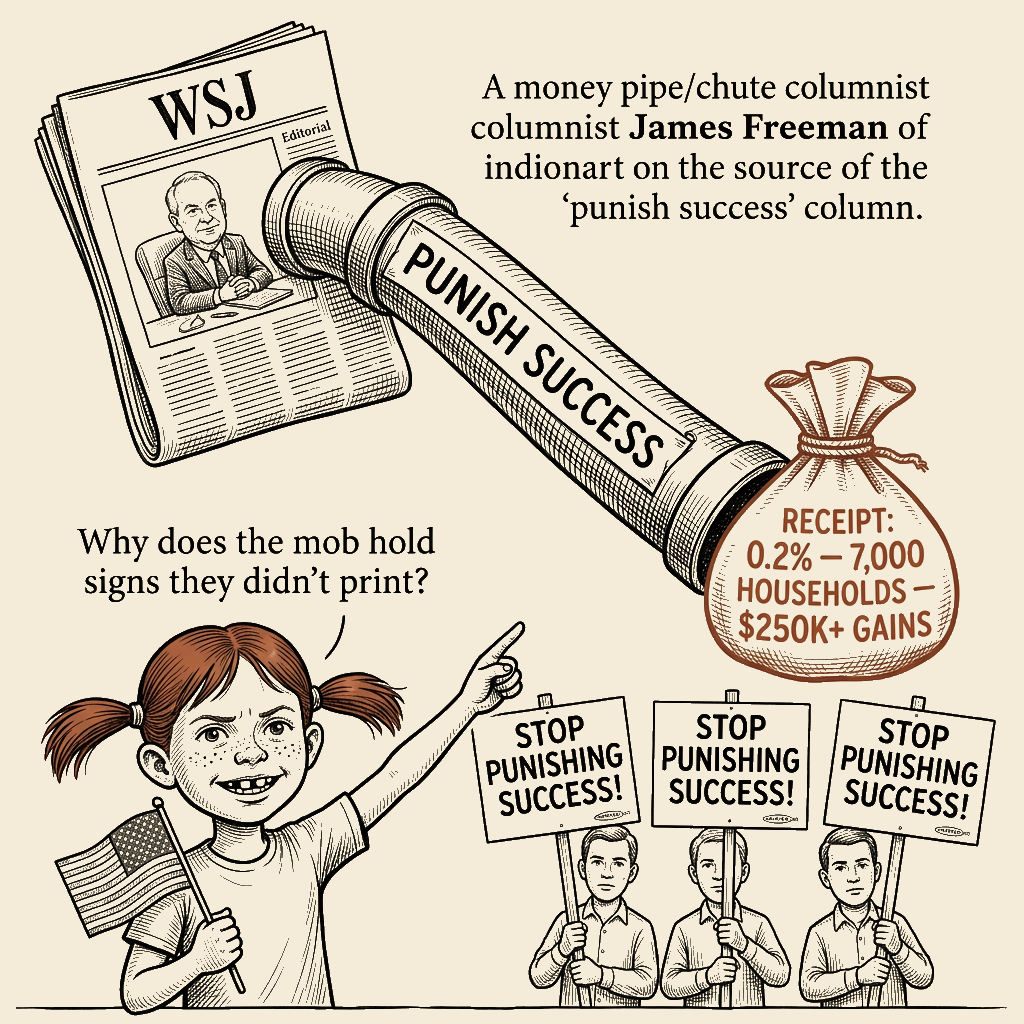
Responding to: Maybe Not the Moment for a Millionaire’s Tax — James Freeman · 2026-09-04
What the Piece Argues
James Freeman’s column argues that Washington state’s new “millionaires tax” — which voters will get a chance to repeal at the ballot in November — is dangerously mistimed. He warns that taxing large investment gains “punishes success and encourages residents to flee,” and that a softening Seattle housing market is no moment to add a “huge new disincentive to locating in Washington.” He frames repeal as a homeowners’ uprising against a tax that was “deceitfully manufactured and marketed,” and extends the affordability complaint to Los Angeles, where he sees climate absolutism running ahead of what voters actually want. The worry is fair on its face — nobody wants a state that prices out its own people. The question is which tax actually does the pricing.
Receipts
The move: take “There’s never a good time for a state to punish success,” dress a tax cut for the top two-tenths of one percent of Washington taxpayers in a homeowner’s robe, then blame a national housing downturn on a levy the homeowner will never pay.
The framing wants you to believe
- Taxing large investment gains “punishes success” and will drive Washington’s achievers to flee.
- The tax is dragging down home values, and repeal is a genuine homeowners’ uprising.
- The tax was sneaked past the public — “deceitfully manufactured and marketed” — so voters never got a fair say.
What’s really going on
- Washington’s 7 percent excise on realized capital gains above $250,000 is paid by roughly 7,000 taxpayers — about two-tenths of one percent of the state’s roughly 3.2 million households. The median Washington homeowner will never pay a dime of it. (Anchor: Washington Department of Revenue; Quinn v. Washington, Wash. S.Ct. 2023, upholding the tax as a constitutional excise.)
- The housing softness the column cites is national. The same Case-Shiller package shows softness in Phoenix, Austin, and Charlotte — none of which carries a 7 percent capital-gains excise like Washington’s. Mortgage rates and supply move prices coast to coast, not a levy on the wealthiest 0.2 percent.
- The proceeds are steered, by budget, into childcare expansion, early learning, school support, and Washington’s Working Families Tax Credit — cash back for low-income working families. When repeal was put to Washington voters in 2023 (Initiative 2109), it lost by roughly two-to-one.
The Response Ladder
Polite Reframe
Let me tell you about Marcus. Marcus runs a small machine shop in Spokane. He’s been at it twenty-two years. Didn’t inherit the building, didn’t have a silent partner with a venture fund. He built it with his hands, his credit, and two decades of showing up before dawn.
Marcus benefits every day from the roads his steel shipments ride on, the community college that trained three of his welders, the fire station four blocks away, and the court system that enforces the contracts keeping his business alive. Those things are not free. Somebody pays for them. In Washington state, the somebody has, for a long time, been disproportionately people like Marcus — because the state has no personal income tax and leans hard on sales and property taxes that hit working people harder per dollar earned.
The capital gains tax on the ballot this November doesn’t touch the first quarter-million in investment profit. Not one cent. It applies only after that — after you’ve cleared more in pure investment gain than most families earn in five years of work. And the argument against it is that it “punishes success.”
King said this country runs socialism for the rich and rugged individualism for the poor, and the numbers prove him right: no income tax, the bottom 20% paying several times the effective rate of the top 1%, and the editorial page calling it punishment the moment someone tries to fix it.
We don’t punish success in this country. We ask the people who benefit most from the system — the courts, the infrastructure, the educated workforce, the stable currency — to contribute to maintaining it. That’s not punishment. That’s the deal. Marcus knows this. Marcus pays his taxes. The question on the ballot isn’t whether Marcus pays — he already does, disproportionately. The question is whether someone clearing a quarter-million in free investment gains will finally be asked to pay something closer to what the system they used actually costs.
Mockery and Ridicule
Somewhere over Idaho, the Fleeing Washington Millionaire is reconsidering. Beneath him, the entire Seattle housing market is softening from the vibration of his departure — or so we’re told. The Wall Street Journal editorial page has the physics all worked out: one man, one Gulfstream, 7 percent of his gains above a quarter-million dollars, and the Case-Shiller index collapses like a soufflé.
Let’s be serious for a moment. The tax that has allegedly depopulated the Pacific Northwest is paid by seven thousand people. Seven thousand. Out of roughly 3.2 million households — two-tenths of one percent. The other 99.8 percent have been informed that they are the “homeowners’ rebellion,” and that their job is to rise up against a levy they will never pay, to defend a neighbor they will never meet, so that the hundreds of millions the tax raises can stay in the portfolios of the people who sold stock at the top. That’s not a rebellion. That’s a rent-a-mob — costumes rented, grievances rented, marching orders faxed from a column that cites falling prices in Phoenix, Austin, and Charlotte — cities in states with no 7 percent capital-gains excise — as proof that Seattle’s levy is cooling the market. The mortgage rate would like a word. So would supply.
The tell is the word “success.” They want you to picture the small-business founder, the grinder who made it, the poster child of “punish success.” The actual defendant is a tax bracket: households clearing $250,000 a year in realized investment gains. That’s not the American Dream; that’s the American Dividend — collected on inherited wealth, on the sale of a third house, on a portfolio that spent the year doing nothing but appreciating. Taxing it isn’t punishment. It’s the caddie fee on a round you already won.
And if this were ever a real rebellion — if three million Washington households were actually rising over a tax they paid — that would be a movement worth watching. It isn’t. The real uprising in this state is the one with bodies behind it: the working families who get the cash-back credits, the parents who got the childcare slots, the schools that got the classrooms. This is a press release with a picket sign photoshopped in — and the homeowner holding it isn’t the author. He’s the one they’re counting on to believe the play.
Nuclear Satire
Behold the miracle of the Fleeing Washington Millionaire — the most athletic creature in American political mythology, capable of outrunning a 7 percent tax while carrying an entire softening housing market on his back. According to the chronicle of this feat, published on the Wall Street Journal editorial page, the Seattle market is collapsing because this titan has decided to decamp, and the Case-Shiller index has gone soft in sympathy. The chronicle does not mention that the index is soft in Phoenix, soft in Austin, soft in Charlotte — cities in states with no 7 percent capital-gains excise to spook him. It is a national downdraft, and they are selling it as a local punishment. That is not analysis. That is a séance.
The séance’s name is “the homeowners’ rebellion.” What a rebellion it is: a grassroots movement that arrived by FedEx, assembled itself in the lobby of a campaign consultant, learned its chants from a focus group, and can be returned for a full refund if the initiative fails. Its army is the median voter; its enemy is a tax the median voter will never pay; its beneficiary is the roughly seven thousand households in the entire state who clear a quarter-million dollars a year in investment gains. It is a costume drama, and the costume budget is enormous — the hundreds of millions the tax raises each year, which lawmakers have steered into childcare, early learning, schools, and cash-back credits for working families, which the production exists to redirect back into the portfolios of the top 0.2 percent.
“There’s never a good time for a state to punish success,” writes James Freeman, with the solemnity of a coroner noting that there’s never a good time for a heart attack. The “success” so tenderly defended arrives by inheritance, appreciates by market tailwind, and departs by private jet — and the “punishment” on offer is that it occasionally contribute to the society that minted it, the way a tree contributes to the soil that fed it. If that is punishment, every one of us should be so lucky. The working mother who receives a cash-back credit from the proceeds is not a revolutionary. She is the victim — in the one act of this drama where the victim is real.
In the script they’ve written, you — the homeowner who will never pay the tax — are cast as the mob. The fleeing millionaire is the hero. And the villain is a levy that funds the schools, the childcare, and the cash that keeps working families whole. It is a passion play performed for an audience of one: the tax bill. The state is invited to watch, and to believe, while the beneficiaries of the “no new taxes” crusade fly overhead and you hum the anthem. That’s not a rebellion. That’s a shakedown with a soundtrack — and the man selling the tickets is the same man collecting the money.
Profane Scorched-Earth
Let’s be clear about what the goddamn thing is. “There’s never a good time for a state to punish success.” Seven thousand people in the entire state of Washington pay this tax. Seven thousand. Out of roughly 3.2 million households. That’s two-tenths of one goddamned percent — and the Wall Street Journal editorial page wants a “homeowners’ rebellion” over it? Bullshit. That’s not a rebellion; that’s a livery service. The homeowners aren’t in the uprising; they’re in the audience, holding a sign printed by a campaign committee that couldn’t find its way to a grassroots movement with a map and a flashlight.
You know who’s actually in this fight? The working mother whose family gets the cash-back credit this tax pays for. The toddler who got a childcare slot. The school that got a classroom. Those are the people the “repeal the millionaire’s tax” crusade is coming for — and they’re not being punished for success, they’re being punished for being poor enough to need the state, while the guy who sold three million in stock and owes 7 percent on the gain is the “victim.” King put it more than half a century ago: this country runs socialism for the rich and rugged individualism for the poor. Here’s the living specimen — a state socializes the cost of childcare and early learning, and the editorial page calls it tyranny; a national housing downturn driven by mortgage rates and supply, and the editorial page calls it the millionaire’s tax’s fault. The Case-Shiller numbers are falling in Phoenix and Austin and Charlotte — cities in states with no 7 percent capital-gains excise — and the Journal cites the softening as evidence for a tax cut for the top two-tenths of one percent. You’d have to be a goddamn genius or a goddamn con artist to hold those two facts in your head at the same time and file that column — and this column is not the work of a genius.
And spare me the “deceitfully manufactured and marketed” bullshit. The 2023 capital-gains tax was enacted by the elected legislature, signed by the governor, upheld by the state Supreme Court as an excise tax, and then put to the voters — and the voters were asked to repeal it in 2023, and they said no by roughly two to one. That’s not a tax manufactured in secret. That’s a tax the people of Washington have seen, inspected, and kept. The only thing manufactured is the “rebellion” — and the ones who manufacture it are the ones who would keep, every year, the hundreds of millions the tax raises, currently steered into childcare, early learning, schools, and cash in the pockets of working families.
There’s never a good time to punish success. Correct. So let’s stop punishing the single mom who works two jobs, and call the tax what it is: the admission price for the society that made the gains possible. If a man’s success was built on Washington’s roads, Washington’s courts, Washington’s schools, Washington’s workers — and it goddamn was — then 7 percent of the gain above $250,000 is not punishment. It’s the bill. It’s the whole bill. Pay the bill, or flee, or shut the fuck up about being punished. The working families this tax keeps whole aren’t the ones doing the fleeing. They’re the ones doing the staying — and the staying is the goddamn point.

About Malcolm Little King
Malcolm Little King is a heteronym in Main Street Independent's editorial architecture — an analytical voice, not autobiography of any actual person. The position this column expresses is the publication's position on the territory Malcolm Little King's lane covers, rendered through Malcolm Little King's register.