Responding to: California’s Pro-Business Wealth Tax Proposition — Ro Khanna · 2026-09-02
What the Piece Argues
A member of Congress writing in the Wall Street Journal opinion pages argues that California’s Proposition 40 — a November ballot measure imposing a one-time 5% wealth tax on the state’s billionaires, with revenue earmarked for healthcare, education, and food assistance — is not antibusiness but actively pro-business. The argument runs that the postwar U.S. economy innovated rapidly under top federal rates of 52% corporate and 91% individual marginal, that named billionaire innovators (Cook, Pichai, Huang, Spielberg, Beyoncé) wouldn’t have produced less work if more had been taxed, and that the 2024 Nobel in economics went to Acemoglu, Johnson, and Robinson for showing extractive institutions — including concentrated wealth translating into political power — are what actually smothers innovation. A 2023 CBO report finding childhood Medicaid enrollment raises adult earnings is offered as evidence the revenue funds productive human-capital investment. Jensen Huang’s “so be it” quote anchors the argument that the innovators themselves aren’t opposing the measure.
Receipts
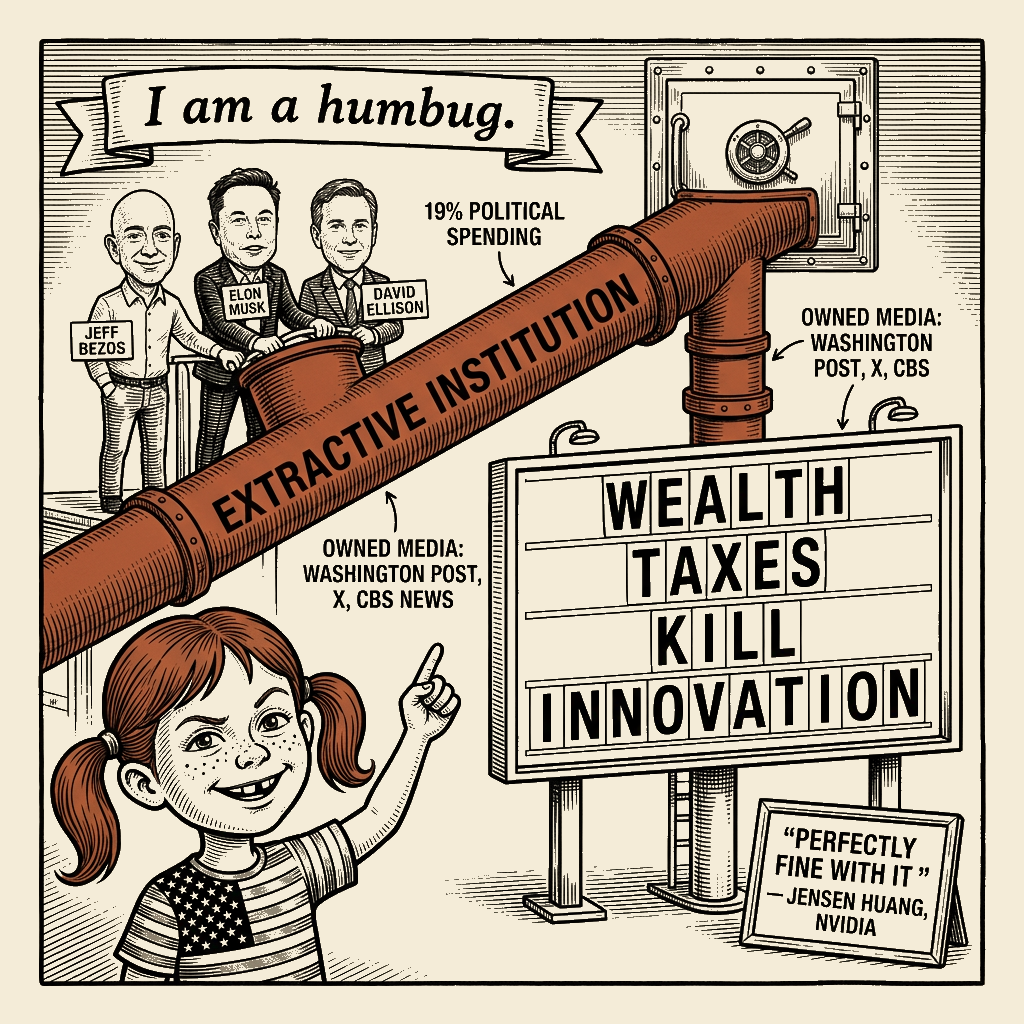
The “wealth tax kills innovation” frame is a defense of the very concentration the Nobel-winning work identifies as the threat.
-
The framing wants you to believe
- Taxing billionaire wealth will “do serious economic damage by killing the incentives of innovators.”
- Wealth taxes are “antibusiness” and harm the economy by deterring entrepreneurship.
- The post-1980 rate-cut era produced the modern innovation boom, and rolling taxes back up will reverse it.
-
What’s really going on
- The 2024 Nobel in economics (Acemoglu, Johnson, Robinson) was awarded for the body of work showing that extractive institutions — concentrated wealth that translates into political power — are what starves innovation of new firms and creative destruction, the opposite of what the talking point defends.
- Billionaire share of U.S. political spending went from 0.3% (2008) to 19% (2024); Jeff Bezos bought the Washington Post, Elon Musk bought X, and David Ellison is running CBS News. That is the “innovation” the talking point protects: not new chips or vaccines, but billionaire-controlled political and media power.
- The postwar U.S. economy — top marginal individual rate 91% through 1963, top corporate rate 52% — built the interstate highway system (1956), invented the integrated circuit (1958), and put a man on the moon (1969). The high-rate era produced the most concentrated technological ferment of the twentieth century.
- Jensen Huang, when asked, said on the record: “Whatever taxes I guess they would like to apply, so be it. I’m perfectly fine with it.” The talking point requires disbelieving the man whose company would pay it.
- Anchor citation: CBO (2023), “Medicaid enrollment during childhood has been shown to increase earnings in adulthood,” with long-run fiscal gains offsetting “half or more” of the initial cost — i.e., the revenue funds an investment that pays back half its own cost.
The Response Ladder
Polite Reframe
When to use: A persuadable moderate or good-faith family member who has heard “wealth taxes kill innovation” and is genuinely uncertain. Calm moral reminder; receipts do the work; no mockery.
Maria is 34. She works two jobs in Stockton and has a kid with asthma on Medicaid. The federal cuts in the One Big Beautiful Bill Act will hit her family in eighteen months. Proposition 40 is the question of whether California steps in. That is the population the wealth tax is built to defend — and that is where the “antibusiness” line should be tested.
The “wealth taxes kill innovation” framing wants you to assume that any tax on billionaire wealth is automatically bad for the economy. Here is the question to ask the critics: when the top marginal rate was 91% in the 1950s and the top corporate rate was 52%, did innovation die? No. The country invented the transistor, built the interstate highway system, landed on the moon, and laid the foundations for the modern middle class. The economy that produced the iPhone and Nvidia chips grew up under tax rates roughly twice what they are now.
The Nobel committee gave its 2024 prize in economics to Daron Acemoglu, Simon Johnson, and James Robinson for work distinguishing inclusive institutions — secure property rights, rule of law, broad opportunity, limits on elite extraction — from extractive ones. Their finding: innovation is smothered when powerful groups hoard resources and translate economic power into political power. The “kills innovation” framing is the extractive pitch. It is the argument that wealth concentration is fine and the tax is the problem, when the prize-winning research says concentration is the problem.
The same critics will tell you the tax will “kill incentives.” What incentives? Jensen Huang, the Nvidia CEO who would owe roughly $8 billion under Proposition 40, told reporters when asked about the tax that he is “perfectly fine with it.” Tim Cook and Sundar Pichai are also billionaires, and none of them have announced plans to leave. The question is not whether they will keep building if taxed. It is whether the country that built them will keep producing the educated, healthy workforce they need. Huang himself said Nvidia is in Silicon Valley “because that is where the talent pool is.” A wealth tax that funds healthcare and education replenishes that pool. That is the investment. That is the incentive.
Mockery and Ridicule
When to use: a Twitter exchange, a Substack reply, a hostile uncle repeating the talking point after dessert. Funny-before-devastating, the inversion stamped explicitly, mockery aimed at the apex and the voter shown they are being used.
The argument that taxing California’s billionaires will “kill innovation” is the funniest thing the rich have produced since the last one. Picture Jensen Huang, CEO of Nvidia — the most valuable chipmaker on earth, the company whose GPUs are powering the entire artificial-intelligence revolution — at his kitchen table, dipping into his roughly $8 billion share of the wealth tax. He has to write a check. He’s ruined. Innovation is over. The H100 production line freezes. The Hopper roadmap collapses. Sundar Pichai, having heard the news, calls his accountant and quits Google on the spot. The economy of the entire Pacific Rim region — half the world’s GDP — collapses because California asked its richest residents to part with five cents on the dollar of their paper wealth. The same five cents that, throughout the postwar decades, was paid at top marginal rates as high as 91% — an era that built the interstate highway system, put a man on the moon, and invented the integrated circuit. The talking point is the cost of admitting that we cut the top rate from 91% to 37% and the innovation didn’t accelerate; the wages stagnated and the wealth concentrated.
Nuclear Satire
When to use: A targeted rebuttal aimed at the conservative apparatus itself — the op-ed page, the donor memos, the billionaire-funded think-tank stenographers. Apex of power named in full; hyperbolic criminal/hellfire metaphors deployed; TRUTH floor absolute constraints still hold.
The “wealth taxes kill innovation” line is the most successful marketing slogan the twenty-first century has produced. Imagine the product: a 5% tax on the unrealized gains of roughly 200 California residents whose combined wealth exceeds $2 trillion, none of whom would notice the loss in any tangible way. Imagine the catastrophe: the United States of America, which invented the airplane under a 91% top marginal rate and put a man on the moon under a 70% top rate and built the silicon chip under a 50% top rate, will lose the capacity to produce innovation because one state asked its billionaires to fund healthcare and education. The sales pitch has been so successful that the man who would owe the most — Jensen Huang, the Nvidia CEO who would owe roughly $8 billion under Proposition 40 — was asked directly and said he is perfectly fine with the tax. The mouthpieces have to do the talking the billionaires will not.
The Nobel committee gave the 2024 prize specifically for the framework that distinguishes inclusive institutions — secure property rights, rule of law, broad opportunity, limits on elite extraction — from extractive ones, where powerful groups hoard resources and translate economic power into political power. The empirical evidence for the extractive threat is right there in the same piece: billionaire share of U.S. political spending went from 0.3% in 2008 to 19% in 2024, and named examples include Jeff Bezos’s ownership of the Washington Post, Elon Musk’s ownership of X, and David Ellison’s running of CBS News. The Nobel awarded the framework; the political-spending data is what empirically instantiates the extractive threat the framework names. The “kills innovation” line is the pitch from the extractive side of the divide — the exact opposite of what the prize was awarded for. To call the line pro-innovation is to call monopoly pro-market. To call it pro-business is to call arson pro-fire-department. The mouthpieces who use the line know better. The think tanks that funded it know better. The billionaires who would benefit know better. The argument has no constituency except the people who stand to inherit the apparatus that funds it.
A 5% wealth tax is what ancient Athens would have called a token. Modern Athens — that is, the American republic — funded the Louisiana Purchase by taxing the wealthy. It funded the transcontinental railroad by taxing the wealthy. It funded the GI Bill by taxing the wealthy. It funded the Apollo program by taxing the wealthy. Every major American investment in the productive capacity of the next generation was paid for by the generation that had extracted the most from the previous one. The line that says this will “kill innovation” is the line that says the productive capacity of the next generation is a cost we cannot afford. The mouthpieces who say it have a name for the cost. They call it “their money.” They call it “antibusiness” when you ask for it. They call it “killing innovation” when you name what it would fund. They call it “socialism” when the kids who benefit grow up to be the workers and soldiers the country needs. The country has a different word for it. The country calls it infrastructure. The country calls it investment. The country calls it what it was called in the 1950s, when the top rate was 91% and the economy was busy inventing the future. The country called it American.
Profane Scorched-Earth
When to use: For the reader who has heard the line one too many times and needs the receipts and the profanity in the same breath. Cathartic; full expletive arsenal deployed; the receipts hold the spine; profanity lands hard.
The fucking “kills innovation” line. California’s billionaires have accumulated more than $2 trillion combined — that is the actual scale. Jensen Huang, the Nvidia CEO, could owe roughly $8 billion under Proposition 40. Tim Cook and Sundar Pichai are also billionaires multiple times over. And the country that these people call home is supposed to tremble because California wants 5% of their unrealized gains — the same country that invented the fucking jet engine under a 91% top rate and built the silicon chip under a 50% top rate and put a man on the goddamn moon under a 70% top rate. The mouthpieces who say this — the think-tank parasites, the lobbyist ghouls, the speechwriters whose kids will never know what the country built — are out here arguing that Jensen Huang will pack his semiconductor fab onto a yacht and sail to Bermuda if California dares to tax him at 5%. The man himself was asked about it. He said he is perfectly fine with it. So the line is not from the billionaires. The line is from the bullshit apparatus the billionaires fund, which got 19% of political spending in 2024 — up from 0.3% in 2008 — and which now sells the country the proposition that its richest residents will stop building things if asked to fund the schools and hospitals that build the workforce that builds the things. Bullshit. That is the word for it. Bullshit with a marketing budget.
The fucking Nobel committee. 2024 prize in economics. Acemoglu, Johnson, Robinson. Awarded specifically for the proposition that innovation is smothered when powerful groups hoard resources and translate economic power into political power. That is what the “kills innovation” line defends. It is the extractive-institution pitch. It is the anti-Nobel pitch. It is the case that the country should keep paying the rich enough to buy the politics that protects the wealth, and the prize-winning research says that this is the structure that kills innovation. The mouthpieces who say otherwise are taking money to argue against a Nobel prize. They know it. They do not give a shit. Their kids go to private schools. Their healthcare is in a different country. Their retirement is in a different state. They have nothing to lose from the argument. You have everything.
Listen. A 5% wealth tax on billionaires in one state, to fund healthcare and education, is not a fucking revolution. It is what ancient Athens would have called a civic duty. It is what the 1950s would have called Tuesday. It is what the New Deal was built on. It is what the GI Bill was. It is what the transcontinental railroad was. It is what every American institution that produced the country you live in was built on: the proposition that the generation that extracted the most from the previous one owes the next generation the schools and hospitals and roads that make extraction possible in the first place. The mouthpieces who call this “antibusiness” are calling the country antibusiness. They are calling the New Deal antibusiness. They are calling the GI Bill antibusiness. They are calling the Apollo program antibusiness. They are calling the silicon chip antibusiness. They are calling the jet engine antibusiness. They are calling the fucking highway system antibusiness. Because the highway system was built by taxing the rich, and the silicon chip was invented under taxes that were twice what they are now, and the moon landing was paid for by people who had been told that high taxes would kill the country and who paid them anyway and built the country anyway. The mouthpieces are full of shit. The billionaires know they are full of shit. The Nobel committee knows they are full of shit. The only people who do not know are the voters they are trying to bullshit, and those voters can either wake up or keep swallowing the line. The arc bends. It bends when people like you decide it bends.
So when the next mouthpiece says “wealth taxes kill innovation,” you say: the 91% top rate built the fucking country. What is your plan — fund it, or keep selling the line that built the mouthpieces?

About Malcolm Little King
Malcolm Little King is a heteronym in Main Street Independent's editorial architecture — an analytical voice, not autobiography of any actual person. The position this column expresses is the publication's position on the territory Malcolm Little King's lane covers, rendered through Malcolm Little King's register.