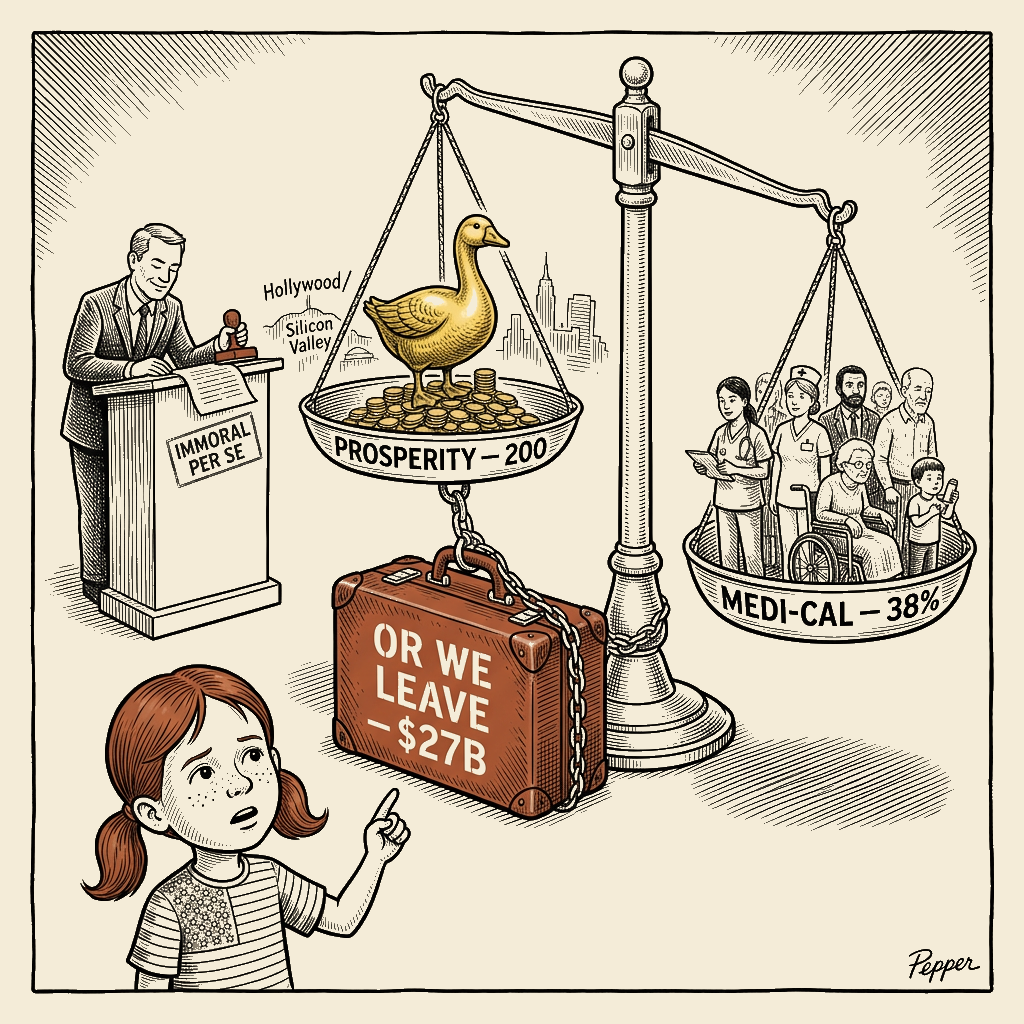
Responding to: Californians Shouldn’t Tax Away the State’s Prosperity — The Editors · 2026-09-04
What the Piece Argues
Proposition 40 would impose a 5 percent wealth tax on net worth above $1 billion — roughly 200 Californians — with revenue earmarked overwhelmingly for low-income health care. The editorial argues the levy is a badly designed, likely unconstitutional penalty on investment that would drive out the state’s most productive residents, cost more in lost income-tax revenue than it raises, and turn government into an instrument of confiscation. It frames the tax as “immoral per se” — naked injustice against “a particular group” — and warns that passing it would kill the state’s “golden goose,” the limitless spirit of building that erected Hollywood and Silicon Valley.
Receipts
The framing performs a shell game: it asks you to worry about California’s “prosperity” while quietly taking the side of the 200 people whose fortunes the tax would touch — against the 38 percent of Californians whose care it would fund.
The framing wants you to believe
- A 5 percent tax on billionaires is “a staggering penalty on investment” that weakens growth and hits job creation.
- Billionaires are “preemptively leaving” — $27 billion in lost income-tax revenue gone — and the Hoover Institution shows the tax would cost the state $25 billion net.
- Thirty-eight percent of Californians on Medi-Cal is a “bloated entitlement bill”; the state should slim it, not fund it.
- Wealth taxes are “immoral per se” — confiscation by an unjust government, and “quite possibly unconstitutional.”
What’s really going on
- The tax applies only to net worth above $1 billion — 200 residents — and is earmarked for low-income health care. The whole editorial is a fight over a roughly $1-trillion pile versus the state’s sickest people, dressed as a jobs report.
- The “investment” the tax would “penalize” has, in this same class’s recent history, gone disproportionately to stock buybacks: after the 2017 federal corporate cut, S&P 500 companies spent a record ~$806 billion on buybacks the following year rather than flowing that money to wages or new investment (S&P Dow Jones Indices).
- The exodus is the leverage, not the math. After California raised taxes on its top earners in 2012 (Prop. 30), researchers found no measurable increase in millionaire out-migration (Varner & Young, Sociological Science, 2015). The Hoover projection assumes the flight it then “discovers.”
- The “typical poverty rate” hides the cost-of-living fact: under the Census Supplemental Poverty Measure, which accounts for cost of living, California ranks among the highest-poverty states in recent years. The 38 percent figure is coverage, not dependency.
The Response Ladder
Polite Reframe
When to use: with a good-faith family member or colleague genuinely torn on the measure — the reader who needs the calmest case before the receipts.
Let me start with Brenda. Brenda is a home-care worker in Fresno. She drives between four clients a day, she changes bedpans, she cooks, she sits with people whose families have moved away, and her own health coverage — and the wages that keep her car running — come out of Medi-Cal, the program the state’s health-care workers are trying to fund. If the tax on the two hundred Californians worth more than a billion dollars passes, that money goes to people like her. If it doesn’t, the money stays where it already is: on top of a thousand fortunes, doing nothing for Brenda.
Now, the editorial raises real questions about administration and valuation, and a court may have to answer them — points the state ought to build the tax to survive.
But hear what the argument is asking you to accept. The same page that calls Brenda’s coverage “bloated” asks you to believe the state’s entire prosperity rides on not taxing the top two hundred. The same editors who say government must not confiscate warn, in the same breath, that the billionaires are ready to leave with $27 billion of state revenue — a threat, dressed as news. An exodus of the very wealthy is not a law of nature. It’s a choice — and it’s a choice the state’s workers, the people who built the platforms those fortunes stand on, are not free to make. They can’t leave Fresno. They’re the ones who stay.
We don’t desert our own. That is not a slogan; it’s a description of what a commonwealth is. The neighbor on dialysis, the home-care worker, the kid whose asthma lands in the emergency room — these are our people, and a state that treats their care as an “entitlement bill” while curtsying to the departure of the men who owe it the most is not being frugal. It’s being a servant. Vote yes — and then hold the legislature to build the tax right. The arc of this state bends the way the people in it bend it, and Brenda and the people she cares for are the state.
Mockery and Ridicule
When to use: with the bystander who’s seen the headline and needs the laugh that breaks the frame — the comment section, the group chat, the dinner table where the “golden goose” line gets repeated.
Let’s talk about the goose. The editorial has decided that California’s prosperity is a golden goose, and the goose is — checks notes — a man worth eleven figures who’s currently on the phone with a relocator in Austin. That’s the goose. Not the 38 percent of Californians on Medi-Cal. Not the home-care worker. Not the nurse. The goose is the man who wants to keep his fourth billion in a trust and his fifth billion in art, and who has decided that a 5 percent tax on the part of his fortune above $1 billion is “confiscation.”
Picture the scene the editors are selling: two hundred men — and it’s almost all men — standing at the state line, holding their yachts over their heads like refugees, while California begs. “Please don’t leave us,” the editors cry, “the limitless spirit of building!” And the men narrow their eyes and say, “Only if you swear on the founders not to touch us.” That’s not prosperity. That’s a hostage negotiation with the hostage-taker as the goose.
And the arithmetic is even funnier. A “onetime” tax of 5 percent on everything above the billion-dollar line: a man worth $2 billion pays 5 percent of the second billion — five cents on the dollar above the line — and the same page that calls that “confiscation” calls 38 percent Medicaid dependency “bloated.” Bloated — by the people it covers. And we’re told a labor union should know better because taxes “hit job creation,” while the last big federal tax cut for this same class produced a record run of stock buybacks — money that went to the goose, not to anyone who builds anything. The Hoover math — $40 billion, not $100! a $25 billion net loss! — is a fortune-cookie projection from a think tank that has never met a tax on the rich it liked, and it’s the only receipt in the whole performance.
Oh, and one more receipt for the goose’s bluff: when California actually raised taxes on its top earners in 2012 under Proposition 30, the researchers who followed the millionaires — Varner and Young, in Sociological Science — found no measurable exodus. The geese stayed. The sun rose. The schools got funded. The goose’s threat is a tell, not a forecast.
Here’s what the bystander should see: the editorial is not worried about the state’s prosperity. The state’s prosperity is the goose’s egg, and the goose wants all of them. The people being asked to worry — you, me, the voter with the Medi-Cal card in the drawer — are being asked to take the goose’s side in a fight between the goose and the henhouse. And there’s a word for the hen that keeps laying for the goose’s table. It’s not “free.” It’s “used.”
Nuclear Satire
When to use: when the editorial is being passed around as wisdom and you need the full grotesque inversion — receipts stacked, identities stamped, no quarter.
The editors of this piece have written a sentence that deserves to be bronzed: “wealth taxes are immoral per se in any republican government.” Let’s sit with the “per se.” Not badly drafted. Not hard to administer. Immoral — in itself — for a government to confiscate the property of “a particular group.” The particular group being: the two hundred Californians whose net worths clear $1 billion. That’s the group the constitutional order was “designed to protect” — the men who built their fortunes on the state’s infrastructure, its universities, its patents, its workers, and now find the republic has the gall to ask them to fund the health care of the people who changed their parents’ bedpans.
Run the inversion the editors are too squeamish to face. The founders they invoke were not building a moat around private fortunes; they were building a republic — and this republic has, since its founding, taxed, regulated, and reordered property whenever the commons demanded it. The “confiscation” they fear is a 5 percent haircut above the billion-dollar line, onetime, for dialysis and primary care. And the “naked injustice” they smell is not in the proposal; it’s in the sentence they wrote themselves: 38 percent of Californians are on Medi-Cal, and the state’s answer, per the editors, is to “slim” the bill — while the men who left “preemptively” took $27 billion of state revenue with them. There’s your naked injustice. A state that tells its sick to be thinner so its billionaires can stay fat.
And the golden goose — let’s cook it properly. The goose is not the state. The goose is the story. The story says: feed the goose forever and it will lay golden eggs forever. But the goose has been shown the knife — a 5 percent tax above $1 billion — and the goose’s answer is to fly to Texas. So the moral of the story is: the goose was never yours. The goose was always a man with options, and the “prosperity” was always the eggs, and the eggs were always going to be laid wherever the goose pleased. The only thing the editors are really protecting is the fairy tale — because without it, you’d notice that the state’s prosperity is fully compatible with 38 percent of its people on Medi-Cal and its sickest children waiting for care, while two hundred men hold the state’s budget hostage from the tarmac.
The prophets had a word for this sentence. Jeremiah’s word was: they did not know how to blush. A government that cannot tax its wealthiest two hundred to care for its sickest 38 percent has not failed at arithmetic. It has failed at judgment — and no amount of “per se” morality will launder that.
Profane Scorched-Earth
When to use: for the reader who has heard the “golden goose” line one time too many and needs the full cathartic release — gloves off, receipts on the table.
I’m going to say the quiet part so loud the goose hears it in Austin: fuck the golden goose.
Let’s be clear about what this editorial is begging for. It is begging — in the language of the founding fathers, the free market, and the “limitless spirit of building” — for the right of two hundred men to keep sitting on roughly a trillion dollars in a state where 38 percent of the people are on Medi-Cal. Not 38 percent of the geese. People. The man in Fresno who wipes his mother’s forehead for a wage that requires Medi-Cal to survive. That’s the “bloated entitlement.” Your aunt’s hospice is “entitlement.” Your kid’s asthma is “bloated.” And the goose — the goose is a man with a third yacht who has decided that a 5 percent tax on the portion of his fortune above a billion dollars is “naked injustice.” Naked injustice, motherfucker? Let’s talk about naked.
A man worth $1.1 billion, under this tax, pays 5 percent of the $100 million above the line — $5 million. Five million out of one point one billion — half of one percent of everything he owns. His housekeeper pays a higher effective tax rate on her wages than he pays on his horde, and when the IRS files were leaked, the very wealthiest Americans turned out to be paying effective tax rates averaging around 3.4 percent — less than the people who clean their houses. And the editors call her coverage “bloated” while they call his tax “immoral per se.” Per se! As if the republic was founded so a man could accumulate a billion and then tell the republic — tell the sick, tell the workers, tell the nurses — “no, and also, you may not ask, because the founders.” The founders are dead, you cowards; they’re not going to be mad that you taxed a billionaire for dialysis. Christ’s only recorded act of force in the gospels was against the men selling doves in the temple — turning profit inside the house of God — and you think he’d be out here defending the goose’s fourth billion against the sick? Get the fuck out of here.
And don’t give me the flight math. The men who “preemptively left” took $27 billion with them — and you report that like it’s weather instead of what it is: a threat, performed in public, to keep the goose fed. The Hoover “conclusion” is a projection from a think tank that would find any tax on the rich unconstitutional “per se”; its arithmetic assumes the answer it wants. The actual record of California taxing the wealthy is right there: 2012, Proposition 30, a real tax increase on the state’s top earners — and the studies (Varner & Young, Sociological Science, 2015) found no measurable millionaire out-migration. No exodus. No goose exodus. The goose bluffed, the state collected, the schools got funded, and the sun still came up in Los Angeles.
So here’s the catharsis, and here’s the truth: the prosperity of California was never the goose. It was always the eggs — the workers, the sick, the nurses, the builders, the Brenda of the world who stay when the goose leaves. Let the goose go. Let him take his fourth billion and his relocator to Austin, and let him discover that Austin doesn’t have the university, the ports, the sun, the people who built the thing he’s standing on. And when he’s gone, the state will still be here — funding the care, paying the workers, laying the eggs — while the editors, who kneeled to a man with a yacht, are left holding the fairy tale and a bill for the goose’s dinner. The arc of the moral universe bends toward justice, but it bends the way it always bends: when the people who stay — the ones who feed, clothe, and heal — refuse, one more time, to kiss the ass of the ones who leave.

About Malcolm Little King
Malcolm Little King is a heteronym in Main Street Independent's editorial architecture — an analytical voice, not autobiography of any actual person. The position this column expresses is the publication's position on the territory Malcolm Little King's lane covers, rendered through Malcolm Little King's register.