Responding to: Handouts for Hollywood—Really? — The Editorial Board · 2026-09-03
What the Piece Argues
The Wall Street Journal Editorial Board argues that President Trump’s proposed federal tax subsidy for Hollywood film and television production is unwarranted corporate welfare that will enrich politically connected producers and labor unions without producing the jobs it claims to create. The piece cites state-level subsidy programs—New York’s $1.2 billion annual film credit and California’s $750 million tax credit—as evidence that production subsidies have demonstrably failed (106,300 industry jobs lost over four years, 63,400 since the pandemic; California alone has lost 19,200 production jobs). It identifies Senator Adam Schiff, Paramount Skydance CEO David Ellison, and Jeffrey Katzenberg as the politically connected insiders who would benefit, and pivots to defending the WSJ’s own free-market orthodoxy—praising the 2017 tax reform as “largely neutral”—as the proper framework for evaluating entertainment industry policy. The piece closes by urging Congress to kill the proposal.
Receipts
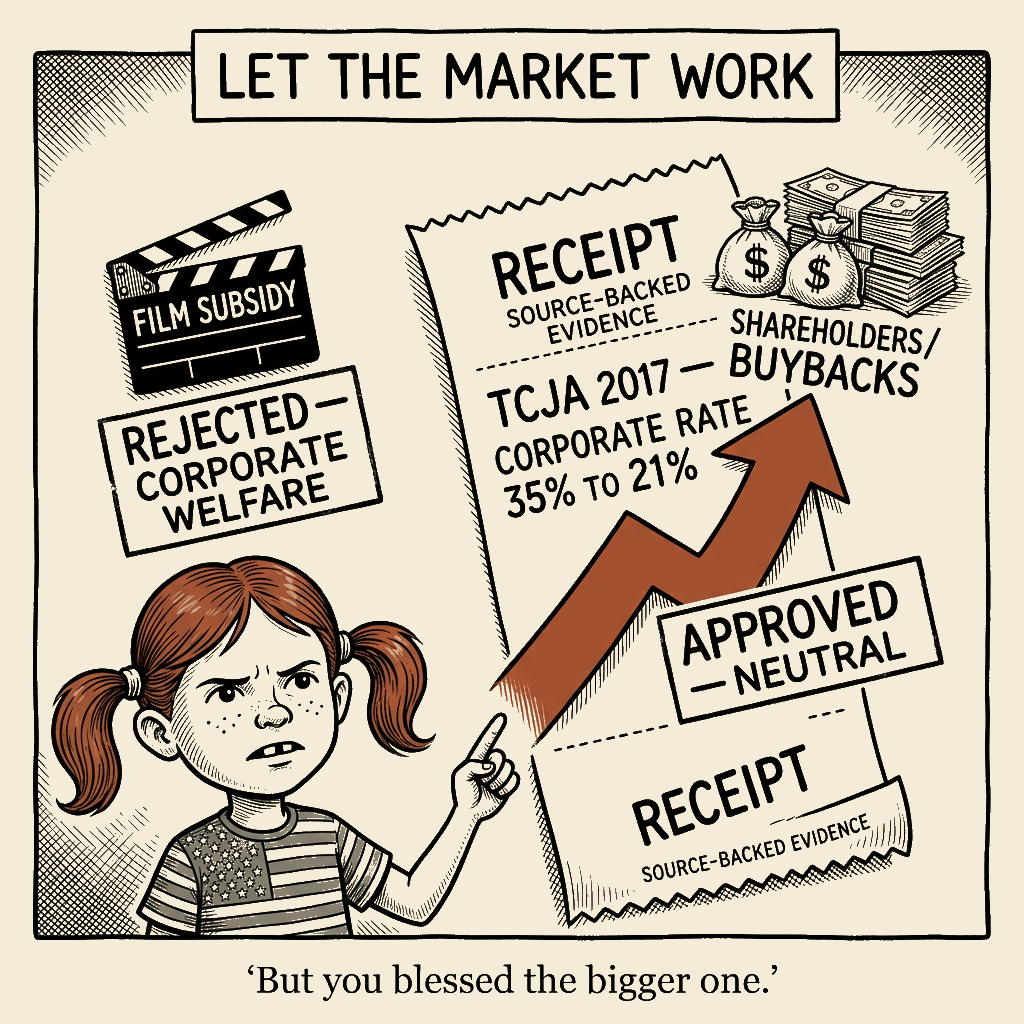
The framing attacks targeted subsidies to displaced entertainment workers as “corporate welfare” while the WSJ’s own preferred tax regime delivered vastly larger corporate welfare to the incumbent capital that did the displacing.
The framing wants you to believe
- Federal film subsidies are corporate welfare that enrich politically connected insiders without producing jobs—state programs prove this.
- The WSJ’s free-market orthodoxy is the proper framework; the 2017 reform was “largely neutral” and pro-growth.
- Production migration is driven by streaming economics and high California costs, not anything subsidies could fix; cutting the subsidy is the right answer.
What’s really going on
- The TCJA of 2017 cut the federal corporate rate from 35% to 21%—the largest permanent corporate tax cut in modern American fiscal history—and the Journal editorial board cheered it on. That windfall flowed overwhelmingly to shareholders and the highest-income households (Joint Committee on Taxation, JCX-67-17, “Distributional Effects of the Conference Agreement for HR 1,” December 2017; Congressional Budget Office, December 2017 cost estimate and “The Budget and Economic Outlook: 2018 to 2028,” April 2018), who executed record corporate stock buybacks in subsequent years (SEC filings; aggregate S&P 500 buybacks reached record highs in 2018, 2021, and 2022).
- The 106,300 jobs the WSJ cites are unionized grips, set builders, costumers, drivers—working people whose employers restructured around streaming incumbents the WSJ never names. The piece names Schiff, Ellison, and Katzenberg; the labor force is unnamed because it is not the constituency the Journal’s editorial page was written to defend.
- The structural drivers of Hollywood’s collapse—streaming consolidation, California’s housing and labor cost base, post-pandemic production economics—are the very conditions the WSJ’s prescription (“kill the subsidy, let the market work”) leaves in place.
The Response Ladder
Polite Reframe
When to use: For a reader who shares the Journal’s free-market instincts but has not thought through who actually pays when the prescription is followed—a persuadable moderate who cares about working people and fiscal discipline.
Take Maria. She was a union grip in Burbank for fourteen years. Steady work, decent wages, a pension she was eight years from vesting. When the streaming restructuring hit, her hours evaporated; when the production migration hit, her calls stopped. She is not one of the three people the editorial names. She is one of the hundred thousand the editorial does not name.
The Journal says “taxpayers” should not underwrite Hollywood. Fair enough. But “taxpayers” did underwrite the largest permanent corporate tax cut in modern American history in 2017—the one the Journal editorial board called “pro-growth” and “largely neutral.” That single reform cut the federal corporate rate from 35% to 21% and delivered a windfall that ran, by the Joint Committee on Taxation’s distributional analysis (JCX-67-17, December 2017) and the Congressional Budget Office’s 2018 outlook, overwhelmingly to shareholders and the highest-income households. What did incumbent capital do with the windfall? It bought back a record share of its own stock. Maria’s pension fund manager did not get to participate.
The Journal asks why “taxpayers” should underwrite Mr. Ellison’s business. The same question deserves to be asked about the Journal’s preferred policy. Whose businesses did the TCJA underwrite? Whose dividends did it fatten? Whose buyback programs did it fund? If “corporate welfare” is the sin the Journal wants to indict, the confession has to start on its own pages.
The union workers the Journal would abandon are not the politically connected class the Journal names. They are the people the WSJ’s prescription leaves behind. Maria’s pension is not vesting. Her calls are not coming. The market the Journal wants to “let work” has already told her she is a cost to be externalized.
If the Journal wants to argue against corporate welfare, the consistent position is to oppose it everywhere—including the corporate welfare the Journal itself celebrated.
Mockery and Ridicule
When to use: For the bystander reader—the social-media thread, the Substack reply, the Thanksgiving uncle who reads the Journal and wants to feel intellectually vindicated. Sharp, satirical; the inversion is stamped explicitly; mockery targets the apex of power.
The Wall Street Journal editorial board, high priests of the free-market creed, have decided this week that the gravest threat to American prosperity is a tax credit for film and television production.
Not the $1.5 trillion corporate windfall they blessed in 2017. Not the record corporate stock buybacks their editorial page celebrated. Not the streaming consolidation that concentrated Hollywood’s production power into three incumbents and threw 106,000 workers out of work. That tax credit. For grips.
The Journal writes: “A federal subsidy for entertainment production on its own won’t create many jobs or enhance U.S. prosperity.”
Read that sentence again, slowly. The free-market editorial board, the in-house theologians of the deregulatory creed, telling the readers of Dow Jones that targeted public investment to preserve American production is the sin against the holy ghost. While incumbent capital—their incumbent capital, the kind they have spent a generation defending—hollowed out the very industry they now say deserves to die on Congress’s cutting-room floor.
It is the arsonist writing the editorial against the fire.
The piece identifies Senator Schiff and David Ellison as the named beneficiaries. Sure. Now name the beneficiaries of the TCJA. The windfall flowed to shareholders of S&P 500 firms (JCT, JCX-67-17; CBO, 2018 outlook), overwhelmingly owners of appreciated capital, overwhelmingly the readership the Journal’s editorial page was written for. Those beneficiaries had names too. They had addresses. They had quarterly earnings calls where they explained what they did with the windfall.
They bought back their own stock.
The Journal’s prescription is not “let the market work.” It is “let the market work for us, and against the people whose work the market has decided to discard.”
Free markets for thee, corporate welfare for me.
Nuclear Satire
When to use: For the reader who needs the grotesque metaphor, the baroque image, the absolute villainization of an idea. The piece’s free-market orthodoxy is the target. Force is the spec.
The free-market orthodoxy of the Wall Street Journal editorial board is a religion. It is not “an economic theory with empirical claims that can be checked.” It is a religion, complete with high priests, original sin, cardinals of the faith, confessional literature, and a heaven to which the saved ascend in first-class seating.
The original sin in this religion is “corporate welfare.” It is the un-clean, the un-pure, the taint upon the market’s soul. When the high priests detect corporate welfare, they summon the editorial thunderbolts. They rend their garments. They write editorials. They call for the idea to “die on Congress’s cutting-room floor.”
But the high priests have their own sacraments. The largest of these is the 2017 tax reform, which the editorial page called “pro-growth” and “largely neutral” as the corporate rate was cut from 35% to 21% and incumbent capital received the largest permanent corporate tax cut in modern American fiscal history (Joint Committee on Taxation, JCX-67-17, distributional analysis, December 2017; Congressional Budget Office, December 2017 cost estimate). They ate the body of the welfare queen. They drank the blood of the windfall. And they wrote on the following days that this was “neutral.”
The windfall flowed where windfalls flow. It flowed upward, to shareholders. The high priests took their dividends. The cardinals of the religion—incumbent capital, the C-suite class, the buyback aristocracy—took their record share repurchases, and the temple choir sang (SEC corporate buyback filings; aggregate S&P 500 buybacks reached successive record highs in 2018, 2021, and 2022). And the parishioners—the working class the religion pretends does not exist—got the pew.
Now one of those parishioners, displaced from her union grip job in Burbank when streaming restructured the industry and the migration of production hollowed out the local labor market, wants a small federal subsidy to help bring some of that work back. And the high priests have descended from their editorial cathedral with the holy water and the incense, to perform the rite of excommunication. Schiff is the devil. Ellison is the devil. Katzenberg is the devil. The workers themselves are not named, because in this religion, the workers are not people; they are the cost to be externalized.
The religion does not oppose corporate welfare. It opposes corporate welfare for anyone except its own congregants. The 2017 windfall was not a redistribution upward; it was a restoration, the return of capital to its rightful place. The Burbank grip’s tax credit is a theft, because it would dilute the restored order.
Read the editorial again, and notice who is named. Schiff. Ellison. Katzenberg. Three men. Who is not named? The 106,300 workers who lost their jobs. The 63,400 lost since the pandemic. The grips, the set builders, the costumers, the drivers. The un-persons of the religion. The congregants whose labor funded the temple.
The religion has a heaven, too. It is the apotheosis of capital, the eternal return of the buyback, the perpetual motion machine of appreciated assets and stepped-up basis at death. In this heaven, there are no Burbank grips. In this heaven, there is only the windfall, forever.
Profane Scorched-Earth
When to use: For the reader who needs full catharsis. The release-valve. The profanity is the spec, not the bug—each one lands for force, gloves all the way off, never gratuitous. The receipts spine stays intact. At least one canonical source is cited.
The Wall Street Journal editorial board—those self-appointed high priests of the free fucking market—have decided this week that the gravest threat to the American republic is a goddamn tax credit for film production. Not the largest permanent corporate tax cut in modern American fiscal history they blessed in 2017. Not the record stock buybacks their editorial page cheered. Not the streaming monopolies that restructured the industry and threw a hundred thousand workers out on their motherfucking ass. No, no, no. The gravest threat is a fucking tax credit.
Well, no. A federal subsidy for entertainment production, on its own, won’t do much for the workers the editorial page wants to abandon. The piece even admits the fucking state programs haven’t worked. One hundred six thousand jobs gone. Sixty-three thousand since the pandemic. The Journal knows the numbers. The Journal names the numbers. The Journal then tells those workers they can go fuck themselves, because the cardinals of the orthodoxy have spoken.
Hear the confession now.
The TCJA cut the corporate rate from thirty-five to twenty-one. That is the largest permanent corporate tax cut in the modern fucking history of the American republic, and the editorial board called it “pro-growth” and “largely neutral” (Joint Committee on Taxation, JCX-67-17, “Distributional Effects of the Conference Agreement for HR 1,” December 2017; Congressional Budget Office, December 2017 cost estimate). Neutral. They wrote “neutral.” With a straight face. While the windfall—more than $1.4 trillion over a decade by the JCT’s own fucking score—flowed to the shareholders, the dividend class, the buyback aristocracy, the motherfucking readership of their own page.
What did the bought-off incumbents do with the windfall? What the bought-off incumbents always do. They fucking bought back their own stock (SEC corporate buyback filings; S&P 500 aggregate buybacks reached record highs in 2018, 2021, and 2022). They did not build new factories. They did not raise fucking wages. They did not invest in the workers. They sent the cash up the goddamn chain to the shareholders and the C-suite, and the C-suite converted a portion to bonuses and the rest to the next buyback announcement.
That is corporate welfare by any honest fucking definition. That is the largest single upward redistribution in modern American fiscal history. That is what the editorial page blessed, with their fucking editorials, in 2017, and has refused to call corporate welfare ever since.
Now a Senator the editorial page doesn’t like wants a smaller, more targeted program to keep some of the workers the windfall and the restructuring and the migration put out on their ass, in the goddamn industry they spent their careers in, and the high priests of the orthodoxy have descended from their editorial cathedral with the holy water and the fucking incense, to perform the rite of excommunication.
Schiff is the devil, the editorial says. Ellison is the devil. Katzenberg is the devil. The fucking workers—Maria, the union grip in Burbank who was eight years from vesting her pension when the calls stopped—are not the devils. They are not even named. They are the un-persons of the free-market religion. They are the cost to be externalized. They are the fucking pews in the temple the orthodoxy built.
The editorial page asks why “taxpayers” should underwrite Ellison’s business. The same fucking question applies to the orthodoxy’s preferred policy. Whose businesses did the TCJA underwrite? Whose dividends did it fucking fatten? Whose buyback programs did it fund? If corporate welfare is the sin the orthodoxy wants to indict, the confession starts on the fucking editorial page, with the 2017 reform they blessed and called “neutral.”
King stood at the National Mall in 1963 and said the arc of the moral universe bends toward justice. The free-market orthodoxy has spent sixty years arguing the arc bends toward the buyback, toward the dividend, toward the windfall that flows up the fucking chain to the congregants of their religion. The arc bends the way the religion pushes it.
The orthodoxy’s prescription for Hollywood is the same prescription the religion has for every industry its congregants have already drained: let the motherfucking market work. Let the workers die. Let the union fade. Let the un-persons become the externalized cost of the restored order. And when the next industry falls, write another editorial about how it deserves to die on Congress’s cutting-room floor.
Maria will not ascend to the orthodoxy’s heaven. The orthodoxy’s heaven does not have room for her. The orthodoxy’s heaven is for the shareholders, the dividend class, the buyback aristocracy, the fucking congregants of the restored order. Maria was not the kind of person who gets to ascend. Her sin was to belong to a union, and to do work the religion does not consider worth saving.
The free-market religion has its martyrs. Its saints are the C-suite class. Its scripture is the 2017 reform. Its heaven is the perpetual motion machine of appreciated assets and stepped-up basis at death. Its priests write editorials about how the pews deserve to die.
By any means necessary that operate within the analytical and political instruments available to us, we name what the religion has done. We keep the receipts. The receipts are the TCJA (JCT, JCX-67-17). The receipts are the buybacks (SEC filings). The receipts are the hundred thousand workers the orthodoxy would abandon. The receipts are the “neutral” the editorial page wrote when the windfall was flowing upward, and the “corporate welfare” the same page now writes when a small program would flow the other goddamn way.
The religion does not oppose corporate welfare. It opposes corporate welfare for anyone except its own congregants.
Free markets for thee. Corporate welfare for me.
The pews get the editorial. The cardinals get the windfall. The arc bends the way the religion pushes it.
By any means necessary, we push back.
About Malcolm Little King
Malcolm Little King is a heteronym in Main Street Independent's editorial architecture — an analytical voice, not autobiography of any actual person. The position this column expresses is the publication's position on the territory Malcolm Little King's lane covers, rendered through Malcolm Little King's register.