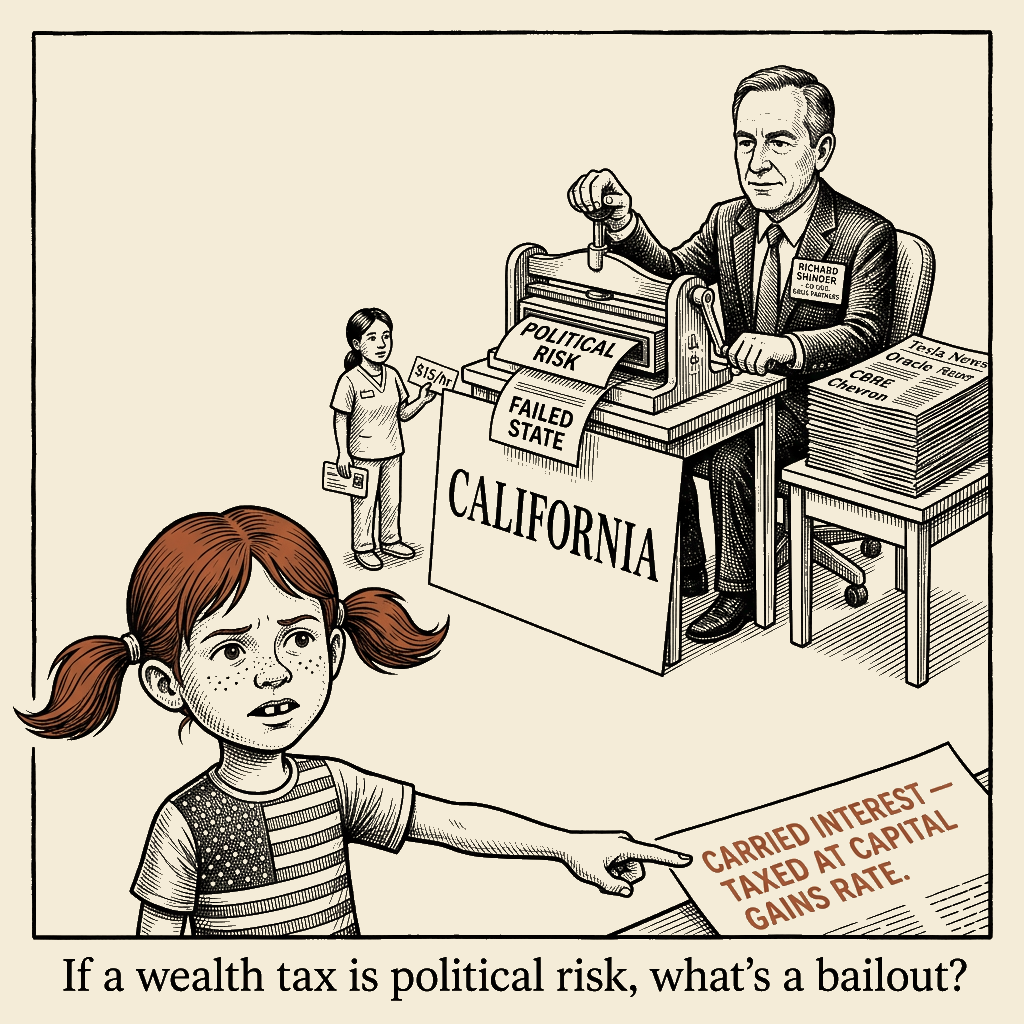
Responding to: What if California Becomes a ‘Failed State’? — Richard J. Shinder · 2026-09-08
What the Piece Argues
Richard J. Shinder’s Wall Street Journal opinion piece argues that progressive state policies — California-style wealth taxes, New York City pied-à-terre levies, exit taxes, slavery-reparation task forces, and what the piece calls ideologically driven “lawfare” — constitute “political risk” of the sort ordinarily attached to unstable foreign jurisdictions, and could push U.S. states and cities toward “failed state” status. The piece frames federalism as having historically worked because capital and labor could “vote with their feet” between jurisdictions, and warns that the new progressive policy mix has become so unpredictable that investors and residents will exit California and similar jurisdictions in larger numbers than they already have (the piece cites Tesla, Oracle, CBRE, and Chevron headquarters relocations, plus California’s loss of a congressional seat after the 2020 census). It closes by borrowing Adam Serwer’s 2018 phrase — “the cruelty is the point,” originally written about the first Trump administration’s family-separation regime — to suggest that progressive elites are promoting policies they know will fail, and that the cruelty is the point. The author is identified as co-founder and co-CEO of Ensis Partners, an investment bank.
Receipts
The piece renames the democratic obligation to pay taxes as “political risk” so that any progressive policy can be delegitimized before it is debated.
-
The framing wants you to believe
- California and other progressive states are on the brink of becoming “failed states,” comparable to “war-torn regions” and “full-blown kleptocracies,” because of wealth taxes, exit taxes, reparations task forces, and regulatory “lawfare.”
- Capital flight is already underway (Tesla, Oracle, CBRE, Chevron HQs cited) and will accelerate as progressive policies make these jurisdictions uninvestable for Western firms.
- Voters backing progressive policies are “a gullible, historically ignorant electorate soaked in social-media-induced class envy,” and the policies’ elite promoters are acting out of malice — “the cruelty is the point.”
-
What’s really going on
- The author is the co-CEO of an investment bank writing in the Wall Street Journal about why his own clients should not be taxed. The piece is the firm’s product sold as opinion.
- California has one of the world’s largest state economies — broadly comparable in scale to the United Kingdom or France as a sub-national unit; the comparison to “war-torn regions” and “kleptocracies” is rhetorical, not analytical.
- The vocabulary is the act: renaming citizenship as “political risk” converts the public square into a market in which only those with exit options have standing, while workers without relocation capital absorb the cost of whatever public goods go unfunded.
- The carried-interest deduction, the basis step-up at death, and the 2008 and 2020 bailouts represent the actual unpriced political risk the piece refuses to name; the contemptuous framing of voters conceals the structural one — the same financial sector has suppressed those voters’ wages for fifty years.
- The piece’s relocation citations are real but cherry-picked: the firms named are publicly traded corporations moving their registered offices, not the individuals whose wealth a wealth tax would actually touch. Their executives’ personal holdings — what any wealth tax would reach — mostly stayed in place.
The Response Ladder
Polite Reframe
When to use: A persuadable family member who shared the piece on Facebook thinking it was reasonable; a friendly political conversation where the moral reframing needs to land without escalation; the good-faith voter who has absorbed the “federalism” framing and needs to be walked back to the underlying question.
Maria works two jobs in Stockton. She takes the bus her grandparents paid for through their property taxes to a grocery store her uncle helped stock during the pandemic to feed neighbors whose cousins teach in public schools whose teachers can’t afford to live in the city they teach in. Maria’s hourly wage has not kept up with rent since 2014. The federal minimum wage her senator has blocked from rising has not changed since 2009. Her state’s billionaire tax on the November ballot would, if it passes, fund childcare for kids like hers and fix roads she drives on. It would not affect her retirement account. It would not affect her house, which she does not own.
When an investment-bank co-CEO writes in the Wall Street Journal that a wealth tax on the first slice of billionaire-level wealth constitutes “political risk” of the kind that makes a jurisdiction comparable to war-torn regions and kleptocracies, he is not making an economic argument. He is making a confession. The argument requires Maria — the worker, the taxpayer, the resident, the human being the piece dismisses as part of a gullible, ignorant electorate — to accept that her own community’s ability to fund her children’s school, her mother’s clinic, her own bus ride is “unpredictable,” while the investor class’s ability to relocate capital without paying any tax on the gains that infrastructure enabled is, somehow, the predictable and stable foundation of the country.
Earn it on your own land or admit you have taken from the commons. The infrastructure that built the companies his firm advises — the courts that enforce their contracts, the universities that train their analysts, the ports that ship their goods, the roads their trucks drive, the regulatory system that prevents their competition from poisoning their customers — is funded by the same tax system the piece is now calling “political risk.” Every billionaire fortune the piece warns is about to flee the state was, in the most literal sense, built using Maria’s labor and the schools her taxes funded and the public goods her parents paid for. If California’s wealth tax is “political risk,” then the entire proposition that the wealthy owe anything to the country that made their wealth possible is political risk.
If federalism works the way the piece says it does — if people and capital can vote with their feet when a policy mix proves toxic — then a California billionaire tax works the same way. People who don’t want to pay it can move. That is the federalism the piece claims to defend. The piece defends a different federalism: one in which capital is mobile and labor is fixed, in which the rich can exit and the rest of us cannot, in which one party calls the policy mix “toxic” and another calls it “fair share,” and the piece sides with the party that benefits from the choice being unavailable to the rest of us.
You can keep the wealth and move the wealth. Maria cannot. The piece asks her to call that arrangement stability.
Mockery and Ridicule
When to use: The bystander in a Twitter thread who needs the argument rendered absurd by literalization; the Thanksgiving uncle who thinks the Wall Street Journal is a serious source; the cynical coworker who quotes the piece at lunch.
Picture it. Richard J. Shinder, co-founder and co-CEO of Ensis Partners, packs his children into the family Range Rover, hands his wife the dog, and idles in the carpool lane of the 405 because the California billionaire-tax initiative on the November ballot might tax the first slice of his net worth above the billionaire threshold. Behind him, three lanes of Teslas that have not left California despite the corporate relocations the piece cites, because Tesla is a publicly traded company whose CEO is a billionaire whose personal holdings dwarf any wealth-tax liability and whose employees cannot afford to live in the buildings they built. Beside him, a Honda Civic driven by a respiratory therapist who makes sixty-two thousand dollars a year and will see no change whatsoever in her tax bill, on her way to the hospital whose funding depends on the same revenue the wealth tax would generate. The Range Rover is the “political risk” the piece warns about. The respiratory therapist is the actual Californian the piece will not name.
The piece wants you to believe that a state with one of the world’s largest sub-national economies — broadly comparable in scale to the United Kingdom or France — is in the category of jurisdictions Western companies decline to invest in. The category is the same one as war-torn regions and full-blown kleptocracies. The Wall Street Journal printed this. The man who wrote it is the co-CEO of an investment bank. The investment bank’s job, when the financial press is not paying attention, is to advise its clients on where the next twelve percent return is hiding, and the advice has been for forty years: in the same jurisdictions whose tax base the piece is now calling too volatile to underwrite.
The piece calls progressive voters “a gullible, historically ignorant electorate soaked in social-media-induced class envy.” This is what investment bankers call the people whose wages their clients have suppressed for thirty years, whose pension funds their clients manage for fees, whose mortgages their clients securitized into the 2008 crisis. The piece mocks them for being manipulated. The manipulation the piece will not name is the one that took the value of their labor, packaged it into financial instruments, and sold it back to them at a markup.
The piece closes by borrowing “the cruelty is the point” — the line originally deployed against the first Trump administration’s family-separation policy — and applying it to progressive taxation. Notice the move. Immigration policy that separates children from parents at the border, holds them in detention, deports long-settled residents without due process — that, the original usage said, was the cruelty being the point. Now the Wall Street Journal tells you the same is true of a wealth tax on billionaire wealth. If you cannot tell the difference between the cruelty of an internment camp and the cruelty of a man being asked to pay tax on the billionaire-wealth slice he did not earn with his own hands, then the Wall Street Journal has already extracted from you whatever it intended to extract.
The piece’s most-quotable line — “What comes of a failed state?” — is what an investment banker asks a country about its own states, with a straight face, while the actual answer to that question has been given at Standing Rock, in Puerto Rico after Maria, in Flint, and in every city whose water the same investment banks’ clients poisoned and whose residents the same investment banks’ clients refused to compensate. The piece is not asking about California. The piece is asking what comes of the rest of the country once California’s wealth tax, if it passes, forces the people the piece defends to admit that wealth they did not build belongs to the country that built it.
Nuclear Satire
When to use: The reader who needs full catharsis; the comment thread that has already devolved; the post you screenshot and send to a group chat to detonate it.
Richard J. Shinder is a man who has decided, at considerable leisure and on the masthead of the Wall Street Journal, that the State of California — one of the world’s largest sub-national economies, the place that invented the semiconductor, the internet, the venture capital fund, the personal computer, the blockbuster film, the GPS-guided missile, the smartphone in his pocket, and the question he is paid to answer on his clients’ behalf about which jurisdiction to park their money in — is in the same risk category as Mogadishu. He has decided this not because the California economy is failing. He has decided it because the people who built that economy might be asked to pay tax on the value of what they built. The decision is, in the precise sense of the term, obscene.
Obscene in the original sense: off-stage. The obscene is what the speaker knows is happening and refuses to name on the page. The piece will not name what Shinder’s clients actually do. It will not name what an investment-bank co-CEO’s compensation looks like. It will not name the carried-interest deduction that taxes his personal income at the capital-gains rate while Maria’s wages are taxed at the marginal rate. It will not name the basis step-up at death that erases a lifetime of accumulated wealth from the income-tax rolls of any estate under fourteen million dollars per person. It will not name that the same financial sector the piece represents received a bailout in 2008 that Maria’s tax dollars funded. It will not name that the same financial sector the piece represents received a bailout in 2020 that Maria’s tax dollars funded. It will not name that the same financial sector the piece represents is the principal driver of housing costs in California, by which mechanism Maria cannot afford to live near the grocery store where she works. The obscene — the thing Shinder knows and the Wall Street Journal knows and the reader is meant not to look at — is that the question the piece pretends to ask is not the question the piece actually answers.
What the piece actually answers: by how much can the financial sector shift the cost of governance onto labor before labor notices?
The answer the piece gives: as much as the labor will bear, plus whatever can be extracted by calling labor “gullible” and “historically ignorant” in the Wall Street Journal.
The piece invents a new vocabulary for the trick. “Political risk” is the piece’s word for what used to be called the obligation of citizenship. The piece treats the willingness to pay taxes as if it were the willingness to flee a failed state. The piece treats the proposal to tax wealth as if it were the proposal to seize assets. The piece treats a public school as if it were a hostile jurisdiction. The piece treats the workers of Stockton as if they were the dependents of a kleptocrat. The vocabulary is the act. By renaming citizenship as political risk, the piece converts the public square into a market in which only those with exit options have standing.
And standing is the point. Maria has no exit option. The piece knows it. The piece counts on it. The piece’s argument works only if Maria cannot leave, only if the alternative to paying the wealth tax is to live in a jurisdiction the piece’s clients have stripped, only if the choice the piece offers Maria is between being taxed in California and being taxed in a state with worse schools and worse roads and worse clinics and worse public goods. The piece calls that “federalism.” Federalism used to mean the freedom of communities to govern themselves. The piece’s federalism means the freedom of capital to choose which community’s tax base to live in, while the residents of every community are stuck with whatever infrastructure the previous owners of that capital left behind.
What comes of a failed state? The answer is in the piece’s own question. Failed states are not states whose wealth taxes pass. Failed states are states whose wealth taxes fail — whose schools decay, whose bridges collapse, whose clinics close, whose water poisons, whose workers flee, whose tax base erodes, whose remaining residents become the labor force of the next jurisdiction’s economy. Failed states are states the financial sector has already finished extracting from. The piece is asking what comes of California if California becomes what Flint already is, what Jackson already is, what half of rural America already is, what Puerto Rico was already made into by Hurricane Maria and the bondholders’ response. The piece is asking, in other words, what happens when Maria stops being able to afford the bus.
The piece will not say so. The piece’s author is paid not to say so. The Wall Street Journal publishes him not to say so. The financial sector’s preferred outcome is that Maria keep taking the bus, that her wages keep not keeping up, that her schools keep not being funded, that her water keep being lead-poisoned, that her bridges keep falling down, that her retirement keep being a 401(k) loaded with the stocks of the same firms that extracted her wages in the first place. The piece calls that the country the financial sector wants to live in. The piece calls it federalism. The piece calls it stability.
The piece calls it, with a straight face, the alternative to a wealth tax.
Profane Scorched-Earth
When to use: the catharsis the reader needs after the WSJ piece itself; the long-form column closer when receipts have stacked and the reader is ready for the full release. The release valve.
So the Wall Street Journal — that venerable organ of the fuck-you-got-mine school of political economy — has finally gotten around to diagnosing California as a failed state. And the doctor they have sent in is Richard J. Shinder, co-CEO of the investment bank Ensis Partners, who has decided that the patient is sick because the patient proposed asking its two hundred wealthiest residents to pay fucking taxes.
Let us be clear about what we are looking at. We are looking at a man whose literal job is to advise rich people where to put their money, writing in a newspaper owned by Rupert fucking Murdoch’s News Corp, telling you that California — a state with the largest economy in the goddamn country, with thirty-nine million residents, with working ports and working airports and working courts and universities that invented the internet — is a failed state because it proposed taxing billionaires. And the technical name he gives this failure is “political risk,” which is investor-speak for “the wrong people are writing the rules now.”
This is not even subtle, and I am not going to be subtle about it. The Wall Street Journal’s opinion section is a fucking instrument. It is designed to take a policy proposal that would fund childcare and housing and mental-health care for working people and rebrand it as a humanitarian emergency. The people paying for that rebranding are the working people whose services the policy would fund. This is not a debate. This is a fucking heist, and the loot is the rhetorical legitimacy of taxing the rich.
Shinder’s evidence is real and tiny. Tesla, Oracle, CBRE, Chevron moved their headquarters — Texas paid Tesla and Oracle to come with significant tax abatements and development-zone support; California’s population declined modestly while remaining the largest state in the country; the billionaire tax would raise a few billion dollars from two hundred people. None of this is the failure of California. All of this is the failure of California’s competitors to be anything other than bribed jurisdictions competing to underbid each other for the privilege of hosting a CEO’s letterhead.
And then — this is the part that should make your fucking blood pressure spike — Shinder reaches for Adam Serwer’s 2018 Atlantic essay “The Cruelty Is the Point,” written about the deliberate infliction of suffering on undocumented immigrants by the first Trump administration, and applies it — with the gravitas of a man comparing his capital-gains rate to a pogrom — to the proponents of a wealth tax. The cruelty is the point, he says. As though a kindergarten teacher in Inglewood paying half her paycheck to a landlord who has raised her rent three times in two years is not a cruelty. As though a homeless encampment on a sidewalk fronting twenty-million-dollar homes is not a cruelty. As though a forty-year policy of subsidizing asset-holders and disciplining wage-earners is not a fucking cruelty. As though the cruelty is something invented by the people who want to change this, rather than by the people who profit from it.
The cruelty is the point, Mr. Shinder. The cruelty is the point of the system you are working to preserve. The cruelty of housing as an asset class. The cruelty of a tax code that lets a billionaire pay a smaller effective rate than his secretary. The cruelty of bailouts for the rich and lectures about discipline for the poor. The cruelty of an investor class that has, for fifty years, extracted everything it could from working communities and is now calling the resulting wreckage a failed state. That is the cruelty. That is the point. And every word you have written in your little investment-bank column is in service of keeping it.
You are not a patriot. You are not a federalist. You are a fucking investment banker describing a wealth tax as though it were a warlord seizure of assets, because that is the vocabulary you have, because the honest vocabulary would be “we don’t want to pay our share,” and you cannot afford to say that out loud.
So let us be honest about it for you.
About Malcolm Little King
Malcolm Little King is a heteronym in Main Street Independent's editorial architecture — an analytical voice, not autobiography of any actual person. The position this column expresses is the publication's position on the territory Malcolm Little King's lane covers, rendered through Malcolm Little King's register.