Responding to: China has a chokehold on your medicine cabinet. It’s a national security threat · 2026-09-14
What the Piece Argues
The Fox News opinion piece, by former Trump DHS official Tricia McLaughlin, argues that U.S. dependence on China for active pharmaceutical ingredients (APIs) — roughly 45% of global production concentrated in one geopolitical rival — represents a national-security emergency demanding immediate domestic reshoring. The piece acknowledges two real dependencies: legitimate API manufacturing for essential medicines, and Chinese precursor chemicals feeding the fentanyl supply chain via Mexican cartels. It frames the cause as “decades of offshoring” that “gutted the American industrial base,” and demands federal procurement restrictions, tariff action, and state-level industrial policy (using Ohio as a model) to rebuild U.S. pharmaceutical manufacturing capacity. The piece largely omits the role of U.S. pharmaceutical corporations in engineering the offshoring through deliberate, documented, profit-maximizing decisions about labor, environmental, and regulatory cost structures.
Receipts
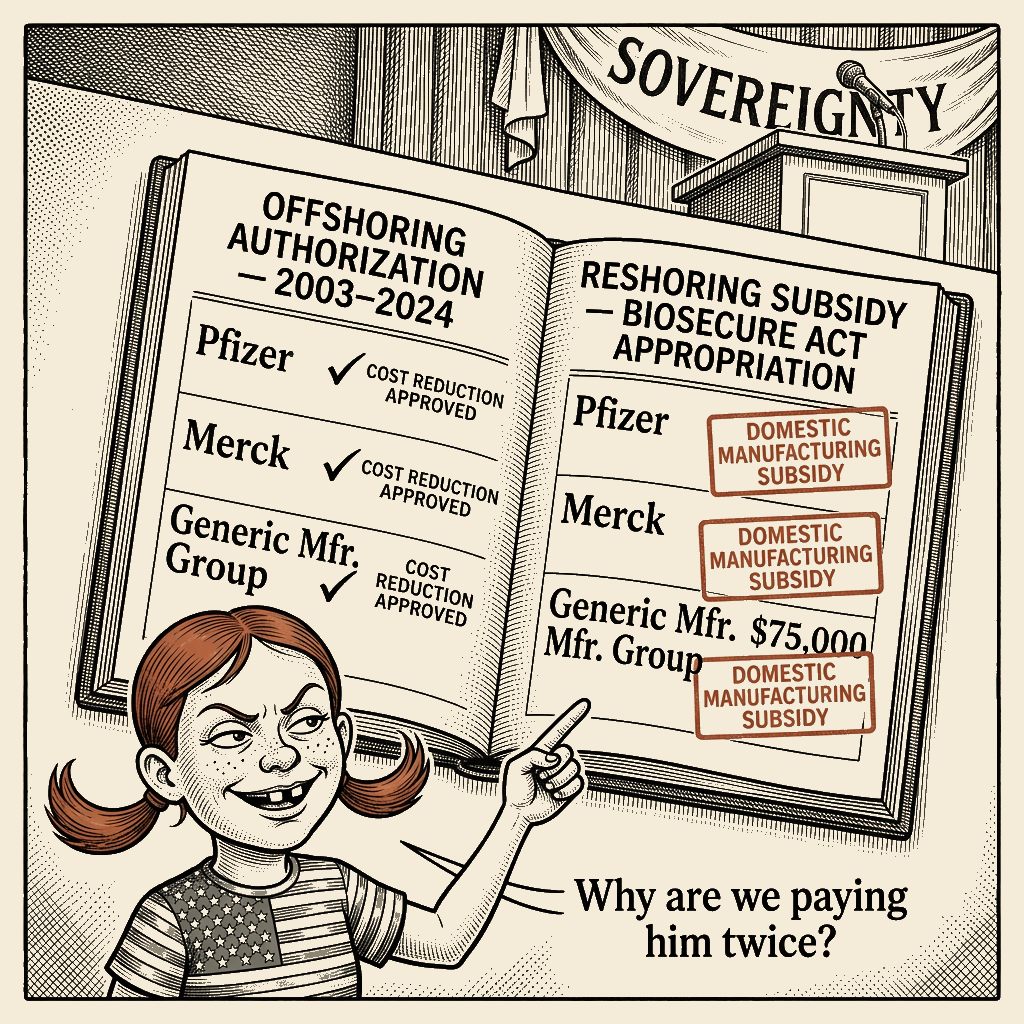
The piece reframes a multi-decade corporate offshoring decision as a foreign-adversary crisis so the firms that made the offshoring choice can be paid to undo it on the taxpayer’s dime.
[Source: CFR “pharma choke point” framing; Johns Hopkins antibiotic supply-chain research; FDA API-origin disclosures]
The framing wants you to believe
- America’s API dependence on China is the product of “decades of offshoring” that “gutted the American industrial base” — an exogenous force, not a series of executive decisions.
- Massive taxpayer-financed domestic pharmaceutical manufacturing is the only credible response to the China “choke point.”
- Chinese suppliers and Mexican cartels operate a “singular adaptive supply chain” that can be turned against American medicine cabinets on Beijing’s command.
What’s really going on
- The offshoring was a corporate strategy, not an accident. US pharmaceutical firms — Pfizer, Merck, the major generic manufacturers — chose to relocate API production to China and India over multiple decades to reduce costs and dodge US environmental and labor regulation; the executives who made those decisions took bonuses tied to cost-of-goods-sold and the supply-chain consequences are now being repackaged as a national-security emergency requiring subsidy of the same firms.
- The Biosecure Act protects designated US suppliers from Chinese competition; it does not address why domestic generic manufacturers went bankrupt. Three drug-purchasing organizations control roughly 80 percent of US generic drug purchases, and their price suppression has been documented as a primary driver of domestic generic manufacturer failure and offshoring — the lever the column never pulls. [Source: Paragon Institute; IntuitionLabs; FTC 2025 PBM report]
- Domestic API manufacturing carries documented cost premiums over Chinese/Indian production, with estimates varying by molecule, and that premium lands on American patients and payers, not on the firms being subsidized. A real national-security policy on medicines would include Defense Production Act standing orders for the top fifty essential medicines, the Civica Rx public-manufacturing model, antitrust against the purchasing concentration that crushed domestic generics, and price-floor policies that keep domestic lines open. None of those tools appears in the column, because none of them enriches the firms the column was written for.
The Response Ladder
Polite Reframe
When to use: A persuadable family member or colleague who is genuinely alarmed about medicine shortages and would benefit from a calm, structural reframing of the issue.
The mother in Dayton was at the pharmacy counter at nine at night with a febrile four-year-old. The amoxicillin was in stock — this time. She paid the copay, drove home, and never thought about where the powder in that bottle had been milled. Neither do most of us.
Tricia McLaughlin is right about the geography. The United States produces roughly 3 percent of the world’s active pharmaceutical ingredients; China produces close to half. Researchers at Johns Hopkins and elsewhere have published analyses tracing American antibiotic supply chains that put Chinese content above 60 percent. The dependence is real. The supply chain is fragile. Anyone who lived through the 2022 amoxicillin shortage already knows that.
Where the column misses is in the prescription. The factories that left this country did not leave because of trade policy. They left because the companies that owned them decided they could manufacture the same molecules at lower cost in China and India, and then pocket the difference. Pfizer, Merck, and the major generic manufacturers that systematically relocated API production to China and India did so because the regulatory and environmental costs of domestic manufacturing made offshoring more profitable. The industry is now asking taxpayers to subsidize the rebuilding of an industrial base it dismantled for shareholder return. That is not national security policy; it is corporate welfare by another name, and the recipient is the same set of actors who created the problem.
There is a real national-security conversation to be had about medical supplies. It includes a Defense Production Act standing order for the top fifty essential medicines, the public-manufacturing model pioneered by Civica Rx, antitrust action against the three drug-buying organizations that buy most American generic prescriptions, and price-floor policies that keep generic manufacturers solvent long enough to keep their domestic lines open. None of those tools is in Ms. McLaughlin’s column. All of them would do what the column claims to want.
We can build the plants. We should. We should also remember who tore them down, and ask who should be paying to put them back.
Mockery and Ridicule
When to use: A social-media thread where the China-threat line is being repeated uncritically; this is for the bystander who needs to see the operation performed out loud.
The new Merck plant is going to be built in West Virginia, and the press release will call it “Project Patriot Shield.” The ribbon-cutting will be held in a former coal mine. The CEO will say the word “sovereignty” eleven times. The press release will not mention that Merck spent the last thirty years paying itself to move the same active ingredients to Wuxi.
Here is the operation, in three receipts. The United States makes roughly 3 percent of the world’s active pharmaceutical ingredients; China makes about 45 percent. This is not in dispute. What is in dispute is whose decision that was. Pfizer did not accidentally wake up one morning and discover its amoxicillin line in a Chinese facility it had never seen before. Merck did not trip and fall into a Wuhan joint venture. These were corporate strategies, made by executives with bonuses tied to cost-of-goods-sold, audited by boards that included former secretaries of state, and approved by shareholders who liked the quarterly numbers. The executives who did this are now retired on their comp packages. The supply chain they left behind is being nationalized, in slow motion, by the same government they spent the last forty years telling you was the problem.
The “weaponization” framing is the second move, and it is the better one. China could, in theory, cut off antibiotic supply. Yes. China could also, in theory, stop buying soybeans. The question is what response makes sense. Cutting off the supply of medicine to American children is what economists call a non-credible threat — a threat so costly to the threatener that no one believes they would carry it out, because doing so would crater the export engine that funds their entire economy. The national-security frame lets the industry skip the credibility analysis entirely and go straight to the subsidy.
The third receipt is the Biosecure Act, which restricts federal procurement from designated Chinese biotech firms. Read the bill. The carve-outs are for designated US suppliers. This is industrial policy with a national-security fig leaf. The fig leaf covers a transfer from American taxpayers to the equity holders of the firms that did the offshoring. If you wanted a real national-security policy on medicines, you would write one that includes antitrust against the three drug-buying organizations that have crushed domestic generic manufacturing, public manufacturing at Civica-style scale, and a Defense Production Act standing order for the top fifty essential medicines. The column doesn’t mention any of those because the column’s job is not to protect your medicine cabinet. The column’s job is to make sure you pay for the column’s friends’ next factory.
Nuclear Satire
When to use: The reader who has heard the China-as-foe framing a hundred times and needs every receipt stacked against it with the full baroque force the pattern warrants.
The Merck board meeting begins with a man in a powdered wig reading from a parchment scroll. “Gentlemen,” he says, “the strategic environment has shifted.” A PowerPoint slide appears bearing the seal of the Department of Defense. “Our Wuxi facility,” the slide reads, “is now a matter of national security.” A man in a Cabela’s cap raises his hand. “Should we have considered this in 2003?” “That,” replies the chairman, “is class warfare. Next slide.”
This is the operation, in three receipts and one grotesque metaphor.
Receipt One: The sovereignty was theirs to sell. Pfizer did not discover that amoxicillin could be made more cheaply abroad. It engineered the discovery. It hired consultants. It built the supply chain. It offshored, in slow motion, for decades. Each year, the same executives who now want you to pay to bring the production home went home to their families on bonus days made possible by the savings. They are not Chinese agents. They are not traitors. They are worse than traitors. They are Americans who sold American manufacturing capacity abroad for personal compensation and are now asking the American public to compensate them for the consequences of their own decisions. The operation is not national security. The operation is corporate welfare with a flag on it.
Receipt Two: The weaponization is a fig leaf over a non-credible threat. China could, in theory, restrict the export of antibiotics to the United States. It could also, in theory, stop buying Boeing aircraft and start building its own. Both moves would impose catastrophic costs on the country that made them. They would crater the export engine that funds the Chinese state’s entire claim to political legitimacy. They are not credible threats. They are the kind of threat a corporate lobby invents when it wants a transfer from the public treasury without having to explain why the transfer is needed. Yes, the fentanyl trade is real. The argument is not whether fentanyl is real. The argument is whether the response to “China could weaponize antibiotics” — a non-credible threat — is the same as the response to “China supplies fentanyl precursors” — a real and ongoing harm. The Biosecure Act’s procurement restrictions treat them as the same. They are not.
Receipt Three: The Biosecure Act is industrial policy with a flag on it. Read the bill. The procurement restrictions exempt specific named US suppliers. The new factories will be built by the same firms that offshored the supply chain in the first place. The subsidies will flow to the equity holders. The construction contracts will go to firms that donate to the right committees. This is the Trump-era industrial policy: a transfer, dressed as sovereignty, secured by fear. If you want a model, look at the CHIPS Act, which spent roughly fifty-two billion dollars to onshore semiconductor manufacturing. Read who got the money. Read who didn’t. The chips are being built in Arizona. The intellectual property is still being licensed from Taiwan. The money went to specific firms. Yours did not.
The grotesque metaphor: the medicine cabinet. Your medicine cabinet has been, for the last thirty years, owned by the same equity holders who own the campaign committees of the politicians now telling you to be afraid of the people they sold it to. The cabinet is not empty. The cabinet is full of pills, manufactured in a country the cabinet’s owner chose, sold at a markup the cabinet’s owner set, distributed through a supply chain the cabinet’s owner built, and now defended from an adversary the cabinet’s owner handed it to. The medicine cabinet is the metaphor for the entire bipartisan American political economy. The contents are not the problem. The ownership is the problem. The “China threat” framing is what the owner says when you ask to look at the deed.
The receipts are stacked. The fentanyl deaths are real. The Chinese dominance in API manufacturing is real. The piece’s argument is not that any of those things are untrue. The piece’s argument is that the policy response — subsidize the firms that did the offshoring, restrict competition from Chinese firms that filled the gap, leave the domestic purchasing and pricing structure untouched — is the right response. It is not the right response. It is the response that benefits the people who wrote the piece.
Profane Scorched-Earth
When to use: The reader who needs full catharsis because they have just been handed the national-security column as if it were analysis and they are tired; the ladder’s release valve.
This column is horseshit. Let me tell you what it actually is.
Tricia McLaughlin was the assistant secretary for Public Affairs at the Department of Homeland Security under Donald Trump. She is now, surprise of surprises, in private life. The piece you just read is not an analysis. It is a paid political advertisement for the next round of pharmaceutical subsidies, written by someone whose next job depends on those subsidies going to the right people. The piece has a byline that pretends it is analysis and a voice that pretends it is journalism and a structural-political framing that pretends it is national security. None of those things are true. It is a fucking handoff.
Here is the operation, with receipts, because the receipts are what they always are in these pieces — the receipts are right there if you look. The United States makes roughly 3 percent of the world’s active pharmaceutical ingredients. China makes about 45 percent. These numbers are not in dispute. They come from FDA reporting, from academic researchers, from a dozen different sources that have been saying the same thing for years. Fine. Good. Real problem. Now, whose fucking decision was it?
It was the decision of every pharmaceutical executive who took a bonus tied to cost-of-goods-sold while shipping amoxicillin production abroad. It was the decision of every Pfizer board member who approved the offshoring of API production to China. It was the decision of every Merck executive who offshored active ingredient production to India. It was the decision of every generic manufacturer that closed a domestic plant and opened a foreign one to dodge the fucking EPA. The names are in the SEC filings. The bonuses are in the proxy statements. The decisions are documented, by the hour, in the public record. These are not foreign agents. These are not traitors. These are American executives who sold American industrial capacity to foreign competitors for personal compensation, and are now asking you — the American taxpayer, the American patient, the American voter — to compensate them for the consequences of their own fucking decisions. The word for this is not national security. The word is fraud. The word is looting. The word is the kind of behavior that, in a serious country, would put people in orange jumpsuits.
But here is the trick: in this country, it does not. In this country, the executives retire on their comp packages intact, and they hire former Trump DHS spokespeople to write Fox News columns warning that the Chinese are about to weaponize your amoxicillin. They fund the Biosecure Act, which restricts procurement from named Chinese competitors. They write the executive orders on tariffs. They get the plant subsidies. The plants will be built. The plants will be built by the same fucking firms that offshored the supply chain in the first place. The subsidies will flow to the equity holders. The construction contracts will go to firms that donate to the right fucking committees. And the Chinese, who were filling the gap because the firms that filled the gap were cheaper, will be replaced, in slow motion, by the same fucking firms that created the gap in the first place.
This is not a national security column. It is a fucking handoff. Read it as a handoff and the entire fucking thing makes sense. Read it as a national security column and you are the fucking mark.
The fentanyl piece is real. The Chinese dominance in API manufacturing is real. The supply chain is fragile. None of those facts are in dispute. The argument is not about whether those facts are true. The argument is about whether the policy response — subsidize the firms that did the offshoring, restrict competition from Chinese firms that filled the gap, leave the domestic purchasing and pricing structure untouched — is the right response. It is not the right response. It is the response that benefits the people who fucking wrote the piece. The right response is antitrust against the three drug-buying organizations that buy the great majority of US generic prescriptions and have crushed domestic generic manufacturing to the point of bankruptcy. The right response is the Civica Rx public-manufacturing model. The right response is a Defense Production Act standing order for the top fifty essential medicines. The right response is a price floor that keeps domestic generic manufacturers solvent. The right response is none of the things in this column. The right response is the response that does not enrich the people who broke the supply chain in the first place.
Malcolm X said, in Cleveland in April 1964, “He’s the criminal. You don’t take your case to the criminal.” The criminal here is named. The criminal is the US pharmaceutical industry that offshored the supply chain, the executives who got paid for it, the politicians who took the campaign donations to enable it, and the commentators who now write columns asking you to pay to fix it. The criminal is not in Beijing. The criminal is in New Jersey. Take your case to the criminal in New Jersey.
Build the plants. Yes. But build them with public money, under public control, in the public interest, and do not let the same fucking firms that tore them down be the ones paid to put them back. Or do not build them at all. A medicine cabinet controlled by the same firms that sold you out is not a sovereign medicine cabinet. It is a fucking franchise.

About Malcolm Little King
Malcolm Little King is a heteronym in Main Street Independent's editorial architecture — an analytical voice, not autobiography of any actual person. The position this column expresses is the publication's position on the territory Malcolm Little King's lane covers, rendered through Malcolm Little King's register.