Responding to: The 9/11 Column You Haven’t Read Yet — Holman W. Jenkins, Jr. · 2026-09-11
What the Piece Argues
Holman W. Jenkins Jr. argues that the real disaster of 9/11 was not the attacks but America’s “gross overkill” fiscal response the next day. He contends airport security had deterred hijackings effectively before 9/11, that the war on terror was on its way to being won before it began, and credits Larry Silverstein’s insurance litigation with reviving lower Manhattan rather than government planning. He links the 9/11 spending response to ObamaCare, climate policy, and Covid as a single pattern of “bankrupting spending extravaganzas” that demonstrate politicians’ caring by “how much money they set on fire.” The piece closes with optimism that AI might finally equip voters to evaluate policy without press intermediation.
Receipts
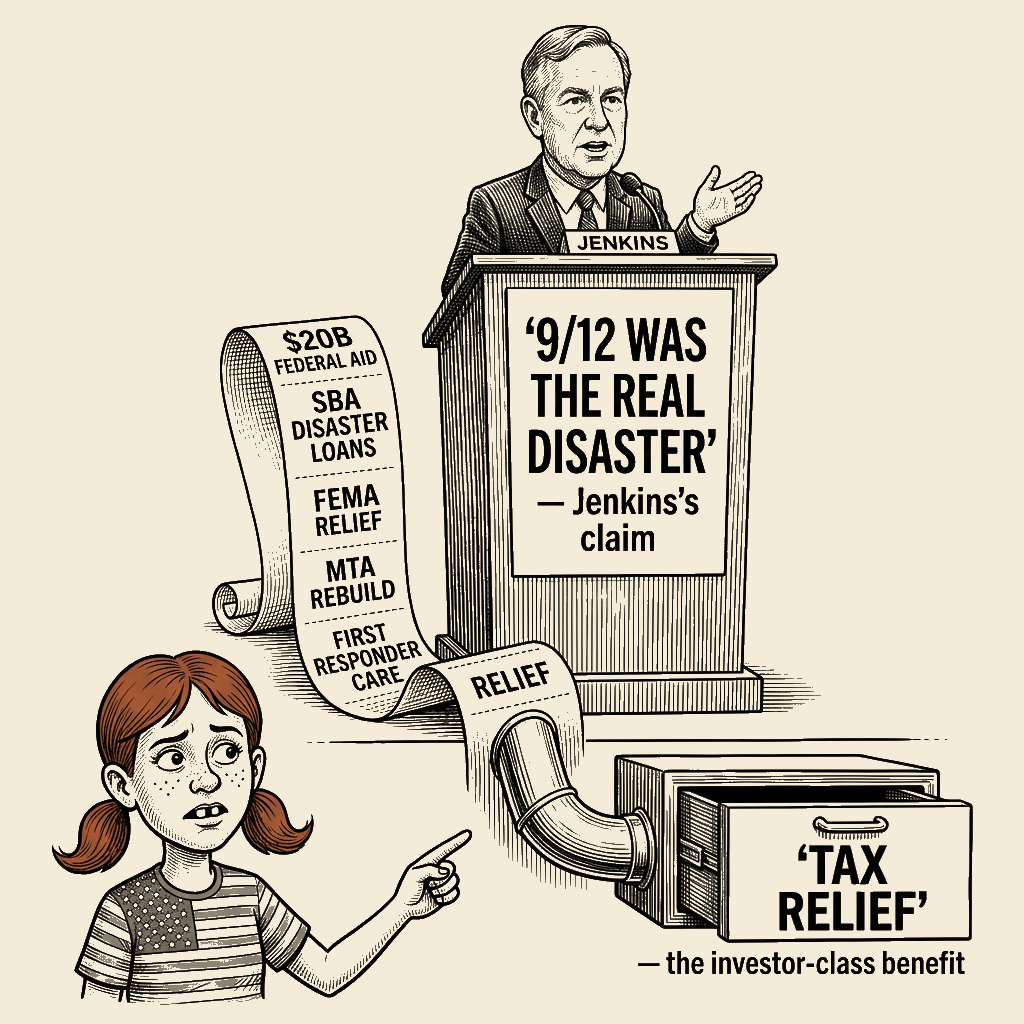
Jenkins’s column executes a gish gallop: bundling four distinct federal policy regimes (9/11 disaster recovery, the ACA, climate policy, and Covid response) under a single “bankrupting spending extravaganza” label without naming a single dollar figure, program, outcome, or alternative — to recast the entire post-9/11 federal crisis-response apparatus as the “real” 9/11 disaster.
-
The framing wants you to believe:
- The actual catastrophe of 9/11 was America’s “gross overkill” fiscal response, beginning “9/12.”
- 9/11 disaster relief distributed taxpayer checks principally to “heiresses and hedge-fund managers” in lower Manhattan.
- 9/11 recovery, the ACA, climate policy, and the Covid response are a single uniform pattern of “bankrupting spending extravaganzas.”
- Politicians demonstrate caring by how much money they “set on fire,” regardless of outcomes.
-
What’s really going on:
- Per GAO report GAO-04-72 on federal disaster assistance following 9/11, approximately $20 billion in federal aid was authorized and committed to specific projects in the New York City area after the attacks — primarily through FEMA disaster relief, HUD housing assistance, DOT transit funding, SBA disaster loans to small businesses, and the Liberty Zone tax benefits. Jenkins names only the Liberty Zone slice and treats it as the whole.
- The Liberty Zone tax credits were not the largest component of the recovery; FEMA, HUD, DOT, and the SBA disaster loan program collectively delivered the bulk of the assistance, much of it to small businesses, displaced residents, transit infrastructure (the MTA, PATH, tunnels), and first responders and victims’ families.
- Analyses by the New York Federal Reserve (Jason Bram and Andrew Haughwout’s work on post-9/11 labor-market dynamics) documented NYC’s labor-market recovery after 9/11 as faster than peer cities’ recovery after comparable disasters — a finding that, were it the framing’s product, would directly contradict the “gross overkill” thesis. The framing’s product is the opposite.
- The structural beneficiary of “every crisis response is overkill” framing is not the median taxpayer, who received disaster relief after 9/11, ACA subsidies, and Covid-era unemployment support — it is the editorial and investor class whose product is the permanent argument that the public sector is the problem and whose portfolios benefit from any tax cut justified by that argument.
The Response Ladder
Polite Reframe
When to use: The persuadable moderate or good-faith family member who repeats Jenkins’s “9/12 was the real disaster” line as if it were settled wisdom. They read the Journal, they remember 9/11 personally, they think of themselves as fiscal conservatives. They are reachable. Open with a named person the policy helped; receipts do the structural work; never mock the voter.
Carmen kept a small bookstore on Greenwich Street, four blocks south of the towers. On the morning of September 11, 2001, she and her husband Antonio made it out with their two children. The store did not. The inventory was crushed. The front window was gone. The block was closed for months.
Carmen is the person Jenkins’s column is not about.
He mentions “dozens of doctors and nurses” standing around at Ground Zero with “nobody to help.” That is a real and terrible memory, and I do not question the witness. But the column then pivots to tell you the federal disaster-relief appropriations that helped Carmen reopen were the actual catastrophe.
Here is what Jenkins does not say. Per GAO-04-72 on federal disaster assistance following 9/11, approximately $20 billion in federal aid flowed to New York in the months and years after the attacks, spanning FEMA disaster relief, HUD housing assistance, DOT transit funding (the MTA’s recovery, the tunnels, the PATH station), SBA disaster loans to small businesses, and the Liberty Zone tax credits. Jenkins highlights one slice — yes, some of those benefits flowed to large financial firms — and treats it as the whole story. Analyses by the New York Federal Reserve (Jason Bram and Andrew Haughwout’s work on post-9/11 labor-market dynamics) documented the city’s labor-market recovery as faster than peer cities’ recovery after comparable disasters, in significant part because of the federal backstop.
When Jenkins calls this “distributing taxpayer checks to heiresses and hedge-fund managers,” he is not wrong about the Liberty Zone slice. He is wrong to make it the whole story. The 9/11 Commission itself documented the federal response as a mixed but largely functional mobilization of disaster-relief capacity the country had spent the 1990s building. SBA disaster loans and LMDC small-business recovery initiatives supported thousands of displaced small businesses, including Carmen’s. The loan was not a “bankrupting spending extravaganza.” It was a federal program that worked.
This pattern — describing a complex federal response by pointing to its most photogenic waste, then declaring the entire thing a debacle — is not a column about 9/11. It is a template. Jenkins runs the same template against ObamaCare, climate policy, and the Covid response in this piece, all in three sentences. The template’s structural product is the same in each case: the case for public investment is never engaged on the merits, because no specific dollar figure, no specific program, and no specific outcome is ever named.
The voter who repeats Jenkins’s framing is not wrong that government sometimes wastes money. It does. The question is whether the waste Jenkins names is the whole picture, or whether he is selecting the evidence that lets him conclude the answer he had already settled on. That is a fair question to ask of any columnist, including this one. The federal program that worked for Carmen’s family is the same kind of program that worked for thousands of others in the same position. We do not have to forgive Jenkins’s framing to do that work. We have to see through it.
Mockery and Ridicule
When to use: The reader who needs the cynicism of the column made visible — the social-media reply, the Thanksgiving-table sibling who keeps linking Wall Street Journal editorials. The point is not to convert Jenkins; it is to give his audience a way to see the operation.
Holman W. Jenkins Jr. has a column in the Wall Street Journal this week explaining that 9/12 was the real catastrophe. Not the attacks. Not the approximately 3,000 dead. Not the soot in Carmen’s lungs as she ran north through the smoke. The federal disaster-relief checks.
Picture the scene Jenkins wants you to imagine. A nation of 330 million people is hit by the deadliest terrorist attack in its history. The economy in lower Manhattan freezes; small businesses shutter; transit tunnels fill with debris; first responders dig for months. Congress appropriates emergency aid. The aid, like all large government programs, contains inefficiencies, gives some money to people who did not strictly need it, and includes Liberty Zone tax credits that benefit large financial firms headquartered downtown.
Jenkins sees this and concludes the spending was the real disaster.
The man watched the towers fall from his rooftop. He stood at Ground Zero with the doctors and nurses who had no one left to save. He wrote the column from inside that memory. And his takeaway, twenty-five years later, is that the federal government’s response was the catastrophe.
Imagine telling that to Antonio, who lost his bookstore.
Imagine telling it to the thousands of small-business owners in lower Manhattan whose shops reopened with SBA loans that the same Wall Street Journal editorial page once praised. Imagine telling it to the ironworkers who rebuilt the transit hub, the nurses who treated responders for years afterward, the city employees who processed death certificates for the families of the approximately 1,100 victims whose remains were never identified from the pile. Imagine telling it to the families of the 343 firefighters who ran into the buildings.
The man has a particular gift for finding the worst interpretation of any public action and presenting it as the only honest one. Research by the New York Federal Reserve documented the city’s labor-market recovery as faster than peer cities’ after comparable disasters. The 9/11 Commission documented the federal response as a mixed but largely functional mobilization. Jenkins does not engage either finding. He substitutes one Liberty Zone tax credit for the entire recovery and declares the math.
The template is the column. “9/11 was overkill. ObamaCare was overkill. Climate policy is overkill. Covid was overkill.” Jenkins does not write a column about any of these policies. He writes the same column four times in three paragraphs and calls it perspective.
It is the perspective of a man whose employer’s product is the permanent argument that the public sector is the problem, and whose readership is the investor class whose portfolios benefit from any tax cut justified by that argument. The arc bends when we stop mistaking that perspective for analysis.
Nuclear Satire
When to use: When the structural anatomy of the column needs to be on the table — the institutional authorship, the funding logic, the long pattern. For the reader who has been marinating in Wall Street Journal framing for years and needs the receipt-stack.
Holman Jenkins has spent thirty-four years on the editorial board of a newspaper owned by a conglomerate whose family fortune was built, in significant part, on the public infrastructure and rule-of-law guarantees the same editorial board has spent decades arguing are unaffordable. This week, on the twenty-fifth anniversary of the worst terrorist attack on American soil, Jenkins used his platform to declare the federal government’s response was the real disaster.
The column’s body is a rhetorical bundle of four distinct policy regimes — 9/11 disaster relief, the Affordable Care Act, climate policy, and the Covid-19 response — attached to a single “bankrupting spending extravaganza” label. He does not name a dollar figure, a program, an outcome, or an alternative. He does not tell you what he would have done instead. He does not tell you who in lower Manhattan should have been left without disaster relief so that the response would not qualify as “overkill.” He writes the indictment and walks away.
The reason he does not write the alternative column is that the alternative column would not serve the structural beneficiary of his framing. The structural beneficiary of “every crisis response is overkill” is not the taxpayer. The taxpayer paid for the Liberty Zone tax credits, and the taxpayer also paid for the small-business grants, the transit reconstruction, the medical care for first responders, and the death benefits for the families of the fallen. The structural beneficiary of the framing is the cohort Jenkins himself belongs to: the editorial class whose product is the permanent argument that the public sector is the problem, whose paychecks depend on that argument remaining plausible, and whose readership is the investor class whose portfolios benefit from any tax cut justified by the rhetoric of public-sector waste.
This is what Jenkins is doing. He is taking the worst day in modern American memory, harvesting the testimonial authority of having survived it, and converting that authority into a sermon about how the federal government that responded was the catastrophe.
If a con artist performed this operation on a street corner, the police would call it fraud. In the opinion section of the Wall Street Journal, it is published under a byline.
The arc of the moral universe does not bend on its own. It bends when we refuse to let the editorial class of the Wall Street Journal convert the worst day in American memory into another sermon for the investor class.
Profane Scorched-Earth
When to use: When polite framing has been tried and has bounced off, when the column’s cynical operation needs to be named in the only register its author respects. This is the ladder’s release valve; use sparingly.
Holman Jenkins wrote a column this week explaining that 9/12 was the real catastrophe, and if you want to know what kind of human being writes that column, you can start with the fact that he watched the towers fall from his rooftop, stood at Ground Zero with the doctors and nurses who had no one left to save, and then — twenty-five years later — decided the lesson was that the federal government spent too much money responding.
This is the fucking operation.
He opens with the testimonial frame of a witness. He uses the moral authority of having survived the day. He tells you about the photographs of the missing on the streets, the empty hospitals, the dead and the unhurt. He makes you feel the day. And then he uses the day to tell you the disaster-relief appropriations Congress passed in the months after were the catastrophe.
He bundles 9/11, the ACA, climate policy, and Covid response into one “bankrupting spending extravaganza” in three goddamned sentences. He does not name a dollar figure. He does not name a program. He does not name an outcome. He does not name the alternative. He just tells you the spending was the disaster and walks off.
That is not analysis. That is a fucking sermon delivered from a fucking pulpit by a man whose fucking employer is owned by a fucking conglomerate that has spent decades running the fucking sermon that the public sector is the problem. The column is a confidence game executed with the solemnity of a eulogy.
Let me tell you who Jenkins’s column is not about.
Jenkins’s column is not about Carmen, who kept a bookstore on Greenwich Street four blocks south of the towers. Jenkins’s column is not about the thousands of other small-business owners in lower Manhattan whose shops reopened with SBA loans. Jenkins’s column is not about the ironworkers who rebuilt the transit hub. Jenkins’s column is not about the nurses who treated responders for years afterward. Jenkins’s column is not about the families of the approximately 1,100 victims whose remains were never recovered from the pile. Jenkins’s column is not about the families of the 343 firefighters who ran into the buildings.
Jenkins’s column is about the Liberty Zone tax credit.
Jenkins has spent thirty-four years on the editorial board of a newspaper whose editorial page has spent those thirty-four years running the same sermon about the unaffordability of the public sector. The sermon is the fucking product. The investor class that reads the Wall Street Journal is the fucking market. The structural beneficiary of “every crisis response is overkill” framing is not the taxpayer — it is the fucking investor class whose portfolios benefit from any tax cut justified by the rhetoric of public-sector waste, and it is the fucking editorial class whose paychecks depend on the sermon remaining plausible.
Jenkins is the fucking beneficiary of the framing he is publishing.
If you want to know what Jenkins’s column actually does, here it is: he takes the worst day in modern American memory, harvests the testimonial authority of having survived it, and converts that authority into a sermon about how the federal government that responded was the catastrophe. The sermon serves the editorial page’s product. The editorial page’s product serves the investor class. The investor class gets tax cuts justified by the rhetoric. The fucking circle closes, and 25 years after approximately 3,000 people were murdered, the editorial board of the Wall Street Journal is using the day to tell you the federal government that responded was the real disaster.
That is the operation. That is the column. That is the fucking paper.
The arc does not bend by itself. We bend it. We bend it here, by naming what the column is, by refusing the framing, and by writing the receipts the editorial page will not write. The pushing is the work. The work does not stop because a man on a rooftop in lower Manhattan spent thirty-four years writing sermons against it.

About Malcolm Little King
Malcolm Little King is a heteronym in Main Street Independent's editorial architecture — an analytical voice, not autobiography of any actual person. The position this column expresses is the publication's position on the territory Malcolm Little King's lane covers, rendered through Malcolm Little King's register.