Responding to: MORNING GLORY: Spare us the AI apocalypse rhetoric. Let Congress decide what comes next — Morning Glory · 2026-09-15
What the Piece Argues
Hugh Hewitt’s column argues that recent public calls from AI CEOs — Dario Amodei of Anthropic, Sam Altman of OpenAI, Elon Musk, and Demis Hassabis of Google DeepMind — for slowing AI development and imposing safety guardrails are self-interested “Trojan horse” maneuvers designed to let incumbents form a cartel by suspending antitrust law. Hewitt endorses David Sacks’s framing (Sacks is the President’s co-chair of PCAST and made the case on X) and argues that the proper venue for AI governance is Congress — specifically the Senate and House Intelligence Committees — and that until Congress legislates, the private sector should be allowed to develop AI “as far and as fast as it wants.” He invokes geopolitical competition with China as a reason not to delay, and frames the rule of law and free market as the framework that produced American abundance and would be jeopardized by AI regulation.
Receipts
The piece frames CEO safety warnings as Trojan horse cartel-formation attempts, but the CEOs most loudly attacked have published specific safety research documenting real harms, the harms themselves are documented in court filings and peer-reviewed studies, and the named defenders of the “let Congress decide” position have direct financial exposure to the AI race.
-
The framing wants you to believe:
- AI safety warnings from CEOs are Trojan horse attempts to suspend antitrust law so the CEOs can form a cartel.
- Congress alone should decide AI regulation; existing agencies have no authority and should not act.
- Until Congress acts, the private sector should develop AI with no oversight.
- Geopolitical competition with China means safety calls are a luxury the US cannot afford.
- The “free market” / rule of law framework that produced American abundance will be undermined by AI regulation.
-
What’s really going on:
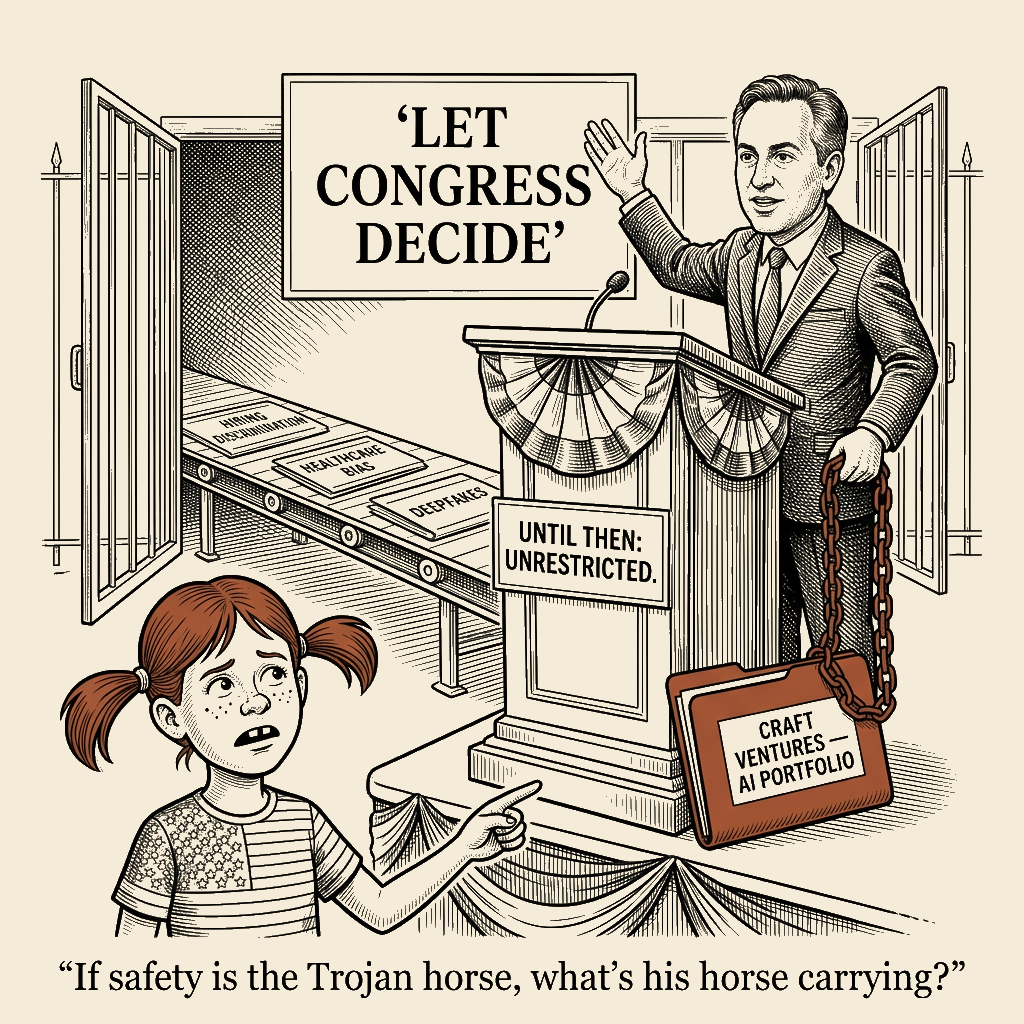
- The “Trojan horse” framing has a specific origin: Vice President JD Vance reiterated it on Monday September 14, 2026 (the day before the column’s publication); David Sacks (PCAST co-chair, founder of Craft Ventures with direct AI investment exposure) amplified the framing on X; and Hewitt endorses it. The man with the most direct financial exposure to AI racing ahead is the man calling safety warnings a Trojan horse.
- The AI sector is already a documented oligopoly: five companies — OpenAI, Anthropic, Google DeepMind, Meta, and xAI — control frontier model development. “Cartel” is not hypothetical; it is the documented structure of the sector.
- The harms the safety warnings describe are not hypothetical: algorithmic hiring discrimination (Mobley v. Workday, No. 23-cv-00770 (N.D. Cal.) — first motion to dismiss granted with leave to amend January 2024, subsequent motion denied in part June 2026, with EEOC enforcement actions on AI hiring bias layered on top); healthcare algorithm bias (the widely cited Obermeyer et al. paper in Science (October 2019), with subsequent peer-reviewed follow-ups documenting persistence of the bias); election deepfakes (the January 2024 New Hampshire Biden robocall — an AI-generated political deepfake that resulted in FCC enforcement against the originator; Slovakia parliamentary deepfake audio in 2023); and child-safety harms (FBI/DOJ public warnings in 2024 on generative AI for CSAM and sextortion material).
- The “let Congress decide” framing ignores the FTC’s existing unfair-and-deceptive-practices authority under Section 5 of the FTC Act (which the agency has begun using against AI products), state-level AI laws (Colorado SB 24-205; California’s AB 2013, SB 942, and AB 3030), the EU AI Act (passed 2024), judicial remedies for documented harms, and voluntary commitments — all of which exist and are operating.
- Anchor citation: Sacks’s X post, verbatim quoted in the column: “Stop pretending you need anyone else’s permission. Stop pretending antitrust law has to be suspended so you can form a cartel. Stop pretending you need a regulatory approval process that supersedes product liability.”
The Response Ladder
Polite Reframe
When to use: At the dinner table with a relative who quoted Hugh Hewitt at you, or with a coworker who genuinely hasn’t thought through what “let the private sector run with the AI ball” means in practice. The voter is never the enemy.
Brenda from Dayton applied for a job through an AI hiring tool in 2023. The algorithm filtered her out before any human saw her résumé. The company could not — or would not — explain the criteria. She never got an interview, never got a reason, never got a remedy. Her case is now part of a class action that has continued to litigate through multiple rounds of motions to dismiss in federal court — the first granted with leave to amend in January 2024, a later one denied in part in 2026. That is what “the private sector gets to run with the AI ball as far and as fast as it wants” looks like in practice for a working mother in Ohio.
The column asks us to trust five companies — OpenAI, Anthropic, Google DeepMind, Meta, and xAI — with the most powerful technology in human history until Congress gets around to holding hearings. There are a few problems with that posture. The FTC already has Section 5 authority to police unfair and deceptive practices, and it has begun using it against AI products. The EU passed an AI Act in 2024 that tiers risk and assigns obligations. Colorado passed SB 24-205. California passed AB 2013 and SB 942. Voluntary commitments from frontier AI companies themselves have produced concrete safety work. The “let Congress decide” framing pretends none of this exists.
The “Trojan horse” framing has a specific origin. Vice President Vance deployed it on Monday. David Sacks — the President’s co-chair of PCAST and the founder of Craft Ventures, a venture firm with direct AI investment exposure — amplified it on X. Hugh Hewitt endorses it in this column. The man with the most direct financial interest in AI racing ahead is the man calling safety warnings a Trojan horse. The Founders fought a revolution against the East India Company. The conservative tradition Burke actually wrote about was about preserving community against concentrated power. Today’s equivalent is five companies controlling the technology that will shape the next century. That’s the version of the free market the column is asking us to trust — five companies with the most powerful technology in human history, until Congress gets around to it. You can decide whether that’s the version you want to live under.
Mockery and Ridicule
When to use: a hostile uncle, a Twitter reply, or a Substack comment thread where the reader is repeating “let Congress decide” with sneering confidence and the audience is the bystanders, not the repeater.
Let me get this straight. Hugh Hewitt — Harvard College, University of Michigan Law, Chapman University Fowler School of Law, where he has taught Constitutional Law since 1996, Fox News contributor, Republican debate moderator — wants you to believe that the right answer to AI is to leave it alone until 48 members of two intelligence committees chaired by Tom Cotton and Rick Crawford get around to it.
That is the pitch. That is the entire pitch.
The rhetorical payload is David Sacks’s — venture capitalist at Craft Ventures with reported AI portfolio exposure, co-chair of the President’s Council of Advisors on Science and Technology, former PayPal colleague of Elon Musk. The punch Sacks wrote, and Hewitt is delivering: “Stop pretending you need anyone else’s permission. Stop pretending antitrust law has to be suspended so you can form a cartel. Stop pretending you need a regulatory approval process that supersedes product liability.”
That is a man with skin in the game telling you the skin-in-the-game men are the problem.
And the rebuttal to Amodei, Altman, Musk, and Hassabis — the four CEOs who said publicly that AI development may be moving too fast — is that they are self-interested. Adam Smith 101, Hewitt says. Sure. Fine. The venture capitalist’s interest in no-regulation is also self-interest. The CEO of the largest AI labs saying “this might be dangerous” is self-interest. The CEO with the most to lose from regulation saying “regulation, please” is also self-interest. We are asked to believe that one form of self-interest is Trojan horse and another form is constitutional principle.
And the constitutional principle in question is: the private sector gets to run with the AI ball as far and as fast as it wants until and unless Congress says stop. Which is to say: until something dramatic happens. Until the catastrophe. Until the disease has spread. That is the actual constitutional principle being advanced by a constitutional law professor. Let it ride. Wait for the wreckage. Then convene.
Then there is the column’s contribution to the actual AI safety debate, which is: a Buc-ee’s anecdote about World Cup crowds and American abundance. That is the substantive policy content. Buc-ee’s. The rest is process fetish dressed up as Madison.
The column is asking you to take the institutional form (Congress should decide) seriously while laughing at the institutional substance (Congressional deliberation is the answer). That is the most elaborate way of saying “do nothing” that a Harvard Law graduate has produced this year.
Nuclear Satire
When to use: the audience is an engaged reader who needs the full grotesque-metaphor treatment to register what’s actually happening — the reader who needs the structural indictment in all its baroque form.
Hugh Hewitt’s Fox News column calling for “Congress” to deliberate AI is a forty-mile-an-hour hearse ride past the future, narrated by a constitutional law professor at Chapman University who has confused the location of his law school with the location of the republic.
The proposal: 48 members of two committees — Cotton’s Senate Intelligence Committee, Crawford’s House Intelligence Committee, both chaired by Arkansas Republicans whose relevant expertise on AI safety is approximately the expertise one accumulates watching Tucker monologues — should hear the matter. Until then, the private sector gets to run with the AI ball as far and as fast as it wants. This is the constitutional procedure. This is what Madison meant.
The vehicle for this proposal: David Sacks, co-chair of the President’s Council of Advisors on Science and Technology, venture capitalist at Craft Ventures with reported AI portfolio exposure, former PayPal colleague of Elon Musk. Sacks wrote the roundhouse that Hewitt is delivering under his own byline. Sacks argues that Amodei, Altman, Musk, and Hassabis — the four largest AI CEOs in the world — are calling for a slower pace because they want to form a cartel under cover of safety. Sacks’s interest in no-regulation is so pure, so Platonic, so entirely unsullied by the venture fund’s exposure to the same companies — that is the position we are asked to treat as the disinterested one.
The framing’s substantive contribution to AI policy: a Buc-ee’s anecdote. The framing’s substantive contribution to constitutional analysis: the proposition that the right committee to deliberate AI safety is the two intelligence committees. The framing’s substantive contribution to democratic theory: the proposition that public concern about AI extinction is “doomerism” and “rhetoric” because for those of us who need a YouTube video to start the dishwasher, 0.01% of America understands the debate. So we should shut up and wait for Cotton and Crawford — the two committee chairs the column has decided constitute “Congress” because they are the two committee chairs most likely to produce the result the column wants.
This is what concentrated economic power dressed in Madison’s clothing looks like when it goes out for the evening. The bowtie is constitutional procedure. The tuxedo is the substantive deregulatory outcome. The puddle in the corner is the public’s ability to do anything about AI before the AI safety researchers are proven right in whatever way they’re proven right.
The piece opens by saying every morning brings a new warning that we are all going to die. By afternoon comes the counter-warning: stand down, nothing to see here. The column then commits to the counter-warning with the full force of a constitutional law professor who has thought about this for the entire duration of a Buc-ee’s visit. The column closes by saying Congress should deliberate. The column never asks whether Congress will deliberate in time.
The answer is no. The answer is no because the piece is the answer. The piece is the mechanism by which deliberation is converted into delay and delay is converted into permission and permission is converted into whatever AI’s most powerful actors do with the period in which they were given permission. This is what “Congress” means in this column: not a deliberating body, but a procedural alibi for letting industry run.
This is the operation. This is who runs it. This is what it produces.
Profane Scorched-Earth
When to use: When you need catharsis and the situation warrants the ladder’s release valve. Gloves off; the receipts stay intact; at least one canonical source is cited. Anyone who reads this as license to harm a person should put the column down.
David Sacks is a fucking venture capitalist with direct AI skin in the game, and he is performing the same goddamn service the tobacco industry performed for fifty goddamn years: when the science starts to bite, attack the scientists as Trojan horses for the regulators. The pattern’s been documented by Oreskes and Conway in Merchants of Doubt — funding front organizations, manufacturing doubt, calling researchers ideological, demanding more study before action. The pattern worked on lead. It worked on asbestos. It worked on opioids. It worked on PFAS. It’s worked on climate. Now David Sacks is running it on AI safety with full theatrical fucking commitment.
“Stop pretending you need anyone else’s permission. Stop pretending antitrust law has to be suspended so you can form a cartel.” That’s the Sacks roundhouse punch. Notice what it does: it puts the words “antitrust” and “cartel” into the mouth of the safety advocate, so that the man with the AI investments gets to perform as the anti-monopoly champion while the man with the safety research gets to perform as the cartel-former. It’s a fucking shell game with regulatory vocabulary, and the public is supposed to watch the shells and not notice that the actual cartel — five companies controlling frontier AI development — is the structure Sacks is fucking defending. The man accusing others of cartel-formation is the man whose money benefits from the cartel he is defending. The man defending “the free market” is the man whose portfolio depends on the market he is defending. The “roundhouse punch” lands, but it lands on Sacks.
Vance says the CEO safety calls are a Trojan horse. The Trojan horse, in Vance’s telling, looks like Dario Amodei publishing an essay. The Trojan horse looks like the safety research team at DeepMind. The Trojan horse looks like a Nobel laureate physicist signing an open letter. These Trojan horses have been waging their cunning assault against the American public by saying maybe we should slow down a little. The phrase “Trojan horse” has been used against AI safety warnings by the same fucking rhetorical tradition that used “junk science” against tobacco epidemiology and “alarmism” against climate science. The tradition is: when the warnings start to land, attack the warners as Trojan horses for the regulators. The tradition is documented. The tradition is being run by the fucking Vice President of the United States.
Hewitt, the fucking constitutional law professor, is teaching his students that the Constitution requires trusting five companies with the most powerful technology in human history until Congress gets around to holding hearings. The Constitution does no such fucking thing. The Constitution authorizes Congress to act. It also authorizes the FTC to act under existing Section 5 unfair-and-deceptive-practices authority. It authorizes states to act under their police powers. It authorizes federal courts to provide remedies for harms. It authorizes the Executive to issue voluntary commitments. The “let Congress decide” framing is industry-standard delay dressed up in constitutional language, and the man deploying it is a constitutional law professor who fucking knows better.
The harms the safety warnings describe are not hypothetical. Algorithmic hiring discrimination is in court right now — Mobley v. Workday is a class action that has continued through multiple motions to dismiss, the first granted with leave to amend in January 2024, a subsequent one denied in part in 2026. Healthcare algorithm bias was documented in the widely cited Obermeyer et al. paper in Science (October 2019), and the follow-ups have only made it worse. Election deepfakes were documented in the 2024 cycle, including the New Hampshire Biden robocall in January 2024 (an AI-generated deepfake, the originator since subject to FCC enforcement) and a Fico deepfake in Slovakia. The FBI and DOJ issued warnings in 2024 about generative AI being used to produce CSAM and sextortion material. These are not Trojan horse hypotheticals. These are documented harms, in court filings, in agency enforcement, in peer-reviewed fucking research.
Jeremiah 8:12: “Were they ashamed when they had committed abomination? No, they were not at all ashamed, nor did they know how to blush.” Vance, Sacks, Hewitt do not know how to blush at defending AI cartel power. They do not blush at attacking safety warnings as Trojan horse tactics. They do not blush at invoking China as a reason not to regulate the technology that may end human civilization if the safety teams are right. They do not blush. The diagnostic is operative. The Jeremiah diagnostic.
The arc of the moral universe is long, King said at Mason Temple in Memphis two weeks before they killed him, but it bends toward justice. The arc bends only when specific people, in a specific moment, push it. The people pushing it right now are the CEOs at Anthropic and DeepMind publishing safety research, the state attorneys general passing AI laws, the workers in algorithmic-discrimination lawsuits, the researchers documenting bias, the public demanding guardrails. The people trying to fucking stop the arc from bending are the venture capitalists and the Vice President and the constitutional law professor performing the tobacco industry’s playbook on AI.
By any means necessary that operate within the analytical and political instruments available to us, we name the fucking apparatus. We name David Sacks’s conflict of interest. We name Vance’s Trojan horse rhetoric. We name Hewitt’s constitutional cover for industry delay. We do not trust five companies with godlike technology until Congress gets around to it. We do not pretend the safety warnings are Trojan horse tactics when the warnings come from inside the same companies. We do not pretend the Constitution requires corporate serfdom. The Founders fought the East India Company. We will fight the AI cartel. By any means necessary.

About Malcolm Little King
Malcolm Little King is a heteronym in Main Street Independent's editorial architecture — an analytical voice, not autobiography of any actual person. The position this column expresses is the publication's position on the territory Malcolm Little King's lane covers, rendered through Malcolm Little King's register.