Responding to: Prescription Drugs Save Lives at a (Mostly) Reasonable Cost — Jeremy Nighohossian · 2026-09-15
What the Piece Argues
A 2026 op-ed argues that prescription drug prices, though seemingly high, are reasonable because they fund the pharmaceutical innovation that saves and improves lives. The author contends that drug development costs roughly a billion dollars per approved medication, that high prices are temporary because generic competition drives prices down 80–85% after patents expire, and that even expensive drugs reduce overall healthcare costs by preventing hospitalizations and costly procedures. The piece concludes by warning that price controls and government regulations would stifle innovation — citing slower drug access in countries that use them — and urges readers to reject such “government overreach” to preserve the current system.
Receipts
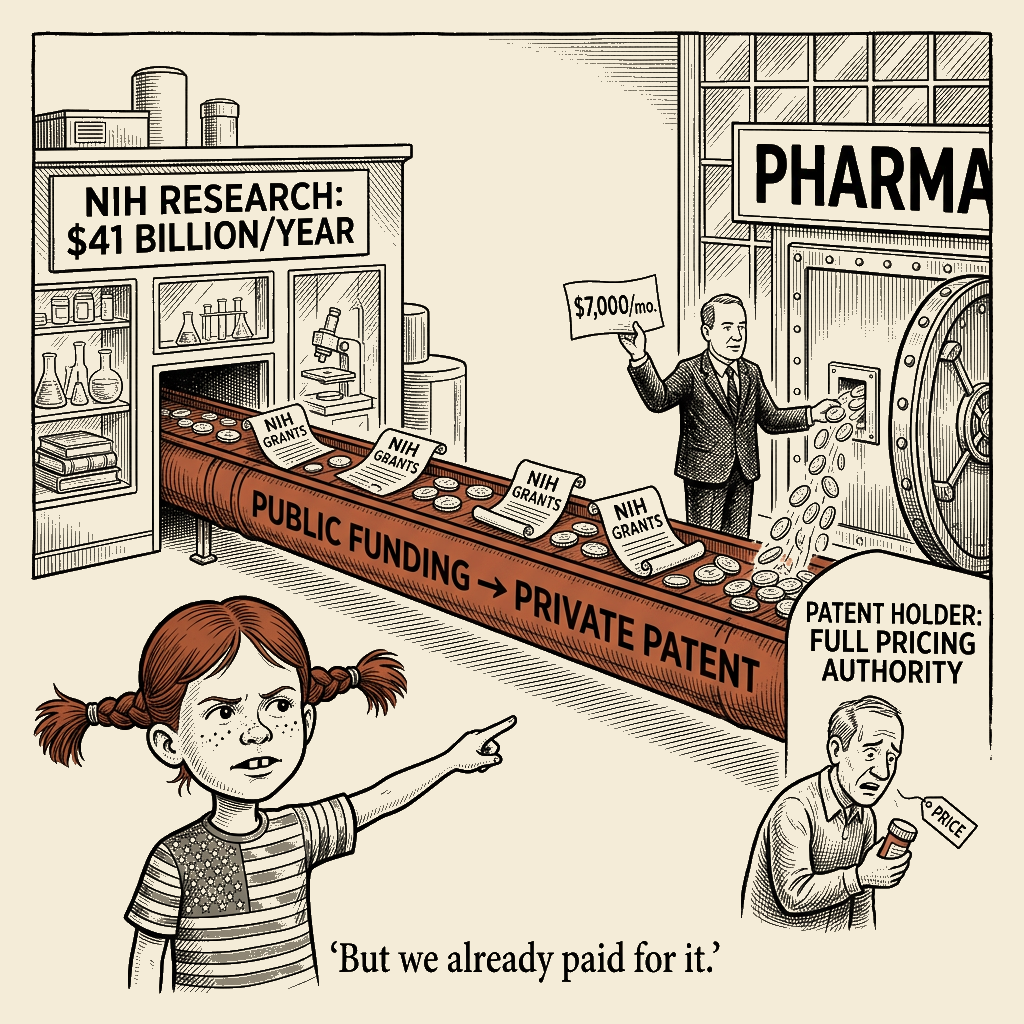
The piece asks you to believe that current drug prices are the natural and necessary cost of a functioning innovation system, when the actual arrangement is a public investment in basic science that gets privatized at the point of profit—with patients paying the world’s highest prices for discoveries their own tax dollars funded.
The framing wants you to believe
- Drug prices are reasonable because developing a single new drug costs roughly a billion dollars and the value delivered—avoided surgeries, prevented hospitalizations—easily outweighs the price tag
- The market works: generic competition eventually drives prices down 80–85 percent, and average drug prices have actually fallen in recent years
- Price controls would destroy American pharmaceutical innovation and produce the same poor access seen in countries with government-regulated prices
What’s really going on
- The American taxpayer funds roughly $41 billion annually in NIH research—the foundational science that makes drug discovery possible—but receives neither equity in the resulting patents nor any leverage over pricing, creating a system where public investment is handed to private firms that then charge patients full freight for what the public already paid to discover
- The “$1 billion per drug” figure conflates genuine R&D with marketing budgets, executive compensation, share buybacks, and clinical trials for me-too drugs that offer marginal improvement over existing treatments—a figure that collapses when you isolate the cost of genuinely novel therapies developed from publicly funded research
- The United States pays an average of 2.56 times what comparable wealthy countries pay for identical brand-name drugs, and millions of Americans ration insulin, skip doses of chemotherapy, or cross the border to Canada for medications their own government’s research investment helped create—a global subsidy arrangement that other nations do not reciprocate
Anchor citation: KFF, “Prices for U.S. Prescription Drugs Are 2.56 Times Higher Than Those in Other Countries,” January 2026; a widely-cited JAMA Network analysis of NIH contributions to new drug approvals documenting that NIH funding contributed to every one of the 210 new drugs approved in that period.
The Response Ladder
Polite Reframe
When to use: A persuadable moderate or family member who repeats the “innovation requires high prices” line without malice; someone whose views aren’t welded to the position and is willing to walk through the receipts.
Maria is fifty-eight. She works two jobs as a medical assistant and a grocery cashier. Her endocrinologist put her on a GLP-1 last spring. The list price, before any coupon, was over a thousand dollars a month. Maria makes too much for Medicaid, too little for the manufacturer’s patient assistance program to kick in, and her employer’s insurance covers none of it. She split her doses in half and stretched them to ten days each. Her A1C crept up. Her doctor is talking about adding a second medication.
I want to talk to you about Maria when you tell me the price of these drugs is reasonable.
The argument you’ve been handed — and it is a real argument, made by serious people — runs like this: yes, list prices look high, but almost no one pays them; the system recoups R&D costs; generic competition knocks prices down 80 to 85 percent once patents expire; and price controls would kill the innovation that saves people like Maria.
Let me keep Maria in the room while we walk through it.
On the $1 billion per drug figure. This comes from the Tufts Center for the Study of Drug Development, an industry-funded research center. Independent peer-reviewed researchers have put the figure substantially lower, even including the cost of failures. (Donald Light’s published work; subsequent reanalyses in Social Science & Medicine, BMJ, and elsewhere.) That is not a conspiracy theory; it is a documented dispute you can look up.
On innovation. The piece says high prices fund innovation. Here is what that sentence leaves out: the basic science behind most new drugs is publicly funded through the National Institutes of Health — roughly $30 billion annually in the early 2010s, rising above $40 billion by FY2020. NIH’s own provenance work suggests its grants contributed to the foundational research behind a large majority of new molecular entities. The industry funds the expensive late-stage clinical trials; the public pays for the discovery.
On other countries. The piece says other countries with price controls have worse access to new drugs. Partially true and partially the wrong comparison. Other high-income countries pay two to three times less than the United States for the same drugs (KFF and RAND analyses going back years), and patients in those countries often have better access to the drugs that actually matter for their conditions. The U.S. pays more partly because other countries pay less. We subsidize the rest of the world’s drugs.
On generic competition. Yes — and it’s the same competition the industry fights hardest to delay. The FTC has sued over pay-for-delay schemes, and the Supreme Court’s 2013 FTC v. Actavis decision held that those reverse-payment settlements can be challenged under antitrust law. AbbVie spent years fending off biosimilar competition for Humira. Generics are great when they arrive; getting them to arrive is the hard part.
On government “overreach.” Here is what Maria’s doctor would call overreach: the federal government, through Medicare, was prohibited by statute from negotiating drug prices for the program that covers sixty million Americans until the Inflation Reduction Act of 2022. That act began to change that, modestly, for a small list of drugs. The industry spent hundreds of millions of dollars lobbying against the provision and ran ads warning it would kill innovation. The policy being framed as “government overreach” is the policy that lets Medicare negotiate a handful of drug prices with the companies that charge the rest of us three times what they charge Germans.
I am not arguing the industry is evil. Many of the people in it are doing serious work. The argument is that the current system — the one the column defends as “reasonable” — has produced record-breaking profits and stock buybacks for the companies, and record-breaking out-of-pocket costs for the people who take the drugs. Those two things happening at the same time is not a coincidence. It is a structure.
Maria isn’t asking for a revolution. She’s asking her insulin to not cost more than her mortgage.
If you want to defend the innovation system, here is a question worth sitting with: the United States invented most of the drugs the world buys. The United States also pays more for those drugs than anyone else. The innovation system you’re protecting is already the most expensive one in the world. What, exactly, is being kept healthy?
Mockery and Ridicule
When to use: The same family member or acquaintance after Polite Reframe has gone in one ear and out the other; the colleague who keeps repeating “innovation requires it” with a straight face; the Twitter reply that needs to land for the bystander watching the exchange.
Imagine, if you will, the columnist at the hearing.
He is wearing a navy blazer. He has a leather portfolio. He is about to tell the Subcommittee on Health that the price of Humira is reasonable because one day, somewhere, a researcher is going to invent a pancreatic-cancer drug. (They are saying this in 2026. Humira has been on the market since 2002. AbbVie raised the price more than two dozen times in the years it owned the drug.)
He is going to tell the widow on Medicare that her out-of-pocket diabetes-medication costs are a sign of a healthy innovation system. He is going to explain to the small-business owner with a high-deductible plan that the policy being framed as “government overreach” is in fact the modest Medicare negotiation that would lower the price she pays. He is going to use the word “overreach” eleven times.
He is going to say, “Today, 90 percent of all prescriptions in the United States are generic,” without mentioning that this is true because of policy choices made in the 1980s — the Hatch-Waxman Act, the carve-outs for biologics, the FTC pay-for-delay enforcement fights — and that the industry’s preferred future is one in which the share of generics is lower, because every biologic that stays a biologic forever is a biologic that stays a biologic forever.
He is going to mention the billion-dollar R&D figure. He is not going to mention that this number comes from a center funded by the pharmaceutical industry, and that independent peer-reviewed estimates have put the figure substantially lower.
He is going to say “other countries with price controls have worse access to new drugs” and not say that those countries pay a third of what we do for the same drugs, that patients in those countries often have better access to the drugs that actually matter for them, and that we subsidize their innovation by paying the highest prices in the world. He is going to say this as though the United States inventing the drugs and the United States paying three times what Germans pay for the drugs were unrelated facts.
He is going to tell you that the answer to the problem of pharmaceutical companies charging too much is to make sure pharmaceutical companies are never asked to charge less.
He is going to use the word “innovation” nineteen times.
He is going to use the word “patient” three times.
He is going to mean the first word.
Nuclear Satire
When to use: The reader who needs the catharsis; the Twitter thread that has worn out Mockery; the moment when restraint is no longer a virtue.
Let me tell you about the most patriotic industry in America.
It takes the medicines invented largely with your tax dollars — the basic research funded by the National Institutes of Health, the early-stage science done in your state universities, the publicly underwritten clinical-trial infrastructure — and once those medicines are approved, it charges you three times what it charges Germans for the privilege of taking them.
It does this in the name of innovation. It does this with a straight face. It does this with the help of a “billion dollars per drug” figure that comes from a center it funds, and that has been disputed by independent peer-reviewed work for over a decade. It does this by telling you the policy that would lower your mother’s drug costs is “government overreach,” as though the only thing standing between your mother and a full life is the freedom of Pfizer to set her copay.
It does this with the help of AbbVie — spun off from Abbott Laboratories in 2013 with Humira as its flagship product, which it then priced up more than two dozen times in the decade that followed, eventually reaching a list price over $7,000 a month for a drug whose original list price was a small fraction of that. AbbVie did this so successfully that Humira became, for a window of years, the highest-revenue drug in industry history by annual sales. (The fact that Humira is now competing with biosimilars and AbbVie has lost patent protection on its biggest product is a development the columnist did not have time to cover.)
It does this with the help of a lobbying operation that spent hundreds of millions of dollars against the Inflation Reduction Act’s Medicare drug-price negotiation provision — the most modest, incremental, market-friendly price-control measure the United States Congress has considered in a generation, and they called it socialism. The provision covers ten drugs a year, starting with drugs Medicare already pays the most for. It is the policy being framed as “government overreach.”
It does this with the help of commentators who know better. Op-ed writers on this beat have been telling their readers for decades that the problem with American healthcare is the wrong kind of government intervention. The piece you are reading is the same piece they have been publishing for decades, dressed up in new statistics. (The statistics are real. The argument is the same one. It has been the same one since the 1990s.)
The argument is that the system in which a Type 1 diabetic in Minnesota pays $300 for a vial of insulin that has been on the market since 1998, in which a Medicare patient cannot afford the blood thinner her cardiologist prescribed, in which a small-business owner with a high-deductible plan drives to Mexico to fill her prescription, is a “healthy innovation system.”
The argument is that the answer to Americans dying because they cannot afford their medications is to make sure the company that owns the medication can continue to charge whatever the market will bear.
The argument is that the appropriate response to a $7,000-a-month Humira is not to ask why Humira costs $7,000 a month, but to ask whether asking why Humira costs $7,000 a month might harm the future Humira.
This is the most patriotic industry in America.
The patriotism is in the structure: we pay, they profit, and the difference is called innovation. The patriotism is in the lobbying: hundreds of millions of dollars a year to keep Medicare from negotiating ten drug prices. The patriotism is in the messaging: “government overreach” is the word for letting Medicare ask Pfizer what it charges for Eliquis.
The most patriotic industry in America would like you to know that you are free. You are free to skip your doses. You are free to take half a pill and hope. You are free to drive to Canada. You are free to choose between groceries and the medication your doctor prescribed. You are free to do anything you want, as long as the company that makes the medication is also free to charge whatever it wants.
The most patriotic industry in America thanks you for your service.
Profane Scorched-Earth
When to use: The reader who needs full catharsis; the comment section that has been beaten past restraint; the moment when the polite register has done its work and the only honest thing left is the unfiltered version.
Your mother skips her blood thinner three days a month because the copay is $400. Your father splits his insulin pens in half. Your wife drives to Canada to afford her Eliquis — a pill that costs a third as much in fucking Berlin.
You have been told this is fine. You have been told this is “innovation.” You have been told the system that charges you three times what it charges Germans is a “healthy marketplace.” You have been told that letting Medicare ask Pfizer what it charges for a pill is “government overreach.”
That is the word they taught you to use. “Overreach.” So that when someone finally proposed letting the largest single buyer of drugs in America negotiate ten drug prices — ten, out of the thousands on the market — you would flinch. So that when someone mentioned that the billion-dollar R&D figure comes from a center they fund, you would call that a talking point. So that when someone pointed out that the public paid for the basic science behind most of the drugs, you would shrug.
You have been governed by people who want you to feel that defending your own mother’s prescription is unpatriotic. That the freedom they care about is the freedom of the company that owns the molecule.
The freedom they mean is AbbVie’s freedom to charge $7,000 a month for Humira — the drug it inherited when it spun off from Abbott Laboratories in 2013, and that it then priced up more than two dozen times over the decade that followed. The freedom they mean is the freedom to fund a think tank that produces a number they then cite back to you as fact. The freedom they mean is the freedom to spend hundreds of millions of dollars lobbying against the modest provision in the Inflation Reduction Act that would have let Medicare negotiate ten drug prices — and then calling that provision socialism.
You are free. You are free to skip doses. You are free to take half a pill. You are free to drive north of the border. You are free to choose between groceries and your cardiologist’s prescription. You are free to do any goddamn thing you want, as long as the company that makes the pill stays free to charge whatever it wants.
Your mother is not free. She is rationing. That is the word for what she is doing. The word the column wants you to use for price negotiation is “overreach.” The word for what your mother is already doing, under the current system, is rationing.
Your mother is rationing so that AbbVie can keep its margins. Your father is rationing so that PhRMA can keep its tax bill. Your wife is rationing so that Pfizer can keep the price of Eliquis higher in America than in any other country on earth.
The structure is not complicated. You paid for the science. They own the price. You pay the difference.
If you want to defend this system, defend it to the widow in the oncologist’s waiting room. Defend it to the small-business owner who hasn’t taken her inhaler in three weeks because the deductible resets in January. Defend it to the Type 1 diabetic in Minnesota who pays $300 a vial for a drug invented in 1998.
Don’t defend it to me.
I’ve read the fucking receipts.

About Malcolm Little King
Malcolm Little King is a heteronym in Main Street Independent's editorial architecture — an analytical voice, not autobiography of any actual person. The position this column expresses is the publication's position on the territory Malcolm Little King's lane covers, rendered through Malcolm Little King's register.