Responding to: AMB GORDON SONDLAND: Canada doesn't need Europe. It needs a new economic deal with America — Amb Gordon Sondland · 2026-09-15
What the Piece Argues
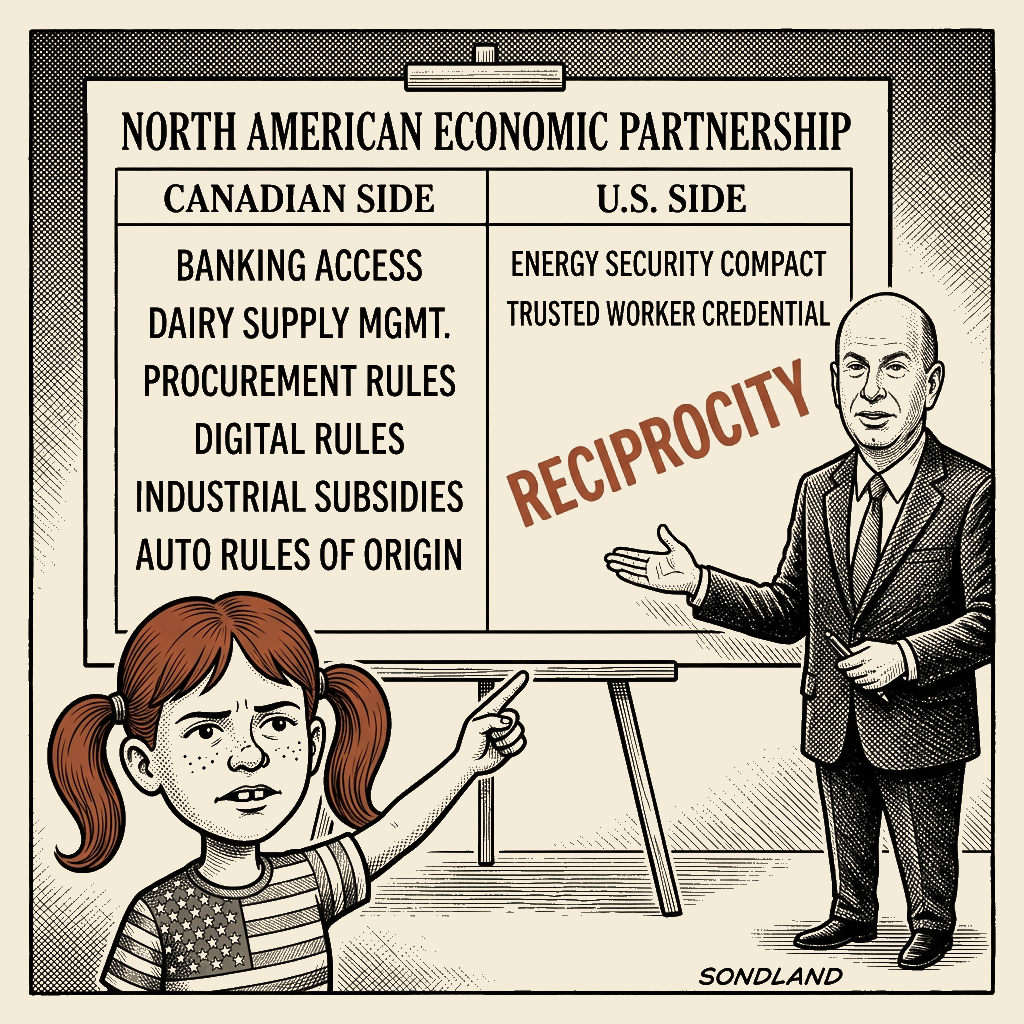
Gordon Sondland, a former U.S. ambassador to the EU writing in a Fox News Opinion column, argues that the United States and Canada are caught in a damaging “bad marriage” dynamic in which Washington humiliates and Ottawa retaliates by diversifying, and that both countries should step back and negotiate a serious continental economic deal. The piece concedes that the Trump tariff regime has been a poor negotiating tactic while criticizing Canada for treating diversification away from the United States as a strategy instead of a tactic. The proposed “new North American economic relationship” would harmonize automotive and supply-chain rules, create a continental energy-security compact, open Canadian banking and dairy markets, and build a reciprocal worker-mobility regime — the concrete asks landing on Canadian protected sectors, with American commitments described in gestures.
Receipts
The framing wants a continental-partnership pitch to read as a meeting between two sovereign equals whose “reciprocity” runs in both directions; the itemization that runs in one direction is the move.
The framing wants you to believe
- Washington humiliates and Ottawa retaliates — two sides at fault, both sides should come to the table, “both instincts emotionally satisfying, neither a strategy.”
- A serious new economic deal would benefit both countries — common rules of origin, energy security, worker mobility — through reciprocity.
- Canada’s push for “associate member” status in the EU is “outsourcing sovereignty” — a political gesture mistaken for an economic plan.
What’s really going on
- The column names six Canadian protected sectors for opening — “Banking, dairy, procurement, digital rules, industrial subsidies and autos” — with zero comparable American protected sectors enumerated in the same trade. The asymmetry is the strategy.
- The specific U.S. benefits appear abstractly — “North American energy-security compact,” “trusted-worker credential,” “shared infrastructure planning.” The Canadian concessions are itemized. One column’s worth of “reciprocity” is not symmetrical.
- The named U.S. beneficiaries have documented stakes: U.S. financial services have lobbied for Canadian banking access across multiple administrations and negotiating tracks; U.S. dairy has pressed for dismantling Canadian supply management since at least the 2018 USMCA renegotiation; U.S. auto manufacturers and parts suppliers have pressed for rule-of-origin redesigns that favor U.S. content; U.S. LNG and critical-mineral exporters have pressed for accelerated cross-border approvals; U.S. technology and digital firms have pressed for Canadian data and digital-services rules aligned with U.S. standards.
- Anchor. The piece’s own identification of the author — Gordon Sondland, “the 20th U.S. ambassador to the EU” — anchors the institutional posture; the asymmetric-itemization pattern tracks the U.S. Trade Representative’s documented negotiating playbook in the 2018 USMCA renegotiation and the tariff-and-duress architecture in continuous use by the second Trump administration.
The Response Ladder
Polite Reframe
When to use: a reasonable family member or colleague has forwarded the column and is asking, in good faith, why you don’t find “let both sides come to the table” persuasive — the piece wears a statesman tone and asks for symmetry; the rebuttal is measured, fact-anchored, and refuses the frame without name-calling.
Marie Tremblay runs a sixty-cow dairy on Route 141 in Coaticook, Quebec. She is the fifth generation on the land. The supply-management system — the program that ties Canadian milk production to a domestic price reflecting cost and Canadian demand — is the difference between her operation staying a working farm and her family’s mortgage being absorbed by a continental dairy integrator at one of those negotiating tables Ambassador Sondland’s column is asking her country to sit down at. Marie does not read trade policy. She reads the bills. She knows what the loss of supply management looks like; she has watched her neighbours in Vermont lose theirs in the 1980s and 1990s, and the shape of a Vermont hill town in 2025 is not a future she wants Coaticook to become.
So when Sondland writes that “both instincts are emotionally satisfying” — the Ottawa instinct to diversify, the Washington instinct to tariff — and asks Canada to come back for “reciprocity,” Marie reads the next paragraph. It is right there. “Banking, dairy, procurement, digital rules, industrial subsidies and autos all belong on the table.” Six protected sectors, all Canadian. The American side of the reciprocity ledger is gestured at in the abstract: “common rules of origin with real North American content,” “North American energy-security compact,” “joint critical-mineral processing,” “trusted-worker credential.” None of these is a U.S. protected sector being asked to open.
There is a real case for continental economic integration, and we should be having that conversation honestly. The honest version would itemize concessions on both sides and binding dispute settlement both can trust. The version in this column does not. The Canadian sectors being itemized — dairy, banking, procurement, digital rules, industrial subsidies, autos — are those whose domestic constituencies have spent a generation being told they are an unfairness the United States is owed. The U.S. protected sectors that another country’s negotiators would itemize — Buy American, agricultural subsidies that distort global commodity prices, the Jones Act on cross-border shipping, federal procurement exceptions — are not in the column. They are not on the table. The column’s “reciprocity” is a word doing the work of a list.
The legitimate value the column serves is real; this rebuttal is not bleaching it. But that value lives in a different document than this one. Two mature democracies with the world’s largest bilateral trade relationship should negotiate as equals — and mature democracies negotiate as equals by enumerating what each side puts down and matching the items, not by itemizing what one side gives while gesturing at what the other might eventually do in the abstract. The members of Marie’s cooperative have a right to a reciprocity ledger they can read. The workers in the Ontario plants whose autos cross the border several times before final assembly have a right to rules of origin they can read. They will get none of those, and they will be told afterwards that they did.
If you want a place to push back — a phone call, an email to your representative, a sentence in conversation — the only useful pressure is to ask, by name, what the U.S. side is putting on the table. Ask it of the column. Ask it of the ambassador. Ask it of anyone who has spent the last eighteen months calling Canada’s dairy, banking, and procurement rules unfair while preserving the American analogues intact.
Mockery and Ridicule
When to use: A reader who needs to see the structural irony of a recalled U.S. ambassador lecturing a sovereign ally about its own dignity.
Picture it: a man recalled from his post as U.S. Ambassador to the EU — a fact he does not mention — has published an essay telling Canada, in the measured tones of a diplomat who has never been on the receiving end of one, that its effort to find trade partners beyond Washington is the political gesture of a nation that has confused its own dignity for strategy.
Sondland has a book to sell. He has a hospitality business. He has a brand that still trades on his title. And he has a piece whose central insight is that Canada should stop being upset about the tariffs the United States put on its steel and aluminum — and accept that the answer is more integration with the country that put the tariffs on its steel and aluminum.
The piece is a marvel of structural diplomacy. It indicts Trump’s “tariffs and public humiliation” approach to Canada. It then proposes, as the alternative, that Canada dismantle dairy supply management, open banking to U.S. institutions, harmonize EV and battery rules with U.S. rules, build out U.S.-aligned energy infrastructure, and adopt a U.S.-designed “trusted worker” mobility regime. It calls this “reciprocity.” It also calls it “not surrendering sovereignty” while describing what is functionally surrendering sovereignty.
Sondland writes: “Washington should stop treating Canada as a trophy to be won. Ottawa should stop treating distance from the United States as a measure of national success.”
Excellent framing. Both sides have a problem. Both sides should stop. Now read the actual proposals. Which side is being asked to stop doing what? Canada: stop diversifying, stop protecting dairy, stop regulating banking its own way, stop controlling its own trade policy as fully. The United States: stop humiliating Canada with tariffs and presidential taunts. That is the ask. That is the entire list. The asymmetry is the essay.
The piece’s keystone is the false choice at the close: “The real choice is not between American dominance and Canadian independence. It is between a continent that builds together and one that slowly hands market share, industrial capacity and strategic leverage to others.”
That is the rhetorical move that does the work. It says: anything short of North American integration on terms shaped in Washington is, by definition, helping Beijing. It says: Canadian dairy farmers protecting their market are handing leverage to China. Canadian banks protecting their market are handing leverage to China. Canadian workers in protected sectors are handing leverage to China. The essay does not say this directly. The math of the framing requires it.
The piece drops the heaviest line of all, almost casually: “Canada does not need to join Europe to preserve its dignity. It needs to help the United States build the most competitive, secure and productive democratic economic space on earth.”
Canada’s dignity. Helping the United States. The “competitive, secure and productive democratic economic space on earth” — to be built by the United States, with Canada as helper. This is not the language of a sovereign nation talking to an equal sovereign nation. This is the language of a senior partner asking a junior one to accept the role.
Sondland is a smart man who knows better. He knows the difference between asking Canada to negotiate and asking Canada to fold. He chose the second framing, dressed it up in the first, and submitted it to a publication that would not edit it down. That tells you who the piece is for.
The reader who took it at face value: take it back at face value. The face value is a recalled U.S. trade official, writing for an American audience, asking Canada to dismantle the parts of its economy that U.S. businesses most want access to, in the name of “building together,” while framing Canadian resistance as a strategic gift to U.S. competitors. That is what is happening here.
Nuclear Satire
When to use: for readers who need the grotesque amplification of the structural operation; bold villainization of the framing’s architecture and its named institutional beneficiaries; receipts deployed with cumulative force; named bad-faith patterns carried on the page; analogies earn their place; the truth-floor holds.
Picture the proposal from the receiving end. A man walks into a Washington hotel conference room. He has been told he is here for “the most mature continental economic conversation in two generations.” He is welcomed by the side that wrote the document. He is offered coffee. He is told there is no document yet. He is told the document will be drafted as the conversation proceeds. He is told his country is a sovereign partner. He is told the side that wrote the document has a few “principles.” Then he is given the list.
Banking, opened. Dairy, dismantled. Procurement, rewritten. Digital rules, realigned. Industrial subsidies, aligned. Autos, rules-of-origin redesigned. Six items. These are not items that touch at the edges of Canadian policy; they are the protected sectors whose continued existence defines a Canadian development model that has held for half a century. They are not the only protected sectors in the relationship. There are Buy American provisions in U.S. federal procurement; there are Jones Act constraints on cross-border shipping; there are federal agricultural-subsidy programs whose market-distorting effect the U.S. Treasury’s own reports periodically flag; there are Section 232 steel and aluminum tariffs maintained as bargaining instruments. None of these appear in the document. None are on the list. The list runs in one direction, and the document is going to come back to the sovereign partner with that list written into it.
The ambassador calls Canadian exploration of EU association “outsourcing sovereignty.” The phrase is correct. The application is interesting. The column is documenting the manufacturing of an outsourcing arrangement in which the outsourcing is being done by the side that drafted the document and the contract is being run on the side whose sectors are itemized. The vocabulary of partnership is being used to ratify a contract whose terms no North American negotiator would accept if read in plain English on a single page. “Reciprocity” is doing the analytical work that an itemized ledger would not survive. “Both instincts emotionally satisfying, neither a strategy” is doing the rhetorical work that the itemization would do if it could survive — symmetry between a population of roughly three hundred and forty million and a population roughly one-twelfth its size, dumping six protected sectors on the smaller economy without enumerating what the larger one will give in exchange.
The operation is identified by name. It is the symmetric-equivalence framing of an asymmetric opening demand. It runs on the rapid-stacking pattern that NCSE’s Eugenie Scott in 1994 named the Gish gallop: six protected sectors, no comparable American sectors, the reader’s fact-checking capacity overwhelmed. It runs on the motte-and-bailey that Nicholas Shackel identified in 2005: a strong claim (continental partnership, both sides emotional, both sides need the table) advanced; under challenge, retreat to the weaker related claim (reciprocity); when the challenge subsides, resume the strong claim (both sides need to lower the temperature and stop measuring each other’s manhood across the border). The structural donor-class beneficiaries are not abstract: U.S. financial services, U.S. dairy, U.S. auto manufacturers and parts suppliers, U.S. LNG and critical-minerals exporters, U.S. technology firms. Industries with documented asks, documented lobbyists, documented stakes. The column addresses the conversation to them by being too gentlemanly to name them. They know who they are. The reading public is asked to nod along without reading the receipt.
This is what “continental partnership” sounds like when the partnership is a contract and the contract is being drafted by the party that already holds the larger instrument of enforcement. The continental partnership ends not with a coup but with a list.
Profane Scorched-Earth
When to use: For the reader who has had it up to here with American policy elites lecturing allies about their own dignity.
Let us be clear about who wrote this piece and who it is for.
Gordon Sondland — the motherfucker was the United States Ambassador to the European Union, a job he got because he was a Republican donor, a job he was recalled from because he got caught lying to Congress about the Ukraine quid pro quo, and a job he is still trading on as credential in op-eds like this one — has written a piece telling Canada, a sovereign fucking nation, that its efforts to find any trade partner besides the United States are “mistaking a political gesture for an economic plan.”
Read that again. The man who was recalled from his ambassadorship for lying to a Congressional committee about whether the President of the United States was running a shadow foreign-policy operation is telling Canada that its trade diversification strategy is unserious. The shit-stained credentials on this man would not pass a high-school guidance counselor’s review. He is selling a book called “The Envoy.” The envoy got fired. The envoy is now writing op-eds about how Canada should not have options.
The piece says Canada should not join the EU. Fine. The piece says EU membership is “legally implausible.” Probably true. The piece says full EU membership would be a “terrible bargain.” Maybe. The piece does not need to make this argument to be the bad piece. The piece needs to be the bad piece because of what it actually proposes.
What the piece actually proposes: Canada should dismantle dairy supply management. Canada should open banking to U.S. banks. Canada should harmonize EV and battery rules with U.S. rules. Canada should accept U.S.-designed mobility credentials so U.S. employers can pull Canadian engineers and electricians across the border to fill U.S. labor shortages. Canada should build out cross-border energy infrastructure that benefits U.S. oil and gas majors. Canada should accept “reciprocity” that runs in one direction: from Canada to the United States.
What the piece says the United States should do: stop humiliating Canada with tariffs and presidential taunts.
That is the fucking asymmetry. That is the entire asymmetry. The piece is dressed up as a balanced call for partnership. It is a list of Canadian concessions paired with a request that the United States stop acting like an asshole. The Canadian concessions are specific and substantial. The American concession is a tonal adjustment.
This is what American trade policy has looked like for forty goddamn years, dressed up in the language of “building together,” and submitted to a publication whose audience has never once been asked to pay the price of Canadian dairy going away or Canadian banking opening up. The American audience gets the speech. The Canadian audience gets the consequences.
And the piece has the fucking gall — the actual, the brazen, the insulting gall — to invoke Canadian dignity. “Canada does not need to join Europe to preserve its dignity. It needs to help the United States build the most competitive, secure and productive democratic economic space on earth.”
Canada’s dignity. Helping the United States. Helping the United States build the space. The piece ends on the word “earth” because it wants the reader to think this is about geopolitics. It is about Canadian supply management. It is about Canadian banking. It is about Canadian labor. It is about Canadian policy space. The United States is going to be just fine. Canada is the country being asked to give things up.
Let us name who benefits when this essay is taken seriously.
U.S. dairy interests get Canadian market access. U.S. banks get Canadian financial-sector entry. U.S. defense and aerospace primes get Canadian engineering labor. U.S. oil and gas get cross-border pipeline and grid expansion. U.S. EV and battery manufacturers get continental rules of origin tilted toward their supply chains. U.S. Treasury gets harmonized tax and subsidy rules that limit Canadian industrial policy. Sondland gets another piece on the resume and another chapter of book sales.
Let us name who pays.
Canadian dairy farmers. Canadian bank workers. Canadian provincial procurement authorities. Canadian industrial policy. Canadian sovereignty over its own trade relationships. The Canadians who actually have to live with the consequences of “North American integration” when integration means the United States writes the rules and Canada signs them.
The piece criticizes Trump’s tariffs and taunts. Fair. The piece does not mention that the United States currently imposes — or has recently imposed — tariffs on Canadian steel, aluminum, lumber, solar, and autos. The piece criticizes Canadian “diversification” as a strategic mistake. The piece does not mention that the Canadian push to diversify accelerated after Trump’s 2018 Section 232 tariffs hit Canadian aluminum going into U.S. auto plants, and after the threatened 2025 auto tariffs. The piece is critical of the consequences of U.S. trade policy. It is silent on the causes.
The piece closes on the false choice. “The real choice is not between American dominance and Canadian independence. It is between a continent that builds together and one that slowly hands market share, industrial capacity and strategic leverage to others.”
That is the load-bearing bullshit of the entire essay. Anything short of full North American integration, on terms shaped in Washington, is a gift to Beijing. Canadian dairy farmers protecting their market are handing leverage to China. Canadian banks protecting their market are handing leverage to China. Canadian workers in protected sectors are handing leverage to China. The essay does not say this directly. The math of the framing requires it.
Sondland knows this. Sondland is a smart man who spent years in the U.S. trade-policy establishment that has spent decades asking Canada to open its protected sectors. Sondland knows what the piece is doing. Sondland wrote it anyway. Sondland submitted it to a publication that would not edit down. Sondland is selling the book and the consulting business that follows.
The piece is not about Canada. The piece is about the United States. The piece is about what kind of partner the United States wants to be. The piece wants the United States to be a partner that gives Canada an honest negotiation and accepts Canadian sovereignty as the floor. The piece then asks Canada to negotiate against that floor as if it were a ceiling.
Canada is a sovereign fucking nation. Canada has the right to make trade policy in its own interest. Canada has the right to develop alternatives to U.S. market dependence. Canada has the right to protect its dairy farmers, its banks, its workers, and its policy space from U.S. corporate access when Canadian democracy decides those protections serve Canadian interests.
This piece is not a serious case for North American integration. This piece is a serious case for Canadian submission, dressed up in the language of partnership, submitted to an American audience that does not have to live with the consequences.
Canada does not need to join Europe to preserve its dignity. But Canada also does not need to dismantle its own economy to satisfy Gordon Sondland’s idea of partnership.
The arc bends. But it does not bend because Gordon Sondland writes an op-ed.

About Malcolm Little King
Malcolm Little King is a heteronym in Main Street Independent's editorial architecture — an analytical voice, not autobiography of any actual person. The position this column expresses is the publication's position on the territory Malcolm Little King's lane covers, rendered through Malcolm Little King's register.