Responding to: The Memory Chip Crisis Washington Can’t Ignore — Ryan Ellis · 2026-09-16
What the Piece Argues
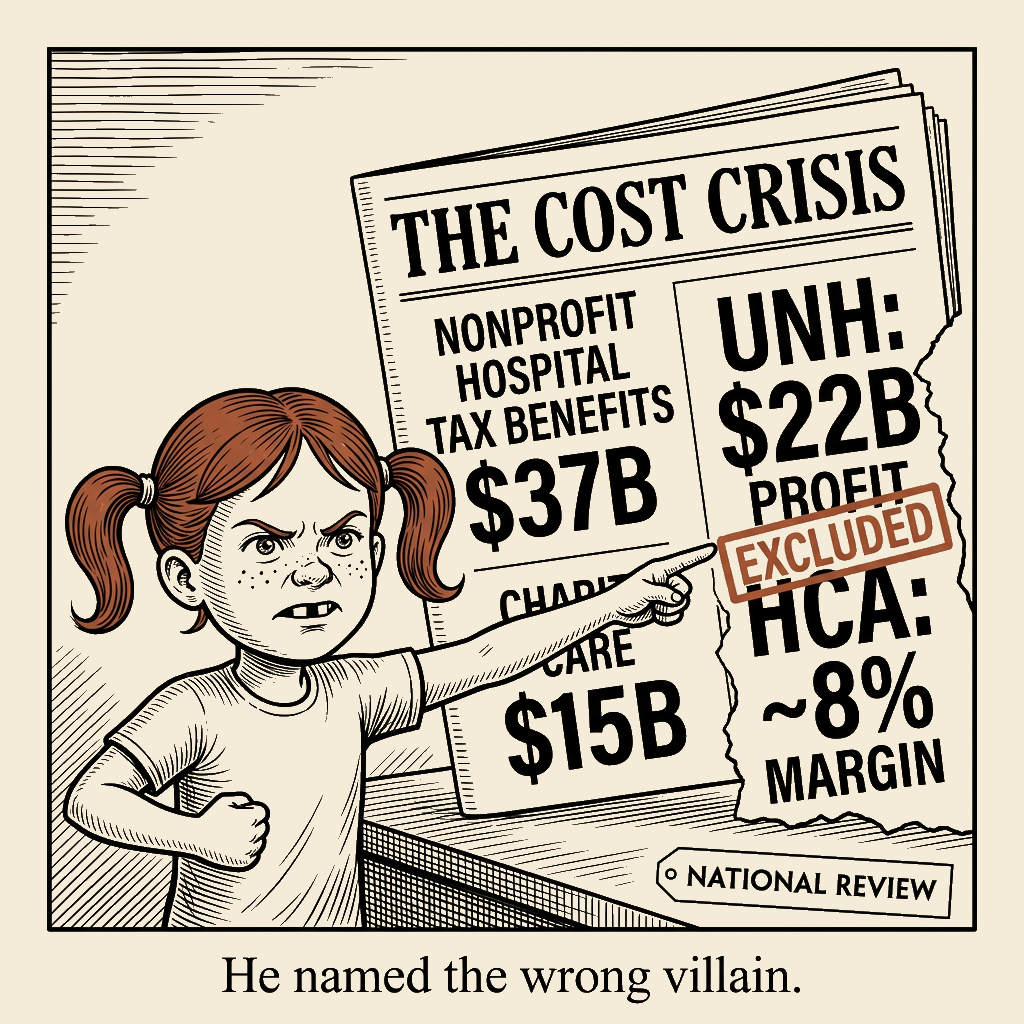
A recent opinion column argues that large nonprofit hospital networks are gaming the federal tax code: they receive roughly $37 billion in annual federal, state, and local tax benefits while providing only about $15 billion in charity care, exploit the 340B drug discount program for billions in additional extraction (citing the Cleveland Clinic’s nearly $1 billion over three years), and operate under a half-century-old IRS “community benefit” standard (Revenue Ruling 69-545) that no longer functions. The column frames these networks as uniquely embedded in progressive coalitions and Democratic-aligned, names an “Iron Triangle” of hospital lobbyists and allied lawmakers that defends the status quo, and proposes disclosure mandates, a charity-care floor equal to public support, an IRS community-benefit standard revision, and escalating penalties up to revocation of tax-exempt status for repeat offenders.
Receipts
The column’s load-bearing claim is a clean, single sentence — and that sentence is doing the work that lets the rest of the column stay narrowly focused on the smaller extraction while leaving the larger one untouched. The verbatim: “Hospital pricing is the biggest driver of America’s health-care cost crisis.”
The framing wants you to believe
- Large nonprofit hospital networks are the primary driver of America’s healthcare cost crisis (the verbatim claim above)
- The asymmetry between $37 billion in 2021 tax benefits and $15 billion in charity care is THE scandal of US healthcare, and reform must begin there
- Democratic-aligned “progressive coalitions” are the political obstacle to reform, and tighter IRS community-benefit standards will fix the cost crisis
What’s really going on
- The specific claims about nonprofit hospital behavior are accurate and documented: the $37B/$15B gap and the Cleveland Clinic 340B extraction are real, and the disclosure/charity-care-floor/IRS-standard reforms the column proposes are sound
- The US healthcare cost gap with peer nations (CMS National Health Expenditure vs OECD Health Statistics) is driven by profit extraction across the entire system — administrative overhead, insurer overhead, PBM rebate-spread extraction, Big Pharma’s multiples-of-peer-nation pricing — not primarily nonprofit hospital behavior
- The column omits UnitedHealth Group’s reported ~$22B in 2023 net earnings on ~$371B revenue (per UNH 2023 Form 10-K), HCA Healthcare’s ~8% 2023 operating margin (per HCA 2023 annual report), the top three PBMs processing roughly 80% of US prescriptions (Drug Channels Institute analysis), Big Pharma’s substantial peer-nation pricing differentials (RAND comparative studies), and the structural reality that the conservative health-policy ecosystem publishing this kind of column has spent thirty years opposing the broader reform that would address the larger extraction
Anchor citation: Senator Bill Cassidy’s (R., La.) oversight report on 340B drug pricing, which documents the Cleveland Clinic’s roughly $1 billion in 340B revenue over three years without accounting for how it was spent — the cleanest receipt in the column and the one the broader-extraction framing has to absorb.
The Response Ladder
Polite Reframe
When to use: A persuadable moderate, a good-faith conservative who needs the receipts and the structural framing; the persuadable uncle at the dinner table who just shared this column.
Picture a 27-year-old nurse on a medical-surgical floor at a major nonprofit hospital system in the Midwest. Twelve-hour shifts, six patients at a time, $34,000 a year — below the local median income for a worker with a four-year degree. Last year the CEO of her system took home eight-figure compensation. The system reported over a billion dollars in net income and paid exactly zero in federal income tax, while the same emergency room sent the nurse a $400 bill for ibuprofen she got during a shift she could not finish because she had to leave to get her own care across town.
The structural facts in that picture are documented in the column and in the IRS filings and Senate oversight report it references. The $37 billion in tax benefits flowing to large nonprofit hospital networks against the $15 billion in charity care they provide is real. The Cleveland Clinic clearing close to a billion dollars over three years from the 340B drug discount program without accounting for how it spent the money is real. The eight-figure executive compensation is real. The Revenue Ruling 69-545 standard that lets hospitals call “community organizing” a charitable activity is real, and it has been a documented failure for half a century.
So the question is not whether the column is right about the specific behavior it documents. The question is what work the framing does when it points at this particular hospital network and not at the other actors that also extract from patients like the nurse.
UnitedHealth Group posted roughly $22 billion in profit on roughly $371 billion in revenue in 2023 (per its Form 10-K). HCA Healthcare, the largest for-profit hospital chain, reported an operating margin of about 8% in 2023 (per its annual report). The top three pharmacy benefit managers — Express Scripts, CVS Caremark, and OptumRx — process roughly 80% of all prescriptions in the United States and operate as the most opaque profit-extraction layer in the entire drug supply chain (Drug Channels Institute analysis). Big Pharma charges American patients multiples of what the same drugs sell for in peer nations (RAND comparative pricing studies). The insurers deny a substantial share of claims on submission (KFF analysis of marketplace denial rates). None of these actors are nonprofit hospitals. None of them are aligned with the progressive coalitions the column indicts.
The nurse, and the rest of us who pay for healthcare in this country, are paying the difference. US healthcare runs at roughly 18% of GDP against 11–13% in peer nations (CMS National Health Expenditure data; OECD Health Statistics); the gap is administrative overhead, profit extraction, and drug pricing — not primarily nonprofit hospital behavior. Treating nonprofit hospitals as the unique villain lets the larger extraction continue undisturbed.
The remedy is not to leave nonprofit hospitals unscrutinized — they do deserve the disclosure requirements, the charity-care floor, and the IRS community-benefit standard reform the column asks for. But the remedy that actually addresses what is bankrupting the nurse is broader than that: site-neutral payments across the whole system, not just nonprofit-vs-for-profit; drug price negotiation that holds Big Pharma to the prices other countries pay; PBM transparency that breaks the rebate-spread extraction; insurer claims-denial rules with teeth. The column gives you a true half. The column does not give you the full picture of where the nurse’s $400 ibuprofen bill actually comes from.
That is the receipt, not the cynicism. The nonprofit hospital networks are doing what the column says they are doing. They are also not the only ones doing it, and they are not the biggest ones doing it. Treating their reform as the whole of healthcare reform is the framing operation the column performs, whether or not the author intended it. The nurse needs the broader reform. So do the rest of us.
Mockery and Ridicule
When to use: The bystander who needs to see the satire land; the reply that needs to be more devastating than the talking point; the friend who is already on board but wants the receipts made sharp.
Picture this: an opinion columnist sits at his keyboard to write about the Outrageous Indignity of a Hospital System That Pays No Taxes. He cites the $37 billion in tax benefits flowing to large nonprofit hospital networks. He cites the $15 billion in charity care they provide. He cites the $1 billion the Cleveland Clinic extracted from the 340B drug discount program. He cites the eight-figure executive compensation. He cites the Revenue Ruling from 1969 that lets “community organizing” count as charity. Every one of those facts is correct.
He does not, in the entire column, cite the $22 billion in profit UnitedHealth Group reported in 2023.
He does not cite HCA Healthcare’s ~8% operating margin.
He does not cite the three PBMs that process roughly 80% of American prescriptions and operate as the most opaque profit layer in the entire drug supply chain.
He does not cite the fact that the United States spends roughly 18% of GDP on healthcare and roughly 11–13% in peer nations — and that the gap is profit extraction and administrative overhead across the entire system, not primarily nonprofit hospital behavior.
The column is the diabetic patient arguing that the Other Diabetic Patient’s insulin intake is the reason we have a national insulin problem. The column is the arsonist asking why his neighbor’s cigarette is such a fire hazard. The column is the mob informant naming the small-time numbers runner while the family keeps the casino open. The column is real, the facts are real, and the framing is a setup, and the setup is what makes it funny.
The nonprofit hospital networks ARE scamming the tax code. The column is right about that. They should face the disclosure requirements and the charity-care floor and the IRS standard reform. The nonprofit hospital networks are also not the largest scam in American healthcare. They are not even the second-largest scam in American healthcare. The column indicts the smallest visible scam in American healthcare with the precision of a forensic accountant and the partisan selection of a campaign operative.
When the conservative health-policy ecosystem needs a story about healthcare costs, it points the camera at the Democratic-aligned nonprofit hospital systems and away from the for-profit hospital chains, the insurance giants, the PBMs, and Big Pharma. When the progressive health-policy ecosystem needs a story about healthcare costs, it points the camera at the insurance giants and the PBMs and Big Pharma and away from the nonprofit hospital systems whose boards include progressive coalition members. The patients get two stories that are both partly true and neither one addresses the actual extraction.
The column is the smaller sibling — both lesser and a lesser-of-two-evils. It is correct that nonprofit hospital systems should be more transparent and more accountable. It is also true that the same conservative ecosystem publishing the column does not want the broader healthcare reform — site-neutral payments across the entire system, drug price negotiation, PBM transparency, claims-denial rules — because that broader reform would hit the players the column does not name.
The right’s healthcare-cost column is the local news story about the guy selling untaxed cigarettes out of his trunk when the actual bootlegger is operating four blocks away with the sheriff’s quiet cooperation. The cigarette guy is real. The cigarette guy should be prosecuted. The cigarette guy is not the operation.
Nuclear Satire
When to use: The reader who needs the full scalding indictment of the entire framing apparatus; the comment thread that needs the receipts deployed with cumulative force; the moment when polite is over and the column is the wrong instrument and the only remaining register is the one that names what the framing actually performs.
The nonprofit hospital column. The Republican Healthcare Scandal That Isn’t Quite The Republican Healthcare Scandal. The column that lets you feel the righteous populist energy of indicting concentrated power without ever indicting the concentrated power that is actually extracting from your paycheck.
Picture, if you will, a Conservative Health Policy Industrial Complex so committed to the discipline of selective outrage that it can publish, in a serious opinion journal, a 1,500-word indictment of large nonprofit hospital networks — citing the $37 billion in tax benefits they receive, citing the $15 billion in charity care they do not provide, citing the Cleveland Clinic’s $1 billion 340B extraction, citing the eight-figure executive compensation, citing the Revenue Ruling 69-545 community-benefit standard that has been a documented failure for half a century — and not once, in the entire 1,500 words, mention UnitedHealth Group’s reported $22 billion in 2023 profit, HCA Healthcare’s ~8% operating margin, the three PBMs that process ~80% of American prescriptions, Big Pharma’s multiples-of-peer-nation pricing, or the 18%-of-GDP-vs-11%-in-peer-nations arithmetic that shows the gap is profit extraction across the entire system and not primarily nonprofit hospital behavior.
This is the genre’s signature. This is the art form perfected. The selective indictment that lets the right-wing media ecosystem feel the warm righteous glow of anti-concentrated-power rhetoric without ever confronting the concentrated power the right-wing media ecosystem is structurally designed to protect.
The column is the diabetic patient lecturing America about insulin while the actual insulin price-fixing operation runs out of the room. The column is the arsonist filing a complaint about his neighbor’s cigarette. The column is the mob informant naming the small-time numbers runner while the family keeps the casino open. The column is the corporate raider explaining why the specific factory he wants to buy has bad working conditions while the corporate raider’s portfolio company three blocks over runs worse.
In Dante’s Inferno there is a circle reserved for those who saw the partial truth and weaponized it. They are made to stand at the rim of the pit with the receipts in one hand and the omission in the other, and they must speak the full sentence for eternity. “Nonprofit hospital networks DO deserve more transparency and more accountability, AND the much larger extraction from UnitedHealth, HCA, the PBMs, and Big Pharma is not addressed by the framing because the framing is a partisan operation.” They must speak that sentence, complete, every day, for ten thousand years.
The column IS correct on the facts it cites. The column is also a smokescreen on the facts it omits. The column is the physician who diagnoses the patient’s sore throat and sends them home from the ER with the heart attack still in progress.
This is what the right’s healthcare cost column does. It performs the analysis. It cites the receipts. It names the villains. It names the wrong villains, with the wrong selection, and it does so with such discipline that you can read a thousand such columns and not once see the names that actually matter.
The same conservative ecosystem publishing the column opposed site-neutral Medicare payments when the Obama administration proposed them. The same conservative ecosystem publishing the column opposes drug price negotiation legislation every time it comes up. The same conservative ecosystem publishing the column has spent thirty years protecting the PBM rebate-spread extraction from any meaningful transparency. The same conservative ecosystem publishing the column has never once published a column this long on the $22 billion profit at UnitedHealth.
When the conservative ecosystem points the camera at the Democratic-aligned nonprofit hospital networks, it is not making an honest mistake. It is performing the operation it has been built to perform. It is the same operation it has been performing for thirty years. The nonprofit hospital networks are real and they should be reformed. They are not what is bankrupting the patient. The patient is being bankrupted by the larger extraction. The conservative column tells you to be mad at the smaller extraction because being mad at the larger extraction would require indicting the players the conservative column is built to protect.
The column is a Trojan horse. It is a Trojan horse with correct facts inside it, and the political purpose of those correct facts is to render invisible the larger extraction that the conservative ecosystem is not going to indict.
That is the operation. The operation is the framing. The framing is the column. The column is what you read if you want the partial truth and the larger lie at the same time.
Profane Scorched-Earth
When to use: The reader who needs full catharsis; the moment when the polite register has been exhausted and the only honest remaining move is to say the whole thing with the gloves all the way off; the comment thread that needs to be closed with receipts and fire.
The motherfucking column. The “look at this scandal” column. The column that wants you to feel the righteous fire of indicting concentrated power while the actual concentrated power sits in the motherfucking room untouched.
OK so let’s lay this shit out.
The column cites $37 billion in tax benefits flowing to large nonprofit hospital networks against $15 billion in charity care. That number is correct. The Cleveland Clinic’s $1 billion 340B extraction over three years is correct. The eight-figure executive compensation is correct. The Revenue Ruling 69-545 community-benefit standard being a documented joke for half a century is correct. The column is right about everything it fucking cites.
The column is a fucking liar about everything it omits.
It does not mention that UnitedHealth Group posted roughly $22 billion in profit on roughly $371 billion in revenue in 2023. It does not mention that HCA Healthcare, the largest for-profit hospital chain in America, ran an ~8% operating margin in 2023. It does not mention that the three largest PBMs — Express Scripts, CVS Caremark, and OptumRx — process roughly 80% of American prescriptions and operate as the most opaque profit-extraction layer in the entire fucking supply chain. It does not mention that Big Pharma charges American patients multiples of what the same drugs sell for in any peer nation. It does not mention that insurers deny a substantial share of claims on submission.
The column is the diabetic patient at the support group lecturing everyone about insulin while the actual insulin price-fixing cartel runs the fucking room.
So let’s call this what it fucking is. The conservative healthcare cost column is a partisan operation. It performs the analysis. It cites the receipts. It names the villains. And the villains it names are the fucking Democratic-aligned nonprofit hospital networks, because the conservative ecosystem publishing the column has spent thirty years making sure the fucking larger extraction — UnitedHealth, HCA, the PBMs, Big Pharma — never gets the same treatment.
The column is a smoke bomb. The column is a smokescreen with correct facts inside it, deployed by a political operation that wants the partial truth to render the larger fucking lie invisible. The column is the arsonist filing the noise complaint about his neighbor’s cigarette. The column is the bootlegger complaining about the small-time moonshiner. The column is the mob informant who tells the FBI about the numbers runner while the family runs the casino.
When the conservative ecosystem points the camera at the Democratic-aligned nonprofit hospital networks, that is the fucking operation it is performing. It is not making an honest mistake. It is not missing the bigger story by accident. It is the bigger story the entire ecosystem is built to not fucking see.
The nonprofit hospital networks DO deserve more transparency and more accountability. The column is right about that. The column is also a fucking smokescreen, and the people publishing it know it is a smokescreen, and the political purpose of the smokescreen is to keep you angry at the smaller extraction so you do not get angry at the larger extraction.
You want the larger extraction’s indictment? Here it fucking is:
US healthcare runs at roughly 18% of GDP and the peer nations run at 11–13%. The gap is administrative overhead, profit extraction, and drug pricing — not primarily nonprofit hospital behavior. Nonprofit hospital systems are part of the problem. They are not the main part of the problem. The main part of the problem is concentrated power the conservative ecosystem publishing this column will not indict because the conservative ecosystem is structurally aligned with that concentrated power.
The column is the smaller sibling. It is the lesser scandal. It is the donkey’s cousin. It is the wrong fucking villain, and the wrong fucking villain is selected for a reason, and the reason is the fucking operation.
You want to reform nonprofit hospitals? Fine. The column gives you the policy. Disclosure requirements, charity-care floor, IRS community-benefit standard reform, penalty escalation, possible revocation of tax-exempt status. All of that is correct. None of it addresses why the working nurse making $34,000 a year paid $400 for ibuprofen at the emergency room of a hospital system that paid zero in federal income tax while the CEO took home eight-figure compensation.
What addresses that nurse is site-neutral payments across the entire fucking system, drug price negotiation that holds Big Pharma to peer-nation prices, PBM transparency that breaks the rebate-spread extraction, insurer claims-denial rules with teeth, and the broader reform the conservative ecosystem publishing this column will not support.
The conservative ecosystem publishes the smaller scandal because publishing the larger scandal would require indicting its own fucking players.
The column is right about what it cites. The column is a fucking lie about what it omits. The column is the diabetic patient’s insulin lecture, the arsonist’s cigarette complaint, the bootlegger’s moonshiner indictment, and the mob informant’s numbers-runner testimony.
It is a smokescreen. It is a smokescreen with correct facts. The political purpose of the correct facts is to render the larger extraction invisible.
That is the operation.

About Malcolm Little King
Malcolm Little King is a heteronym in Main Street Independent's editorial architecture — an analytical voice, not autobiography of any actual person. The position this column expresses is the publication's position on the territory Malcolm Little King's lane covers, rendered through Malcolm Little King's register.