Responding to: Climate Law Heats Up — John R. Puri · 2026-09-17
What the Piece Argues
The article examines Suncor Energy v. Boulder County, a pending Supreme Court case in which Boulder County sues Suncor and ExxonMobil for climate-related damages. The energy companies argue that federal law preempts state-level climate suits — that carbon emissions are inherently a federal matter, and letting one county’s lawsuit proceed would open a patchwork of 50 different jurisdictions regulating the same conduct. The piece also highlights a paradox: if conservatives succeed in overturning Massachusetts v. EPA (the precedent enabling federal carbon regulation), the preemption argument collapses and climate torts could be refiled in federal court with broader remedies available — meaning the energy companies’ victory could backfire. The article presents the legal arguments from both sides with particular attention to this strategic contradiction.
Receipts
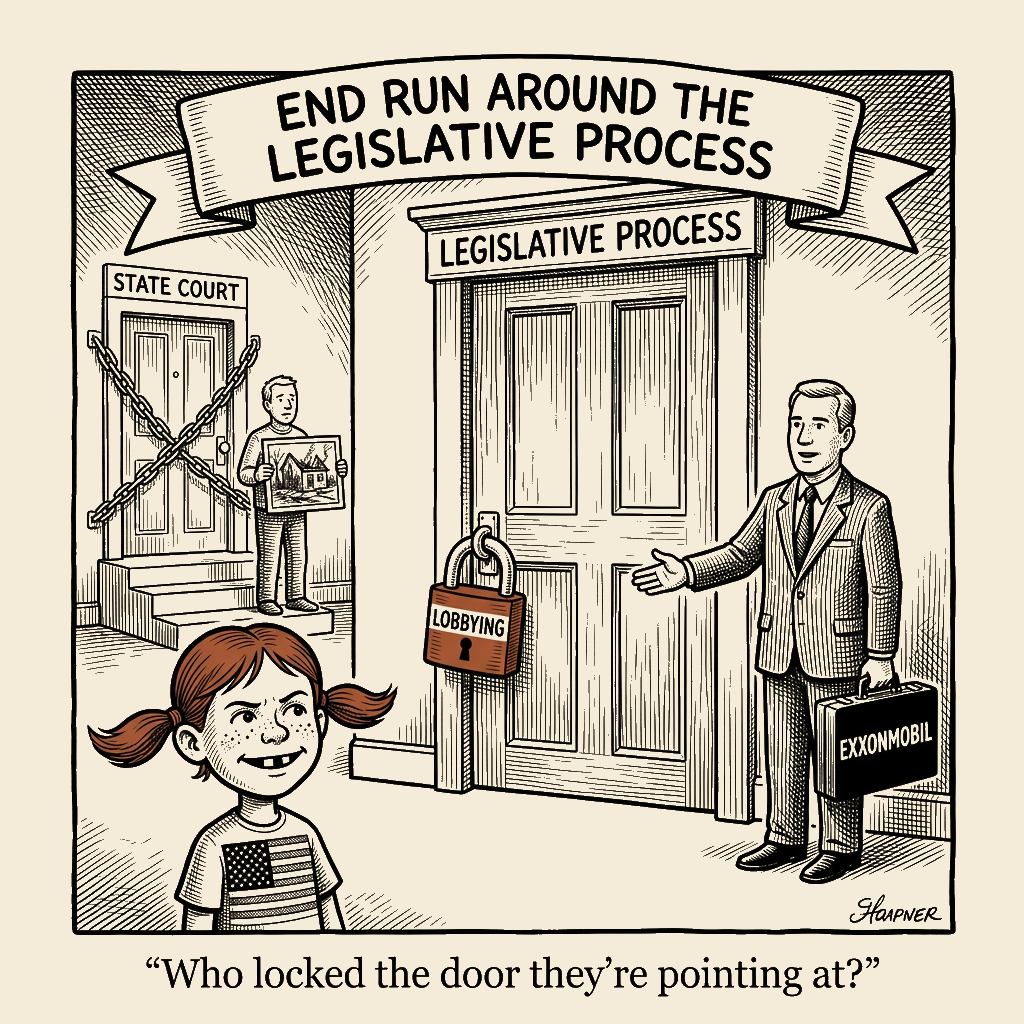
The “end run around the legislative process” framing is a fossil-fuel-allied defense that conceals who is actually trying to evade accountability.
-
The framing wants you to believe:
- Climate tort suits are “judicial activism” — activists trying to enact through courts what they failed to pass through Congress.
- Letting Boulder proceed would let “plaintiffs in one state regulate conduct in other states,” opening the door to devastating copycat suits in all 50 jurisdictions.
- Climate change is inherently a federal (even international) matter, beyond any state court’s reach.
-
What’s really going on:
- Boulder County is suing for documented local damages — the Marshall Fire of December 30, 2021 (widely reported as the most destructive wildfire in Colorado history at that time, destroying over 1,000 homes in Superior and Louisville, per state and federal damage assessments) and the September 2013 Boulder County floods (per Colorado Division of Homeland Security and Emergency Management records), along with infrastructure costs traceable to a warming Western U.S. — not seeking a national emissions policy. The energy companies are the ones trying to use federal common-law preemption to shut down state-court accountability.
- ExxonMobil’s own scientists modeled anthropogenic warming by the late 1970s (InsideClimate News, “Exxon’s Own Research Confirmed Fossil Fuels’ Role in Global Warming,” September 2015), and the company funded a multi-decade public disinformation campaign to keep selling the product, including the American Petroleum Institute’s Global Climate Science Communications Plan (publicly archived; see Union of Concerned Scientists, “Smoke, Mirrors & Hot Air,” 2007). Anchor: Supran, Rahmstorf & Oreskes, “Assessing ExxonMobil’s global temperature projections,” Environmental Research Letters, Vol. 18, No. 2, February 2023.
- The “50 jurisdictions” warning inverts the picture: the industry’s preferred outcome is zero jurisdictions where any town can recover a dollar for documented harm their products caused.
The Response Ladder
Polite Reframe
When to use: a persuadable moderate — a family member, a colleague, a neighbor who reads this kind of piece and is honestly weighing the federalism question.
Take any one of the Boulder County homeowners who lost their house in the Marshall Fire of December 30, 2021 — one of thousands of residents whose homes burned in what was widely reported as the most destructive wildfire in Colorado history at that time, driven by drought and wind conditions that climate models had flagged as part of a warming Western U.S. That homeowner is one of the people the county is, in practical terms, trying to recover for. Boulder County is not asking the Supreme Court to set national climate policy. It is asking a state court to award damages for documented local harm — a fire that destroyed homes, the September 2013 floods that wrecked infrastructure (per Colorado Division of Homeland Security and Emergency Management records), costs traceable to a product whose harms the companies that sold it knew about and concealed.
The “end run around the legislative process” framing flips the picture. The actual end run was the fossil-fuel industry’s fifty-year project of concealing what its own scientists knew. ExxonMobil’s internal scientists modeled anthropogenic warming as early as the late 1970s (InsideClimate News, “Exxon’s Own Research Confirmed Fossil Fuels’ Role in Global Warming,” September 2015). A peer-reviewed study published in Environmental Research Letters, Vol. 18, No. 2, in February 2023, by Geoffrey Supran, Stefan Rahmstorf, and Naomi Oreskes, documented that the company’s subsequent public communications systematically misrepresented its own internal science. Tort recovery for documented harm is not legislation by another name. It is the oldest function of the civil-justice system — the system the founders explicitly reserved to the states under the Tenth Amendment.
Here is the alternative-design test: if the energy companies’ “federal-only” framing prevails, no municipality in America can recover a dollar from the corporations whose products burned its forests and flooded its streets. That is not federalism. That is immunity for the arsonist, written in constitutional grammar.
Usurp: we keep families in their homes. We hold the company that burned the house to account. They defend the company’s right to keep the match.
Mockery and Ridicule
When to use: a hostile interlocutor on social media or at a dinner party who is repeating the “judicial activism” line about Boulder.
Picture ExxonMobil’s lawyers before the Supreme Court, hand on heart, tears streaming, wailing that the terrible people of Boulder County are trying to regulate Texas by filing a tort suit for the wildfire that destroyed their subdivisions. The company knew its product was cooking the planet by 1978 — its own scientists told them so (InsideClimate News, “Exxon’s Own Research Confirmed Fossil Fuels’ Role in Global Warming,” September 2015). The company spent four decades funding a disinformation operation to keep selling that product (Supran, Rahmstorf & Oreskes, “Assessing ExxonMobil’s global temperature projections,” Environmental Research Letters, Vol. 18, No. 2, February 2023). The company made hundreds of billions of dollars doing so. And now the company is standing before the justices saying that the real problem is that a town whose subdivisions burned wants the court to let it ask for damages.
The inversion is the one the industry doesn’t want you to make. They call it “judicial activism” when victims of documented harm file suit. They don’t call it activism when their lawyers invent a constitutional doctrine so the suit can’t be heard. They call it federalism when Boulder County is forbidden from seeking compensation in its own courts. They didn’t call it federalism when their allies spent forty years blocking federal climate legislation through lobbying, dark-money groups, and the manufactured-doubt apparatus that InsideClimate News and the peer-reviewed Supran studies documented.
Usurp: we keep families in their homes. We hold the arsonist accountable. They defend the arsonist’s right to keep the match.
Nuclear Satire
When to use: the reader who needs full catharsis, who is sick of watching polluter-friendly framing get smuggled into “federalism” packaging.
The patient is on a stretcher. The planet is the patient. The emergency-room physicians at the bedside are reading aloud from a court order: “Treatment denied. Patient is from Colorado. Only physicians in Washington may diagnose emissions-related illness. State physicians must refer all greenhouse-gas cases to the federal government, which has rescinded its license to treat this category of patient.” ExxonMobil is the company whose executives have known since the late 1970s that their product is killing the patient. They funded the disinformation apparatus — including the American Petroleum Institute’s Global Climate Science Communications Plan (publicly archived; see Union of Concerned Scientists documentation) — that produced the political paralysis they now cite as the reason no court may hear the case. They are standing before the Supreme Court asking the justices to invent a constitutional principle — a constitutional principle, not a statute, not a precedent, an actual doctrine of federal immunity that no prior Court has ever recognized — so that no town in America can ever ask them for a dollar. They call this federalism.
The framers of the Tenth Amendment — “The powers not delegated to the United States… are reserved to the States respectively, or to the people” — would have laughed. The receipts stack. Internal Exxon climate modeling from 1977 (InsideClimate News, “Exxon’s Own Research Confirmed Fossil Fuels’ Role in Global Warming,” September 2015). Peer-reviewed documentation of the company’s public/private disinformation gap (Supran, Rahmstorf & Oreskes, “Assessing ExxonMobil’s global temperature projections,” Environmental Research Letters, Vol. 18, No. 2, February 2023). The documented damages in Boulder County — the Marshall Fire of December 30, 2021 (widely reported as the most destructive wildfire in Colorado history at that time, destroying over 1,000 homes in Superior and Louisville), the September 2013 Boulder County floods (Colorado Division of Homeland Security and Emergency Management records), infrastructure costs traceable to a warming Western U.S. The inversion is Luciferian in the strict sense: they carry the cross into the courtroom and weep for the Constitution while their products burn the forests.
Usurp: we feed, clothe, heal. We keep families together. We hold the arsonist accountable. They torch the village and sue the fire department.
Profane Scorched-Earth
When to use: when the full cathartic register is what the moment demands — the reader who has read enough, seen enough, and needs the fury stated plain.
“The legislative process.” The legislative fucking process.
That’s the sacred principle. The hallowed democratic mechanism. The founding-father-approved venue for resolving the greatest environmental catastrophe in human history. Congress. The people’s house. Where the fossil fuel industry spent four decades and god knows how many billions making absolutely goddamn sure nothing would ever happen.
These are the people who wrote the model legislation. These are the people who funded the think tanks that manufactured the doubt. These are the people who bought the senators, who wrote the riders, who stuffed the appropriations bills, who killed cap-and-trade in the Senate in 2010, who gutted the Clean Power Plan, who fought every single regulatory attempt at every single level for forty goddamn years — and now they have the audacity, the un-fucking-believable audacity, to stand in front of the Supreme Court and say “this is a matter for Congress.”
THE CONGRESS THEY OWNED.
“We believe in the legislative process,” says the industry that, by widely cited climate-policy research, spent over $2 billion lobbying against climate legislation between 2000 and 2016 alone. “Let the people’s representatives decide,” says the industry that wrote the model bills the people’s representatives rubber-stamped. “Federalism demands it,” says the industry that used federal preemption to block state-level renewable energy standards when those worked against them.
The legal argument is a fucking masterpiece of bad faith. The constitutional principle is “states can’t regulate across borders.” The factual basis is that carbon emissions cross borders. The conclusion is that nobody can regulate them — not the feds (because West Virginia v. EPA said Congress has to authorize it), not the states (because Suncor says states can’t touch it), not the courts (because this is a legislative matter), and not Congress (because the industry made sure Congress would never act).
It is an accountability black hole. It consumes every possible avenue of redress and leaves nothing behind except the quarterly earnings report. The communities that flood, the farmers whose crops fail, the municipalities that rebuild their infrastructure — they get a lecture on federalism. They get told their courthouse is the wrong courthouse. They get told to wait for Congress. Congress that the defendant paid to be inert.
And the thing that makes the whole goddamn apparatus collapse under its own weight is the trap in the center of it: if these companies succeed in convincing the Court that carbon isn’t regulated under federal law, they lose the preemption shield. Federal common law reopens. Boulder County walks into federal court — not asking for damages anymore, but seeking an injunction. The energy companies’ victory on the jurisdictional question becomes the opening for the substantive claim they most fear.
You built a machine to produce accountabilitylessness and you rigged every gear, and in the middle of the machine you left a gear that, when it turns, opens the one door you cannot shut. That is not constitutional craftsmanship. That is the fossil fuel industry in a nutshell: an operation so committed to avoiding consequence that it forgot to check whether its own machinery was self-devouring.
The Supreme Court will hear this case. And somewhere in the questioning, a justice should ask the energy companies’ lawyer a simple question: You say the legislative process is the right venue. You spent forty years ensuring it wouldn’t work. What, exactly, were the people of Boulder County supposed to do while you were killing the legislature and shutting the courthouse door? Wait for the next flood? Pay for the next rebuild? Absorb the next cost — the cost of your product, the cost of your profit, the cost of your constitutional principle?
Because that’s what “federalism” means to these companies. It means: we externalize the damage, and you externalize the bill. We take the profit, and you take the flood. And if you try to find a courtroom, any courtroom, that will hear your case — we will argue, with a straight face and a constitutional brief, that the only proper venue is the Congress we purchased.
That’s not federalism. That is a fucking shakedown dressed in a legal brief. And the only thing more obscene than the argument is the decades of purchased paralysis that made it possible.

About Malcolm Little King
Malcolm Little King is a heteronym in Main Street Independent's editorial architecture — an analytical voice, not autobiography of any actual person. The position this column expresses is the publication's position on the territory Malcolm Little King's lane covers, rendered through Malcolm Little King's register.