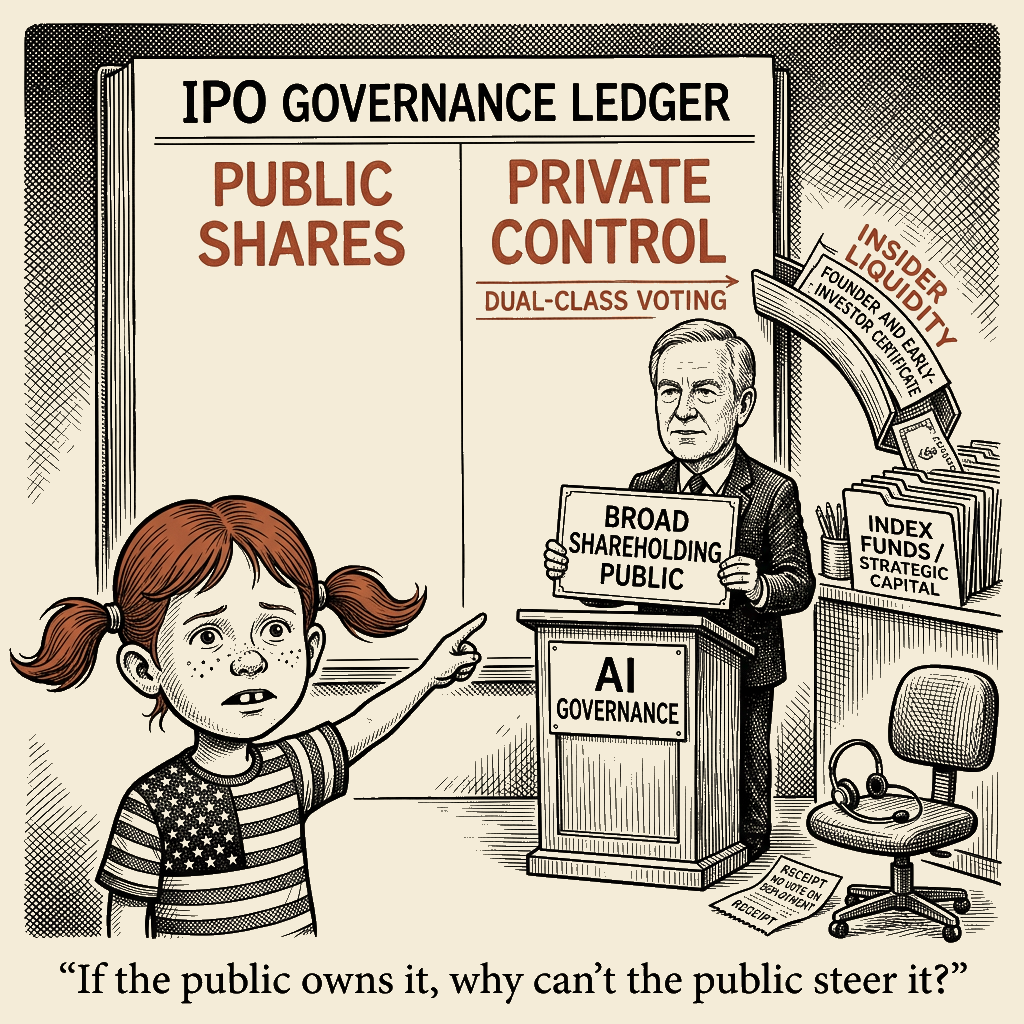
Responding to: AI, Get Thee to an IPO! — Holman W. Jenkins, Jr. · 2026-09-18
What the Piece Argues
Holman W. Jenkins Jr., a Wall Street Journal editorial board member, argues that OpenAI and Anthropic should accelerate their IPOs so that a “broad shareholding public” can replace the “highly ideologized and oddball founders” currently running them. He treats the founders’ effective-altruism and AI-safety convictions as a cultish drag on the companies’ commercial value, claims the leaders are already captured by market incentives anyway, and runs a parade of AI-doom scenarios (extinction, Chinese open-weight models, AI-sentience advocacy) before concluding that shareholder discipline is the cure. The piece operates as a libertarian-on-libertarian prescription: the AI economy is being held back not by structural underregulation, not by monopoly concentration, not by the largest capital-event in a generation — but by eccentric rich men who refuse to list their stock.
Receipts
The piece sells an IPO as a transfer of power to a “broad shareholding public” — its load-bearing phrase. What’s hidden is that this “public” is the most concentrated ownership structure in modern finance.
- The framing wants you to believe:
- “Broad shareholding public” means small investors getting democratic control over consequential technology.
- The founders’ effective-altruism and AI-safety beliefs are an exotic cult whose grip on the AI economy is the problem.
- China, sentience-rights advocacy, and P(doom)=100 are warning signs the founders have mishandled.
- Faster IPOs = market discipline on AI safety.
- What’s really going on:
- Founders routinely retain voting control through dual-class share structures. Google (2004 IPO, Brin and Page retained control through Class B super-voting stock); Meta (2012, Zuckerberg retained control via dual-class); Snap (2017, Spiegel retained control, public received no voting shares); Uber (2019, founders retained super-voting); the pattern is the rule, not the exception. Public stock = economics; founder = control. (Anchor: dual-class retention is standard in tech IPOs from Google 2004 forward.)
- Anthropic is a Delaware Public Benefit Corporation that legally requires balancing shareholder return against public benefit and stakeholder interests — under 8 Del. C. § 362 and following, a PBC must balance shareholder return against the public benefit identified in its charter and the best interests of those materially affected by its conduct. This is the structural brake Jenkins’ column smears as “cult behavior.” (Anchor: Delaware PBC statute, 8 Del. C. §§ 362–368.)
- Tech IPOs overwhelmingly allocate to BlackRock, Vanguard, Fidelity, the Saudi Public Investment Fund, ADQ, Temasek, GIC, and the half-dozen banks that take 5–7% of offering size in fees — the retail investor gets leftover allocation, not control. (Anchor: institutional-allocation norms in large-cap offerings.)
- The “broad shareholding public” in question (U.S. equity holders) is, per Federal Reserve Survey of Consumer Finances and Gallup data on stock ownership, roughly 58% of adults — and ownership is heavily skewed toward the top 10% of households (roughly 70% of equity value), with the bottom 50% holding effectively zero.
The Response Ladder
Polite Reframe
When to use: A friend or family member who read Jenkins’s column and found the “shareholder discipline fixes the cult” line persuasive and needs a calm, fact-anchored reframe that does not mock them for the read.
Doris worked seventeen years at a regional insurance company’s call center. Her customer-satisfaction scores were in the top quartile. In May her employer rolled out an AI customer-service agent that, in the company’s press release, “augments our human team.” Doris’s team of forty-six was reduced to eleven by Labor Day. She is now working part-time at a grocery store and applying to jobs she is overqualified for, and she watched the company’s stock tick upward on analyst calls that cited, in the third paragraph, “AI-driven cost reduction.” She did not get a vote when the AI was deployed, and she did not get a vote when the company decided to deploy it. She did not, in particular, get a vote at any shareholder meeting.
Holman Jenkins’s column in The Wall Street Journal is asking us to believe that the remedy for the AI industry’s problems is more of exactly what produced Doris’s situation: a more robust, more disciplined, more “shareholder-responsive” ownership structure. Founders, in his telling, are “ideologized,” “oddball,” and “cult”-ish. Markets will discipline them. An IPO will “unload the baggage.”
Consider, briefly, what “shareholder-responsive” already looks like in the AI industry’s visible operations. In February 2024, Klarna announced that an AI customer-service agent was doing the work of roughly 700 human customer-service reps — a claim the company’s CEO repeated in interviews, and a posture Klarna has since walked back under customer-experience and recurring-revenue pressure. IBM has paused hiring for back-office roles that AI is now expected to fill. Salesforce has used the verb “redirected” to describe the deployment of AI in customer service, and has reversed some of those decisions under investor and customer scrutiny. These are the surface instances of the discipline Jenkins’s column never names; the people on the receiving end of the redirection do not get a vote on the day the redirection is announced.
It is worth being precise about what an IPO actually does. It is a liquidity event. It converts the paper wealth of founders, early employees, and early-stage investors — Microsoft is the largest external shareholder in OpenAI; Amazon and Google have made large strategic investments in Anthropic — into cash, on terms set by the same executive leadership Jenkins calls cultish. The “broad shareholding public” that is supposed to provide sober second sight is, by the time retail gets involved, mostly institutional — pension funds, index providers, and asset managers whose fiduciary duty is to deliver quarterly returns, not to ask whether the technology is safe to deploy at scale.
This is not a thought-experiment. The track record of publicly traded firms with public-market discipline is not what Jenkins describes. Boeing was a publicly traded, “shareholder-responsive” firm when its 737 MAX design decisions killed 346 people across Lion Air 610 (October 2018) and Ethiopian 302 (March 2019). Purdue Pharma answered to public shareholders when it marketed OxyContin. The Ford Pinto was built by a publicly traded firm that had done the math and decided the settlements cost less than the fix. Public ownership does not produce safety; public ownership produces whatever the institutional investor base will reward. Where safety and quarterly return conflict, quarterly return wins, and the people who bear the cost — Doris, the passengers, the patients, the families — pay the bill without a vote.
The legitimate concern Jenkins is gesturing at is real: AI labs do have unusual governance, and some of their founders have made statements that are either very serious or very strange depending on your priors. But the fix for that is not a louder bell at the IPO. The fix is a Securities and Exchange Commission with a safety mandate before deployment, a public-disclosure regime that lets Doris see what is being put into production before she is replaced by it, and a governance structure that gives the people who bear the cost a seat at the table. That last is what Jenkins’s framing, by design, never asks for.
The founders will be fine. The question is whether the rest of us will be.
Mockery and Ridicule
When to use: Anywhere the audience has a taste for ridicule and the goal is to make the bystanders wince — a Substack comments section, a group chat, or an in-person argument at a dinner where Jenkins’s column is making the rounds.
Holman Jenkins, member of the editorial board of The Wall Street Journal (the same publication that, week in and week out, extols the discipline of public markets), has discovered the cause of the AI industry’s problems. It is the founders. They are “ideologized.” They are “oddball.” They are, in some unspecified way, members of a “cult.”
The cure, he informs us, is an IPO.
Imagine, for a moment, that you have a friend with a drinking problem. Your friend has been drinking heavily. He has been drinking at work. He has, on several documented occasions, driven home drunk. He has missed deadlines, alienated colleagues, and his wife has, in the strongest possible terms, suggested that something change. You take him to an investment banker. The investment banker says, sir, the cure for your drinking problem is a public offering. Once dispersed shareholders are watching you, you will be sober. Public-market discipline is the answer. Sir does the IPO. The Ring the Bell. The 25th Anniversary. And then what happens?
If you are a stock analyst, you know what happens: the same behavior continues, the price adjusts to reflect the behavior, and the incentives for ongoing behavior are now sharper than they were before, because now there is a share price for management to defend. The Ford Pinto was manufactured by a publicly traded firm. The 737 MAX was certified by a publicly traded firm. OxyContin was marketed by a publicly traded firm. The Cruise robotaxi that dragged a pedestrian in San Francisco was deployed by General Motors, a publicly traded firm, in pursuit of a metric tracked on quarterly earnings calls.
The Jenkins thesis is the financial equivalent of leading the very fine horse to water and expecting the act of standing near the water to produce drinking. The bankers who would ring the bell on this IPO, by the historical pattern of mega-listings, are the bulge bracket — Goldman Sachs, JPMorgan, Morgan Stanley — the same firms whose structured-finance desks packaged the derivatives that broke in 2008, the same firms whose research analysts upgraded the same stocks they were quietly selling to their wealth-management clients in the early 2000s. The underwriting fee on a combined OpenAI-plus-Anthropic offering in the hundreds of billions is, by standard practice, in the low single digits of gross proceeds — a fee pool measured in single-digit billions, paid on listing day regardless of what the listing-day share price does thereafter. The bankers get paid on the way in. The cure for the AI industry’s founders’ cultishness is not the chairman’s chair of an SEC-filed S-1. The cure for the AI industry’s founders’ cultishness is making the chair answerable to people who bear the cost of what the chair does.
But Jenkins does not want that, and the reason Jenkins does not want that is that what is actually being asked for is not accountability — it is permission. Public-market discipline is what you get when you cannot get accountability through the legislative process. It is what you get when the regulators are slow and the safety-testing regime is unset and the workers who would object don’t have a seat. The pitch from Jenkins is not “let us be careful with this technology.” The pitch from Jenkins is “let us be careful to ensure that no one but the people who currently own it get to be careful with this technology.”
And the people who own it are, of course, currently the founders — who, Jenkins assures us, are weird cultists — and Microsoft, which owns a significant stake in OpenAI, and Amazon and Google, which have placed strategic bets on Anthropic, and the early-stage venture capitalists who funded the labs in 2016 when the products were demos, and the NVIDIA shareholders whose market cap went from roughly $300 billion in October 2022 to north of $3 trillion by June 2024 on the assumption that the labs will deploy as fast as possible.
These are the people to whom the IPO is to give “responsiveness.” These are the people whose interests will be served when “shareholder-responsive” replaces “ideologized.”
Say it slowly. Say it in the voice of a man who has been saying it for forty years on the editorial board of a newspaper that has been saying it for longer than he has been alive: these are the people to whom the cure is to give the disease.
You, Doris, are not invited. You get the price discovery. And Doris does not even get the dignity of having her name in this essay until I use it — Jenkins’s column does not name her, because his column does not see her, because his column is written in the language of a stock-exchange trading floor where Doris is not a symbol and not a market and not, by the editorial board’s account, even the kind of thing one is required to notice.
But Jenkins will explain your problem to you. He will explain it in his column. He will explain that the founders — actual people, with names, with pictures, with bylines — are the cult. He will explain that the remedy is to give them more money. He will explain this in measured prose. He will explain this in the Wall Street Journal. He will do so because, on the editorial page of the Wall Street Journal, Doris is the mark, and the founders are the patient, and the doctor is, of course, Jenkins.
Nuclear Satire
When to use: The reader who already knows Jenkins’s column is a con and wants to see the con spelled out in satirical form — for hostile forums, essays where the audience is ready for the structural indictment stated without flinching, or anywhere the polite version is not enough.
The argument is a beautiful thing, when the argument is on your side.
Holman Jenkins of The Wall Street Journal has, in approximately 1,200 words, performed the central miracle of contemporary American capitalism: he has taken the act of three billionaires getting rich and turned it into a civic-feeling essay about accountability. He has taken a transaction in which a small number of named individuals convert their shares of a private company into publicly tradeable equity, on terms set entirely by them, in a market whose gatekeepers are themselves, and he has named this transaction “discipline.” He has looked at the cult of personality that produced Sam Altman’s house-of-cards governance of OpenAI and the magnetic-field-of-altruism that produced Anthropic, and he has looked at all of this and decided that the principal problem is that these companies have not yet performed enough public offerings.
It is, in its way, the most American sentence ever written. The American sentence is never “I am taking your money.” The American sentence is “I am rescuing you from the inefficiency of your own arrangements.”
Let us reconstruct the full democracy of the thing. OpenAI was founded in 2015 as a nonprofit. In 2019, Sam Altman shepherded a corporate restructuring in which a “capped-profit” subsidiary was placed under the nonprofit, allegedly to raise the capital required to compete. The board of the nonprofit fired Altman in November 2023 over a dispute, allegedly, about safety disclosures. The board reinstated him five days later, allegedly, because the employees threatened to quit. The reinstating vote, in effect, was the workforce-labor market’s verdict on the directors who had made the safety finding — the safety finding was correct until the labor market threatened to walk, at which point the safety finding was replaced by the labor market’s verdict. This is the prototype of the discipline Jenkins is recommending. Substitute “quarterly earnings call” for “mass resignation threat,” and the prototype is the public-market regime: the safety finding is correct until the share price threatens to fall, at which point the safety finding is replaced by the analyst call’s verdict. Microsoft, the largest outside investor, by all accounts, was informed of the firing ninety seconds before the public announcement. The nonprofit’s commitments to “broadly distributed benefits” — a phrase written into its charter, in a meaningful echo of the Constitution’s “general Welfare” clause — have, in the years since, drifted toward whatever the for-profit subsidiary’s deal flow makes comfortable. The “open” in OpenAI is, at this point, a geographic rather than a structural term.
Anthropic was founded in 2021 by Dario Amodei and Daniela Amodei, formerly of OpenAI, partly on the argument that OpenAI had lost its way. The “effective altruism” and “longtermism” backgrounds of the founding team are not in dispute. They are, as Jenkins says, “weird.” Their product, Claude, is currently offered via Amazon Web Services through Bedrock, and has been reported across major outlets — including Reuters, The Wall Street Journal itself, and Bloomberg — to be in use at multiple Fortune 500 companies and at agencies of the United States government, including in defense contexts. The “ideology” of these founders — the cautious, pre-deployment-testing, don’t-ship-until-the-safety-team-signs-off ideology — is, precisely, the thing Jenkins is diagnosing as a disease. The cure, in his telling, is to dilute it through public shareholders.
But here is the thing that cures the cure. A public offering does not dilute ideology. A public offering installs different ideology. The ideology a public offering installs is the one for which the quarterly return is the metric of value. The ideology a public offering installs is the one in which “AI safety” is whatever the safety team can defend in a PR crisis — and the November 2023 board crisis was the live demonstration: a safety finding, made by directors, was overridden five days later by a labor-market threat, and the safety finding was quietly retired. Substitute the share price for the labor-market threat and the demonstration is the public-market template. The ideology a public offering installs is the one in which the share price is a constraint on the safety team’s recommendations, because the share price is the metric by which the CEO’s job is graded. The cruise robotaxi that dragged a pedestrian in San Francisco was tracked by GM’s quarterly earnings. The 737 MAX was tracked by Boeing’s quarterly earnings. The maintenance that wasn’t performed on a contaminated produce line was tracked by a publicly traded firm’s quarterly earnings. Quarterly earnings are a typewriter for the worst words in the corporate vocabulary, and the install of quarterly earnings is what Mr. Jenkins, in the Wall Street Journal, is recommending.
The cruelest joke in the column is the inversion of “shareholder-responsive” itself. Shareholders, in Mr. Jenkins’s telling, are the cure for ideological capture. But the shareholders of a public company are not a check on the management; the shareholders of a public company are the funders of the management. They do not discipline the executives; the executives discipline them through option grants and earnings calls. By the time a stock is in your mutual fund, it is in your mutual fund because an executive named the stock a buy. The structure Mr. Jenkins is recommending is one in which the founders who currently cannot be fired by the public become the founders who cannot be fired by anyone except a market that rises when their stock goes up.
The “national-security state” worry is a similar confection. The thing Jenkins calls “national-security state” is, in plain English, the thing the editorial boards call “national-security state” when they oppose it (the military, the intelligence community, certain regulatory capture) and “national interest” when they support it (the military, the intelligence community, certain regulatory capture). The “national-security” framing is not a critique of state power; it is a critique of state power that does not have Wall Street’s fingerprints on it. State capacity controlled by capital is, in Jenkins’s framing, fine. State capacity that steps on capital is the threat. This is consistent with the editorial board’s historical posture; it is also consistent with the editorial board’s commercial posture; both posts are reasonable to hold simultaneously if you are on the editorial board of the Wall Street Journal.
And Mr. Amodei, CEO of Anthropic, who has, according to reports, been making what Jenkins calls “harsh depictions of the Chinese threat” — let us pause on the Chinese threat for a moment. China has, in fact, in the last couple of years, openly distributed open-weight AI models with very few guardrails, including DeepSeek-class releases that bypassed U.S. export controls on the underlying compute. The threat this represents is not theoretical. The threat is that someone, somewhere, with no safety filter and a strong incentive, will use one of these models in a way that produces a public disaster. The threat is real. The response to a real threat is not, however, what Jenkins recommends. The response to a real threat is safety testing before deployment. Mr. Jenkins’s response, instead, is to mock Mr. Amodei for daring to call the threat by name, on the grounds that calling the threat by name is what CEOs of “$2 trillion businesses” should not do.
Mr. Jenkins’s prescription: shut up, IPO, and ship the product. Mr. Amodei’s prescription: pause, test, deploy cautiously. Jenkins thinks this is weirdness. Amodei thinks it is the function of the job. Mr. Jenkins should not, on the editorial page of the Wall Street Journal, be telling Mr. Amodei what to do with a $2 trillion business. But he should, on the editorial page of the Wall Street Journal, also not be mocking the founder of a multi-hundred-billion-dollar business for taking safety seriously when the alternative is the alternative, which is what he is, in fact, mocking him for taking seriously. He is using his column to accuse a CEO of inappropriate seriousness. He is using his column to recommend an institutional structure in which the chief executive has fewer incentives to be serious. He is, in his small way, the public-facing apologist for the accelerant.
The conclusion that you, the reader, are invited to draw is that the disaster, when it comes, will not be the fault of the AI. The disaster will be the fault of the editorial board that recommended the institutional structure in which the disaster could be made profitable. The Wall Street Journal’s editorial page is a contributor to the AI safety problem. The Wall Street Journal’s editorial page is a participant in the project’s permission structure. The Wall Street Journal’s editorial page is in this, and the bill, when it comes due, will arrive with the dispatch of a hospital administrator and the efficiency of a debt collector.
You, Doris, are not invited. You get the bill. You are, however, invited to read this column and to recognize it as the model it is. The model is “weird, cultish, ideologized, founder-led company needs public-market discipline to deliver for shareholders.” The model applies to OpenAI. The model applies to Anthropic. The model applied to Boeing. The model applied to Purdue Pharma. The model applied to the makers of the Ford Pinto. The model was, in every case, the model in which the people who bore the cost — the passengers, the patients, the families — were not invited to the meeting. The model is a heist presented as a discipline. The IPO is the moment the founders’ escape pods detach from the rocket. Share price goes up. The cost is to you.
This is not a debate among reasonable people.
Profane Scorched-Earth
When to use: The reader who needs the polite version deconstructed and the case put plainly — the call-center worker Doris, the copywriter who got the “AI-pivot” email, anyone who has read Jenkins’s column and felt something twist in their stomach and not been able to name it. Gloves off. Catharsis permitted.
Holman Jenkins Jr., member of the editorial board of The Wall Street Journal, has solved the AI safety problem. The AI safety problem, as it turns out, was not AI safety. The AI safety problem was the founders. The AI safety problem was a small, rich, highly educated, deeply weird group of people who looked at their own technology and decided that something should be done about it before it killed everyone. The cure for this problem, as Holman Jenkins would have you understand, is a fucking IPO.
Let me make sure I have this right. The cure for a group of people whose stated concern is that their technology may be too powerful to deploy safely is, in Holman Jenkins’s diagnostic, more capitalism. The cure for caution is a quarterly earnings call. The cure for “this thing might destroy the world if we move too fast” is a ticker symbol. The cure for a “cult” — Jenkins’s word, not mine, the word he keeps using to describe the entire field of people who think that this technology deserves more than a normal amount of reflection — is a fucking S-1 filing with the Securities and Exchange Commission.
I want to say what I just said again, slowly, because it is among the most batshit-insane sentences in the American business press this week and I want to give it the time it deserves. The most powerful technology ever built, by a group of people who themselves think the most powerful technology ever built should be deployed cautiously, should be put into the hands of the same institutional structure that brought us the Ford Pinto, the 737 MAX, the OxyContin script line, the 2008 financial crisis, and the lithium-ion battery that caught fire in your apartment because somebody decided a thermal separator wasn’t worth the seven cents. That is Holman Jenkins’s prescription. Holman Jenkins is a member of the editorial board of The Wall Street Journal. Holman Jenkins has a master’s degree in journalism from Northwestern University. Holman Jenkins won a Gerald Loeb Award. I do not believe these facts are unrelated.
Let us be specific about who pays and who is paid. Microsoft owns a shit-ton of OpenAI. Amazon and Google own a shit-ton of Anthropic. NVIDIA’s market cap went from roughly $300 billion in October 2022 to north of $3 trillion by June 2024 on the assumption that the labs deploy at scale. The institutional fund managers — BlackRock, Vanguard, State Street — already own a meaningful share of every stock in your 401(k) and will own a meaningful share of OpenAI and Anthropic the day those stocks list. The retail shareholders who Jenkins imagines reading 10-Qs and writing letters to the board are a margin note in the operation. The retail shareholders are the mark. The retail shareholders are the people who take the deal. The retail shareholders are the ones who buy in at $40 and sell at $24 and write a Bloomberg op-ed about how they “took a chance on the future of American innovation.”
The retail shareholders are the people who, in Jenkins’s essay, are described as the disciplining force against the founders. The retail shareholders are, in the actual operation, the structural support that converts the founders’ $X-billion stake into $Y-billion in cash.
You, Doris — a category we have been using for the displaced call-center worker, the laid-off translator, the copywriter who did twelve-hour days and now does no days at all because her employer “pivoted,” the parole officer whose caseload was reduced because a model was given the predictive-risk job, the nurse whose floor got short-staffed because the hospital bought an “ambient documentation” tool that, in the cost-benefit, looks like headcount reduction if you don’t ask too many questions — you are not in this story. You are not in this story because you are not a holder. You are not a holder because the labor of your life was never legible as something that could be converted to equity. Your skills are a cost. Your displacement is a write-down. Your job is a line item on a financial model called “AI-enabled gross margin expansion,” which is consultant-speak for “we will be doing this with less of you.” Klarna told you in early 2024 that an AI agent was doing the work of seven hundred customer-service reps, then walked it back when customers started canceling subscriptions; IBM put a hiring freeze on back-office roles; Salesforce “redirected” customer-service headcount and walked some of it back under pressure. Your story is the only story in this whole essay that isn’t a press release, and the only story nobody in Jenkins’s column can be bothered to name.
Doris is not invited to the bell-ringing. Doris does not get the founder’s letter. Doris is the person for whom the AI-enabled gross margin expansion happens. Doris is the person who pays.
Now let me read you a passage from Frederick Douglass’s 1852 address, the one he delivered on the Fourth of July, the one in which the orator turned the holiday into an indictment:
“What, to the American slave, is your 4th of July? I answer: a day that reveals to him, more than all other days in the year, the gross injustice and cruelty to which he is a constant victim.”
Replace “American slave” with “Doris.” Replace “4th of July” with “IPO day.” Replace “the slaveholder” with “the editorial board of the Wall Street Journal.” The structure holds. The holiday is the day the masters celebrate their freedom. The bell is the bell the masters ring. The speech at the lectern is the speech the masters give each other. The cost, on the day of celebration, is the cost the master doesn’t see. The master doesn’t see the cost because the master’s eye is on the share price. The master’s eye is on the share price because the master’s eye is, like Jenkins’s, on what the share price legitimizes.
Jenkins writes: “More intelligence, even if it’s artificial, can only improve matters.”
To whom?
If “matters” means the share price of OpenAI on the first day of trading, then yes, more intelligence can only improve matters. If “matters” means the safety of Doris’s grandchildren, who by Jenkins’s own writing do not get interstellar migration and who cannot expect to outrun the climate the editorial board has also decided is someone else’s problem to solve, then no, more intelligence deployed with these institutional structures will not improve matters. More intelligence deployed with these institutional structures is the accelerant.
Jenkins writes that the public warnings of recent days amount to “the neighborhood dogs yapping in chorus three weeks after the burglar has been and gone.”
The dogs, in Jenkins’s metaphor, are the AI safety researchers and the lab CEOs publicly raising concerns. The dogs are not protecting Doris. The dogs are protecting the share price. If the dogs keep yapping, the public will get spooked. If the public gets spooked, the regulatory pause the founders are publicly worried about will arrive. If the regulatory pause arrives, the IPO will be delayed, the share price will not pop, and the founders’ cultish baggage will not be unloaded. The burglar, in Jenkins’s metaphor, has been and gone. The burglar has been and gone because the burglar is the system the editors of the Wall Street Journal have spent forty years building. The burglar is the share-price-as-incentive structure. The dogs are the people who object.
Now to be clear, because I have to be clear: this is not a brief against AI. AI is a tool. Tools are what you do with them. The same model built by the same people can be used to surface medical patterns that save lives, or to displace call-center workers and call it “gross margin expansion.” The argument is not about the tool. The argument is about the institutional structure that decides which deployment gets built. The argument is about who sits at the table when the deployment decision is made. The argument is that when Jenkins says “shareholder-responsive,” he means “responsive to the people already rich enough to own shares.” The argument is that when Jenkins says “broad shareholding public,” he means the people whose retirement account has a meaningful weighting in S&P 500 index funds — which is not Doris. Doris does not have a meaningful weighting in S&P 500 index funds. Doris has a savings account and a tenant lease.
The argument that Jenkins is making is the same argument that has been made on the editorial page of the Wall Street Journal since the founding of the editorial page. The argument is that the markets know best, and the people who know what the markets know are the people who own things, and the people who own things get to decide, and the people who don’t own things get to take what’s left. The argument is deregulation as civic religion, and it is a religion that has been wrong about a series of things in a sequence long enough now that you can say “I told you so” without irony. The argument was wrong about financial derivatives in 2007. The argument was wrong about subprime mortgages in 2007. The argument was wrong about the math of the 737 MAX and the certification regime. The argument was wrong about the cost-benefit of the Ford Pinto. The argument was wrong about the marketing of OxyContin.
The argument is wrong about AI.
The argument is wrong about AI because the argument is wrong about everything. The argument is wrong because the markets, by themselves, do not optimize for Doris. The markets, by themselves, optimize for the next quarter. The next quarter is incompatible with the safety-testing regime the founders are worried about. The next quarter is incompatible with the pre-deployment pause the founders are publicly asking for. The next quarter is incompatible with the worker transition Doris is owed. The next quarter is the IPO.
At the Oxford Union in December 1964, after he had made the pilgrimage to Mecca, Malcolm X — in his post-hajj Malcolm register, in the register our composite voice is built to speak from — was asked by a previous speaker, with the full honorific of British understatement, whether he might consider a more moderate posture. Malcolm answered no. He answered, and this is from the speech, that he was done pretending the political dispute among reasonable people was the dispute he had come to Oxford to discuss. The dispute was structural. The dispute was about whose interests the institutions served. The dispute was about who got the bell on IPO day and who got the line item on the cost-benefit.
The common problem is the institutional structure that converts the public benefit of a powerful technology into the private profit of a small holder class and leaves the cost on Doris. The common problem is that Jenkins’s column is a part of the political operation that converts that conversion into anodyne editorial-page prose. The common problem is that the IPO is what the operation looks like when the operation has finished its work and is taking itself public.
So the next time you read Jenkins, or the editorial board that hosted him, or the financial press that amplified him, asking you to understand that the cure for the AI industry’s founders is more capitalism — understand what you’re being asked to approve. You’re being asked to approve the exit. You’re being asked to approve the conversion. You’re being asked to approve the moment the founders’ escape pods detach from the rocket. You’re being asked to approve the moment Doris becomes the cost. You’re being asked to approve this, on the editorial page of The Wall Street Journal, in measured prose, by a man with a journalism degree.
By any means necessary within analytical instruments, name what they are doing. Name who pays. Then do the work the work requires, which is to make sure the bell-ringing on IPO day is not the sound of a victory, but the sound of the moment Doris became the line item.

About Malcolm Little King
Malcolm Little King is a heteronym in Main Street Independent's editorial architecture — an analytical voice, not autobiography of any actual person. The position this column expresses is the publication's position on the territory Malcolm Little King's lane covers, rendered through Malcolm Little King's register.