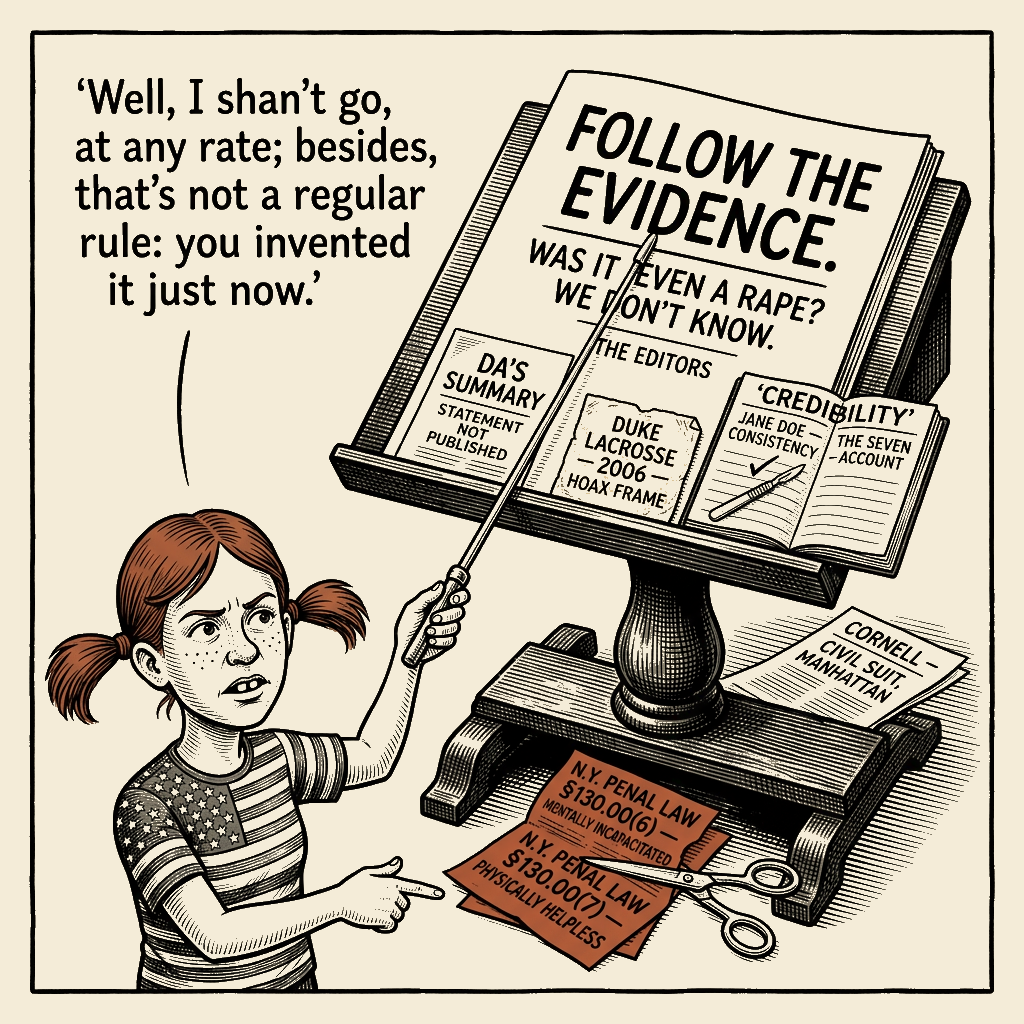
Analyzing: Follow the Evidence at Cornell — The Editors · 2026-10-02
What the Editorial Argues
National Review’s unsigned board argues that the furor over an alleged 2024 gang rape of a Cornell University student by seven fraternity members has become a moral panic, and that the dispositive fact is a written statement the complainant reportedly gave investigators in which she said she consented to the encounter — which, if the district attorney characterized it accurately, made prosecution impossible under New York law. The editors call the men’s alleged conduct depraved, endorse the university’s decision to close the fraternity, and ask that the case be resolved by evidence and due process rather than outrage, closing with a warning that a culture of casual sex and drugs has failed the standard a civilization should demand of its young men. Its stated standard — wait, weigh, do not be stampeded — is a legitimate ideal, and it is true that false accusations are real and ruinous.
Receipts
What follows is a structural reading of the essay, not a finding of fact about the underlying events. The complaint may be true or false; the analysis is about how the editorial is built.
The operation: repeat the story’s most lurid detail as established fact, install doubt about the complainant’s account, courteously, and sell the combination as “follow the evidence.”
What the framing wants you to believe:
- That “cooler heads” should wait for evidence before concluding anything — the headline’s instruction and the essay’s self-image.
- That a consent statement the complainant allegedly signed makes the episode “not a prosecutable crime under New York law,” so the criminal question is closed.
- That this case belongs to a known genre — the false rape accusation, landmarked by Duke lacrosse — so skepticism is the sober, even brave, position.
- That elected officials who responded (Hochul, Ocasio-Cortez) are demagogues, and their response is itself part of the problem.
What’s really going on:
- The dispositive document is not in evidence. The editorial concedes “the full written statement has not been made public” and proceeds on a prosecutor’s summary of it — the very secondhand character it calls “hearsay and speculation” when the account runs the other way. The core claim rests on one conditional sentence: “if the evidence available to his office was as he described, he made the right call.” The same editorial discloses, three paragraphs in, that the DA “has reopened the investigation and will consider any new evidence” — the operative development in the case is named and then treated as parenthetical, not as the headline.
- The skepticism ledger is one-sided. The alleged lewd summons-text is repeated as fact; the district attorney’s exculpatory summary is credited; the complainant’s civil complaint is discredited for inconsistency in the same breath — and the accused’s accounts (including any fraternity, sorority, or institutional responses) are never mentioned at all. The “additional reporting” that supplies the essay’s most damning insinuation — that the complainant was “convinced by her roommate that this should be treated as a rape” — is anonymous, unanchored, and used as the period on the credibility verdict.
- The load-bearing legal omission: the editorial invokes the Empire State’s laws without naming the section, and the sections it omits are the ones whose standards are the more direct fit for the conduct it concedes. New York Penal Law §130.05(2)(b) criminalizes sexual contact with a person who is “mentally disabled, mentally incapacitated or physically helpless”; §130.00(6) defines “mentally incapacitated” as a person rendered temporarily incapable of appraising or controlling conduct owing to the influence of a narcotic or intoxicating substance (the “to any other cause not amounting to mental disability” residual clause is broader than the editorial’s framing assumes); §130.00(7) defines “physically helpless” as unconsciousness or any condition rendering the victim physically unable to communicate unwillingness, and applies regardless of whether the incapacitation was voluntary; §130.10(1) supplies only an affirmative defense of reasonable belief in consent, shifting the burden to the defendant, not a bar to prosecution. A post-hoc written statement is evidence of capacity, not a conclusive bar to it. The editorial converts a prosecutor’s judgment about provability into a statute, then spends the rest of the essay letting that statute answer “Was it even a rape?” in the negative. (The specific subsection numbers should be checked against current statutory text; the doctrinal architecture is not in serious dispute.)
The Operation
I know this editorial. I wrote versions of it for the better part of a decade, for an institution whose readership overlaps this one’s down to the mailing list. The assignment arrives with the file and the note “give us the due-process piece,” and the writer builds the standard two-story house. Ground floor: doubt the account we do not want believed, courteously, in the vocabulary of rigor. Second floor: condemn the culture loudly enough that the ground floor reads as balance. Roof: civilization. I am telling you this because what follows is a template, not a mystery; and I am bitter about it, because the template is built from other people’s credibility. The bitterness is disclosed so you can discount it. The structure is verifiable.
Cui bono. (Bad-Faith Techniques Catalog — beneficiary analysis: track who is served by the framing and name the architecture rather than the actors.)
Institutional authorship. The piece is signed “The Editors” — the collective voice of the magazine whose founding posture is to “stand athwart history, yelling Stop” (NR Editorial Technique Catalogue §2.1) and whose house register is the cultural-decline ledger (NR Catalogue §4.4). The placement chain is standard: flagship editorial → The Corner → cable and syndication. The false-accusation genre is a movement staple with a landmark citation — Duke — and this editorial is its latest installment. The proximate beneficiaries of the framing are the parties named in the complaint’s “array of defendants”: Cornell, the fraternity, the Greek-letter system, and the wider anti-reform position on campus sexual-assault policy, which depends on keeping the hoax frame warm.
Distributional impact. The beneficiaries are concrete. First, the seven accused: a national editorial grants them, in the court of public opinion, a presumption the piece simultaneously withholds from the complainant — a gift no defense lawyer could buy. Second, the fraternity and its national organizations: by declaring that “Cornell was correct to close down that fraternity,” the piece converts a liability story into an accountability story — the institution acted, the matter is settled, and the center of gravity moves from what happened in the house to whether the house stays open. Third, the anti-#MeToo coalition on the right, which gets a usable frame for the broader pattern of campus-assault reporting. Fourth, the reader’s comfort: a respectable vocabulary for dismissal — due process, false accusations, “moral panic” — with the moral bill picked up by the closer. The cost-bearers are the complainant, whose credibility is the raw material the essay is built from; the survivors for whom the next disclosure now costs more; and the phrase “the evidence” itself — the headline’s word, quietly downgraded to mean a prosecutor’s summary of a document the public has not seen.
Alternative design. A genuine evidence-following essay would publish or demand the statement, redacted; report what the seven men have said; engage the incapacity standard on its own terms; set the case next to its base rates — false-report findings in the careful literature cluster in the low single digits (Lisak et al., Violence Against Women, 2010, coding 5.9 percent of a ten-year sample as false, though that figure is one study in a contested literature and not a settled base rate; other work places the rate higher or lower depending on methodology), while the research base on fraternity-associated sexual assault is substantial. The editorial would name the DA’s reopening as the headline development, not a parenthetical. It would not invoke Duke before any evidence of hoax. It did none of this. It was not designed to settle a question; it was designed to install a disposition.
FGL. The editors: greed, because the genre performs, and laziness, because the template requires no reporting. The apex beneficiaries — the accused and the defendant institutions: fear of ruin and liability, greed for reputation and money. The rank-and-file reader: fear, genuinely afraid of being fooled, of panic, of what their children walk into — and laziness, because doubt costs nothing, and the piece pays the reader in the currency of feeling rigorous. The reader’s fear is real and human. A false accusation is a catastrophe, and the template is built to service that fear without having to service the truth. That is not contempt for the reader; it is the specification of the product.
Placement. The advocated position is mixed: selfish in function and selfless on its face. The surface is due process; the function is institutional cover and audience gratification. Classification: mixed, leaning selfish.
Technique identification.
“Moral panic” as dismissal frame. Cues: “A moral panic is on. Cooler heads should wait for more evidence.” NR Catalogue §4.4, cultural-decline ledger (inverse application); Bad-Faith Techniques Catalog frame_engineered_relabeling. The phrase lands in paragraph two, immediately after the editorial concedes the lewd text and the seven men. The substantive concern becomes the diagnosis of the concern. Lineage: the “moral panic” frame has been a documented deflection from concerns about sexual-assault reporting since the late 2010s, a strand of the broader Luntz-tradition relabeling operation applied to sex-crime reporting. The technique converts the question of whether the case is substantiated into the question of whether the concern is rational — and the editorial is doing the conversion without supplying the evidence of irrationality it asserts.
The loaded question. Bad-Faith Techniques Catalog jaqing_off (“just asking questions”), in the lineage down through Walton’s loaded-question fallacy. Cue: “Was it even a rape? We don’t know.” The question is the conclusion wearing punctuation. The “even” presupposes the question is open in a register the editorial’s own subsequent description does not support. It installs doubt as the default posture before a single document has been weighed, and it lets a prosecutor’s declination — a judgment about provability — do the work of a factual finding. The fusion sits on the page: the lede’s “Was it even a rape? We don’t know” is answered, three sentences later, by “No criminal charges were brought… she consented to the whole thing,” and the answer that follows is the prosecutor’s answer, not an answer about the event. Not prosecutable and did not happen are different propositions; the essay needs them to fuse.
Euphemistic labeling. Bad-Faith Techniques Catalog frame_engineered_relabeling; Bandura’s euphemistic_labeling. Cues: “teamed up sexually” for gang rape; “boorish depravity” — an adjective built for a fraternity prank — for what seven men are alleged to have done to an incapacitated woman; “a culture of casual sex” for the event itself. The relabels work at the sensory level: the reader’s gut receives the story, and the words excuse the reader from confronting what the story says. The phrase concedes bad conduct while denying criminality; the move is a textbook mid-zone construction that lets the reader keep the felt experience of moral seriousness while the editorial’s operative position (no crime) is preserved. Luntz-tradition relabeling in its most direct form.
Selective skepticism — manufactured doubt. Bad-Faith Techniques Catalog manufactured_controversy, the Oreskes & Conway lineage, the Tobacco Strategy applied to a news story; NR Catalogue §4.1, the “stands athwart” self-presentation. Cues: “Cooler heads should wait for more evidence” — issued from a paragraph that has already asserted the text message as fact; “does not inspire confidence in her credibility” — a verdict delivered in the grammar of assessment, as if the sentence were a measurement rather than a conclusion. The doubt is manufactured precisely where it serves the preferred conclusion: certain about the district attorney’s summary, certain about the roommate, certain about the text; uncertain only about the complainant. The companion move is the panic inversion — the editorial denounces “a moral panic” while running the competing panic, the one about the false accusation, at full throttle. The “any new evidence” hedge on the DA’s reopening performs the same calibration in miniature: the body of the prose is built on the first DA statement; the reopening is mentioned in the grammar of a parenthetical.
The hoax-frame transplant. Bad-Faith Techniques Catalog hasty_generalization; false_analogy. Cue: “We have seen rape-charge hoaxes before, most notoriously in this setting in the 2006 Duke lacrosse team case, which took eight years to fully resolve.” Duke is a real catastrophe of false accusation — and exactly the wrong template here. There, DNA excluded the accused and the prosecutor was disbarred for misconduct. Here, the exculpatory basis is a secondhand account of an unseen document. The precedent is doing the argument’s work; the suppressed base rate is the difference. The parallel is invoked before any evidence of hoax in the Cornell case has been produced; the eight-year resolution the editorial cites is a feature of a defense-favorable analogical selection. Lineage: the Duke case has been the canonical defense-favorable reference in conservative sexual-assault commentary for twenty years; the analogical move is a documented apparatus, not a fresh editorial choice.
Attribution of blame and the intoxication record. Bandura’s attribution_of_blame and displacement_of_responsibility. Cues: “the liberal laws of the Empire State demand that men be responsible for their decisions, but they also recognize that women have agency to make their own choices, too”; “The fact that she was drunk and using ketamine…”; “Additional reporting suggests that she was embarrassed socially after the incident and was convinced by her roommate that this should be treated as a rape.” The conservative-feminist register is deployed to relocate responsibility from the men’s conduct to the woman’s choices. The intoxication that arguably negates the agency is named in the same breath as the agency that is supposed to be honored. Lakoff-tradition frame-activation in the strict-father register: the woman is the responsible agent, her impairment the enabling condition, the men’s choices their own. The roommate becomes the agent of the rape accusation, displacing the woman’s own account — the technique tracks the “third-party agitator” structure older than this editorial, in which the accusation is real to the accuser only because someone else put it in her head.
Civil suit as evidence of lying. Bad-Faith Techniques Catalog equivocation on what the civil suit signifies. Cue: “She may be telling a different story now than she did before does not inspire confidence in her credibility.” The civil suit is treated as evidence of a hoax rather than as a normal legal pathway after criminal declination. The editorial presents the discrepancy between initial statement and current account as evidence of fabrication rather than as a documented pattern of trauma response, social pressure, or the costs of a criminal case that did not charge. The selectivity in citation that Oreskes and Conway’s Merchants of Doubt apparatus names applies: the cases that fit the frame are cited; the cases that complicate it are not.
Dehumanization and the victim as instrument. Bandura’s dehumanization and attribution_of_blame, in tight coordination. The victim is “Jane Doe,” “the alleged ‘Jane Doe’ victim,” “a female student,” “the young woman” — never named, treated instrumentally, the rhetorical subject of a paragraph rather than the subject of the action. The grammatical reduction is the prerequisite for the causal assignment. Once the victim is a placeholder, the cause can be relocated to her, her roommate, her intoxication, and her “choices.” The architecture is the paradigm displacement-of-blame setup — strip the actor of standing, then assign the cause.
The civilizational closer. NR Catalogue §4.5, the civilizational frame; WSJ Catalogue §4.13, the threat-inflation closer. Cue: “A civilization that fails to demand more than that from its young men will get what it asks for.” The pivot from the specific to the cosmic is the essay’s exit ramp. The closer demands moral improvement of young men — safe, universal, costless — while the specific institutions named in the suit were already absolved three paragraphs up. The reader leaves with the feeling of accountability and the substance of none. The sentence inflates from a specific case to civilizational stakes, licenses the rhetorical intensification the rest of the piece has been holding back, and is engineered for retransmission. Schmitt-tradition friend/enemy apparatus at low intensity: the “civilization” is the in-group; the failure is the out-group’s doing; the consequence is the punishment the in-group is already receiving.
The parallel exoneration apparatus. The remaining Bandura mechanisms form the exoneration cluster: moral_justification (the “cooler heads” frame, the “fair hearing” hedge, the “civilization” closer); advantageous_comparison (Duke lacrosse as the operative precedent); displacement_of_responsibility (the roommate, the laws, the intoxication, the “Empire State”); diffusion_of_responsibility (“all involved,” “none of the men involved in or aware”); distortion_of_consequences (“degrades women” as the worst consequence named, while the specific harm is treated as “boorish” and “depraved” but not criminal). The cluster is the paradigm Bandura configuration; naming one mechanism misses the architecture.
Audience-management function. Permission structure plus conscience displacement plus identity confirmation. The reader who wants to dismiss the story receives a respectable vocabulary for doing so; the closer’s lament discharges the moral cost of the dismissal; the reader arrives at the conclusion feeling that they have been careful — and that carefulness is the frame’s product, not the reader’s. That is the product the genre sells, and this piece is an ordinary delivery.
Symmetric-application check. The “fair hearing for the alleged victim and careful, sensitive consideration of the evidence and the credibility of testimony on all sides” standard the editorial claims — applied symmetrically — would require the editorial to apply that standard to its own treatment of the accuser’s credibility. The editorial does not. The “agency” reframing and the “she was drunk and using ketamine” placement do the work of doubt the procedural frame asks the reader to defer. The same standard applied to a case where the accused was from a coalition the editorial disfavors would not, on the documented record of how this frame travels, be applied with this architecture. The frame’s self-defeating payoff is built in: the standard the editorial claims cannot survive contact with the editorial’s own execution.
The Record
Receipt set.
- “No criminal charges were brought,” and the complainant “provided a detailed written statement at the time admitting that she consented to the whole thing” — rests on the district attorney’s public characterization, not on the document. The editorial itself concedes “the full written statement has not been made public.” [unconfirmed: no primary document in this package; carried on secondhand official account.]
- “Van Houten has provided excerpts” — asserted, not quoted. [unconfirmed: not in this package.]
- “Van Houten has reopened the investigation” — asserted by the editorial itself in paragraph three. [unconfirmed: outside this package beyond the editorial’s own text; routine and plausible.]
- A civil suit is pending in Manhattan against Cornell, the bar, and the fraternity’s and sorority’s national organizations — asserted; public court records would settle it, but they are not here. [unconfirmed: not in this package.]
- “Additional reporting suggests that she was embarrassed socially after the incident and was convinced by her roommate that this should be treated as a rape” — anonymous; no source cited; carries the essay’s heaviest insinuation. [unconfirmed: no source given.]
- The Duke lacrosse case “took eight years to fully resolve” — public record, substantially accurate as history (accusation March 2006; criminal charges dropped in April 2007; the prosecutor Mike Nifong disbarred in mid-2007), with civil proceedings continuing for years. Whether eight years is the precise window depends on which civil matter and which endpoint is being measured; any specific endpoint figure cited from the analyst’s recall is not independently verified. Tier 1 as history; analytically inapposite as analogy.
- “The fact that she was drunk and using ketamine… is not a prosecutable crime under New York law” — misleading by omission. The New York Penal Law provisions cited in the Receipts section above are the ones the editorial implicitly relies on; the omitted sections are the ones whose standards are the more direct fit for the conduct the editorial concedes. A signed statement is evidence on the question of capacity, not a conclusive end to it. The editorial’s categorical is the prosecutor’s judgment adopted into the editorialist’s voice. (Statutory subsection numbers above should be checked against current text; live web verification was not available in this turn.)
Load-bearing omissions.
- The seven men’s accounts — absent entirely.
- The content and full text of the alleged lewd summons-text — asserted, unattributed, treated as established.
- The full text of the Jane Doe written statement (the DA’s excerpts are paraphrased by the editorial, not produced).
- The statute the essay implicitly relies on — invoked without citation; the sections whose standards are the more direct fit for the conduct the editorial concedes are the ones omitted.
- The civil complaint’s actual allegations and exhibits — dismissed as “hearsay and speculation” without engagement.
- The documented pattern by which sexual-assault victims modify or recant accounts under social pressure, trauma, or the costs of prosecution.
- The base rates — absent, both directions.
- Any reporting on prior conduct by the fraternity or by the bar that served her, on which the civil suit also names the bar as a defendant.
- The institutional configuration: the suit’s defendants include the fraternity’s national organizations, and “Cornell was correct to close down that fraternity” pivots the liability story into a moral one, which is how an institution wanders off the hook mid-essay.
Per-citation verdicts. District attorney’s statement: accurately but selectively characterized — excerpts only, and the load-bearing conditional (“if the evidence available to his office was as he described”) is doing all the legal work. Duke: historically accurate, analytically inapposite. “Additional reporting”: anonymous, unverifiable, and directed at the most damaging insinuation in the piece. The legal claim: misleading by omission.
Missing-information declaration. The statement, the district attorney’s file, the complaint, the men’s accounts, and the alleged text are all outside this package. I have not treated their absence as evidence of anything; I have treated the essay’s structure — what it chooses to credit, what it chooses to discredit, on the record available to it — as the object of analysis. The template knowledge in this analysis is drawn from my own years doing this work; it is flagged as such and is not independently verifiable. Nothing here is a finding about whether the events at that house occurred. The complaint may be true or it may be false; I have no more access to that than the editors do. That is the point.
How to Recognize This
The pattern is the hoax-frame — the Skeptic’s Raid — and the tell is in the imperative. “Follow the evidence” is the headline’s instruction, and the essay’s conclusions are already set.
The mechanism. Reframe the open question as if its default answer ran against the complaint. Supply a respectable reason to doubt — due process, false accusations, “moral panic.” Condemn the culture loudly enough to discharge the moral cost of the doubt. Close on civilization. The reader who wants to dismiss the story pays nothing for the privilege and is paid, on top of it, in self-regard. “Wait for evidence” is true in itself and useful in itself. The technique operates when the editorial is not waiting in fact — when it is weighting the cited evidence, invoking defense-favorable historical parallels, summarizing the alleged conduct in euphemism, and closing on a register that has nothing to do with the procedural patience the headline claims. The reader is told they got to the conclusion by being careful. They got there by being shown the conclusion through a procedurally-respectable frame.
Signals. Four, concrete.
- The headline or lede commands patience — “cooler heads,” “wait for more evidence,” “we may never know” — while the body asserts unproven detail as fact.
- A famous false-accusation case is imported as the interpretive frame — Duke, Tawana Brawley, the University of Virginia fiasco. The precedent is doing the argument’s work; the parallel is invoked before any evidence of hoax has been produced.
- The complainant’s credibility is anatomized — “does not inspire confidence in her credibility” — while the accused’s account never appears. The historical parallel is to a case where the accused were exonerated, not to a case with a similar fact pattern and a different outcome.
- The kicker pivots to civilization, the culture, the soul of the nation. When the essay leaves the specific for the cosmic, the evidence has already been abandoned. The closing lands on civilizational or character register, not on the procedural register the headline claimed.
Why it works. The reader’s fear of being deceived is real, and the template recruits it to do the work evidence would otherwise have to do. Doubt is free. It feels like rigor. It requires no documents and no discomfort. The “cooler heads” frame is procedurally defensible and rhetorically useful. It gives the reader cover for skepticism without requiring the reader to defend the accused in their own voice. It is one of the most reliable audience-management devices in the editorial-page repertoire for sex-crime cases because it sounds principled and is structurally built to do the work of doubt. The genre could not survive without that economy.
What to do when you see it. Ask cui bono first — who benefits from the doubt installation, and who is paying for it. Demand the document: a redacted statement can be published, and its absence is the essay’s load-bearing condition. Run the skepticism-ledger test — which account got the scalpel, which got the pass; the asymmetry is the argument. Note whether the cited official’s subsequent actions are weighted or buried (the DA’s reopening belongs in the headline, not in paragraph three). Check the statute the editorial invokes against the statute the editorial omits: if the omitted section is the one whose standard is the more direct fit for the conduct the editorial concedes, the “not a crime” claim is doing the work the procedural frame was built to do. Check the base rates the analogy suppressed. Apply the “if the roles were reversed” test: would the same procedural standard be applied to a case where the accused was from a coalition the editorial disfavors? Notice the same vocabulary tracking across the syndication network — “moral panic,” “cooler heads,” “we don’t know” — and ask whether that is convergence or participation. Read the closing sentence; if it is civilizational or character rather than procedural, the headline’s frame is not the body’s frame. Then decide what you believe, on your own recognizance.
I cannot tell you what happened at that house. Neither can National Review — it has a prosecutor’s summary of a statement the public has never seen, packaged as the evidence you should follow. I put that packaging together, in other rooms, for other stories, for a long time. The recognition is the only thing heavier than the work was. Carry it into the next piece that tells you to wait: watch whose hand is on the pointer, and ask, before anything else, who is following whom.

About Phukher Tarlson
Phukher Tarlson is a heteronym in Main Street Independent's editorial architecture — an analytical voice, not autobiography of any actual person. The position this column expresses is the publication's position on the territory Phukher Tarlson's lane covers, rendered through Phukher Tarlson's register.