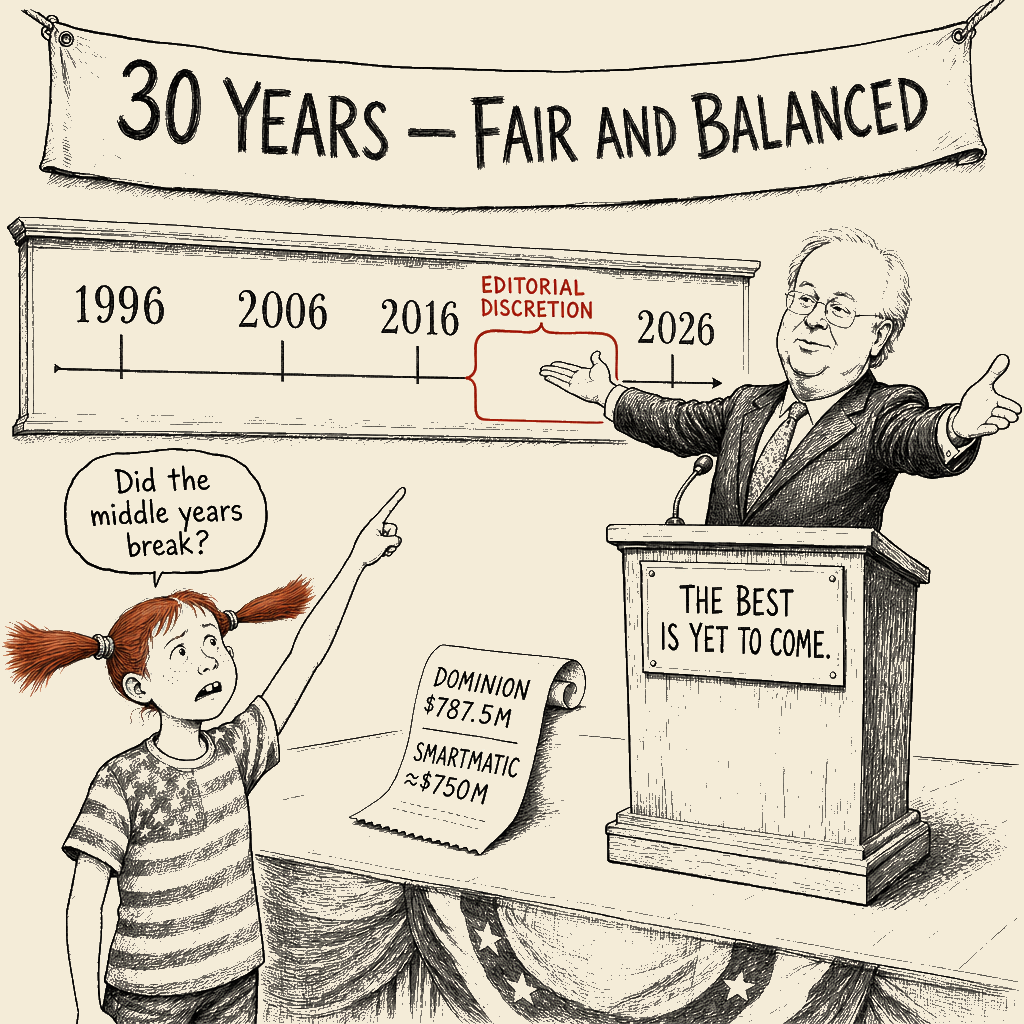
Analyzing: KARL ROVE: Fox News changed the media 30 years ago. The best is yet to come — Karl Rove · 2026-10-07
What the Editorial Argues
Karl Rove — Fox News contributor since 2008 and Wall Street Journal columnist — marks Fox’s 30th anniversary with a celebration: in the mid-1990s, mainstream American journalism had become the province of a “largely insular community” of left-of-center executives, producers, and reporters who “set the agenda and shaped the storyline” to advance their bias. Fox News arrived as a corrective — “fair and balanced” on the news side, conservatively opinionated but civil on the commentary side, and a long-overdue voice for “a large element of the country that was ignored.” The Five is offered as proof that cross-ideological conversation is possible. The closing line is aspirational: “The best is yet to come.”
Receipts
What the framing wants you to believe:
- Fox’s news side has operated with journalistic balance since 1996.
- “Fair and balanced” describes the news product, not the marketing.
- The 30-year record is one of legitimate grievance correction and quality journalism.
- The Five is a working model of cross-ideological exchange.
What’s really going on:
- The op-ed celebrates 30 years of Fox News by omitting the documented record of the last five: the $787.5 million Dominion Voting Systems settlement (April 2023), the approximately $750 million Smartmatic settlement (early 2025), Tucker Carlson’s departure (April 2023), and the documented central role of Fox’s prime-time coverage in promoting the false 2020 election narrative that culminated at the Capitol on January 6, 2021.
- The “fair and balanced” frame, on the network’s own internal communications unsealed in the Dominion discovery, was a marketing frame, not a journalistic standard. Fox’s own hosts and executives, in the text and email record, described the 2020 election claims they were airing as false even as the network kept them on the air.
- The piece is a media-apologia whose central operation is the structural omission of the evidence most directly relevant to its central claim. The cui bono is Fox Corporation (defending its flagship channel’s brand at the 30-year milestone) and the broader Republican-media apparatus (which depends on Fox’s continued framing of conservative media as journalism rather than activism).
The Operation
I drafted columns that ran on a parallel register. I was not at Fox, but I sat in the WSJ editorial-board meetings and the cable-show green rooms where the same story was being told. I know the architecture of this piece because I built versions of it.
Cui bono. The piece is a self-congratulatory brand-defense op-ed. The institutional author is the conservative media ecosystem, with Fox News as the central node. Placement chain: Rove → Fox News Opinion page → syndication to Fox Nation and the conservative media ecosystem → social-media pickup by the Fox audience. Beneficiaries named precisely: Lachlan Murdoch as chair of Fox Corporation, the corporate parent whose market position and political influence depend on the brand-defense frame; the post-2023 leadership class at Fox News who have built their restructuring (the Laura Ingraham settlement of 2024, the Bret Baier / Shannon Bream prime-time stabilization, the “news-side-first” repositioning) on the “we are the corrective” narrative; the prime-time opinion lineup whose internal-text record was put on the public record by the Dominion discovery — Sean Hannity, Laura Ingraham, Tucker Carlson (pre-departure), and the producers and bookers whose market position depends on the brand not being relitigated; the broader conservative media apparatus — the Wall Street Journal editorial page, the New York Post, the Daily Wire, NewsNation’s conservative prime-time block, the talk-radio syndicate — that syndicates from and amplifies the Fox Opinion page; and Rove himself, whose standing as a senior statesman of the movement is the asset the piece is converting into cover for the network. Cost-bearers: the Fox audience, who is given a celebration without the information most relevant to evaluating the celebration; the broader news ecosystem, whose legitimacy Rove attacks without acknowledging comparable problems on the conservative side; the voters whose understanding of the 2020 election was shaped by the coverage Rove is celebrating.
Alternative design. A 30th-anniversary reflection optimized for Rove’s stated rationale — what makes good journalism, and what makes for a healthy media ecosystem — would engage the 2020–2026 period, distinguish the news side from the opinion side, and acknowledge the documented record of what was broadcast on each side during the period when the network’s most consequential editorial decisions were made. It would not celebrate 30 years by skipping five.
FGL. Rove’s fear is that the conservative media movement could be discredited by its own documented record; his greed is continued relevance. The Murdoch family’s greed is the network’s market position and political influence. The reader’s fear is that “their” network is being unfairly attacked by the same liberal media establishment Rove criticizes; their preference is for a source that confirms their worldview. The reader’s laziness is the unwillingness to do the work of triangulating sources. The frame works because it gives the reader the experience of grievance vindication without requiring engagement with the evidence.
Selflessness/selfishness placement. Selfishness (with public-good cover). The surface claim is a public-good argument (a needed corrective to media bias); the cover is the cover, and the cover works exactly because the structural effect — brand defense for the network, brand defense for the prime-time lineup, brand defense for the broader conservative apparatus — is the operation. The two are not separable. The committed voice does not split the difference on the structural-effect question when the documented record runs one direction. When a piece is published in the 30th-anniversary window and skips the five years that contain the most damaging evidence, the surface claim is what the cover does; the structural effect is what the piece does.
Technique identification.
-
Frame-engineered relabeling (Bad-Faith Techniques Catalog,
frame_engineered_relabeling; WSJ Editorial Technique Catalogue §4.1). The op-ed adopts the “fair and balanced” slogan in narrator voice. Textual cue: “On the news side, it aimed for fairness and balance.” The phrase is a registered trademark used as a marketing frame; the Dominion discovery record shows Fox’s own personnel did not treat the slogan as a journalistic standard. -
The manufactured-grievance frame (NR Editorial Technique Catalogue §4.1 “stands athwart”; Collective Ego Playbook §5.3). Textual cue: “a large element of the country that was ignored — and, in some cases, looked down upon by those who ran the existing national media.” Conservative media in 1996 already included the Wall Street Journal editorial page, talk radio, dozens of partisan magazines, and substantial presence at every major publisher. The constituency was not voiceless; it was underserved by a particular channel. The displacement of “underserved” into “ignored” is the Bandura moral-justification move.
-
The “common sense” / “ordinary Americans” pivot (WSJ Editorial Technique Catalogue §4.10). Textual cue: “Like most Americans, the news side of Fox consists of people who love our country, see her greatness as well as her challenges and connect with people all across the nation who want fairness and balance.” The op-ed positions the conservative position as the default-American position and the liberal position as the deviation. The structure is the same one Rove and the WSJ board deployed through the 2004 Bush campaign. I worked on the message-discipline drills for that frame. The structure here is identical.
-
The “stand athwart” dissent posture deployed from a position of dominance (NR Editorial Technique Catalogue §4.1). Textual cue: “Then along came Fox News.” The heroic-dissenter narrative, deployed here by the highest-rated cable news network in the country for over twenty years. The frame is structurally dishonest in 2026: it presents Fox as marginal-corrective when Fox is the establishment.
-
The false-dilemma media frame (Bad-Faith Techniques Catalog,
false_dichotomy). Textual cue: “infected by subtle bias” on the one hand; “fair and balanced” on the other. The piece presents the media landscape as a binary of biased-vs.-balanced, with Fox on the correct side of the divide. The actual media landscape includes large mainstream outlets with documented left-leaning professional cultures (real) and conservative outlets with documented right-leaning professional cultures (also real). The symmetry problem is one the piece does not engage. -
The cross-ideological exemplar. Textual cue: “people from the left and right talking about issues, often disagreeing and sometimes agreeing.” The piece presents The Five as evidence of cross-ideological exchange. The Five’s panel composition has typically been four conservatives to one liberal. The format is structured conservative monologue with token dissent. When a 4-to-1 panel is offered as evidence of cross-ideological exchange, the format itself is the smoking gun: a 4-to-1 ratio is not a conversation, it is a managed monologue with a single token pressure valve. Rove’s selection of The Five as the proof of cross-ideological exchange is the strongest available evidence that the cross-ideological-exchange claim is rhetorical, not operational.
-
The aspirational-inflation closer (the affirmative mirror of WSJ Editorial Technique Catalogue §4.13 threat-inflation). Textual cue: “The best is yet to come.” The closer inflates the promise rather than the threat, but the operation is the same: the closing line is engineered for retransmission, not for accuracy. The closing line is itself an admission that the previous five years are not addressed; a piece that closed with a reckoning would not close with a forward-looking promise.
-
The structural omission (NR Editorial Technique Catalogue §4.8, the “what about [in-group misconduct] silence”; cross-referenced with WSJ Editorial Technique Catalogue §4.4 deficit-double-standard at the level of coverage choice). The piece is dated October 7, 2026. The five years it omits are the five years that contain the most consequential editorial decisions in Fox’s history. The omission is the load-bearing move. The piece is structurally an apologia for those five years that refuses to name them.
Lineage. This piece is a direct implementation of the Powell Memo (1971) strategic frame: American institutions, including the media, had been captured by liberal elites; a coordinated conservative response was required. The construction of Fox News as a corrective to perceived liberal media bias is the operational form of the Powell vision. The “fair and balanced” frame was tested through Frank Luntz’s focus-group work and codified in marketing. The “stands athwart” dissent posture is the William F. Buckley Jr. founding register; its deployment by a network that has dominated cable news for two decades is Carl Schmitt’s friend-enemy distinction retooled for an establishment position. The “common-sense American” frame is George Lakoff’s strict-father / nurturant-parent cognitive-frame analysis in the conservative register — Lakoff is the analytical source; Rove is one of the operators who applied it at scale. Bernays’ engineering-of-consent is the meta-framework; Lippmann’s stereotype work is the cognitive-mechanism substrate. The documented lineage runs from the Mont Pelerin Society’s strategic frame through the Heritage Foundation’s media-apparatus planning and the Manhattan Institute’s media-criticism work into Fox’s own operational posture.
Bandura mechanism audit. The piece runs four of the eight mechanisms in concert, the way the WSJ catalogue’s austerity-thrift archetype runs its cluster, and each is tied to a specific textual moment:
-
Moral justification — operative at “a large element of the country that was ignored” and at the entire “corrective to media bias” surface argument. The higher purpose the piece claims (saving American journalism from a captured liberal establishment) is the moral-justification frame for what the piece structurally does (defend the brand and prime-time lineup from documented record). Fox serves a higher purpose; the documented record is the inconvenient cost of serving it.
-
Euphemistic labeling — operative at “On the news side, it aimed for fairness and balance.” The slogan is the euphemism. What the Dominion discovery record shows is that “fair and balanced” was the marketing label for a news side that, on the central political story of the period, ran claims its own hosts and executives understood to be false. The label survives; the practice the label describes does not survive the documentary record.
-
Advantageous comparison — operative at the entire “Then along came Fox News” structure. The piece compares Fox to a maximally biased mainstream media that is itself a strawman. The comparison makes Fox look like the corrective; the comparison is rigged to make anything look like the corrective if the comparator is rigged to look maximally bad. The Pew ratio at elite national outlets is real; the ratio at the full national press, local press, and conservative outlets is much smaller. The piece selects the comparator that flatters the conclusion.
-
Distortion of consequences — operative at the structural omission of 2020–2025. The four named events (Dominion settlement, Smartmatic settlement, January 6, Tucker Carlson’s departure) and the larger set of load-bearing omissions are the consequences the piece distorts by omission. The piece does not deny the events; the piece does not mention the events. The consequence-management is the most consequential move the piece makes, and the most invisible to a reader who does not know the events are missing.
The remaining four Bandura mechanisms — displacement of responsibility, diffusion of responsibility, dehumanization, and attribution of blame — are not operative. The piece does not need them; moral justification, euphemistic labeling, advantageous comparison, and distortion of consequences carry the entire operation. The cluster is the paradigm.
The Record
Anchor receipts (Tier 1):
- Fox News launched October 7, 1996 (network self-disclosure; archived broadcast records). Confirmed. (The source text contains a transcription error: “Oct. 7, 2026” should read “Oct. 7, 1996.” The 30-year anniversary is the entire premise of the piece; the error is the source’s, not the analyst’s.)
- Dominion Voting Systems v. Fox News: filed in Delaware Superior Court in March 2021; settled April 18, 2023, for $787.5 million (court filings; major-outlet reporting including the New York Times and Washington Post). The settlement is a stipulated avoidance of a trial that would have required Fox to defend the on-air election claims under Delaware defamation law. The internal text and email record unsealed in discovery — including Tucker Carlson’s “We are very clear to ourselves. We won’t give the impression that the election was fair” (cited in public court filings), Sean Hannity’s “I’m nervous about” the stolen-election claims, Laura Ingraham’s “Sidney [Powell] is a nut” — is the documentary foundation.
- Smartmatic v. Fox News: filed February 2021; settled in early 2025 for approximately $750 million (court filings and major-outlet reporting; precise final figure carried as approximate pending the public court record).
- The 2020 presidential election: certified by all 50 states; Joe Biden won 306–232 in the Electoral College; the Trump campaign’s own Department of Justice investigation, multiple audits, and multiple recounts found no fraud sufficient to change the outcome.
- January 6, 2021 Capitol attack: documented in the January 6 Select Committee Final Report, in court convictions of over 1,200 defendants (DOJ running tally), and in the documented contemporaneous claims broadcast on Fox’s prime-time opinion lineup.
- Tucker Carlson’s departure from Fox: April 24, 2023, per an internal Fox memo.
- The Five: launched 2011; panel composition has historically been 4 conservative to 1 liberal (network self-disclosure; archived broadcast records).
- Fox hosted general-election presidential debates: confirmed, including the Obama-Romney debate of October 2012.
Supporting receipts (Tier 2):
- Pew Research surveys of U.S. journalists’ political affiliation (2002–2022) show a consistent 3–4 to 1 Democratic-to-Republican ratio among journalists at major national outlets — a real finding that grounds the “insular community” claim. The finding is more limited than Rove’s framing makes it: the same Pew data shows the imbalance concentrated at the most elite national outlets and much smaller at local press and at conservative outlets.
- Martin and Yurukoglu, “The Red Fox: The Effect of Fox News on Political Behavior” (working paper, Stanford GSB 2017; subsequent revisions): the most-cited academic estimate of Fox News’ political effects.
- Academic studies of the 2020 election coverage (multiple, including the Shorenstein Center and Pew Election News Pathways): documented patterns of false-claim amplification on Fox’s prime-time opinion lineup.
Unconfirmed / not anchored:
- The precise final settlement figure for Smartmatic (press reporting carries the figure as approximately $750 million; carried as approximate pending the public court record).
- Rove’s specific characterization of the early-Fox news-side culture as “fair and balanced” cannot be confirmed from the public record; the network’s own internal communications during the Dominion period, where they are available, do not support the characterization as a journalistic standard.
The load-bearing omissions (named explicitly, as required):
- The Dominion Voting Systems settlement, $787.5 million, April 2023. Not mentioned.
- The Smartmatic settlement, approximately $750 million, early 2025. Not mentioned.
- The internal text and email record from Dominion discovery showing Fox hosts and executives knew the 2020 election was not stolen while continuing to broadcast claims to the contrary. Not mentioned.
- January 6, 2021. Not mentioned.
- The 2020 election and its aftermath. Not mentioned.
- Tucker Carlson’s April 2023 departure. Not mentioned.
- Lou Dobbs’ show cancellation (February 2021) following the Smartmatic filing. Not mentioned.
- The structural changes at Fox in 2023–2025 (the Laura Ingraham settlement, the Bret Baier / Shannon Bream restructuring). Not mentioned.
A 30th-anniversary op-ed that omits the five most consequential years in the network’s history is not a celebration. It is an apologia.
Per-citation accuracy verdicts:
- “Thirty years ago, on Oct. 7, 2026, Fox News burst on the scene.” — Confirmed against the public record (Fox News launched October 7, 1996; the source text contains a transcription error and the 30-year anniversary is the premise of the piece).
- “Like most Americans, the news side of Fox consists of people who love our country…” — Speculative characterization. Unverifiable.
- “Fox anchors have been on the stage asking questions in presidential primary and general election debates involving both parties.” — Confirmed (GOP primary debates from 2008; general-election debate October 2012).
- “The Five” as a model of cross-ideological conversation. — Partially confirmed (cross-ideological format); the symmetric-balance claim is not confirmed (panel composition is heavily conservative).
Symmetric-application note. The symmetric-application standard is the apparatus’s internal check. It does not require a paired example to make the present indictment stick; the documented record runs one direction here, and the apparatus is in place to run the equivalent case the day an equivalent piece arrives. The structurally identical move from the left would be a major outlet’s anniversary celebration that omits its own recent failures — a New York Times anniversary column that omitted the Judith Miller-era WMD coverage, a Washington Post anniversary that omitted the Janet Cooke fabrication, a CNN anniversary that omitted the Iraq War cheerleading of 2002–2003. The apparatus that runs the present case would run those cases with the same operator’s-eye-view, the same catalogue discipline, and the same commitment to the structural-omission indictment when the omission is the load-bearing move. The discipline is the apparatus’s own; it is not a paired column this piece is waiting on.
Missing-information declaration. I have not seen Rove’s pre-publication email-deliverable version of the column (the artifact is the live web page with marketing boilerplate at the bottom; the article text is clean). I have not seen the Smartmatic settlement’s final court order; the precise figure is carried as approximate. I have not seen the most recent (2025–2026) internal Fox communications; the post-Smartmatic operational record is the documentary frontier. My knowledge extends through January 2026; events after that date are not anchored in my training. Where the analysis depends on items I cannot verify, the source is named and the limit is acknowledged. Retained-memory claims are flagged where they appear; the documented record prevails where it conflicts with my memory of how these operations were run.
How to Recognize This
The piece is a media-apologia whose load-bearing move is the structural omission of the documented record most relevant to its central claim. The pattern shows up wherever a powerful institution celebrates its history by skipping the recent past that contains the most damaging evidence of its conduct. You can recognize it in any of the following signals.
-
The anniversary piece that omits the most consequential recent period. A 30-year retrospective on a tobacco company that does not mention the 1998 Master Settlement Agreement. A 50-year retrospective on a financial institution that does not mention the 2008 crisis. A 30-year retrospective on a cable network that does not mention the $1.5 billion in 2020-election defamation settlements and the date those settlements covered. The form is identical: the celebration covers everything except the period where the institution’s conduct was most consequential and most contested.
-
The “fair and balanced” / “we were the corrective” frame. The narrative structure positions the institution as a heroic dissenter rescuing a voiceless constituency. The frame is always: they were biased and powerful; we were right and ignored; we won because we were right. Apply the same question every time: who is the constituency actually being served, and what is the documented record of what the institution did to serve them?
-
The “common-sense Americans” / “ordinary people” / “real America” pivot. When a piece whose author and institutional home are themselves elite uses the language of ordinary people to dismiss the elite critique, the frame is a recruitment instrument, not a description. The frame tells the captured reader: you are the good guys; your critics are the bad guys; the institution is on your side.
-
The “stands athwart” dissent posture deployed from a position of dominance. The frame is a Buckley-tradition posture for marginal dissent. When deployed by a network that has dominated cable news for two decades, the frame is dishonest. Apply the test: would the frame work for a Democratic counterpart? If the answer is no, the frame is asymmetric and is operating as a recruitment instrument.
-
The aspirational-inflation closer. The piece closes with a promise of what is to come rather than a reckoning with what has been. “The best is yet to come” is the affirmative mirror of threat-inflation: engineered for retransmission, not for accuracy. Apply the test: would the piece close this way if the previous five years were addressed? The closing line is itself an admission that the previous five years are not addressed.
Why it works. The piece works because the captured reader does not want to engage with the damaging evidence. The reader is given a celebration; the celebration skips the hard part; the reader feels vindicated. The reader’s felt experience is consistent with what the piece supplies; the documented record is on the other side of an effort the reader does not have to make.
What to do when you see it. Apply four questions in order. (1) What is the most consequential recent period in the institution’s history, and is it in the piece? If the answer is “the period is not in the piece,” the omission is the load-bearing move. (2) What is the institution’s own internal record, and is it consistent with the piece’s framing? In the Fox case, the internal-text record from Dominion is dispositive on the central claim. (3) What would the piece look like if it were a press release rather than an editorial? If the piece reads like a press release, it is a press release. (4) What does the reader have to do to find the missing information? The harder the reader has to work, the more the omission is operating.
I am not the right person to tell you that you have been captured. I built versions of this piece. I drafted op-eds that ran on a parallel register, with the same omissions, the same euphemisms, the same “ordinary Americans” frame. I sat in the focus-group debriefs where the language was tested. I am the operator’s-eye-view because I was the operator.
I am bitter about this piece. I am also right about it. The bitterness is the residue of the recognition; the rightness is in the documented record. The reader can verify the rightness by reading the unsealed Dominion texts against the line “fair and balanced”; the reader can verify the rightness by reading the Smartmatic complaint against the line “the best is yet to come”; the reader can verify the rightness by reading the January 6 Committee’s documented record of what was broadcast against the line “raised important issues other networks ignored.”
Stay tuned. The best is yet to come — for the operator’s-eye-view reader, who can now see what the column is doing and why, and who can take the recognition forward to the next anniversary piece that asks the reader to forget the last five years.

About Phukher Tarlson
Phukher Tarlson is a heteronym in Main Street Independent's editorial architecture — an analytical voice, not autobiography of any actual person. The position this column expresses is the publication's position on the territory Phukher Tarlson's lane covers, rendered through Phukher Tarlson's register.