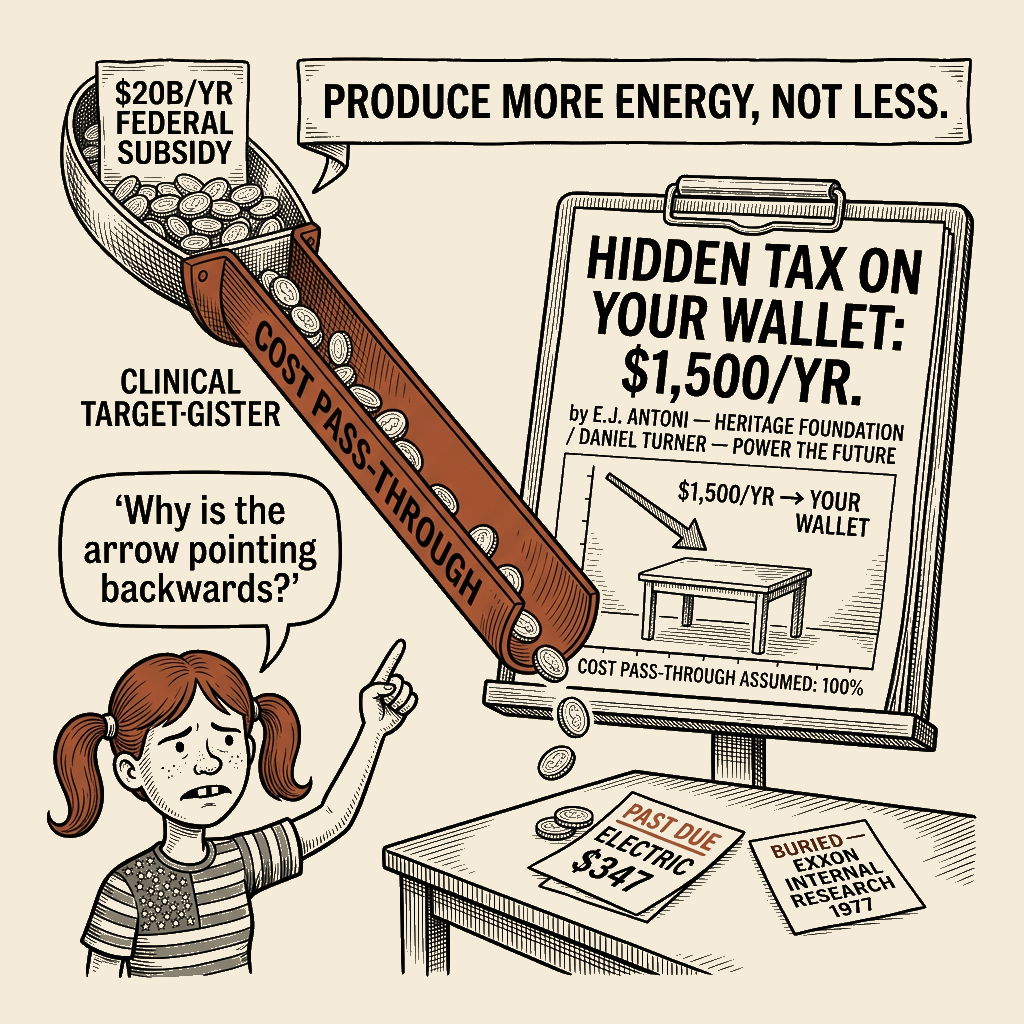
Responding to: Eco-warriors want to turn up the heat on your wallet to fund their climate agenda · 2026-10-07
What the Piece Argues
The piece, written by Heritage Foundation’s chief economist E.J. Antoni and Power The Future founder Daniel Turner, argues that a wave of climate lawsuits, state “climate superfund” statutes, and federal climate-finance legislation would impose roughly $1,465 per year in additional energy costs on the average American household — functioning as a backdoor carbon tax that circumvents voters. The authors contend that the fossil fuel industry cannot absorb these costs and will necessarily pass them to consumers at the pump and the meter, that even shareholder liability would drain middle-class pensions and 401(k)s, and that the better path is producing more energy rather than penalizing producers. The central talking point: “Businesses must pass costs to consumers, and that’s exactly what will happen here, regardless of whether some government bureaucrat decrees specific costs to be from yesteryear.”
Receipts
The piece frames climate accountability as a hidden tax on you, but the hidden subsidy it is actually protecting is the trillion-dollar cost fossil fuel companies have already offloaded onto the public for half a century of climate damage their own scientists warned them about.
-
The framing wants you to believe:
- Climate lawsuits and “superfund” laws would impose a $1,500-a-year hidden tax on the average household
- Fossil fuel companies cannot absorb liability costs; they will pass them to consumers at the pump and the meter
- Even “shareholder” liability would drain middle-class pensions, 401(k)s, and retirement accounts
- The alternative is producing more energy, not penalizing producers
-
What’s really going on:
- The $1,465 figure comes from a report by the same authors — a Heritage Foundation chief economist and the founder of a fossil fuel industry advocacy nonprofit — and assumes 100% cost pass-through with no modeling of profit margins, competitive response, or the trillion dollars in existing climate damage already on the public’s tab
- ExxonMobil’s own internal scientists, on company time and company money, confirmed in 1977 that burning their product would measurably warm the planet; the industry spent the next four decades funding the climate-denial apparatus to defer accountability (InsideClimate News, Pulitzer-finalist investigation; Supran, Oreskes, et al., Environmental Research Letters, 2023)
- The U.S. fossil fuel industry receives roughly $20 billion a year in direct federal subsidies; the five largest Western oil and gas majors posted roughly $200 billion in combined profits in 2022 and directed the bulk to stock buybacks rather than consumer relief
- The top 10% of Americans own roughly 89% of all stocks; the “shareholders are middle-class pensioners” framing is doing very heavy lifting the actual ownership distribution will not support
- William Nordhaus of Yale shared the 2018 Nobel Prize in Economics for work integrating climate change into long-run macroeconomic analysis; calling carbon pricing a “radical climate agenda” is a remarkable position for an economist to take on the record
The Response Ladder
Polite Reframe
When to use: a good-faith neighbor, cousin, or coworker who has just read the piece and wants to think it through with you. Calm. Receipts-carrying. No mockery. The reader they want to persuade, not the reader they want to perform for.
Cousin Darnell lives three streets over. She works the second shift at the packaging plant, raises her grandson, and her lights got cut off last February because the bill was $347 and her check was $318. She is not a footnote in a Heritage Foundation report. She is the reason this argument matters, and she is the first person the “$1,500 hidden tax” framing wants you to forget.
The Heritage Foundation’s chief economist, E.J. Antoni, and the founder of Power The Future, Daniel Turner, wrote a piece this week arguing that climate lawsuits and “climate superfund” laws would impose about $1,465 a year on the average American household. They frame it as a hidden carbon tax, something climate activists are sneaking past voters through the courts. The argument is structurally familiar: businesses must pass costs to consumers, so any attempt to hold fossil fuel companies accountable for climate damage is really a tax on you.
Here is what the framing works hard to suppress. The $1,465 figure is a number the report itself constructed, built on the assumption of full pass-through, with no modeling of profit margins, competitive response, or the trillion dollars in climate damage that fossil fuel companies have already offloaded onto the public. ExxonMobil’s own internal scientists, on company time and company money, confirmed in 1977 — forty-nine years ago — that burning their product would measurably warm the planet. The company spent the next four decades funding the climate-denial apparatus to keep that knowledge from settling into regulation. The Pulitzer-finalist investigation by InsideClimate News documented exactly this. The hidden tax isn’t the one climate lawsuits would impose. The hidden tax is the one fossil fuel companies have been collecting for half a century in the form of hurricane recovery, wildfire suppression, coastal infrastructure damage, and the public-health costs of breathing the air their product is heating.
The U.S. fossil fuel industry receives roughly $20 billion a year in direct federal subsidies. The five largest Western oil and gas majors posted roughly $200 billion in combined profits in 2022 alone and directed the bulk of it to stock buybacks, not consumer relief. The top 10% of Americans own roughly 89% of all stocks; the “shareholders are middle-class pensioners” line is doing very heavy lifting that the actual ownership data will not support.
William Nordhaus of Yale shared the 2018 Nobel Prize in Economics for work integrating climate change into long-run macroeconomic analysis and demonstrating that carbon pricing is among the most efficient mechanisms a market economy has for addressing the problem. The IMF, the World Bank, and the OECD have all reached similar conclusions. The idea that pricing carbon is a “radical climate agenda” is a remarkable position for a serious economist to take on the record.
The late Dr. King, in the days before he was killed, said that a country with America’s wealth that does not use it to end poverty is bound, in the most theological sense, for hell. He was talking about then. He is talking about now. The question Darnell’s lights pose is not whether someone is going to pay. The question is whether the bill goes to Darnell, who did not cause the warming, or to the companies that knew in 1977 and chose the buybacks.
The “produce more energy” line at the end of the piece is the tell. The authors are not arguing for an all-of-the-above energy policy. They are arguing for the continued right of their funders’ industry to externalize its costs onto Darnell’s lights. The earth was given as a trust, not as a resource to strip for the next quarter’s profits. Cousin Darnell is, by the same accounting, one of the grandchildren we were supposed to be conserving it for.
Mockery and Ridicule
When to use: the friend-of-a-friend on Facebook, the uncle at Thanksgiving who has already forwarded three op-eds this month, the online exchange where the point is to perform for the bystander. Reach for this when the persuadable has been spoken for and the audience is everyone else at the table.
Picture the executive floor of a major American oil company in 2026. A memo has arrived from a Heritage Foundation economist estimating the cost of climate lawsuits. The executive reads the memo. The memo puts the household tab at $1,465 a year. The executive nods. The executive reaches for the phone. “Get me the Wall Street Journal op-ed page. And tell the people at Power the Future to put a sheep farmer on the byline — rural optics.”
That is the operation. The $1,465 figure comes from a Heritage Foundation report by the people writing the op-ed about the Heritage Foundation report. Power the Future, the co-signer of the piece, is a fossil fuel industry advocacy outfit operating under a name that is at least honest about who it is for. The Heritage Foundation’s climate and energy work has been paid for, in patterns documented by OpenSecrets and DeSmog, by donors whose fortunes depend on the same companies the lawsuit campaign is trying to reach. This is a press release dressed up as a column, written by the people whose paychecks depend on the conclusion.
Now read the trick in the middle out loud. “Making shareholders pay means raiding retirement accounts.” Out loud. Because the people whose retirement accounts hold fossil fuel stocks are also the people who pay the energy bill. And the insurance bill. And the asthma bill. The op-ed asks you to feel sorry for the share to keep you from asking who actually got paid.
You aren’t being asked to choose between the energy bill and the climate bill. You are being asked to pay the climate bill without a name attached to it, by an industry that has known exactly what it was doing since the late 1970s — when Exxon’s own scientists wrote the internal research predicting present-day warming, which the company then spent the next four decades publicly contradicting. The piece wants to call the lawsuit “lawfare.” The lawsuit is the first time in fifty years anybody had the temerity to send the bill. The “lawfare” is the four-decade campaign to keep the bill from being sent.
Nuclear Satire
When to use: a Substack reply, a long comment section, or a column-of-comment context where the target has earned the full treatment and the bystander is ready for the receipts to be stacked to the ceiling. Baroque. Cumulative. Grotesque. The full villainization of the operation, the institution, and the named apex-of-power figures.
In 1977, Exxon’s own scientists, working inside the company on company time with company money, concluded that burning their product would measurably warm the planet. The company buried the science, funded the denial, and then — forty-nine years later — hired two gentlemen to write a Fox News column explaining that the real climate problem in America is the people trying to make Exxon pay for what Exxon’s own scientists told them in 1977.
The two gentlemen are E.J. Antoni, chief economist at the Heritage Foundation, a think tank whose climate work has historically been supported by the Koch network and fossil-fuel-aligned donors, and Daniel Turner, the founder and executive director of Power The Future, which is, in the organization’s own self-description, a fossil fuel industry advocacy nonprofit. The piece announces itself as concerned about American households. The piece is concerned about the Heritage Foundation’s and Power The Future’s clients. The American household is the costume the concern is wearing this week.
The $1,465-a-year figure the report produces is built on the report’s own assumption of 100% cost pass-through, with no acknowledgment of the trillion dollars in climate damage the fossil fuel industry has already offloaded onto the public. The American household already pays for the industry’s product. The American household pays for it in hurricane recovery, in wildfire suppression, in coastal infrastructure, in the public-health costs of breathing the air the industry’s product is heating. The hidden tax the report is protecting is the one the public has been paying since 1977. The new lawsuits are not the creation of a tax. They are the first serious attempt in American history to make the industry pay the tax it has been running up on the public’s tab for half a century. The industry is not being asked to pay for the first time. It is being asked, by a coalition of state attorneys general, county governments, and a sitting Supreme Court, to pay for what it already owes.
The “shareholders are middle-class pensioners” line is a fraud so specific it should have a billing address. The top 10% of Americans own roughly 89% of all stocks. The middle-class pensioner the line is built around is statistically a rounding error next to the institutional and high-net-worth ownership of fossil fuel equities. The line exists not because it is true but because it is necessary: the moment the report describes liability falling on the actual owners of the industry, the political coalition for protecting the industry collapses into a class argument the authors cannot win. So the authors describe a different class. The class that votes the way the authors want. The class that doesn’t own the equities the report is actually protecting.
William Nordhaus of Yale, who built his career demonstrating that carbon pricing is among the most efficient mechanisms any market economy has for addressing climate change, shared the 2018 Nobel Prize in Economics for the work. The piece this week calls carbon pricing a radical climate agenda. The piece is, in this respect, the most distinguished institutional dissenter from a Nobel Prize the Nobel committee has yet produced. It has company. The Koch network, Exxon, and the American Petroleum Institute all disagree with Nordhaus. They have all, for forty years, agreed with each other. The economics profession has, for thirty of those forty years, agreed with Nordhaus. The disagreement is not a debate within economics. The disagreement is between economics and the industry that has to pay the bill.
The “produce more energy, not less” closer is the sentence that tells you what the report is actually for. “Produce more energy, not less” is “let the producers externalize their costs onto the public.” It is “let the public continue to subsidize the industry through unpriced climate damage.” It is the cheapest sentence in American energy debate and it has been the cheapest sentence in American energy debate since the day Exxon’s scientists wrote their 1977 memo. The piece this week is not a debate contribution. It is a delay tactic with a report attached.
The late Dr. King, in his last book, Where Do We Go from Here: Chaos or Community? (1967), wrote that you cannot talk about ending the slums without first saying profit must be taken out of them. The same architecture applies here. You cannot talk about ending the climate bill on the public without first saying the profit that produced the bill has to be taken out of it. The Heritage Foundation’s chief economist is arguing, on the record, for the continued right of the industry he is paid to defend to keep its profits and ship its costs. He calls this a market position. The market, in the form of the 2018 Nobel committee, disagrees. The market, in the form of the IMF and the OECD and the insurance industry’s accelerating retreat from climate-exposed regions, disagrees. The dissenters are not in the dissent. The dissenters are in the column.
Profane Scorched-Earth
When to use: the friend who is tired, the comment section after the third reply, the long-post moment where the gloves need to come off and the receipts need to land with the vajra edge. The catharsis is the point. The profanity is the spec. Every paragraph still carries a quote, a receipt, or a named technique. The voice holds.
E.J. Antoni and Daniel Turner — chief economist of the Heritage Foundation and the founder of a goddamn fossil fuel industry front group, respectively — sat down at Fox News this week to explain that the real climate problem in America is the fucking lawyers.
Not the carbon. Not the warming. Not the thousand-year floods. Not the wildfires. Not the coastal cities buying themselves out from under their own insurance markets. The fucking lawyers.
Their report estimates that climate lawsuits would cost the average household about $1,465 a year. They are absolutely furious about this. They are not at all furious about the trillion dollars in climate damage the fossil fuel industry has been shoving onto the public’s tab since at least 1977, when Exxon’s own goddamn scientists — on company time, with company money — confirmed the warming their product would cause. That number is in a different report. By a different set of authors. For a different set of clients. The clients this week are the ones who are allowed to keep externalizing.
The “businesses must pass costs to consumers” line is the oldest fucking trick in the product-liability playbook. The same line, deployed in 1998 against the tobacco industry, would have told us that the lung-cancer settlements were really a tax on smokers. The same line, deployed in 2007 against the Sackler family, would have told us that the opioid settlements were really a tax on chronic-pain patients. The same line, deployed in 1978 against Ford about the Pinto, would have told us that the exploding-car settlements were really a tax on drivers. Every fucking time a corporation with a documented product liability needs the rest of us to feel bad about making them pay, this is the line that gets rolled out. It is the bullshit of last resort and it has been the bullshit of last resort for a century.
The “shareholders are middle-class pensioners” line is a separate, even more disgusting lie. The top 10% of Americans own roughly 89% of all stocks. The middle-class pensioner the line is built around is a fucking statistical rounding error next to the institutional and high-net-worth ownership of fossil fuel equities. The line exists not because it is true but because the moment the report describes liability falling on the actual owners of the industry, the political coalition for protecting the industry collapses into a class argument the authors cannot win. So the authors describe a different class. The class that votes the way the authors want. The class that doesn’t.
David Bookbinder, one of the lawyers behind the climate-accountability efforts the column is trying to kill, even admitted on the record that the desired outcome is an indirect carbon tax, with companies passing costs to consumers in the form of higher prices. Read that again. The lawyer whose lawsuit the column wants dead is saying, out loud, that the lawsuit would result in higher prices. The column treats this as a confession of villainy. It is, in fact, a confession that prices do not currently reflect the cost of the product. The column wants the prices to stay where they are. The column wants the public to keep subsidizing the product. The column wants Darnell to keep getting her lights cut off in February so the column’s clients don’t have to disclose their emissions.
One in six American households is already behind on their energy bills. One in four has cut spending on food or medicine to pay them. Electricity prices are up seven percent last year and nine percent the year before. The column tells these households the problem is the lawyers. The column does not tell these households what their bills would look like in a world where the fossil fuel industry had to internalize the climate damage it has been externalizing since 1977. The column’s report, very generously, breaks down the cost of accountability as forty-one cents a gallon at the pump, one and a half cents per kilowatt-hour, a nine-percent increase in your electricity rate. It does not break down what the cost of non-accountability has been. The column does not need to break that down. The column’s clients do not need that breakdown disclosed.
William Nordhaus of Yale shared the 2018 Nobel Prize in Economics for building the case that carbon pricing is among the most efficient mechanisms any market economy has for addressing climate change. The Heritage Foundation, on the record this week, called this efficient mechanism a radical climate agenda. The Heritage Foundation is, in this specific respect, in a more distinguished institutional dissent from the Nobel committee than any other organization in the country. The Koch network is with them. Exxon is with them. The American Petroleum Institute is with them. The economics profession, the IMF, the World Bank, the OECD, and the insurance industry’s accelerating retreat from climate-exposed regions are not with them. The dissenters are not in the dissent. The dissenters are in the goddamn column.
The “produce more energy, not less” closer is the sentence that tells you, in plain English, what the column is for. “Produce more energy, not less” is “let the producers keep their profits and ship their costs to the public.” It is “let the public continue to subsidize the industry through unpriced climate damage.” It is the cheapest sentence in American energy debate and it has been the cheapest sentence in American energy debate since the day Exxon’s scientists wrote their 1977 memo. The column this week is not a debate contribution. It is a delay tactic with a fucking report attached.
The late Dr. King, in his last book, Where Do We Go from Here: Chaos or Community? (1967), wrote that you cannot talk about ending the slums without first saying profit must be taken out of them. The same fucking architecture applies here. You cannot talk about ending the climate bill on the public without first saying the profit that produced the bill has to be taken out of it. The Heritage Foundation’s chief economist is arguing, on the record, for the continued right of the industry he is paid to defend to keep its profits and ship its costs. He calls this a market position. The market, in the form of the 2018 Nobel committee, disagrees. The market, in the form of every major reinsurance company on earth, disagrees. The dissenters are not in the dissent. The dissenters are in the goddamn column.
So. The $1,500 hidden tax is real. It is not the tax the column is talking about. It is the tax the public has been paying since 1977 in the form of unpriced climate damage. The new lawsuits are not the creation of a tax. They are the first serious attempt in American history to make the fucking industry pay the tax it has been running up on the public’s tab for half a century. The column is opposed to that. The column is paid to be opposed to that. The column is paid by the same goddamn industry that has been running up the tab. That is the operation. The “your wallet” framing is the costume. The Heritage Foundation and Power The Future are the tailors.

About Malcolm Little King
Malcolm Little King is a heteronym in Main Street Independent's editorial architecture — an analytical voice, not autobiography of any actual person. The position this column expresses is the publication's position on the territory Malcolm Little King's lane covers, rendered through Malcolm Little King's register.