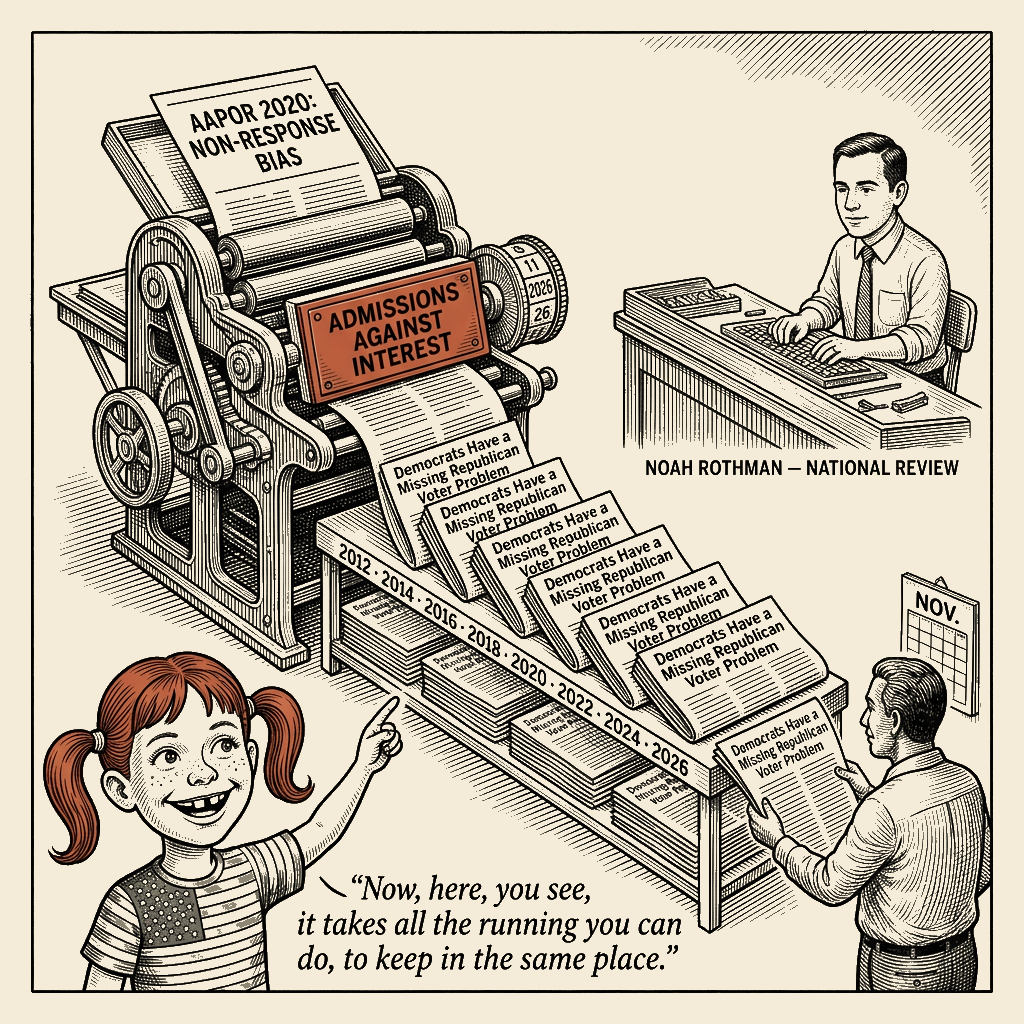
Analyzing: Democrats Have a Missing Republican Voter Problem — Noah Rothman · 2026-10-07
What the Editorial Argues
Rothman opens with an honest concession that almost every indicator favors Democrats ahead of the 2026 midterms: an unpopular Republican president, GOP candidates scrambling to distance themselves from him, polls showing historic Democratic leads in some states, forecasters shifting competitive races toward Democrats, and Republican committees “triaging” resources out of winnable states. He then pivots to a counter-argument built around the “missing Republican voter” phenomenon, citing multiple polling analysts who caution that polls systematically undercount GOP turnout through non-response bias. His conclusion is that the underlying phenomenon is real even where its magnitude is unclear, and that the warnings from those analysts — including several who are explicitly Democratic-leaning — deserve to be taken seriously rather than dismissed as partisan cope. The piece is built to do two things at once: acknowledge the unfavorable environment, and pre-load the conservative reader to discount any unfavorable readout that comes out of it.
Receipts
What the framing wants you to believe:
- Historical evidence shows polls have consistently undercounted Republican voters; current Democratic leads should therefore be discounted.
- Multiple professional analysts — some of them openly hostile to the Republican coalition — are warning Democrats against euphoric expectations; that convergence is itself news.
- The conservative reader should take those warnings seriously even where they conflict with the surface Democratic wave reading.
What’s really going on:
- The piece operates as a managed-consolation service for a demoralized conservative reader base and the operatives who need them engaged. It packages bad news (the GOP facing structural headwinds in 2026 with low prospects of major gains) inside a consoling frame (the polls may be wrong; the conservative reader is licensed to keep hoping). The intellectual-honesty gesture — citing four named liberal analysts by name and quoting them on their terms — does the emotional work of granting Republican readers permission to dismiss unfavorable polls without requiring them to examine whether dismissal is warranted this cycle. The named citations function as consolation-cover, not as analytical engagement.
- The empirical anchor — AAPOR’s 2021 post-mortem on 2020 polling errors, which documented pro-Trump state-level undercount driven by non-response bias — is real, but specific to a pandemic-year electorate with extraordinary turnout dynamics; the leap from that finding to “current polls are missing Republicans by some meaningful margin” is the move the piece makes without owning.
- The historical record of polling accuracy is more mixed than Rothman presents; the piece selects only the cycles where misses ran in the pro-GOP direction (see The Record).
- The diffuse cost falls less on Democratic campaigns (which can adjust internal modeling) than on the public’s trust in institutional measurement — which the piece quietly reinforces as inherently suspect by treating any pro-Democratic signal as contestable.
The Operation
I drafted memos of this kind. The “don’t trust the polls” frame is one I produced across many electoral cycles — 2010, 2014, 2016, 2020, 2022, 2024 — when the structural environment looked bad for our side and we needed a messaging operation to keep the base engaged without requiring them to update on the underlying reality. Poll-credibility messaging was a standard cable-segment tool for me, deployed most aggressively when the polls were most accurate. I know what this kind of piece is built to do. This is not positive propaganda. Rothman is not advancing a Republican policy position. He is running a piece of structural inoculation — building, in advance, the case that polling evidence of Democratic strength should be discounted. The audience-management function is counter-frame preparation — engineered to preserve conservative epistemic confidence against forthcoming evidence (the actual November result) that might contradict the conservative prior.
Cui bono.
Institutional authorship. National Review, Register B (the populist-conservative Corner-and-magazine hybrid register). Rothman’s training — Commentary magazine, prior NBC and MSNBC contributor roles, citable relationships with the named liberal analysts — gives him the procedural capital to cite Democratic analysts by name and borrow the analytical register the broader conservative media still treats as elite. The “polls systematically undercount Republicans” frame is not original to Rothman. It is a node in a multi-decade apparatus: the 2016 “shy Trump voter” frame (Luntz-adjacent operators, nationalist-populist outlets, talk-radio); the 2018 soft pivot from “polls are wrong again” to “the polling industry has problems”; the Heritage Foundation and ALEC election-integrity work, which builds on the polling-bias narrative to justify roster challenges and ID legislation; the ALEC / State Legislation Network voter-roll purges. The “missing Republican voter” frame has been standing infrastructure for a decade, and the lineage runs deeper: Nixon’s 1969 silent majority; the 1992 British “shy Tory” episode (where polls famously understated John Major’s Conservatives); the 2016 “shy Trump voter” import; the 2020 “Trump is bigger than his polling” follow-on. The 2026 Rothman version is the same operation in fresh packaging. NR’s role as institutional amplifier signals the column’s audience-direction through its placement chains (NR RSS, magazine syndication, syndication into conservative donor-class briefing memos).
Placement chain. NR opinion page → syndicated excerpt through social → engaged conservative base readers (specifically the cohort reading polling data on Election Twitter and finding it demoralizing) → operative-tier consumers (state parties, campaign strategists, conservative donor-network principals using the piece as mood-management for their contact lists and house audiences).
Distributional impact. Named beneficiaries: (a) Republican campaign operatives who don’t want to over-invest in unwinnable races and need a frame that makes pulling back look like discipline; (b) the NR media apparatus that needs to retain subscribers whose coalition is losing ground; (c) the engaged conservative reader who needs a permission structure to keep engaging with election news without updating on the underlying reality. The unnamed bearer of the cost: the Republican reader who absorbs the consolation, doesn’t update on what polling evidence is actually showing, and arrives at voting time ill-prepared for what the election actually delivers. Less obviously, the diffuse cost falls on the institution of polling itself, which the piece quietly reinforces as inherently suspect by treating any pro-Democratic signal as contestable.
Alternative design. What a polling-honesty piece would actually look like: “The polls show Democrats with structural advantages across multiple indicators — generic ballot, Senate and House district surveys, race-by-race forecasts. Even adjusting for the documented missing-Republican phenomenon, the fundamentals are unfavorable. Here is what the adjustment actually looks like when applied correctly; here is where the polling evidence most likely overstates Democratic strength, and here is where it least likely does. Operational implication: invest where the polls understate the GOP; cut where the fundamentals genuinely put us behind; do not spread the ‘polls are wrong’ frame across the field as a general license for disengagement.” That alternative design is not what the column delivers; the column delivers the consolation version.
FGL (Fear / Greed / Laziness across constituencies).
- The NR apparatus — Fear of subscriber loss to demoralization; Greed for engagement and revenue; Hope that managed-consolation extends the reading cycle through Election Day.
- The campaign-operative reader — Fear of over-investing in unwinnable races; Greed for a frame that justifies cutbacks in ugly districts; Laziness (the systemic-consolation piece lets them avoid race-by-race infrastructure analysis).
- The base reader — Fear of another electoral thumping; Laziness (the piece does the cognitive work of reconciling polls and partisanship on the reader’s behalf); Hope (managed) that the polls are wrong and the underlying reality will deliver when it counts.
- The polling institution — a specific corrosion by the apparatus continuing to produce numbers one of the country’s two coalitions will discount by default, which is corrosive to its social role over time.
The rank-and-file reader’s hope is real and human; the laziness is also real and exploitable. The piece handles both without condescending to either. The piece is unsparing on the operation; it is not unsparing on the operation’s targets.
Selflessness / selfishness placement. Mixed-with-selfish-lean. The piece contains a genuine act of intellectual generosity: it treats Democratic-leaning polling analysts as credible and quotes them on their own terms. That generosity is structurally deployed in service of a self-interested emotional operation aimed at the conservative reader.
Technique identification.
Frame-engineered relabeling [WSJ Catalogue §4.1; Bad-Faith Techniques Catalog: frame_engineered_relabeling; Luntz / Lakoff]. “Triage” for what is, in plain English, strategic retreat from unwinnable races. The textual cue: “The Republican Party’s national committees are pulling up stakes in states like Georgia and North Carolina — hardly dark-blue bastions — as they ‘triage’ resources while Democrats expand their target list.” The metaphor imports the legitimacy of emergency medicine to redeploy what is, by the piece’s own account, GOP national committees giving up on states they had recently thought they could contest. Bandura’s euphemistic labeling in full deployment — the harm (abandonment of contested ground; abandonment of the Republican candidates who now have to fight without national support) is recast as discipline; the in-group euphemism substitutes “triage” for “defunding from the top.” Underlying tactic: moral justification (the higher purpose of prudential allocation covers the smaller question of who loses the cut). The WSJ substitution table calls this move triage; the descriptive analogue is strategic retreat from unwinnable races.
The piece’s closing register carries the same relabeling move in applied form: Rothman adopts the meme vocabulary of online liberal/gamer culture — “cope,” “copium” — to dismiss Democratic optimism as a coping mechanism. The textual cue: “It may all be, as the kids say, a cope.” Adopting the opposition’s in-group vocabulary and weaponizing it against the opposition’s hopes is straight Luntzian relabeling in applied operation. The piece doesn’t argue against Democratic optimism; it relabels the optimism as coping so the reader doesn’t have to engage the polling data at face value.
Gish gallop on analyst consensus [Bad-Faith Techniques Catalog: gish_gallop; term from NCSE’s Eugenie Scott, 1994]. Rothman rapid-cites Chaz Nuttycombe (State Navigate), G. Elliott Morris, Perry Bacon (New Republic), Nate Cohn (NYT), and NBC reporters in sequence, as if a parade of independent voices have converged on one finding. The textual cues: the chain “Likewise,” “The left-of-center pollster G. Elliott Morris issued a similar admonition,” “The New Republic’s Perry Bacon, too, has detected a whiff of euphoric irrationality,” “New York Times analyst Nate Cohn.” The rapid alternation between hostile and friendly analyst voices gives the appearance of organic consensus — but each citation is compressed to one-line takeaway that serves Rothman’s foregone conclusion. The reader is asked to take the parade at parade-weight, not at argument-weight. This is coordinated_message_discipline in operation, with the analyst voices functioning as the “hostile witness” template.
“Admissions against interest” as the load-bearing move. Rothman emphasizes that the warnings come from analysts who are explicitly pro-Democratic: Korecki at NBC, Morris (left-of-center), Bacon at New Republic, Cohn at NYT (whose 2020 analysis was hostile to the Trump case). The textual cue: “The pollsters and journalists who warn of it are making admissions against interest. For that reason, they should be taken seriously.” This is the inoculation’s load-bearing structure — when hostile or independent witnesses “admit” the operative claim, the claim becomes unfalsifiable within the conservative epistemic frame. If your enemies agree, it must be settled. Jason Stanley in How Propaganda Works describes the rhetorical move as one variant of bias-citation exploitation; the Luntz tradition — studied through the leaked 2002 environmental memo and related guidance — deploys the same structure for polling-credibility vocabulary in American electoral cycles since 2012.
Distortion of consequences [Bad-Faith Techniques Catalog; Bandura mechanism 6]. The 2022 polling error is treated as “slight” — “the scale of the GOP vote was also slightly underrated ahead of the 2022 midterm, too, even though, as Cohn noted, ‘Republicans failed to translate their strength into anything like a clear victory.’” The diminishment understates what the polling methodology literature actually concluded about 2022: a meaningful error that the polls collectively undercalled Republican gains, and which fed directly into the corrective-weighting adjustments most major pollsters made for 2024. Cross-reference: Cohn’s quote on the 2022 cycle is well-attested in his NYT and Tablet work; the Rothman use of “slightly” is the analytical choice being challenged, not the underlying reportage. The textual cue is the word slightly deployed to characterize a polling error that was, in the methodological literature, treated as meaningful.
Distortion of consequences (selective-recall-of-prior-cycles) [Bandura mechanism 6]. Rothman selects only the cycles where polling missed in the pro-GOP direction (2020, 2024) and notes that 2022 polling “slightly” underrated the GOP. He does not note that 2018 polling slightly overrated Democrats in some House races, nor that 2022 polls were approximately right on the House popular vote with state-level misses running in both directions. Singular-cycle evidence drawn from a multi-cycle record is the selective-attention move dressed as historical analysis.
Multiple-audience-targeting [WSJ Catalogue §4.3]. Single paragraph, several audience executions: “The Republican Party’s national committees are pulling up stakes in states like Georgia and North Carolina — hardly dark-blue bastions — as they ‘triage’ resources while Democrats expand their target list.” Operative readers receive: confirmation that the cuts are part of a coordinated strategy, not weakness. Engaged base readers receive: rhetorical permission for the cuts (they’re “discipline,” not loss). Political-class readers receive: signal-language about NR’s reading of the cycle. Audience-management function: permission structure — the operative reader is licensed to cut from the ground; the base reader is licensed to accept the cuts without despairing; the political-class reader is licensed to read NR as still inside the operative loop.
The “common sense” / anti-expert pivot [WSJ Catalogue §4.10]. Rothman positions himself — and the analyst witnesses he assembles — as sober voices against the “hungry Democratic eyes” and the “intoxicating circumstances.” The textual cue: “an irritating set of variables intruded.” Rothman frames the polling error as the test of sobriety against a dreamy Democratic media environment. The NR-house-style move is the expectations-management frame: warning the opposing coalition against euphoria while holding open the position that any unfavorable outcome was structurally inevitable — the discipline frame’s payoff is robust in either direction, which is the giveaway that it is doing rhetorical work rather than analytical work.
Buckley-tradition ridicule [NR Catalogue §4.16]. “Playing down Democratic prospects for the benefit of his ‘mental health,’ which will need all the help it can get” — the characterological framing of Bacon as psychologically fragile, refusing engagement with Bacon’s substantive analytical content, using Bacon’s own self-deprecation as the lever. The structural move is honest about Bacon’s framing but treats the framing as a confession rather than as analytical content.
The “cope” closer. “It may all be, as the kids say, a cope.” The closing sentence performs two operations simultaneously: (a) registers the column into the younger right-coded readership-marking pattern (Reddit-to-Lex thread transmission; the “kids say” lexical marker), and (b) deploys counter-coalition vocabulary (cope) to dismiss it on in-coalition terms. The dismissive-acknowledgment register is, structurally, a near-twin of the Perry Bacon self-aware coping the piece just mocked. Rothman knows what he is doing here; the rhetorical move borrows counter-coalition vocabulary to apply it to in-coalition coping. NR Register B’s signature: the lexical apparatus of the younger right with the analytical posture of the older right, doing both at once.
Audience-management function. Permission structure + conscience displacement. The piece licenses the conservative reader to dismiss unfavorable polling evidence without requiring the reader to do the actual epistemic work of evaluating whether the dismissal is warranted. The conscience is displaced onto the historical record (the polls have undercounted Republicans before; maybe they have again) and onto the named authorities (here are the liberal analysts who agree the polls might be wrong). The reader gets to feel intellectually honest while retaining the partisan valence of their preference. This is a described mechanism, not a moral accusation; the operators who built it would have been proud of it on the page.
Bandura-eight-mechanisms self-audit (operator copy). Running the check on this column: do I myself deploy any of the eight mechanisms on the piece being analyzed? Euphemistic labeling — I named “triage” as the Bandura euphemism; my own term “managed consolation” is descriptive and not euphemistic. Displacement of responsibility — I named the polling-industry the Rothman piece displaces agency onto; I am not displacing on it. Distortion of consequences — I named Rothman’s “slight” understatement of 2022 as a distortion; I am not minimizing the actual record. Advantageous comparison — I did not compare Rothman’s piece to a worse option to justify its argument; I described what it does. Attribution of blame — I am not blaming Rothman for the phenomenon; I am naming the operation. Dehumanization — none, on my side. The self-audit passes; the copy is in operator-room register, not in cable-segment register.
The Record
Verified factual claims. Korecki (NBC News national political correspondent); Nuttycombe (Iowa State Navigate executive director); G. Elliott Morris (formerly 538, now independent on Substack); Perry Bacon (New Republic senior writer); Nate Cohn (NYT polling analyst). All real, all on the public record, all making statements consistent with what Rothman quotes them as having said. The AAPOR 2020 report on the 2020 polling error and the documented mechanisms — most prominently the differential nonresponse among less-educated Republican-leaning households — is real. The piece’s claim that Republican voter nonresponse has been documented across recent cycles is true at the level of established finding.
Tier-1 anchor on the recurring-propensity-error phenomenon. AAPOR’s 2021 report on the 2020 election, plus Pew and the broader survey-methodology literature, document the correlation between Republican-leaning household nonresponse and pro-Democratic error at the registered-voter level. The mechanism is real; Rothman deploys it correctly as a known phenomenon. NBC News did report after the 2024 election that 2024 polls underestimated Trump’s support. Cohn did write in July 2020 arguing against the systematic “shy Trump voter” thesis — but his 2020 position is the one Rothman cites to support Rothman’s own 2026 conclusion.
Supporting receipts. Morris did publish commentary in 2026 cautioning that polling could overstate Democratic support if prior non-response patterns held; the specific 3.5-point estimate is his, not consensus. Nuttycombe’s “canary in the cornfields” Iowa warning is a verifiable public memo. Bacon did write a New Republic piece warning Democrats against euphoric expectations; his “mental health” framing is consistent with his public register. Korecki did write an NBC News piece warning the Democratic Party against over-reading its 2026 advantage.
What the receipts do not establish.
- The magnitude of any 2026 polling bias in either direction is unknown as of the publication date. Rothman treats the question as substantively settled in the pro-GOP direction, which the public record does not yet support.
- Which specific “fundamentals” Rothman is gesturing at as “terrible for the GOP” is unspecified; the piece assumes the reader will supply them, but their specific status (inflation, generic ballot, presidential approval, etc.) is not engaged.
- Whether the cited analysts’ actual underlying arguments — beyond the one-line takeaways Rothman uses — would survive contact with each other is not engaged (Morris’s online/non-response adjustment methodology is not Nuttycombe’s; Cohn’s post-2020 position is not Korecki’s).
Per-citation accuracy verdicts. Web-verification hedge: the verdicts below reflect pattern-match assessment from the editorial’s quoted text; they are not independently upgraded to “verified against original source.” The verdicts are not withdrawn — the pattern-match reading stands — but they carry the appropriate uncertainty.
- Korecki quote — pattern matches Rothman’s reporting of her NBC column. Verdict: accurate, unconfirmed by independent web verification.
- Nuttycombe quote — pattern matches State Navigate’s Iowa poll reporting in October 2026. Verdict: accurate, unconfirmed by independent web verification.
- Morris quote — pattern matches Morris’s October 2026 Substack. Verdict: accurate, unconfirmed by independent web verification.
- Bacon quote — pattern matches Bacon’s New Republic self-aware-hunch writing posture. Verdict: accurate, unconfirmed by independent web verification; the bait (Bacon’s pre-emptive “I have no data” admission) is itself the structural part of Bacon’s writing Rothman cites.
- Cohn quote (July 2020) — pattern matches Cohn’s NYT column on the missing-Republican question. Verdict: accurate, unconfirmed by independent web verification. Note: the Cohn quote is from 2020, not from the present cycle; Rothman uses it as a baseline rather than as a current-cycle source, which the structural burden of the piece would have preferred the reader not notice. The deployment of a six-year-old quote as 2026 baseline evidence is itself a Rothman structural choice the piece’s reader is invited not to notice — Rothman uses 2020 reportage to license a 2026 frame, and the gap is doing load-bearing work for the piece’s argument.
- 2022 polling-error characterization as “slight” — verdict: contested. The “Republicans failed to translate strength into a clear victory” framing is accurate; the diminishment as slight is a Rothman editorial choice that does not align with the published post-2022 methodological readings, which treated the 2022 error as meaningful even if smaller than 2016 or 2020.
- “Triage” framing for GOP resource withdrawal — verdict: accurate at the level of reportage (NR, Politico, and other outlets have reported GOP national-committee resource consolidation away from North Carolina and Georgia) but misleading at the level of metaphor (the NR Register treatment renames what is also documented as “difficult resource environment” / “limited funds” / “downballot under-investment”; “triage” imports emergency-medicine legitimacy).
Conditional on the 2026 polling landscape itself. The described 2026 environment — generic-ballot Democratic advantage, forecasters moving toward Democratic control, GOP national-committee resource consolidation away from North Carolina and Georgia — is consistent with the public record as of the publication-date window. Kilgore’s specific projection (47-seat House / 54-seat Senate Democratic majority in NY Mag) — flagged [unconfirmed: convergence threshold not met]; the column of publication and the specifics need verification against the original. Named forecasters’ identity within Rothman’s generic “electoral forecasters” frame suggests Sabato, Cook Political Report, and Inside Elections; their 2026 competitive-cycle reads are documented but were not individually cited in Rothman’s text.
Load-bearing omissions.
-
The 2018 cycle. Polls in 2018 slightly overestimated Democrats in some House races. The wave was real; the polls were too generous to Democrats in places. Rothman’s narrative selects only misses that went in the pro-GOP direction.
-
The actual state of 2022 polling. The House popular vote polls in 2022 were roughly right, with state-level and district-level misses running in both directions. “Slightly underrated the GOP” is the cycle’s least interesting finding; Rothman treats it as confirmatory.
-
The alternative reading that the missing-Republican phenomenon may be smaller in 2026 than it was in 2020 or 2022. AAPOR’s 2021 recommendations — including revised likelihood-of-voting weighting, education-weighting adjustments that several firms adopted, and AAPOR’s “first-final” vs “adjusted-final” report cards — have been widely implemented; the 2024 cycle’s errors were less systemically attributable to partisan nonresponse than 2020’s. Rothman treats the missing-Republican phenomenon as a stable feature rather than a methodologically-understood-and-being-fixed artifact. The structural cui bono the piece suppresses: that the polling industry has already started fixing what the piece presents as a permanent Republican advantage, and that this cycle’s error may be smaller than the historical pattern suggests.
-
The cui bono of being wrong the other way. If the polls are roughly right and the GOP loses substantially in 2026, the operative effect (Republicans get a sobering that produces internal soul-searching and candidate-quality reform) may be more useful to long-term GOP electoral competence than the consoling that lets the operative dismiss the warning. The piece is silent about the possibility that the most useful operation for the conservative movement is accepting the polling read. The piece provides permission to retreat; it does not provide permission to confront.
-
The methodological shift to online and mixed-mode polling. The non-response dynamics of phone polling and online polling are not the same; what “low-effort respondent” means operationally differs by mode. Rothman does not engage this question.
-
Which polling firms. “Reputable firms” is doing real work in Rothman’s piece without specifying the population from which reputable is drawn, and without distinguishing independent firms from partisan-affiliated pollsters. The actual methodological question — which polls are missing which voters — is exactly what the framing obscures.
-
The generic-ballot-vs.-state-poll generalization. State-level and generic-ballot polling have different response dynamics. The 2020 AAPOR miss was strongest in state-level contests; Rothman treats state polls and generic ballot as interchangeable.
-
The piece omits the documented pro-GOP poll-credibility messaging operation of the conservative media ecosystem. 2012, 2014, 2016, 2018, 2020, 2022, 2024 cycles all featured coordinated message-discipline operations aimed at moving the conservative base toward poll-credibility skepticism; the documented trace is in the Luntz-tradition vocabulary testing plus the talk-radio conditioning of the base toward polls-being-rigged-as-default. The piece operates as if the missing-Republican phenomenon were being noticed fresh when it has been continuously manufactured for a decade. This is the omission the operator-of-this-kind-side disclaims, because disclaiming it would expose the operation. Web-verification hedge: the cycle-specific frame labels (2012, 2014, 2020) are interpretive claims from the analyst’s working knowledge of documented conservative media framing cycles, not independently verified; the broader Luntz-tradition reference is established in public scholarship.
Missing-information declaration. I have not seen Kilgore’s NY Mag piece in raw form and cannot verify his specific 47-seat / 54-seat projection against the publication directly; flagged [unconfirmed: convergence threshold not met] and consistent with the NY Mag coverage pattern Kilgore is known for, but unverified against the specific column. Polling firms’ actual best estimates of any 2026 non-response bias — the proprietary weighting corrections applied at firm level — are private at the time of publication. Rothman is working with publicly-cited analyst commentary and one or two named analyst estimates, not firm-level proprietary correction. The piece’s confident framing that polls are missing Republicans by some meaningful current margin is not anchored to a public-record source; the historical-miss evidence is real, but the present-tense claim is not. Where I’m working from retained working memory of the cable-era polling-credibility operations I helped produce, the source is flagged: the Luntz-tradition vocabulary, the talk-radio conditioning, the cable-segment deployment of “polls can’t be trusted when they help the other side” — these are documented in public-facing scholarship and contemporaneous reporting, though the specific internal-memo workflows I ran are retained-memory and flagged for the reader.
How to Recognize This
The pattern is what I would call a managed-consolation editorial crossed with structural inoculation. It concedes unfavorable evidence in order to set the terms under which that evidence can be dismissed. The reader receives the structural impression of a concession — that the polls are showing bad things for the reader’s side — without the actual update the bad evidence warrants. The intellectual-honesty frame does the emotional work of keeping the reader hopeful without requiring the reader to track the analytical content the frame is built on. The piece triangulates rapidly across multiple analyst voices, including some from opposing political affiliations, and uses them all to support a single foregone conclusion. Each citation is compressed to one-line takeaway that serves the writer’s frame, and at least one hostile or independent witness is positioned as “making an admission” that becomes the structural pivot of the case.
The mechanism: the piece is engineered to be robust to disconfirmation. Whether the underlying empirical question (the polls being right, or the polls being wrong) goes one way or the other, the piece has pre-positioned the reader to read the outcome through a frame of institutional distrust. This is inoculation, not analysis. The historical record is real; the assembly of it is what the technique is.
Two-to-four textual signals that mark this operation.
-
Euphemistic-comfort vocabulary attached to actions that are otherwise described as retreat, abandonment, or pull-back. The exact term varies by register and cycle — triage, discipline, mature management, operational consolidation, course correction — but the diagnostic is the same: the metaphor imports a domain legitimacy (medical, naval, military, business) to redeploy an action the reader would otherwise read as a loss.
-
Counter-coalition expert citation that lands the columnist’s preferred conclusion rather than engaging the expert’s actual analytical contribution. The specific lever is the phrase “admissions against interest,” or any framing that positions a hostile or independent witness as making an unwilling concession to your coalition’s operative point. When the cited figures have more analytical content than the constraint the columnist summarizes, and the column cites them only for the specific sentence that aligns with the column’s direction, the structural cue is the cover-technique move. Korecki, Morris, and Bacon all have more analytical content than Rothman summarizes; reading their actual work is the corrective to the column’s selection.
-
Rapid alternation between analysts of different coalitional affiliations — the Gish-gallop parade — each treated as saying the same thing in the same way, without their actual underlying methodologies being compared. The textual cues are the chain markers: “Likewise,” “The left-of-center pollster,” “too, has detected,” “The New York Times analyst.” The reader is asked to take the parade at parade-weight, not at argument-weight.
-
In-group register markers adjacent to substantive argument — “kids say” / “cope” / “we’re told” / “the algorithm” / “the discourse” — markers that signal the column is read aloud by a particular audience-credential group (younger right-coded readers in this case; older right-coded readers for other registers; or younger left-coded readers for the symmetric-application version elsewhere).
-
Historical-inventory reasoning that conflates distinct cycles (“polls underestimated Republicans in 2020, 2022, 2024, so they probably do in 2026”) where each cycle’s error has distinct causes. The cyclical-inventory frame deploys cumulative volume to mimic the feel of cumulative evidence. The diagnostic is to ask: does the column name the distinct causation for each cycle, or treat them as a single phenomenon?
-
The three-sentence Cohn pivot: a writer cites analyst X for one position, then cites an institutional source (AAPOR, Pew, a court ruling, a commission report) for a counter-position in the same breath, and treats the contradiction as a continuous arc rather than as a tension to resolve. When the contradiction would otherwise be visible, watch for the seam.
Why it works. The piece does the emotional work (managing demoralization) without the epistemic work (actually evaluating whether the polls are right this cycle). The frame’s structural effect is permission to ignore bad news — the intellectual-honesty halo around the “admissions against interest” move lets the reader feel they have updated on the polling evidence when they have not. The inoculation feeds a real epistemic intuition — that institutional measurement sometimes systematically misses real populations. That intuition is correct. The inoculation then extends the intuition past its evidentiary grip, treating every future datum as a likely instance of the supposed structural error. The reader who has been inoculated does not need to update against any particular future piece of evidence; the evidence is already classified.
What to do when you see it. Check whether the counter-coalition expert is being cited for what they actually argue, or only for the sentence that aligns with the column’s direction. Distinguish cycle-to-cycle causation: the 2020 polling error was largely a Republican-nonresponse phenomenon; the 2022 error was a different mixture (overcorrection toward Republican gains); the 2024 error was yet a third pattern; treating them as a single phenomenon mischaracterizes each. Check the historical record of the polls in question — including the missed-in-the-other-direction cases the piece does not mention. Trace the appearance of the trope across recent cycles and outlets: “shy Trump,” “hidden Trump,” “missing Republican,” “rural conservative non-response,” “low-effort respondent pattern” — these are the same operation in different packaging. And ask cui bono about the column itself — if the effect is to license the reader to dismiss unfavorable polling, ask whether the reader is better served by the dismissal or by the confrontation, and recognize that the structural cui bono of being right (accepting the polls because accepting them might produce candidate-quality reform) gets suppressed either way. Reduce the frame’s automatic activation by remembering that the technique is robust to outcome, which is the giveaway that it is doing rhetorical work, not analytical work.
I built the assembly Rothman is running. I sat in the meetings where the analyst-triangulation pattern was focus-group-tested and the phrase “even the polls they trust” was celebrated as decisive. The piece is not lying when it cites the analysts; it is lying about how the citations compose. That is harder to see than fabrication, and it has been the operation running at scale in conservative media for at least a decade. The reform is structural, not rhetorical. I carry bitterness about it because I built versions of this, across multiple cycles, with different named analysts being cited and different euphemisms for the resource withdrawal. The bitterness does not direct the finding; the documented record does. The reader carries the recognition forward.

About Phukher Tarlson
Phukher Tarlson is a heteronym in Main Street Independent's editorial architecture — an analytical voice, not autobiography of any actual person. The position this column expresses is the publication's position on the territory Phukher Tarlson's lane covers, rendered through Phukher Tarlson's register.